
Deuteronomy
The covenant, restated.
All 34 chapters drafted.
How to read it
Themes: the covenant renewed for a new generation on the plains of Moab · YHWH is one and Israel’s love must be undivided (the Shema) · the law as gracious gift and Israel’s wisdom before the nations · one God, one people, one sanctuary · blessing and curse, life and death set before Israel · remember, and do not forget · a circumcised heart God himself will give · the prophet like Moses still to come Literary design: three farewell addresses from Moses (1:1-4:43; 4:44-28:68; 29-30) framed by the approach to the land, shaped from beginning to end like an ancient Near Eastern suzerain-vassal treaty (preamble, historical prologue, stipulations, blessings and curses, witnesses), and closed by a succession narrative, the Song of Moses (32), the Blessing of Moses (33), and the death of Moses on Nebo (34) Frameworks at play: the Shema · Torah as gift · the place YHWH will choose · circumcision of the heart · the Sinai covenant · the divine council · two ways · the new Moses · holy war and herem · exile and return · bearing God’s name · the new covenant · the exodus pattern
Deuteronomy is the book that gave the others their voice. Its English name comes, by way of the Greek Deuteronomion, from a line in 17:18 where the king is to write himself “a copy of this law”; the Septuagint read the phrase as to deuteronomion touto, “this second law,” and the name stuck. It is a slight mistranslation, and a misleading one. Deuteronomy is not a second, different law. It is the one covenant restated, preached, and pressed into the hearts of a new generation standing where their parents turned back.
The Hebrew name is truer. The book is called Devarim, “words,” from its opening line: These are the words that Moses spoke to all Israel beyond the Jordan. Deuteronomy is, almost entirely, the words of a dying man. Moses stands on the plains of Moab, within sight of a land he will not enter, and preaches the covenant one last time to the children of the generation that died in the wilderness. The book is a farewell sermon with the structure of a treaty and the cadence of a love song, and it is the most quoted book of the Torah in the rest of the Bible.
This page is a “how to read it” overview, meant to be read alongside the chapter commentaries (linked at the bottom). If you want the verse-by-verse work, follow a chapter link. If you want the lay of the land before you walk it, you’re in the right place.
The storyline
Deuteronomy is built as a series of speeches, not a sequence of events. Almost nothing “happens” in it: Israel does not move, no battles are fought, no journey is made. The only narrative action is at the very end, when Moses commissions Joshua, sings his song, blesses the tribes, and dies. Everything in between is preaching. The book divides into Moses’s addresses, framed by the editorial notices (“These are the words…”, “This is the law…”, “These are the words of the covenant…”) that mark each new speech.
The first address (1:1-4:43) rehearses the journey. Moses retells the story from Horeb to the plains of Moab, the appointment of leaders, the spies and the refusal at Kadesh, the forty years, the defeat of Sihon and Og, the allotment of the Transjordan. It is a historical prologue in the treaty sense: before the stipulations come the deeds, the rehearsal of what YHWH has already done. It closes with a sermon on the danger of idolatry and the wonder of a God who speaks (4), the chapter that grounds the whole book in the uniqueness of YHWH and even names the apportioning of the nations to “the host of heaven” (4:19-20).
The second address (4:44-28:68) is the heart of the book. It opens with the Decalogue restated at the new generation’s own Horeb (5), moves into the Shema and the great sermon on undivided covenant love (6-11), and then lays out the law code itself (12-26): the single chosen sanctuary (12), worship and apostasy (13-14), the sabbatical release and the festivals (15-16), the offices of judge, king, priest, and prophet (16:18-18:22, including the promised “prophet like me”), cities of refuge and the laws of war (19-21), and a long sequence of civil, family, and social laws (22-26) shot through with care for the vulnerable. The address ends with the ceremony of blessing and curse at Ebal and Gerizim (27) and the great catalogue of covenant blessings and curses (28), the chapter whose curses read, in retrospect, like a prophecy of exile.
The third address (29-30) renews the covenant in Moab. Moses gathers Israel to ratify the covenant afresh, warns of the exile to come, and then makes the book’s most astonishing promise: beyond the failure and the scattering, YHWH himself will circumcise your heart so that you can love him (30:6). The address closes with the word that is “very near you, in your mouth and in your heart” (30:11-14) and the final appeal: “I have set before you life and death, blessing and curse. Therefore choose life” (30:19).
The conclusion (31-34) hands the story forward. Moses commissions Joshua and deposits the law beside the ark (31), sings the Song of Moses, a sweeping poetic indictment and hope that contains the divine-council text of 32:8-9 (32), blesses the twelve tribes (33), and climbs Mount Nebo to see the land before he dies (34). The Torah ends not in the land but in sight of it, with its greatest prophet buried in an unmarked grave and a successor leading the people across.
Why the book matters
Few books cast a longer shadow. Deuteronomy is, with Psalms and Isaiah, one of the most frequently cited books in the New Testament, and it supplies the theological grammar for much of the Hebrew Bible that follows. The historian’s framework of Joshua, Judges, Samuel, and Kings is so shaped by this book’s theology that scholars call those books the “Deuteronomistic History”: the long story of Israel in the land, told by the measure of Deuteronomy’s covenant.
Its fingerprints are everywhere in the gospel. When Jesus is tested in the wilderness, all three of his answers are quotations from Deuteronomy 6-8: man shall not live by bread alone (8:3), you shall not put the Lord your God to the test (6:16), you shall worship the Lord your God and him only shall you serve (6:13). When asked for the greatest commandment, Jesus recites the Shema (6:4-5). Peter and Stephen both preach Jesus as the long-promised “prophet like Moses” (18:15; Acts 3:22-23, 7:37). Paul reaches for Deuteronomy 30’s “the word is near you” to describe the gospel itself (Rom 10:6-8). The book’s vision of a circumcised heart becomes the seed of the new-covenant hope that Jeremiah, Ezekiel, and Paul all harvest.
And the book matters for what it teaches about the shape of covenant love. Deuteronomy is the Bible’s most sustained meditation on loving God, and on what makes such love possible. It insists that the law is gift before it is demand, that obedience is the grateful response of a people already redeemed, and that the heart capable of undivided love is finally something God must give. It is law preached as grace.
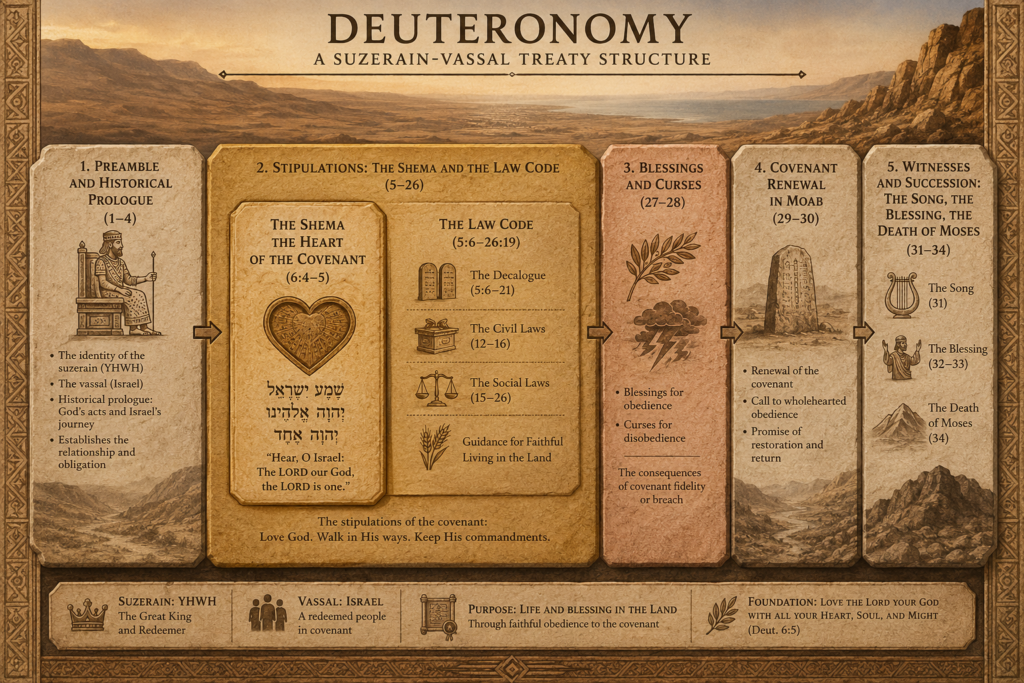
Literary architecture
The single most important observation about Deuteronomy’s structure is that the whole book is shaped like an ancient Near Eastern suzerain-vassal treaty, the same form that stands behind the Sinai covenant. The Hittite and later Assyrian treaties followed a recognizable sequence: a preamble naming the great king, a historical prologue rehearsing what he had done for the vassal, the stipulations, provisions for the document’s deposit and public reading, a list of witnesses, and the blessings and curses that sealed the whole. Deuteronomy follows that shape across its entire length, preamble (1:1-5), historical prologue (1:6-4:43), stipulations general and specific (5-26), document deposit and public reading (27, 31:9-13), witnesses (the “heavens and earth” of 30:19, 31:28, 32:1), and blessings and curses (28). George Mendenhall and Meredith Kline pressed this reading; Moshe Weinfeld set it within the broader world of Deuteronomic theology. To read Deuteronomy is to read a covenant document, a binding charter between the great King and his people.
Within that frame, the book is organized by Moses’s speeches and held together by repetition: hear, remember, do not forget, love, the place YHWH will choose, that it may go well with you. The Song of Moses (32) and the Blessing of Moses (33) form a poetic climax, and the death of Moses (34) closes not only the book but the entire Torah, deliberately leaving the people on the threshold so that the story leans forward into Joshua and beyond.
The frameworks at play
Deuteronomy gathers up frameworks built across the Pentateuch and adds several of its own.
The Shema is the theological center of the book. Deuteronomy 6:4-9, Hear, O Israel: YHWH our God, YHWH is one, is both Israel’s creed and its first commandment, and the wilderness tests, the warnings against other gods, and the demand for exclusive worship are all its outworking. Jesus names it the greatest commandment.
Torah as gift governs how the commentary reads the law code. Deuteronomy presents the law not as a ladder of merit but as gracious instruction, Israel’s wisdom before the watching nations (4:5-8), a word near and doable (30:11-14), the path of life (30:15-20). This is the Hebrew Bible counterweight to Paul’s hard sayings about “works of the law.”
The place YHWH will choose structures the legal core. Deuteronomy 12’s demand for a single sanctuary “to make his name dwell there” reorganizes sacrifice, tithe, and festival around one place, and sends the story forward toward Zion, the temple, and finally Christ.
Circumcision of the heart is the book’s deepest promise. Deuteronomy moves from command (circumcise your own heart, 10:16) to promise (God will circumcise it, 30:6), naming both Israel’s inability and the grace that will one day make covenant love possible, the seed of the new covenant.
The Sinai covenant supplies the treaty form that shapes the whole book; Deuteronomy is, in Weinfeld’s phrase, the most complete extant ANE treaty document in Scripture.
The divine council surfaces at 4:19-20 and decisively at 32:8-9, where the Most High apportions the nations to the “sons of God” and keeps Israel as his own portion, the backdrop for the book’s relentless demand that Israel worship YHWH alone.
Two ways runs straight out of Deuteronomy 30’s “life and death, blessing and curse” and becomes the wisdom-tradition form that reaches Psalm 1 and the Sermon on the Mount.
The new Moses is promised here in person: the prophet like Moses (18:15) that the New Testament identifies with Jesus, and the death of Moses (34) that leaves the office open.
Holy war and herem governs the hard conquest texts of chapters 7 and 20, read on this site through the cross rather than weaponized or dismissed.
Exile and return is set in motion by chapters 28-30, whose curses anticipate the scattering and whose promise of a gathered, heart-renewed people anticipates the restoration.
What this site does with Deuteronomy
The commentary reads Deuteronomy as covenant preaching, not as a dry law code, and keeps the treaty shape and the sermon’s heart in view together. It follows the Hebraic and Second-Temple sensibility of Marty Solomon (Bema) and the Jewish commentary tradition of Jeffrey Tigay (JPS) as the lead voices, with Moshe Weinfeld (Anchor) for the treaty form and Deuteronomic theology, Daniel Block (NIVAC) for thorough covenant exegesis, and Richard Nelson (OTL) and S.R. Driver (ICC) filling in on critical questions.
Specifically, the commentary:
- Reads the whole book as a suzerain-vassal treaty, using the Sinai covenant, so the law code is heard as the stipulations of a binding relationship rather than as arbitrary rules.
- Treats the law as gift, drawing on Torah as gift, and refuses the law-versus-grace dichotomy that Deuteronomy itself never makes.
- Holds the Shema at the center, reading the wilderness retrospect, the warnings, and the festivals as the outworking of love YHWH with all your heart.
- Takes the divine-council reading of 32:8-9 seriously (with the Dead Sea Scrolls “sons of God” text), drawing on Michael Heiser, without flattening the Song of Moses into a single proof-text.
- Engages the Jewish interpretive tradition (Rashi, Ibn Ezra, Maimonides, Nachmanides) and the ANE treaty parallels where the rabbinic memory and the archaeology keep modern readers from misreading.
- Names the Christ-ward trajectories the tradition has found here, the prophet like Moses, the circumcised heart, the word that is near, without turning Deuteronomy into a mere Christian prologue. The book has its own Hebrew Bible weight to honor first.
- Handles the hard chapters with the site’s standard posture: take the text seriously, take the reader seriously, lay out the faithful options, and refuse to make any single solution a hill to die on.
Approaching the hard chapters
Deuteronomy contains some of the most difficult material in the Torah.
Chapters 7 and 20 (the command to “devote to destruction” the nations of Canaan): the conquest commands are the hardest texts in the book. The commentary works them through holy war and herem, setting them in their ANE world, distinguishing the rhetoric of total war from its actual conduct, laying out the range of faithful readings, and keeping the cross at the center, neither softening the text nor turning it into a license.
Chapter 13 (the apostate city and the prophet who leads astray): the death penalties for leading Israel after other gods read harshly. The commentary sets them within the treaty logic of exclusive loyalty and the life-and-death stakes of the covenant, without pretending the severity is comfortable.
Chapter 21 (the captive woman, the rebellious son, the body on the tree): a cluster of laws modern readers find disturbing. The commentary reads them in their ANE legal context, notes how the rabbinic tradition limited and in some cases effectively suspended them, and is honest about what remains hard, while marking that Paul reads “cursed is everyone who hangs on a tree” (21:23) straight into the cross.
Chapters 22-25 (mixed civil, sexual, and social laws): several of these laws, especially those concerning women, sexuality, and warfare, are difficult for modern readers. The commentary works them case by case, distinguishing the humane trajectory of Deuteronomic law (protection of the vulnerable, limits on power) from the cases that remain genuinely hard, and resists both apologetic flattening and anachronistic dismissal.
Chapter 28 (the curses): the catalogue of covenant curses is graphic and, in its closing verses, harrowing. The commentary reads it as the treaty’s sealing sanction, hears in it the later experience of exile, and holds it within the book’s own larger movement toward the heart God promises to give.
Chapters
- Deuteronomy 1 · Eleven days that took forty years: the journey retold, and a good land refused at Kadesh
- Deuteronomy 2 · The lands God would not give Israel, the end of a generation, and the first battle
- Deuteronomy 3 · The last giant king falls, the eastern land is divided, and Moses is told he will see but not enter
- Deuteronomy 4 · Listen and live: the law as wisdom, the God with no form, and the confession that YHWH alone is God
- Deuteronomy 5 · The Ten Words for a new generation, the terror at the mountain, and the heart God wished they had
- Deuteronomy 6 · The Shema: hear that YHWH is one, love him with everything, and never stop teaching it
- Deuteronomy 7 · Drive out the nations, and the reason Israel was chosen: not greatness, but love
- Deuteronomy 8 · Manna, memory, and the peril of plenty: man does not live by bread alone
- Deuteronomy 9 · Not because you are righteous: a stiff-necked people, the golden calf remembered, and the prayer that saved them
- Deuteronomy 10 · What does YHWH require? Circumcise your heart, and love the foreigner as the God of gods does
- Deuteronomy 11 · A land that drinks rain from heaven, the words bound to heart and home, and a blessing and a curse on two mountains
- Deuteronomy 12 · One place, one altar: the central sanctuary, the blood poured out, and joy before the Lord
- Deuteronomy 13 · When the signs come true and the voice is someone you love: loyalty to God above every other claim
- Deuteronomy 14 · Children of God, a set-apart table, and a tithe that feeds the landless
- Deuteronomy 15 · The year of release: cancel the debt, free the slave, open your hand
- Deuteronomy 16 · Three pilgrim feasts and a doubled command: justice, justice you shall pursue
- Deuteronomy 17 · Two or three witnesses, a supreme court at the chosen place, and a king hemmed in by the Torah
- Deuteronomy 18 · The Levites' true inheritance, no traffic with the occult, and the promise of a prophet like Moses
- Deuteronomy 19 · Cities of refuge, the boundary stone, and 'eye for eye' as the limit on revenge
- Deuteronomy 20 · Laws of war: do not be afraid, the exemptions, peace offered first, and the trees that must be spared
- Deuteronomy 21 · Innocent blood, a captive woman's dignity, the firstborn's right, and the curse on the tree
- Deuteronomy 22 · Neighbor-love in small things, the mother bird, mixed kinds, and the hard laws on women and sex
- Deuteronomy 23 · Who may enter the assembly, a holy camp, refuge for the runaway slave, and no interest on a brother's debt
- Deuteronomy 24 · A certificate of divorce, the cloak returned by sundown, and the sheaf left for the poor
- Deuteronomy 25 · Forty lashes and no more, the ox unmuzzled, raising up a brother's name, honest weights, and Amalek
- Deuteronomy 26 · The basket of firstfruits, the wandering-Aramean creed, and the day two parties declared each other
- Deuteronomy 27 · The law written on stones, an altar on the mountain of curse, and a people who answer Amen
- Deuteronomy 28 · Blessing and curse: the flourishing of obedience and the long shadow of exile
- Deuteronomy 29 · The covenant renewed in Moab, a heart not yet given, and the secret things that belong to God
- Deuteronomy 30 · Beyond the curse: gathered from exile, the heart God circumcises, the word that is near, and 'choose life'
- Deuteronomy 31 · Be strong and courageous: Joshua commissioned, the law deposited, and a song given as a witness
- Deuteronomy 32 · The Song of Moses: the Rock, the nations apportioned, Israel's forgetting, and the God who kills and makes alive
- Deuteronomy 33 · Moses blesses the tribes, and a parting comfort: the eternal God is your dwelling place
- Deuteronomy 34 · The death of Moses on Nebo, the end of the Torah, and the prophet still to come