

With chapter 31 the sermons are over and the book turns to endings and handoffs. Moses, a hundred and twenty years old, announces that he will not cross the Jordan, and begins the work of leaving well: commissioning Joshua, depositing the written law, and providing for the covenant’s survival after he is gone. The keynote he sounds, three times, is be strong and courageous, for Yahweh your God himself goes with you; he will not fail you nor forsake you (31:6-8), words that will echo into Joshua 1 and all the way to Hebrews 13:5 (see the new Moses).
But the chapter is strikingly unsentimental about what lies ahead. God tells Moses plainly that the people will turn to other gods and break the covenant (31:16-21), and so a song is commissioned, taught to the whole nation, “put in their mouths,” to serve as a witness when that day comes. The written law is laid beside the ark for the same reason, “a witness against you.” Deuteronomy ends its instruction the way an honest farewell must: not pretending the future will be easy, but planting words that will still be there, in the people’s memory and on the page, when they need them most.
A · Deuteronomy 31:1-8 · Be strong and courageous
¹ Moses went and spoke these words to all Israel. ² He said to them, “I am one hundred twenty years old today. I can no more go out and come in. Yahweh has said to me, ‘You shall not go over this Jordan.’ ³ Yahweh your God himself will go over before you. He will destroy these nations from before you, and you shall dispossess them. Joshua will go over before you, as Yahweh has spoken. ⁴ Yahweh will do to them as he did to Sihon and to Og, the kings of the Amorites, and to their land, when he destroyed them. ⁵ Yahweh will deliver them up before you, and you shall do to them according to all the commandment which I have commanded you. ⁶ Be strong and courageous. Don’t be afraid or scared of them, for Yahweh your God himself is who goes with you. He will not fail you nor forsake you.” ⁷ Moses called to Joshua, and said to him in the sight of all Israel, “Be strong and courageous, for you shall go with this people into the land which Yahweh has sworn to their fathers to give them; and you shall cause them to inherit it. ⁸ Yahweh himself is who goes before you. He will be with you. He will not fail you nor forsake you. Don’t be afraid. Don’t be discouraged.” (Deuteronomy 31:1–8, World English Bible)
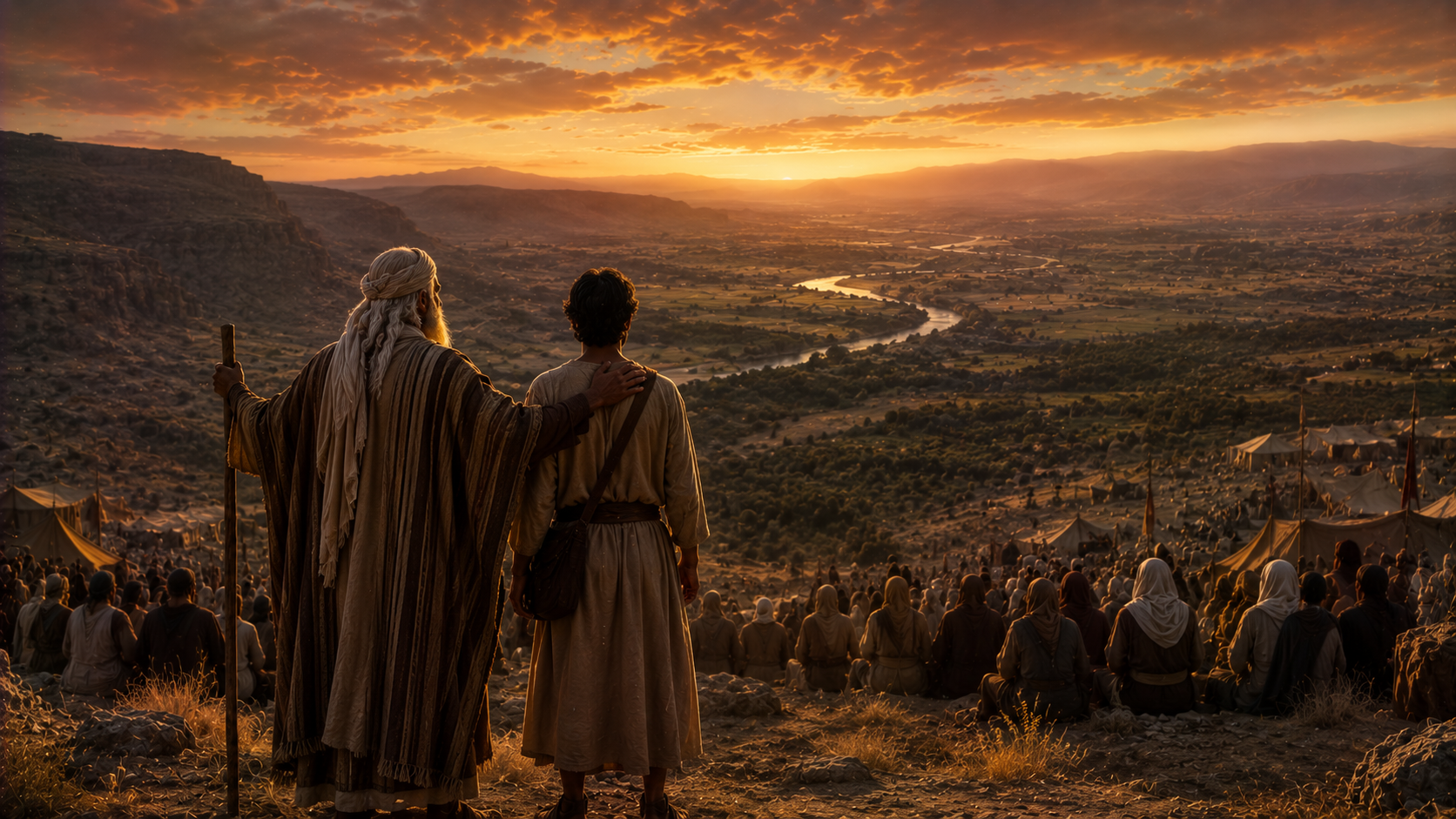
- Be strong and courageous… he will not fail you nor forsake you (verses 1-8). Moses’ last public charge has two audiences, the people and his successor, and the same words for both. The courage commanded is not self-confidence but its opposite: it rests entirely on the promise that Yahweh himself goes ahead and will not fail you nor forsake you. This is the lesson the first generation never learned at Kadesh (1:30), now handed to Joshua, who will carry the people in. And the promise outlives the moment: Hebrews quotes “I will never leave you nor forsake you” (Heb 13:5) to steady Christians centuries later. Courage in Deuteronomy is always a derivative of presence, you can be unafraid because you are not alone.
B · Deuteronomy 31:9-13 · The law read aloud to all
⁹ Moses wrote this law and delivered it to the priests the sons of Levi, who bore the ark of Yahweh’s covenant, and to all the elders of Israel. ¹⁰ Moses commanded them, saying, “At the end of every seven years, in the set time of the year of release, in the feast of booths, ¹¹ when all Israel has come to appear before Yahweh your God in the place which he will choose, you shall read this law before all Israel in their hearing. ¹² Assemble the people, the men and the women and the little ones, and the foreigners who are within your gates, that they may hear, learn, fear Yahweh your God, and observe to do all the words of this law, ¹³ and that their children, who have not known, may hear and learn to fear Yahweh your God, as long as you live in the land where you go over the Jordan to possess it.” (Deuteronomy 31:9–13, World English Bible)
- Read this law before all Israel… the men, the women, the little ones, and the foreigners (verses 9-13). Every seventh year, at the Feast of Booths, the entire law is to be read aloud to everyone. The guest list is, as always in Deuteronomy, radically inclusive, men and women, children, even resident foreigners. The word is not the private possession of a priestly elite; it belongs to the whole community, who must hear it for themselves so the next generation, “who have not known,” can learn the fear of the Lord. This public, recurring, all-ages reading of Scripture is the engine of covenant memory, the safeguard against the forgetting that the book has feared from the start.
C · Deuteronomy 31:14-30 · A song given as a witness
¹⁴ Yahweh said to Moses, “Behold, your days approach that you must die. Call Joshua, and present yourselves in the Tent of Meeting, that I may commission him.” Moses and Joshua went, and presented themselves in the Tent of Meeting. ¹⁵ Yahweh appeared in the Tent in a pillar of cloud, and the pillar of cloud stood over the Tent’s door. ¹⁶ Yahweh said to Moses, “Behold, you shall sleep with your fathers. This people will rise up and play the prostitute after the strange gods of the land where they go to be among them, and will forsake me and break my covenant which I have made with them. ¹⁷ Then my anger shall be kindled against them in that day, and I will forsake them, and I will hide my face from them, and they shall be devoured, and many evils and troubles shall come on them; so that they will say in that day, ‘Haven’t these evils come on us because our God is not among us?’ ¹⁸ I will surely hide my face in that day for all the evil which they have done, in that they have turned to other gods. ¹⁹ “Now therefore write this song for yourselves, and teach it to the children of Israel. Put it in their mouths, that this song may be a witness for me against the children of Israel. ²⁰ For when I have brought them into the land which I swore to their fathers, flowing with milk and honey, and they have eaten and filled themselves, and grown fat, then they will turn to other gods, and serve them, and despise me, and break my covenant. ²¹ It will happen, when many evils and troubles have come on them, that this song will testify before them as a witness; for it will not be forgotten out of the mouths of their descendants; for I know their ways and what they are doing today, before I have brought them into the land which I promised them.” ²² So Moses wrote this song the same day, and taught it to the children of Israel. ²³ He commissioned Joshua the son of Nun, and said, “Be strong and courageous; for you shall bring the children of Israel into the land which I swore to them. I will be with you.” ²⁴ When Moses had finished writing the words of this law in a book, until they were finished, ²⁵ Moses commanded the Levites, who bore the ark of Yahweh’s covenant, saying, ²⁶ “Take this book of the law, and put it by the side of the ark of Yahweh your God’s covenant, that it may be there for a witness against you. ²⁷ For I know your rebellion and your stiff neck. Behold, while I am yet alive with you today, you have been rebellious against Yahweh. How much more after my death? ²⁸ Assemble to me all the elders of your tribes and your officers, that I may speak these words in their ears, and call heaven and earth to witness against them. ²⁹ For I know that after my death you will utterly corrupt yourselves, and turn away from the way which I have commanded you; and evil will happen to you in the latter days, because you will do that which is evil in Yahweh’s sight, to provoke him to anger through the work of your hands.” ³⁰ Moses spoke in the ears of all the assembly of Israel the words of this song, until they were finished. (Deuteronomy 31:14–30, World English Bible)
Influence callout: a song “put in their mouths” as a witness
The chapter’s most poignant theme is its realism. God does not pretend Israel will be faithful; he tells Moses outright that once the people are “filled… and grown fat,” they “will turn to other gods” (verses 16-21), the exact danger of chapter 8 and the curse of chapter 28, now stated as certainty. So God provides for the failure in advance, and the provision is striking: a song. “Write this song… put it in their mouths, that this song may be a witness” (verse 19). Why a song and not just a law? Because a song survives: it lodges in memory, gets sung by children, “will not be forgotten out of the mouths of their descendants” (verse 21) even when the scroll is neglected. When the predicted disaster comes, the song will already be on their lips, ready to interpret it and call them home (the Song itself follows in chapter 32). The written law, too, is deposited “by the side of the ark… for a witness against you” (verse 26), with Moses’ blunt diagnosis attached: “I know your rebellion and your stiff neck” (verse 27; see the Sinai covenant, where the covenant document and its witnesses are central). This is grace that plans for the worst: God embeds his word so deep in the culture, sung and stored, that even apostasy cannot fully erase it, and a remnant can always find its way back to the words still echoing in its own mouth.
Influence callout: Jeffrey Tigay on the song as shir-`eduth (song-as-witness)
The instruction in 31:19-22 to write a song and put it in their mouths, that this song may be a witness for me against the children of Israel uses a striking legal-liturgical hybrid: a song (shir) is being commissioned to function as a witness (`ed). Tigay’s JPS commentary notes the ANE legal background. Suzerain-vassal treaties typically called witnesses, usually deities, sometimes geographical features (mountains, rivers, springs), whose function was to attest and to enforce the covenant. Deuteronomy has already called heaven and earth as witnesses (4:26; 30:19; 31:28; 32:1) and deposited the law beside the ark as a witness against you (31:26). The song is the most surprising witness on the list. Why a song and not just another document? Because a song survives. Tigay: the song will lodge in the people’s memory in a way that a deposited scroll cannot. “For it shall not be forgotten out of the mouths of their descendants” (31:21). When the predicted disaster comes, when the scroll is buried under rubble or the priesthood compromised, the song will already be on their lips, sung at weddings and funerals, hummed at the loom, and the song will accuse and correct and call home. Tigay’s reading: God is embedding the covenant’s witness in the most durable medium a culture has, its songs. The form is the wisdom. A song carried in the throat outlives the destruction of every other text. The chapter that follows (32) is then the song itself, placed into Israel’s mouth on purpose, so that when everything else fails, the music will not.
Reflection prompts
- Moses’ charge to be “strong and courageous” rested entirely on “he will not fail you nor forsake you”, courage as a byproduct of presence, not self-confidence. Where are you trying to manufacture bravery on your own, when the actual ground of courage on offer is simply that God goes with you?
- The law was to be read aloud to everyone, every seven years, so no generation could quietly forget. What rhythms keep God’s word genuinely heard in your life and household, not just owned but rehearsed often enough to shape memory?
- God planted a song in Israel’s mouth because he knew they would fail, mercy that prepares for the worst. Is there a word, a song, a Scripture, lodged deep enough in you that it would surface and call you home if you wandered? How might you put one there?
Frameworks at play in this chapter: the new Moses, the Sinai covenant.