

Chapter 28 is the longest in Deuteronomy and the climax of the whole covenant document, the blessings and curses that seal an ancient treaty (see the Sinai covenant). The proportions tell the story: fourteen verses of blessing, then fifty-four of curse. The asymmetry is not an accident; the weight falls on warning, because Deuteronomy knows the people it is addressing. The blessing is comprehensive and beautiful, flourishing in city and field, womb and barn, “the head and not the tail.” But the curses build in wave after harrowing wave, through disease, drought, defeat, and madness, down to siege, starvation, and exile.
Read with hindsight, the curses are uncanny. They read less like generic threats and more like a preview of Israel’s actual history, the Assyrian and Babylonian conquests, the scattering among the nations, even the return “to Egypt in ships.” This is the covenant’s unflinching realism about where unfaithfulness leads (see two ways, exile and return). And yet the curse is not the last word. The next chapters promise restoration beyond it (30:1-10), and the New Testament announces a Messiah who, on a tree, “became a curse for us” (Gal 3:13), taking this very curse-list onto himself so the blessing could reach the world.
A · Deuteronomy 28:1-14 · The blessing
¹ It shall happen, if you shall listen diligently to Yahweh your God’s voice, to observe to do all his commandments which I command you today, that Yahweh your God will set you high above all the nations of the earth. ² All these blessings will come upon you, and overtake you, if you listen to Yahweh your God’s voice. ³ You shall be blessed in the city, and you shall be blessed in the field. ⁴ You shall be blessed in the fruit of your body, the fruit of your ground, the fruit of your animals, the increase of your livestock, and the young of your flock. ⁵ Your basket and your kneading trough shall be blessed. ⁶ You shall be blessed when you come in, and you shall be blessed when you go out. ⁷ Yahweh will cause your enemies who rise up against you to be struck before you. They will come out against you one way, and will flee before you seven ways. ⁸ Yahweh will command the blessing on you in your barns, and in all that you put your hand to. He will bless you in the land which Yahweh your God gives you. ⁹ Yahweh will establish you for a holy people to himself, as he has sworn to you, if you shall keep the commandments of Yahweh your God, and walk in his ways. ¹⁰ All the peoples of the earth shall see that you are called by Yahweh’s name, and they will be afraid of you. ¹¹ Yahweh will grant you abundant prosperity in the fruit of your body, in the fruit of your livestock, and in the fruit of your ground, in the land which Yahweh swore to your fathers to give you. ¹² Yahweh will open to you his good treasure in the sky, to give the rain of your land in its season, and to bless all the work of your hand. You will lend to many nations, and you will not borrow. ¹³ Yahweh will make you the head, and not the tail. You will be above only, and you will not be beneath, if you listen to the commandments of Yahweh your God which I command you today, to observe and to do, ¹⁴ and shall not turn away from any of the words which I command you today, to the right hand or to the left, to go after other gods to serve them. (Deuteronomy 28:1–14, World English Bible)
- Blessed in the city… in the field… the head, and not the tail (verses 1-14). The blessing is sweeping and concrete: it touches the city and the countryside, the womb and the soil, the basket and the kneading trough, coming in and going out, the rain and the harvest. This is not “spiritual” blessing floating above ordinary life; it is the flourishing of a whole community in a real place, families, herds, fields, security from enemies, all of it held together by the relationship at its center. Note that the blessings “overtake you” (verse 2), they chase you down; a faithful people can’t outrun God’s goodness. And the goal is vocational (verse 10): the nations see Israel flourishing under God’s name, so that the blessing is also a witness.
Pushback note: prosperity-gospel readings of Deuteronomy 28
If Deuteronomy 8 is one of the most-inverted chapters in modern American Christian teaching, Deuteronomy 28 is its companion. The prosperity preacher reads 28:1-14, the blessings of the obedient (you will be blessed in the city and the field; the fruit of your body, your livestock, your basket and kneading trough will be blessed; you will lend to many nations and not borrow), as a personal-wealth contract for the faithful individual. Do your part, and God will pay out. The chapter functions in nothing like this way. Deuteronomy 28 is covenant sanctions over a national community, not a vending-machine for the godly investor. The blessings are tribal-agricultural, social, military; they describe what a people under covenant looks like flourishing, not what the obedient stockbroker should expect God to deliver. The curses (28:15-68) are written in the same register: not “what God will do to the faithful person who slips up,” but what a people walking out of covenant ends up living through. Deuteronomy 28 is historical theodicy, language that makes sense of what happened to Israel between 722 and 587 BC (siege, exile, scattering), far more than it is individual prosperity contract. To use 28:1-14 as a wealth-contract proof text you have to ignore 28:15-68 entirely (which prosperity teaching almost always does) and abstract the blessings from the corporate, agricultural, geopolitical body Deuteronomy assumes. The Christianity formed by Deut 28 reads as a community under covenant whose collective faithfulness or unfaithfulness shapes the world it lives in. The Christianity that turns Deut 28 into a personal-finance app turns the chapter into something the chapter was never trying to be.
B · Deuteronomy 28:15-24 · The curse begins
¹⁵ But it shall come to pass, if you will not listen to Yahweh your God’s voice, to observe to do all his commandments and his statutes which I command you today, that all these curses will come on you and overtake you. ¹⁶ You will be cursed in the city, and you will be cursed in the field. ¹⁷ Your basket and your kneading trough will be cursed. ¹⁸ The fruit of your body, the fruit of your ground, the increase of your livestock, and the young of your flock will be cursed. ¹⁹ You will be cursed when you come in, and you will be cursed when you go out. ²⁰ Yahweh will send on you cursing, confusion, and rebuke in all that you put your hand to do, until you are destroyed and until you perish quickly, because of the evil of your doings, by which you have forsaken me. ²¹ Yahweh will make the pestilence cling to you, until he has consumed you from off the land where you go in to possess it. ²² Yahweh will strike you with consumption, with fever, with inflammation, with fiery heat, with the sword, with blight, and with mildew. They will pursue you until you perish. ²³ Your sky that is over your head will be bronze, and the earth that is under you will be iron. ²⁴ Yahweh will make the rain of your land powder and dust. It will come down on you from the sky, until you are destroyed. (Deuteronomy 28:15–24, World English Bible)
- The curse is the blessing, inverted (verses 15-24). The curse section opens as a deliberate, point-by-point reversal of the blessing: cursed in the city and field, basket and womb, coming in and going out, the exact categories of verses 3-6 turned inside out. The most haunting image is verse 23: your sky… will be bronze, and the earth… iron, a heaven that yields no rain and a ground that yields no crop, the precise undoing of the “good treasure in the sky” (verse 12). To forsake the covenant is not to escape into freedom; it is to watch every good gift curdle.
C · Deuteronomy 28:25-37 · Defeat, disease, and madness
²⁵ Yahweh will cause you to be struck before your enemies. You will go out one way against them, and will flee seven ways before them. You will be tossed back and forth among all the kingdoms of the earth. ²⁶ Your dead bodies will be food to all birds of the sky, and to the animals of the earth; and there will be no one to frighten them away. ²⁷ Yahweh will strike you with the boils of Egypt, with the tumors, with the scurvy, and with the itch, of which you can not be healed. ²⁸ Yahweh will strike you with madness, with blindness, and with astonishment of heart. ²⁹ You will grope at noonday, as the blind gropes in darkness, and you shall not prosper in your ways. You will only be oppressed and robbed always, and there will be no one to save you. ³⁰ You will betroth a wife, and another man shall lie with her. You will build a house, and you won’t dwell in it. You will plant a vineyard, and not use its fruit. ³¹ Your ox will be slain before your eyes, and you will not eat any of it. Your donkey will be violently taken away from before your face, and will not be restored to you. Your sheep will be given to your enemies, and you will have no one to save you. ³² Your sons and your daughters will be given to another people. Your eyes will look and fail with longing for them all day long. There will be no power in your hand. ³³ A nation which you don’t know will eat the fruit of your ground and all of your work. You will only be oppressed and crushed always, ³⁴ so that the sights that you see with your eyes will drive you mad. ³⁵ Yahweh will strike you in the knees and in the legs with a sore boil, of which you cannot be healed, from the sole of your foot to the crown of your head. ³⁶ Yahweh will bring you, and your king whom you will set over yourselves, to a nation that you have not known, you nor your fathers. There you will serve other gods of wood and stone. ³⁷ You will become an astonishment, a proverb, and a byword among all the peoples where Yahweh will lead you away. (Deuteronomy 28:25–37, World English Bible)
- Defeat, exile, and “a byword among all the peoples” (verses 25-37). The curses widen from agriculture to the whole of life: military defeat, disease “of which you cannot be healed,” madness, and the bitter futility of building what you’ll never enjoy (verse 30, betroth but don’t marry, build but don’t dwell, plant but don’t harvest, the exact reversal of the war-exemptions of 20:5-7). Verse 36 names the destination plainly: exile to “a nation you have not known,” king and all. Israel, meant to be God’s showcase among the nations (verse 10), becomes instead “a proverb and a byword.”
D · Deuteronomy 28:38-46 · Futility, and the great reversal
³⁸ You will carry much seed out into the field, and will gather little in, for the locust will consume it. ³⁹ You will plant vineyards and dress them, but you will neither drink of the wine, nor harvest, because worms will eat them. ⁴⁰ You will have olive trees throughout all your borders, but you won’t anoint yourself with the oil, for your olives will drop off. ⁴¹ You will father sons and daughters, but they will not be yours, for they will go into captivity. ⁴² Locusts will consume all of your trees and the fruit of your ground. ⁴³ The foreigner who is among you will mount up above you higher and higher, and you will come down lower and lower. ⁴⁴ He will lend to you, and you won’t lend to him. He will be the head, and you will be the tail. ⁴⁵ All these curses will come on you, and will pursue you and overtake you, until you are destroyed, because you didn’t listen to Yahweh your God’s voice, to keep his commandments and his statutes which he commanded you. ⁴⁶ They will be for a sign and for a wonder to you and to your offspring forever. (Deuteronomy 28:38–46, World English Bible)
- He will be the head, and you will be the tail (verses 38-46). The reversal becomes total. The blessing said Israel would be “the head, not the tail” and would “lend to many nations” (verses 12-13); now the resident foreigner rises “higher and higher” while Israel sinks “lower and lower,” and the borrowing is reversed. Every promised good has its exact mirror-image curse. The point is sobering: the covenant’s blessings were never Israel’s by right or by ethnicity; they were the fruit of relationship, and they could be lost.
E · Deuteronomy 28:47-57 · The siege and its horror
⁴⁷ Because you didn’t serve Yahweh your God with joyfulness and with gladness of heart, by reason of the abundance of all things; ⁴⁸ therefore you will serve your enemies whom Yahweh sends against you, in hunger, in thirst, in nakedness, and in lack of all things. He will put an iron yoke on your neck until he has destroyed you. ⁴⁹ Yahweh will bring a nation against you from far away, from the end of the earth, as the eagle flies: a nation whose language you will not understand, ⁵⁰ a nation of fierce facial expressions, that doesn’t respect the elderly, nor show favor to the young. ⁵¹ They will eat the fruit of your livestock and the fruit of your ground, until you are destroyed. They also won’t leave you grain, new wine, oil, the increase of your livestock, or the young of your flock, until they have caused you to perish. ⁵² They will besiege you in all your gates until your high and fortified walls in which you trusted come down throughout all your land. They will besiege you in all your gates throughout all your land which Yahweh your God has given you. ⁵³ You will eat the fruit of your own body, the flesh of your sons and of your daughters, whom Yahweh your God has given you, in the siege and in the distress with which your enemies will distress you. ⁵⁴ The man who is tender among you, and very delicate, his eye will be evil toward his brother, toward the wife whom he loves, and toward the remnant of his children whom he has remaining, ⁵⁵ so that he will not give to any of them of the flesh of his children whom he will eat, because he has nothing left to him, in the siege and in the distress with which your enemy will distress you in all your gates. ⁵⁶ The tender and delicate woman among you, who would not venture to set the sole of her foot on the ground for delicateness and tenderness, her eye will be evil toward the husband that she loves, toward her son, toward her daughter, ⁵⁷ toward her young one who comes out from between her feet, and toward her children whom she bears; for she will eat them secretly for lack of all things in the siege and in the distress with which your enemy will distress you in your gates. (Deuteronomy 28:47–57, World English Bible)
Influence callout: the curse that came true (the siege, the exile, and where it points)
This section is almost unbearable to read, and the site does not blunt it: a foreign army “from the end of the earth, as the eagle flies” (verse 49), an iron yoke, a siege so total that parents eat their own children (verses 53-57). What makes it more than rhetoric is that Israel’s own Scriptures record it happening, twice. The siege of Samaria in 2 Kings 6:28-29 and, most harrowingly, the Babylonian siege of Jerusalem, which Lamentations remembers in exactly this language: “the hands of compassionate women have boiled their own children” (Lam 4:10; cf. 2:20). Deuteronomy 28 is the template the historians and prophets reach for to interpret 722 and 586 BC, the Assyrian destruction of the north and the Babylonian destruction of Jerusalem (see exile and return). The deepest diagnosis is verse 47: the curse comes not because Israel had too little, but because “you didn’t serve Yahweh your God with joyfulness… by reason of the abundance of all things.” Ingratitude amid plenty, the exact danger Deuteronomy warned of in chapter 8, is what unravels everything. The chapter is the dark proof of the book’s central claim: a people that forgets the Giver eventually loses the gift, and itself. And it is precisely this accumulated covenant curse that Paul says Christ “became” on the tree (Gal 3:13), absorbing the verdict so the exile could end in a homecoming.
F · Deuteronomy 28:58-68 · Scattered among the nations
⁵⁸ If you will not observe to do all the words of this law that are written in this book, that you may fear this glorious and fearful name, YAHWEH your God, ⁵⁹ then Yahweh will make your plagues and the plagues of your offspring fearful, even great plagues, and of long duration, and severe sicknesses, and of long duration. ⁶⁰ He will bring on you again all the diseases of Egypt, which you were afraid of; and they will cling to you. ⁶¹ Also every sickness and every plague which is not written in the book of this law, Yahweh will bring them on you until you are destroyed. ⁶² You will be left few in number, even though you were as the stars of the sky for multitude, because you didn’t listen to Yahweh your God’s voice. ⁶³ It will happen that as Yahweh rejoiced over you to do you good, and to multiply you, so Yahweh will rejoice over you to cause you to perish and to destroy you. You will be plucked from the land that you are going in to possess. ⁶⁴ Yahweh will scatter you among all peoples, from one end of the earth to the other end of the earth. There you will serve other gods which you have not known, you nor your fathers, even wood and stone. ⁶⁵ Among these nations you will find no ease, and there will be no rest for the sole of your foot; but Yahweh will give you there a trembling heart, failing of eyes, and pining of soul. ⁶⁶ Your life will hang in doubt before you. You will be afraid night and day, and will have no assurance of your life. ⁶⁷ In the morning you will say, “I wish it were evening!” and at evening you will say, “I wish it were morning!” for the fear of your heart which you will fear, and for the sights which your eyes will see. ⁶⁸ Yahweh will bring you into Egypt again with ships, by the way of which I told you that you would never see it again. There you will offer yourselves to your enemies for male and female slaves, and nobody will buy you. (Deuteronomy 28:58–68, World English Bible)
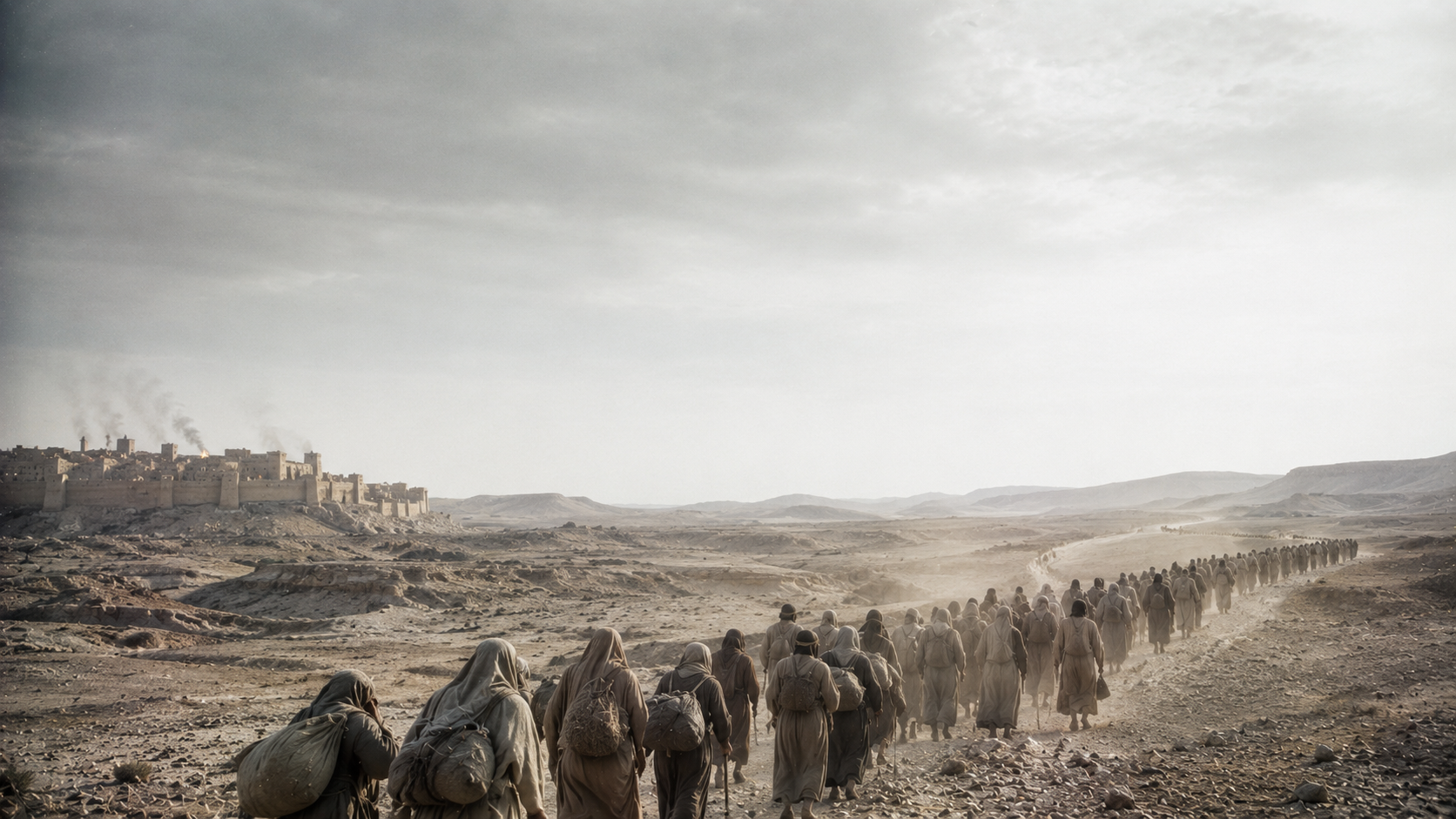
- Scattered… back to Egypt in ships (verses 58-68). The curse reaches its terminus in exile: “scattered among all peoples, from one end of the earth to the other” (verse 64), reduced from “the stars of the sky for multitude” to “few in number.” The final image (verse 68) is the most devastating reversal of all, back to Egypt, undoing the exodus itself, the house of bondage reopened, and this time “nobody will buy you,” not even worth selling. The whole story run in reverse. Yet even here Deuteronomy plants a clue that this is not annihilation but discipline: the people survive, scattered, “with a trembling heart” but alive, and the very next breath of the book (chapter 30) will speak to them “among all the nations where Yahweh has driven you” and promise a gathering. The curse is terrible and real; it is not, in the end, final.
Influence callout: Walter Brueggemann on the curses as exilic theodicy
Brueggemann’s prophetic-imagination reading of Deuteronomy 28’s curses takes its bearings from the historical fact that the chapter, in its final canonical form, was being read by a community that had already lived through what it describes. The siege language of 28:49-57 (a nation from far away whose tongue you do not understand; the besieged eating the flesh of their own children, 28:53) is not generic horror; it is the lived memory of the Babylonian siege of Jerusalem (586 BC), recorded in Lam 4:10 and 2 Kgs 6:24-29. Brueggemann: the chapter is therefore not primarily prediction but theodicy. The exilic community is being given a frame for making sense of what happened to them: the catastrophe is not random; it is not the gods of Babylon defeating the God of Israel; it is Israel’s God remaining faithful to a covenant Israel walked out of. The curses are not God’s vindictiveness toward strangers; they are how a covenant community lives out the choice of unfaithfulness when its God refuses to coerce its loyalty. Reading Deut 28 as exilic theodicy changes the chapter’s tone. It is not God spitting threats at his enemies; it is God grieving with a people whose choices led to the siege and refusing to let them lose the sense that he is still the God who acts here. The exile is, in this frame, not the end of the covenant story but the place where the covenant story becomes most painfully audible. The chapter that looks like a threat reads, in Brueggemann’s hands, as a strange and severe act of love.
Reflection prompts
- The curse is simply the blessing inverted, every good gift turned to futility. It’s a sobering picture of what it is to “have everything” while having forsaken the Giver. Where might you be enjoying gifts while drifting from the One who gave them?
- The deepest reason given for the catastrophe is verse 47: failing to serve God “with joyfulness… by reason of the abundance.” Ingratitude amid plenty. Is there abundance in your life you’ve stopped being grateful for, and what does Deuteronomy suggest that ingratitude slowly does?
- The chapter ends in exile, but not in the void, the people live, and God speaks to them “among the nations.” When you’re in a far country of your own making, where do you look for the word that promises a way back?
Frameworks at play in this chapter: two ways, exile and return, the Sinai covenant, the cruciform hermeneutic.