
On the edge of the Jordan, Moses removes the one prop Israel will most want to lean on once it wins: the belief that it deserves the land. Israel is about to dispossess the sons of the Anakim, the very giants whose report broke the first generation at Kadesh (1:28; 9:2). Lest victory curdle into pride, Moses says the same thing three times in three verses: not for your righteousness. The land comes because of the nations’ wickedness and because of God’s oath to the fathers, never because of Israel’s goodness, for you are a stiff-necked people (9:6).
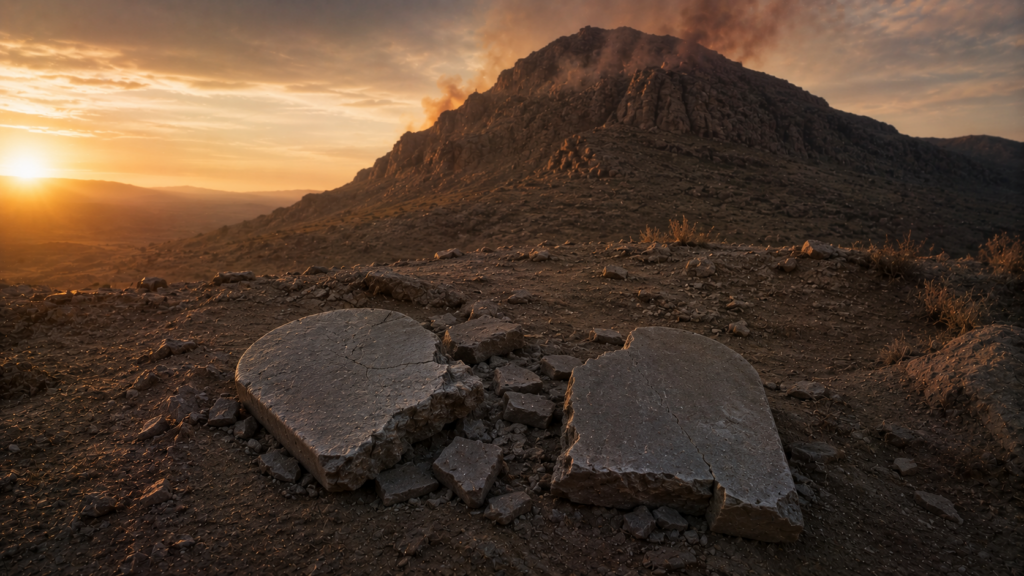
Then he proves it. The whole middle of the chapter is a retelling of the golden calf: while Moses was on the mountain receiving the covenant, Israel was at the foot of the mountain breaking it. The tablets shattered on the ground. And the only reason the nation survived its own founding sin is that its mediator threw himself down for forty days and prayed, appealing not to anything in Israel but to God’s name and God’s promise. Chapter 9 is the Hebrew Bible’s great sermon against self-righteousness, and its great picture of intercession.
A · Deuteronomy 9:1-6 · Not because you are righteous
¹ Hear, Israel! You are to pass over the Jordan today, to go in to dispossess nations greater and mightier than yourself, cities great and fortified up to the sky, ² a people great and tall, the sons of the Anakim, whom you know, and of whom you have heard say, “Who can stand before the sons of Anak?” ³ Know therefore today that Yahweh your God is he who goes over before you as a devouring fire. He will destroy them and he will bring them down before you. So you shall drive them out and make them perish quickly, as Yahweh has spoken to you. ⁴ Don’t say in your heart, after Yahweh your God has thrust them out from before you, “For my righteousness Yahweh has brought me in to possess this land;” because Yahweh drives them out before you because of the wickedness of these nations. ⁵ Not for your righteousness or for the uprightness of your heart do you go in to possess their land; but for the wickedness of these nations Yahweh your God does drive them out from before you, and that he may establish the word which Yahweh swore to your fathers, to Abraham, to Isaac, and to Jacob. ⁶ Know therefore that Yahweh your God doesn’t give you this good land to possess for your righteousness, for you are a stiff-necked people. (Deuteronomy 9:1–6, World English Bible)
- Who can stand before the sons of Anak?… Yahweh goes over before you as a devouring fire (verses 1-3). The proverbial terror of the Anakim is named and then dissolved. Israel cannot stand before them; Yahweh can, and goes ahead as a devouring fire (the same image as 4:24). The victory will be real, and it will be God’s.
- Not for your righteousness… but for the wickedness of these nations (verses 4-6). Three times the point lands, and it is one of the most important in the book.
Influence callout: “not because of your righteousness” (election and gift as grace)
Deuteronomy will not let Israel convert God’s gift into Israel’s wage. The dispossession happens for two reasons, neither of them Israel’s merit: the wickedness of these nations (a moral judgment on Canaan, long delayed; cf. Gen 15:16, “the iniquity of the Amorite is not yet complete”) and God’s resolve to establish the word which he swore to your fathers. Verse 6 drives the nail: not… for your righteousness, for you are a stiff-necked people. This is the same grace-logic as 7:7-8 (chosen not for greatness but for love), now stated even more bluntly: you receive the land despite your character, not because of it. The line runs straight to Paul, who insists salvation is “not because of works, so that no one may boast” (Eph 2:9), and to the whole biblical refusal of merit. Israel’s only “qualification” for grace is that it has none. Read this chapter beside chapter 7 and the pattern is complete: God acts out of love and faithfulness, full stop.
B · Deuteronomy 9:7-24 · The evidence: a history of rebellion
⁷ Remember, and don’t forget, how you provoked Yahweh your God to wrath in the wilderness. From the day that you left the land of Egypt until you came to this place, you have been rebellious against Yahweh. ⁸ Also in Horeb you provoked Yahweh to wrath, and Yahweh was angry with you to destroy you. ⁹ When I had gone up onto the mountain to receive the stone tablets, even the tablets of the covenant which Yahweh made with you, then I stayed on the mountain forty days and forty nights. I neither ate bread nor drank water. ¹⁰ Yahweh delivered to me the two stone tablets written with God’s finger. On them were all the words which Yahweh spoke with you on the mountain out of the middle of the fire in the day of the assembly. ¹¹ It came to pass at the end of forty days and forty nights that Yahweh gave me the two stone tablets, even the tablets of the covenant. ¹² Yahweh said to me, “Arise, get down quickly from here; for your people whom you have brought out of Egypt have corrupted themselves. They have quickly turned away from the way which I commanded them. They have made a molten image for themselves!” ¹³ Furthermore Yahweh spoke to me, saying, “I have seen these people, and behold, they are a stiff-necked people. ¹⁴ Leave me alone, that I may destroy them, and blot out their name from under the sky; and I will make of you a nation mightier and greater than they.” ¹⁵ So I turned and came down from the mountain, and the mountain was burning with fire. The two tablets of the covenant were in my two hands. ¹⁶ I looked, and behold, you had sinned against Yahweh your God. You had made yourselves a molded calf. You had quickly turned away from the way which Yahweh had commanded you. ¹⁷ I took hold of the two tablets, and threw them out of my two hands, and broke them before your eyes. ¹⁸ I fell down before Yahweh, as at the first, forty days and forty nights. I neither ate bread nor drank water, because of all your sin which you sinned, in doing that which was evil in Yahweh’s sight, to provoke him to anger. ¹⁹ For I was afraid of the anger and hot displeasure with which Yahweh was angry against you to destroy you. But Yahweh listened to me that time also. ²⁰ Yahweh was angry enough with Aaron to destroy him. I prayed for Aaron also at the same time. ²¹ I took your sin, the calf which you had made, and burned it with fire, and crushed it, grinding it very small, until it was as fine as dust. I threw its dust into the brook that descended out of the mountain. ²² At Taberah, at Massah, and at Kibroth Hattaavah you provoked Yahweh to wrath. ²³ When Yahweh sent you from Kadesh Barnea, saying, “Go up and possess the land which I have given you,” you rebelled against the commandment of Yahweh your God, and you didn’t believe him or listen to his voice. ²⁴ You have been rebellious against Yahweh from the day that I knew you. (Deuteronomy 9:7–24, World English Bible)
- Remember, and don’t forget, how you provoked Yahweh… in Horeb (verses 7-14). To prove Israel’s lack of righteousness, Moses calls the receipts. The centerpiece is the golden calf, and the timing is the scandal: while Moses was on the mountain forty days and forty nights receiving the covenant, the people quickly turned away and made the calf. They broke the covenant before the ink, the stone, was even dry. It was apostasy at the wedding (see the Sinai covenant, where Sinai is read as a marriage); the bride betrayed the groom during the ceremony.
- I took hold of the two tablets… and broke them before your eyes (verses 15-21). Moses’ shattering of the tablets is more than a fit of temper; it is a visual verdict, the covenant document, torn up because the covenant had already been broken. Then he burned the calf, crushed it… as fine as dust, and threw the dust into the brook, a deliberate, total un-making of the idol. The god they made is reduced to powder in the water; it could not save itself, much less them.
- You have been rebellious against Yahweh from the day that I knew you (verses 22-24). Moses widens the indictment beyond the calf, Taberah, Massah, Kibroth-hattaavah, Kadesh, a whole itinerary of rebellions. The verdict is comprehensive: not one good stretch to point to, but a consistent record of a stiff neck. The point is never to crush Israel but to leave it with nothing to boast in, and therefore nothing but grace to stand on.
Word study: qashe-‘oreph, “stiff-necked”
The phrase the LORD keeps using for Israel through the calf episode and forward, qashe-‘oreph, “stiff-necked”, is more than a personality assessment (9:6, 9:13, 10:16, 31:27). The metaphor is from animal husbandry: a yoke-animal whose neck will not bend to the driver’s touch. The diagnosis is muscular, not moral. Israel’s problem isn’t that they don’t know the right thing; it’s that the apparatus that translates knowledge into obedience has seized up. This is why the Deuteronomic answer to the stiff neck is not better information or harder effort, but surgery: “circumcise the foreskin of your heart, and be no longer stiff-necked” (10:16), and then, when even that command is admitted to be too much, the promise that God himself will do the circumcision (30:6). The same diagnosis runs into Paul, “I do not do the good I want” (Rom 7:19), and the same answer follows: not better effort, but a new heart, given. The word that names the problem is also the word that quietly forces the gospel: as long as the neck is stiff, all the law can do is point. Something else has to bend it.
C · Deuteronomy 9:25-29 · The intercessor in the breach
²⁵ So I fell down before Yahweh the forty days and forty nights that I fell down, because Yahweh had said he would destroy you. ²⁶ I prayed to Yahweh, and said, “Lord Yahweh, don’t destroy your people and your inheritance that you have redeemed through your greatness, that you have brought out of Egypt with a mighty hand. ²⁷ Remember your servants, Abraham, Isaac, and Jacob. Don’t look at the stubbornness of this people, nor at their wickedness, nor at their sin, ²⁸ lest the land you brought us out from say, ‘Because Yahweh was not able to bring them into the land which he promised to them, and because he hated them, he has brought them out to kill them in the wilderness.’ ²⁹ Yet they are your people and your inheritance, which you brought out by your great power and by your outstretched arm.” (Deuteronomy 9:25–29, World English Bible)

- I fell down before Yahweh the forty days… I prayed (verses 25-29). The chapter ends with the reason Israel still exists: Moses prayed. Offered the chance to be made into a nation mightier and greater than they while Israel was destroyed (verse 14), Moses refuses the promotion and throws himself between God and the people instead.
Influence callout: Moses in the breach, and the intercessor to come
Look closely at how Moses prays (verses 26-29), because his argument is a masterclass in intercession (see the new Moses). He appeals to nothing in Israel, indeed he asks God to not look at “the stubbornness of this people, nor at their wickedness, nor at their sin” (verse 27). Instead he stakes everything on three things outside Israel: God’s investment (these are “your people and your inheritance” whom you redeemed), God’s oath (“remember your servants, Abraham, Isaac, and Jacob”), and God’s reputation (lest the nations say “Yahweh was not able to bring them in,” verse 28). The mediator stands in the breach (Ps 106:23 says exactly this) and pleads the name and the promise of God against the deserved judgment of the people. It is the shape of all true intercession, and it points forward: the New Testament presents Jesus as the greater Moses who “always lives to make intercession” (Heb 7:25), the mediator who not only prays in the breach but fills it with himself. Moses, face-down for forty days pleading God’s own faithfulness, is a living preview of the cross.
- Yet they are your people and your inheritance (verse 29). The prayer ends where it must, on the unbreakable bond. Whatever Israel has done, it is still his. The same logic that grounded the election in chapter 7 grounds the survival here: God’s commitment, not Israel’s record, is what holds.
Reflection prompts
- Moses worked hard to keep Israel from ever saying “my righteousness earned this.” Where do you quietly read God’s blessings in your life as rewards you deserved, rather than as grace you didn’t?
- The diagnosis was a stiff neck, a settled resistance to being led, not mere ignorance. Where in your life is the issue not that you don’t know the right way but that your neck won’t bend to it?
- Moses interceded by appealing entirely to God’s character and promise, not to Israel’s worth. When you pray for people (or yourself) who don’t “deserve” it, what do you appeal to? What changes if you plead God’s faithfulness instead of anyone’s merit?
Frameworks at play in this chapter: the two generations, the Sinai covenant, the new Moses, circumcision of the heart.