

If chapter 1 was the failure remembered, chapter 2 is the long sentence served. Thirty-eight years pass in a few verses while the generation of the refusal quietly dies out in the wilderness, and Israel circles back toward the land by the long eastern road. But the chapter’s real surprise is not the marching. It is what God repeatedly forbids. Three times Israel is told it may not touch a neighbor’s territory: not Edom, not Moab, not Ammon, because YHWH himself gave those lands to those peoples. The book that is about to describe a conquest opens its travelogue by drawing hard borders around what Israel is not allowed to take.
That changes how the conquest should be heard from the start (see holy war and herem). YHWH is not a tribal real-estate god backing his team against all comers. He is the God who assigns nations their inheritances, who settled Esau in Seir and Lot’s sons in Moab and Ammon, and who even moved the Caphtorim and displaced the Avvim, all part of one sovereign ordering of the peoples (a theme that will surface explicitly in 32:8; see the divine council). Only at the chapter’s end, with Sihon, does the fighting finally begin, and with it the first of the book’s hard texts.
A · Deuteronomy 2:1-12 · Turn north: the land God gave to Esau
¹ Then we turned, and took our journey into the wilderness by the way to the Red Sea, as Yahweh spoke to me; and we encircled Mount Seir many days. ² Yahweh spoke to me, saying, ³ “You have encircled this mountain long enough. Turn northward. ⁴ Command the people, saying, ‘You are to pass through the border of your brothers, the children of Esau, who dwell in Seir; and they will be afraid of you. Therefore be careful. ⁵ Don’t contend with them; for I will not give you any of their land, no, not so much as for the sole of the foot to tread on, because I have given Mount Seir to Esau for a possession. ⁶ You shall purchase food from them for money, that you may eat. You shall also buy water from them for money, that you may drink.’” ⁷ For Yahweh your God has blessed you in all the work of your hands. He has known your walking through this great wilderness. These forty years, Yahweh your God has been with you. You have lacked nothing. ⁸ So we passed by from our brothers, the children of Esau, who dwell in Seir, from the way of the Arabah from Elath and from Ezion Geber. We turned and passed by the way of the wilderness of Moab. ⁹ Yahweh said to me, “Don’t bother Moab, neither contend with them in battle; for I will not give you any of his land for a possession, because I have given Ar to the children of Lot for a possession.” ¹⁰ (The Emim lived there before, a great and numerous people, and tall as the Anakim. ¹¹ These also are considered to be Rephaim, as the Anakim; but the Moabites call them Emim. ¹² The Horites also lived in Seir in the past, but the children of Esau succeeded them. They destroyed them from before them, and lived in their place, as Israel did to the land of his possession, which Yahweh gave to them.) (Deuteronomy 2:1–12, World English Bible)
- Don’t contend with them… I have given Mount Seir to Esau for a possession (verses 1-6). Israel is to pass through Edom’s territory buying its food and water like any traveler, not seizing an inch, not so much as for the sole of the foot to tread on. The reason is startling in its generosity: Esau, Jacob’s estranged brother, has a God-given inheritance that Israel must respect. The election of Jacob never meant the abandonment of Esau’s descendants.
- You have lacked nothing (verse 7). In the middle of the marching orders comes a tender summary of the whole wilderness: forty years, and you have lacked nothing. The God who carried them like a son (1:31) has also provided for them at every step (see wilderness and liminality). The wilderness was discipline, but it was never abandonment.
- The Emim lived there before… considered to be Rephaim, as the Anakim (verses 9-12). The chapter keeps pausing for strange ethnographic notes about earlier giant peoples, the Emim, later the Zamzummim, the Horites, Rephaim reckoned alongside the towering Anakim who so terrified the spies (1:28). The point of these asides is not antiquarian. They quietly insist that God has been clearing fearsome giant-clans out of the way for other nations too, as Israel did to the land of his possession, which Yahweh gave to them. The very giants Israel feared, God has already been displacing across the region.
Influence callout: Michael Heiser and the God who allots the nations
Two threads in this chapter belong to the wider divine-council story (see the divine council). First, the Rephaim. The giant clans, Emim, Zamzummim, Anakim, Rephaim, are the same kind of fearsome, oversized peoples whose memory the Hebrew Bible links back to the Nephilim of Genesis 6:4 and the rebellion of the “sons of God”; Heiser reads the conquest, in the biblical writers’ own framing, as part of a confrontation with these lingering bloodlines. Second, and more important, the allotment. Deuteronomy 2 shows YHWH assigning Seir to Esau, Ar to Moab, and the Ammonite land to Lot’s sons, and even narrating the Caphtorim displacing the Avvim. This is the same God who, at 32:8, “fixed the borders of the peoples”; the same truth Amos states when he asks whether YHWH did not also bring the Philistines from Caphtor and the Arameans from Kir (Amos 9:7), and that Paul preaches at Athens when he says God “determined allotted periods and the boundaries” of every nation (Acts 17:26). Israel’s God is the God of all the migrations, not a local patron.
B · Deuteronomy 2:13-25 · The generation consumed, and the land God kept for Ammon
¹³ “Now rise up and cross over the brook Zered.” We went over the brook Zered. ¹⁴ The days in which we came from Kadesh Barnea until we had come over the brook Zered were thirty-eight years, until all the generation of the men of war were consumed from the middle of the camp, as Yahweh swore to them. ¹⁵ Moreover Yahweh’s hand was against them, to destroy them from the middle of the camp, until they were consumed. ¹⁶ So, when all the men of war were consumed and dead from among the people, ¹⁷ Yahweh spoke to me, saying, ¹⁸ “You are to pass over Ar, the border of Moab, today. ¹⁹ When you come near the border of the children of Ammon, don’t bother them, nor contend with them; for I will not give you any of the land of the children of Ammon for a possession, because I have given it to the children of Lot for a possession.” ²⁰ (That also is considered a land of Rephaim. Rephaim lived there in the past, but the Ammonites call them Zamzummim, ²¹ a great people, many, and tall, as the Anakim; but Yahweh destroyed them from before Israel, and they succeeded them, and lived in their place, ²² as he did for the children of Esau who dwell in Seir, when he destroyed the Horites from before them; and they succeeded them, and lived in their place even to this day. ²³ Then the Avvim, who lived in villages as far as Gaza: the Caphtorim, who came out of Caphtor, destroyed them and lived in their place.) ²⁴ “Rise up, take your journey, and pass over the valley of the Arnon. Behold, I have given into your hand Sihon the Amorite, king of Heshbon, and his land; begin to possess it, and contend with him in battle. ²⁵ Today I will begin to put the dread of you and the fear of you on the peoples who are under the whole sky, who shall hear the report of you, and shall tremble and be in anguish because of you.” (Deuteronomy 2:13–25, World English Bible)
- Thirty-eight years, until all the generation of the men of war were consumed (verses 13-16). Here is the verdict of 1:35 carried out, stated with sober restraint. Nearly four decades pass in the space of two verses, and the only event recorded is a generation slowly dying from the middle of the camp. This is the somber center of the book’s two-generation structure (see the two generations): the old generation does not enter and does not get a narrative; it simply, gradually, ends, so that the new one can cross.
- Don’t bother them… I have given it to the children of Lot for a possession (verses 17-23). The same restraint applies to Ammon as to Edom and Moab, with another giant-clan parenthesis: the Zamzummim, a great people, many, and tall, as the Anakim; but Yahweh destroyed them from before Israel, and gave the land to Ammon. The repetition is the point. God’s faithfulness to give Israel a land does not cancel his prior gifts to others.
- I will begin to put the dread of you and the fear of you on the peoples (verses 24-25). With the old generation gone, the campaign can begin. The first word is the divine-warrior motif: the dread of Israel will fall on the peoples who are under the whole sky. The fear that paralyzed Israel at Kadesh (1:28) will now fall on Israel’s enemies instead. The same emotion, reassigned.
Word study: yarash and natan, the conquest’s two verbs
Two verbs trade off all through Deuteronomy 2-3 and the book that follows. Natan (“give”) is what God does: he gave the land to Esau (2:5), to Moab (2:9), to Ammon (2:19), and will give the Amorite land to Israel (2:24, 31). Yarash (“dispossess, take possession of”) is what Israel does: rise up, cross the valley, yarash the land (2:24). The vocabulary keeps a tension the book never collapses. The land is a gift before it is a possession; the possession is real human action — Israel actually crosses the Arnon and fights — but the action only follows the gift. The same God who gives Edom and Moab and Ammon their lands has decided to give the Amorite kingdom to Israel; nothing about this is “their land was inferior and ours is superior.” The conquest’s grammar refuses both Israelite triumphalism (we earned this) and Israelite quietism (we don’t have to act). It also refuses any modern reader’s wish to read “manifest destiny” out of it: this is gift-shaped conquest, with God’s prior gifts to others as its outer boundary.
C · Deuteronomy 2:26-37 · Sihon: words of peace, a hardened king, and the first herem
²⁶ I sent messengers out of the wilderness of Kedemoth to Sihon king of Heshbon with words of peace, saying, ²⁷ “Let me pass through your land. I will go along by the highway. I will turn neither to the right hand nor to the left. ²⁸ You shall sell me food for money, that I may eat; and give me water for money, that I may drink. Just let me pass through on my feet, ²⁹ as the children of Esau who dwell in Seir, and the Moabites who dwell in Ar, did to me, until I pass over the Jordan into the land which Yahweh our God gives us.” ³⁰ But Sihon king of Heshbon would not let us pass by him, for Yahweh your God hardened his spirit and made his heart obstinate, that he might deliver him into your hand, as it is today. ³¹ Yahweh said to me, “Behold, I have begun to deliver up Sihon and his land before you. Begin to possess, that you may inherit his land.” ³² Then Sihon came out against us, he and all his people, to battle at Jahaz. ³³ Yahweh our God delivered him up before us; and we struck him, his sons, and all his people. ³⁴ We took all his cities at that time, and utterly destroyed every inhabited city, with the women and the little ones. We left no one remaining. ³⁵ Only the livestock we took for plunder for ourselves, with the plunder of the cities which we had taken. ³⁶ From Aroer, which is on the edge of the valley of the Arnon, and the city that is in the valley, even to Gilead, there was not a city too high for us. Yahweh our God delivered up all before us. ³⁷ Only to the land of the children of Ammon you didn’t come near: all the banks of the river Jabbok, and the cities of the hill country, and wherever Yahweh our God forbade us. (Deuteronomy 2:26–37, World English Bible)
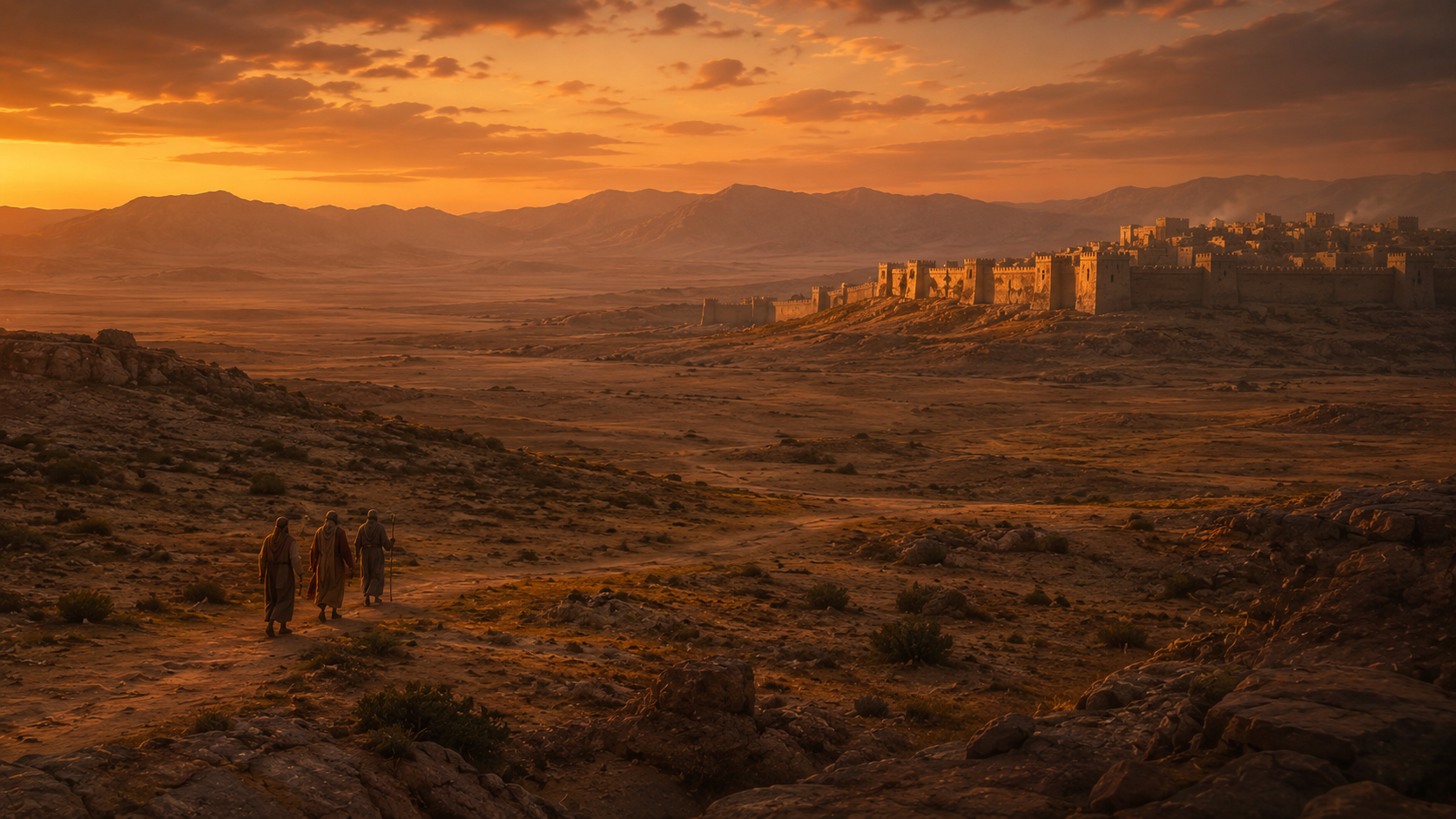
- I sent messengers… with words of peace (verses 26-29). It is worth noticing how the first battle begins: with an offer of peaceful passage. Israel asks only to travel the highway, buying food and water, harming nothing. The war with Sihon is not Israel’s first choice; it is Sihon’s response to a request for peace. Deuteronomy’s later law of war will formalize this, requiring an offer of peace before any siege (20:10).
- Yahweh your God hardened his spirit and made his heart obstinate (verses 30-31). Sihon refuses, and the text says God hardened him, the same disquieting language used of Pharaoh. The hardening is not God overriding a willing peacemaker; Sihon, like Pharaoh, is already set against Israel, and the text describes God handing him over to the obstinacy he has chosen, that he might deliver him into your hand. It is a hard idea, and Deuteronomy states it without flinching: the God who allots the nations is also sovereign over the moment of judgment.
- We… utterly destroyed every inhabited city, with the women and the little ones (verses 32-37). The battle is won, and with it comes the first instance of herem, the devotion-to-destruction that runs through the conquest narratives and troubles every honest reader.
Word study: cherem (חֵרֶם), “devoted to destruction, under the ban”
The verb behind verse 34 (ha-charem) is from the root cherem, which means to place something irrevocably under God’s claim, often by destroying it, so that it can never be turned to common or personal use. The translations render the act as “utterly destroyed” (WEB, NASB, NRSVue) or “completely destroyed” (CSB, NIV, NLT). It is the most disturbing vocabulary in the book. Three things keep the site from either weaponizing or waving it away (see holy war and herem): the cherem is bounded, not a blanket license, the same chapter forbids touching Edom, Moab, and Ammon; the “we left no one remaining” and “women and little ones” language follows a known pattern of ANE military rhetoric, where total-destruction claims regularly outran literal practice (the same Joshua who “left no survivors” keeps meeting survivors); and the trajectory of Scripture runs from this devoted destruction toward a Messiah who is himself devoted to death for his enemies. The honest reading does not pretend the text is gentle. It refuses to make it the last word, and refuses to make it a model.
Pushback note: “These are still slaughtered cities. You can’t explain that away.”
No, and the site does not try to. Even granting the bounded scope and the hyperbolic conventions of ANE war-reporting, real violence sits in these verses, and a reading that makes it comfortable has stopped telling the truth. The point of holy war and herem is not to soften the texts but to refuse two easy exits: the fundamentalist exit that turns them into a timeless template for religious violence, and the dismissive exit that tears them out of Scripture. Deuteronomy itself frames these wars as a one-time, geographically limited judgment within a specific moment of the story, hedged by laws of restraint, not a permission slip. And the cross stands at the end of the canon as God’s own verdict on where the story was always heading: the God who once handed enemies over to destruction finally hands himself over for them. We read the hard chapters honestly, and we read them in light of the One who said “Father, forgive them.”
Reflection prompts
- God drew firm borders around what Israel could not take, honoring his gifts to Esau, Moab, and Ammon. Where does remembering that God provides for others, even rivals, reshape what you feel entitled to claim?
- You have lacked nothing. The whole forty years gets summed up in three words of provision. Looking back over a hard stretch of your own, where can you honestly say the same, even if it did not feel like it at the time?
- The first battle began only after words of peace were refused. How does it change your picture of these conquest stories to see that the war Israel is remembered for started with an offer of peace?
Frameworks at play in this chapter: holy war and herem, the divine council, the two generations, wilderness and liminality.