
Chapter 3 finishes the eastern campaign and turns the page toward the future. Og of Bashan, the last giant king, falls; the conquered Transjordan is parceled out to Reuben, Gad, and half of Manasseh; Joshua is charged to lead what Moses cannot. The chapter is full of victory, and its giant is not incidental: Og is the last of the remnant of the Rephaim (3:11), the very kind of towering enemy whose existence made the spies’ hearts melt at Kadesh (1:28). The fear that lost the first generation the land is, in this generation, simply overthrown.
But the chapter’s true center is its quiet ending. Moses, who has carried this people from Egypt to the edge of the promise, asks God for one thing: to cross the river and see the good land. He is refused. He may climb Pisgah and look, west and north and south and east, but he will not set foot in it; Joshua will lead the people in. The man who gave Israel the Torah dies looking at a rest he will not enter, and the mediator stops at the Jordan (see the new Moses).
A · Deuteronomy 3:1-11 · Og of Bashan, the last of the giants
¹ Then we turned, and went up the way to Bashan. Og the king of Bashan came out against us, he and all his people, to battle at Edrei. ² Yahweh said to me, “Don’t fear him; for I have delivered him, with all his people and his land, into your hand. You shall do to him as you did to Sihon king of the Amorites, who lived at Heshbon.” ³ So Yahweh our God also delivered into our hand Og, the king of Bashan, and all his people. We struck him until no one was left to him remaining. ⁴ We took all his cities at that time. There was not a city which we didn’t take from them: sixty cities, all the region of Argob, the kingdom of Og in Bashan. ⁵ All these were cities fortified with high walls, gates, and bars, in addition to a great many villages without walls. ⁶ We utterly destroyed them, as we did to Sihon king of Heshbon, utterly destroying every inhabited city, with the women and the little ones. ⁷ But all the livestock, and the plunder of the cities, we took for plunder for ourselves. ⁸ We took the land at that time out of the hand of the two kings of the Amorites who were beyond the Jordan, from the valley of the Arnon to Mount Hermon. ⁹ (The Sidonians call Hermon Sirion, and the Amorites call it Senir.) ¹⁰ We took all the cities of the plain, and all Gilead, and all Bashan, to Salecah and Edrei, cities of the kingdom of Og in Bashan. ¹¹ (For only Og king of Bashan remained of the remnant of the Rephaim. Behold, his bedstead was a bedstead of iron. Isn’t it in Rabbah of the children of Ammon? Nine cubits was its length, and four cubits its width, after the cubit of a man.) (Deuteronomy 3:1–11, World English Bible)
- Og the king of Bashan came out against us… “Don’t fear him” (verses 1-7). The pattern of the Sihon campaign repeats: a king comes out to battle, God says don’t fear, and the cities fall under the cherem (see holy war and herem, where the chapter-2 hard text is treated at length). The first word God speaks is the word Israel could not hear at Kadesh: don’t fear. Courage here is not bravado; it is the simple willingness to believe that God goes ahead.
- Only Og king of Bashan remained of the remnant of the Rephaim (verses 8-11). The campaign summary pauses, as chapter 2 kept pausing, for a note about giants, and this one is the most vivid: Og is the last of the Rephaim, and his enormous bedstead of iron, nine cubits long, was still on display in Ammon.
Historical note: Og’s iron “bedstead” (3:11)
The detail is famous and odd: an iron bed roughly thirteen feet long, kept as a relic. Older readings took it as Og’s actual bed and proof of his giant size; many scholars now suspect it was a basalt sarcophagus (the dark volcanic stone of Bashan can be called “iron”) or a monumental dolmen, the kind of oversized megalithic tomb that dots the region. Either way the function in the text is the same. Og is named the last of the Rephaim, the final survivor of the giant clans the Hebrew Bible associates with the old rebellion behind Genesis 6 (see the divine council). The terror of the Anakim that broke the first generation ends here, with the last giant’s tomb turned into a tourist curiosity. What looked unbeatable from Kadesh is, on God’s timetable, already a museum piece.
Pushback note: the Rephaim, the giants, and a sober reading
The note about Og’s “iron bed, nine cubits long” (3:11) is the kind of verse modern readers tend to handle in one of two unsatisfying ways. Pop-evangelical literalism turns it into a “giant skeletons” subgenre, with conspiracy threads about Smithsonian cover-ups and Nephilim breeding programs. Academic-progressive reading tends to roll its eyes and move on. Both miss what the text is doing. Deuteronomy is drawing on a real ancient memory of Rephaim, a class of legendary pre-Israelite peoples (Anakim, Emim, Zamzummim; 2:10-11, 20-21; 3:11) whose names hover at the boundary between human dynasty and underworld shade. The “iron bed” looks much more like a sarcophagus than a piece of furniture; the verse reads more like a museum tag than a wildlife report. Within the worldview of Deuteronomy and the Hebrew Bible (see the divine council), these peoples carry traces of pre-flood, divine-council disorder, the same conceptual world that Genesis 6’s “sons of God” and Numbers 13’s Anakim belong to. You don’t have to swallow YouTube giant-bones theories to take the text seriously; you also don’t have to demythologize it to keep your dignity. Deut 3:11 is the Bible’s note in the margin: we remember these kings, and they were not invincible, and they are gone.
B · Deuteronomy 3:12-22 · Dividing the eastern land, and the charge to Joshua
¹² This land we took in possession at that time: from Aroer, which is by the valley of the Arnon, and half the hill country of Gilead with its cities, I gave to the Reubenites and to the Gadites; ¹³ and the rest of Gilead, and all Bashan, the kingdom of Og, I gave to the half-tribe of Manasseh—all the region of Argob, even all Bashan. (The same is called the land of Rephaim. ¹⁴ Jair the son of Manasseh took all the region of Argob, to the border of the Geshurites and the Maacathites, and called them, even Bashan, after his own name, Havvoth Jair, to this day.) ¹⁵ I gave Gilead to Machir. ¹⁶ To the Reubenites and to the Gadites I gave from Gilead even to the valley of the Arnon, the middle of the valley, and its border, even to the river Jabbok, which is the border of the children of Ammon; ¹⁷ the Arabah also, and the Jordan and its border, from Chinnereth even to the sea of the Arabah, the Salt Sea, under the slopes of Pisgah eastward. ¹⁸ I commanded you at that time, saying, “Yahweh your God has given you this land to possess it. All of you men of valor shall pass over armed before your brothers, the children of Israel. ¹⁹ But your wives, and your little ones, and your livestock, (I know that you have much livestock), shall live in your cities which I have given you, ²⁰ until Yahweh gives rest to your brothers, as to you, and they also possess the land which Yahweh your God gives them beyond the Jordan. Then you shall each return to his own possession, which I have given you.” ²¹ I commanded Joshua at that time, saying, “Your eyes have seen all that Yahweh your God has done to these two kings. So shall Yahweh do to all the kingdoms where you go over. ²² You shall not fear them; for Yahweh your God himself fights for you.” (Deuteronomy 3:12–22, World English Bible)
- This land we took in possession… I gave to the Reubenites and to the Gadites (verses 12-17). The conquered Transjordan is distributed to the two and a half tribes who will settle east of the river. The land is described, surveyed, named, the gift made concrete. Deuteronomy never lets the promise float in the abstract; it always comes down to specific valleys and towns.
- All of you men of valor shall pass over armed before your brothers (verses 18-20). The eastern tribes get their inheritance early, but with a condition: their fighting men must cross the Jordan and fight for the rest until Yahweh gives rest to your brothers. No tribe is allowed to settle into its own rest while the family is still unsettled. Inheritance carries obligation to the whole people.
- Your eyes have seen… Yahweh your God himself fights for you (verses 21-22). Moses commissions Joshua with a memory and a promise. The memory: your eyes have seen all that Yahweh your God has done to these two kings. The promise: Yahweh your God himself fights for you. The whole theology of Israel’s wars is here in one line, the battle belongs to God; Israel’s task is to not be afraid. It is the exact lesson the first generation failed (1:30), now handed to the leader who will get it right.
C · Deuteronomy 3:23-29 · The plea denied: Moses sees the land he cannot enter
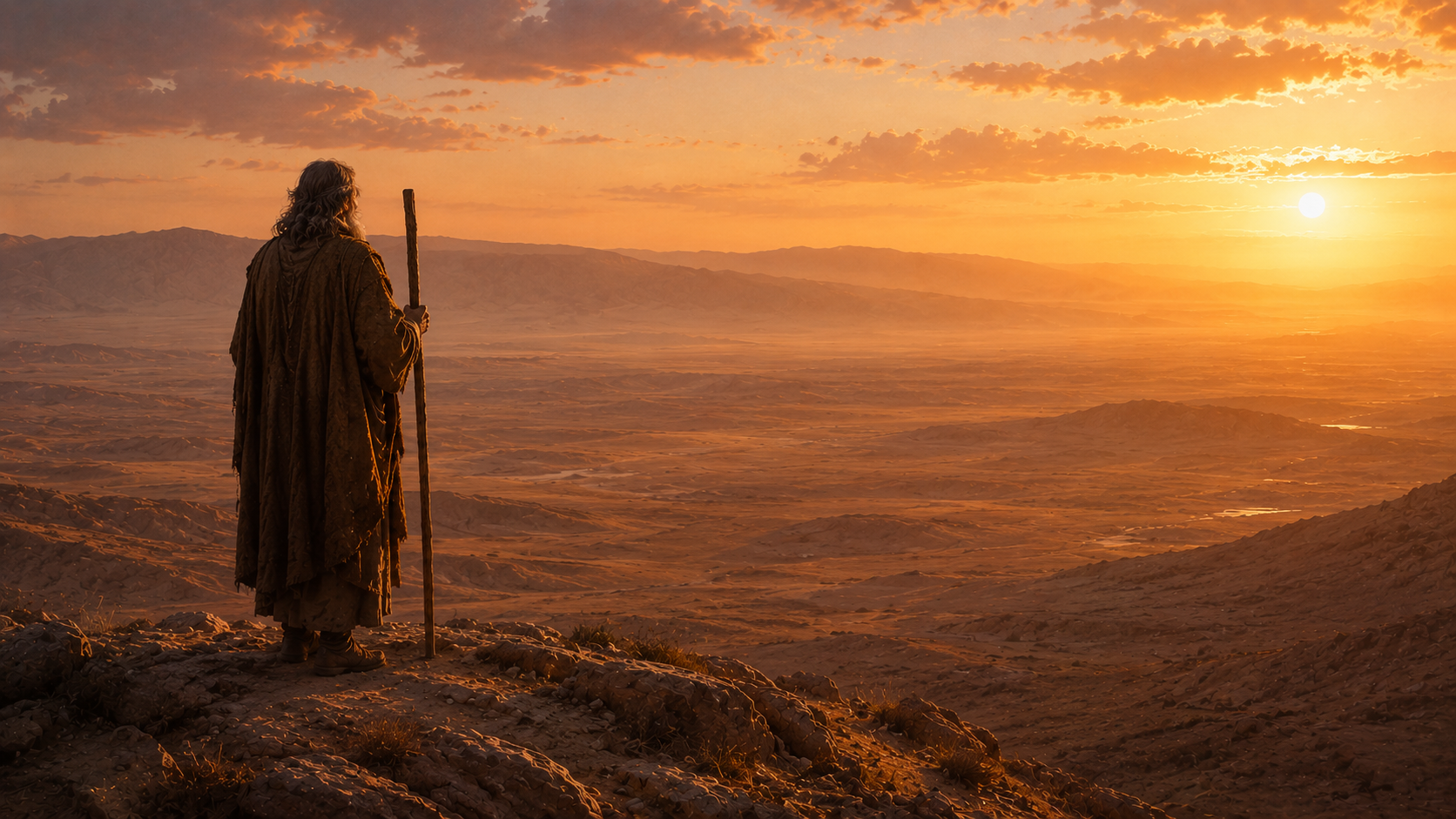
²³ I begged Yahweh at that time, saying, ²⁴ “Lord Yahweh, you have begun to show your servant your greatness, and your strong hand. For what god is there in heaven or in earth that can do works like yours, and mighty acts like yours? ²⁵ Please let me go over and see the good land that is beyond the Jordan, that fine mountain, and Lebanon.” ²⁶ But Yahweh was angry with me because of you, and didn’t listen to me. Yahweh said to me, “That is enough! Speak no more to me of this matter. ²⁷ Go up to the top of Pisgah, and lift up your eyes westward, and northward, and southward, and eastward, and see with your eyes; for you shall not go over this Jordan. ²⁸ But commission Joshua, and encourage him, and strengthen him; for he shall go over before this people, and he shall cause them to inherit the land which you shall see.” ²⁹ So we stayed in the valley near Beth Peor. (Deuteronomy 3:23–29, World English Bible)
- What god is there in heaven or in earth that can do works like yours? (verses 23-24). Moses begins his plea with worship. His prayer for entry is wrapped in a confession of God’s incomparability, what god is there in heaven or in earth who can act like this God?
Word study: incomparability, not arithmetic (mi-el, “what god”)
Moses’ question, what god is there in heaven or in earth that can do works like yours (3:24), is the language of incomparability, and the translations keep its flavor: “what god is there in heaven or on earth who can do such works” (NASB), “is there any god in heaven or on earth who can perform such great and mighty deeds” (NLT), with several rendering the address Sovereign LORD (NIV) or O Lord God. This is how Hebrew monotheism characteristically talks. It does not usually argue that other elohim do not exist; it declares that none of them can be compared to YHWH (see the divine council). The same note sounds in the Song of the Sea (“who is like you, Yahweh, among the gods?” Ex 15:11) and across the Psalms. By chapter 4 Moses will press further toward “there is no other” (4:35, 39); here the confession is incomparability, the LORD outclasses every power in heaven or earth.
- Lord Yahweh… please let me go over and see the good land (verses 25-26). The request is human and aching: just let me cross and see it. The answer is one of the most abrupt in the Torah: “That is enough! Speak no more to me of this matter.” And again the exclusion is framed corporately, Yahweh was angry with me because of you (see the discussion at 1:37). The greatest prophet Israel ever had is told, flatly, no.
Influence callout: the mediator who does not enter (the new-Moses pattern)
There is a deep and deliberate sadness in how the Torah ends (see the new Moses). Moses leads Israel out of Egypt, through the sea, to Sinai, across the wilderness, to the very bank of the Jordan, and then stops. He sees the land from Pisgah but does not enter it; the one who brought the rest does not share it. The successor who leads the people in is named Yehoshua, Joshua, “YHWH saves,” the Hebrew name behind Jesus. The New Testament will read this pattern carefully: the law given through Moses brings Israel to the threshold, but it is Joshua/Jesus who brings the people into the inheritance (a logic Hebrews 3-4 works out, that Joshua’s rest was not the final rest). There is even something cruciform in it (see the cruciform hermeneutic): the mediator bears the exclusion for the people and dies outside the rest he secured for them. Moses on Pisgah, gazing at a promise he will not touch, is one of Scripture’s most poignant figures, and one of its most forward-pointing.
- Go up to the top of Pisgah… see with your eyes; for you shall not go over this Jordan (verses 27-29). God’s “no” is not without mercy. Moses is given the whole panorama, the land laid out in every direction, and the assurance that the work will continue without him: commission Joshua, and encourage him… he shall cause them to inherit. The chapter ends with Israel camped near Beth Peor, on the threshold, where the great body of the book’s preaching will now be delivered.
Reflection prompts
- Og the last giant ends up as a relic in a foreign city, the unbeatable enemy turned into an old curiosity. What “giant” in your own life have you assumed is permanent and undefeatable that God may already be retiring?
- The eastern tribes could not rest until their brothers had rest too. Where are you tempted to settle into your own comfort while people you belong to are still unsettled?
- Moses brought the people to the edge of a promise he himself would not enter. Have you ever poured yourself into something whose fruit you will not get to enjoy? What would it mean to do that faithfully, as he did, trusting the Joshua who comes after?
Frameworks at play in this chapter: the new Moses, holy war and herem, the divine council, the two generations.