
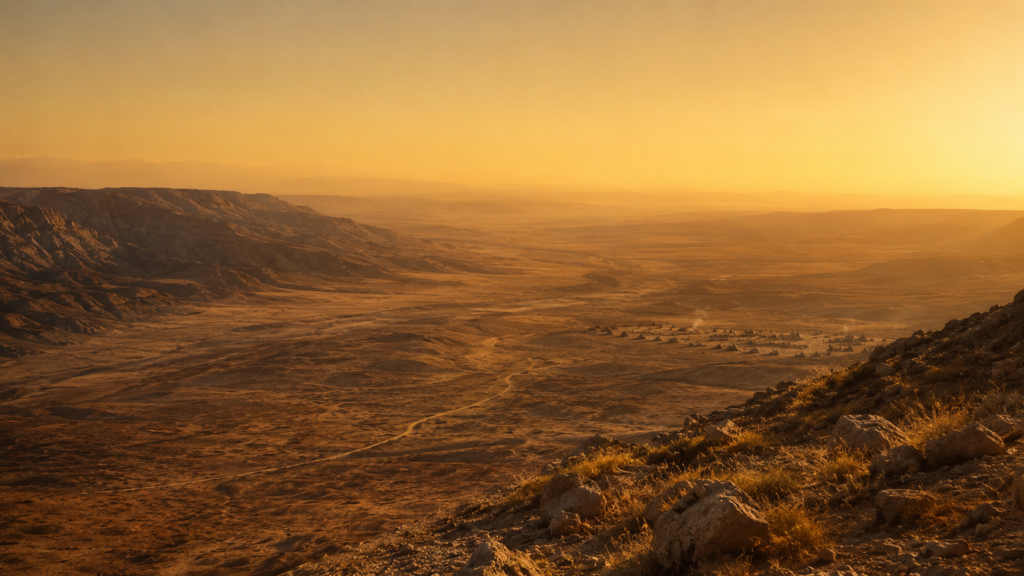
Deuteronomy opens not with a law but with a memory. Moses stands on the plains of Moab, east of a river he will never cross, and begins to preach. The first thing he does is tell the story again, the whole journey from the mountain of God to this last campsite, and he tells it to a generation that, for the most part, was not there for it. The book’s most quietly devastating line is its second verse: it is eleven days’ journey from Horeb by the way of Mount Seir to Kadesh Barnea (1:2). Eleven days. The trip took forty years. That gap between the eleven days the journey should have taken and the forty years it actually took is the wound this chapter probes.
This is the historical prologue of the covenant document (see the Sinai covenant): before the great King states his terms, he rehearses what he has already done. And it is preached to the children of the people who died in the wilderness, the second of the book’s two generations (see the two generations). When Moses says you saw, you rebelled, you wept, most of his hearers were small children or unborn. Deuteronomy deliberately collapses the distance. Every generation, it insists, stands at Kadesh and must decide whether it believes the God who carried it through the wilderness (see wilderness and liminality).
A · Deuteronomy 1:1-8 · The words beyond the Jordan, and the land set before them
¹ These are the words which Moses spoke to all Israel beyond the Jordan in the wilderness, in the Arabah opposite Suf, between Paran, Tophel, Laban, Hazeroth, and Dizahab. ² It is eleven days’ journey from Horeb by the way of Mount Seir to Kadesh Barnea. ³ In the fortieth year, in the eleventh month, on the first day of the month, Moses spoke to the children of Israel according to all that Yahweh had given him in commandment to them, ⁴ after he had struck Sihon the king of the Amorites who lived in Heshbon, and Og the king of Bashan who lived in Ashtaroth, at Edrei. ⁵ Beyond the Jordan, in the land of Moab, Moses began to declare this law, saying, ⁶ “Yahweh our God spoke to us in Horeb, saying, ‘You have lived long enough at this mountain. ⁷ Turn, and take your journey, and go to the hill country of the Amorites and to all the places near there: in the Arabah, in the hill country, in the lowland, in the South, by the seashore, in the land of the Canaanites, and in Lebanon as far as the great river, the river Euphrates. ⁸ Behold, I have set the land before you. Go in and possess the land which Yahweh swore to your fathers—to Abraham, to Isaac, and to Jacob—to give to them and to their offspring after them.’” (Deuteronomy 1:1–8, World English Bible)
- These are the words which Moses spoke to all Israel beyond the Jordan (verses 1-2). The book names itself in its first phrase: eleh ha-devarim, “these are the words,” from which Deuteronomy takes its Hebrew title, Devarim. The catalogue of place-names (Suf, Paran, Tophel, and the rest) reads like the worn itinerary of a long detour, and verse 2’s aside about the eleven-day journey hangs over all of it. The geography is preaching: this is the route unbelief takes.
- In the fortieth year… Moses began to declare this law (verses 3-5). The date matters. It is the very end of the wilderness years; the old generation is gone, and Moses speaks to those who will actually enter. The verb in verse 5, be’er, is not “recite” but “make plain,” and the translations feel its weight differently.
Word study: be’er (בֵּאֵר), “to make plain, expound, explain”
Verse 5 says Moses “began to declare this law” (WEB). The Hebrew be’er appears only a handful of times and means to engrave or set out clearly (it is used in 27:8 of writing the law “very plainly” on plastered stones). This is why the translations reach for teaching words: Moses “began to explain this law” (CSB, NASB, ESV), to expound it (NIV, NRSVue), or “carefully explained the Lord’s instructions” (NLT). The point is genre-setting. Deuteronomy is not fresh legislation; it is Moses the preacher expounding the covenant already given at Sinai, pressing it into the hearts of a new generation. The whole book is a sermon on the Torah, not a second Torah, which is exactly what its mistaken Greek name (“second law”) obscures.
- You have lived long enough at this mountain… I have set the land before you (verses 6-8). The first words God speaks in the book are a command to move. Sinai was the wedding, not the home; the mountain was never the destination. I have set the land before you frames the land as sheer gift, and the gift is anchored in the oath sworn to Abraham, Isaac, and Jacob (see the exodus pattern). Possession is commanded, but only because the giving has already happened.
Influence callout: Daniel Block on Deuteronomy as preached Torah
Block’s reading of Deuteronomy in the NIVAC commentary keeps insisting on its genre: the book is not annal or chronicle but sermon, three farewell addresses preached by Moses to a generation on the brink of the land. Chapter 1 sets the rhetorical key for the rest. Moses does not just recall the journey; he re-applies it. The “eleven days that took forty years” (1:2-3) is not a footnote; it is the move that turns geography into theology, and theology into a question for this generation: will you do at the Jordan what your parents would not do at Kadesh? That sermonic register is why the same phrase, “Hear, O Israel,” can open the law code (6:4) and the war manual (20:3) and the covenant ceremony (27:9). The whole book is preached at a people, in the live “today” of the assembly. Reading Deuteronomy as a sermon, rather than as an information drop, changes what the modern reader is expected to do with it.
B · Deuteronomy 1:9-18 · A burden too heavy: judges for a multiplied people
⁹ I spoke to you at that time, saying, “I am not able to bear you myself alone. ¹⁰ Yahweh your God has multiplied you, and behold, you are today as the stars of the sky for multitude. ¹¹ May Yahweh, the God of your fathers, make you a thousand times as many as you are and bless you, as he has promised you! ¹² How can I myself alone bear your problems, your burdens, and your strife? ¹³ Take wise men of understanding who are respected among your tribes, and I will make them heads over you.” ¹⁴ You answered me, and said, “The thing which you have spoken is good to do.” ¹⁵ So I took the heads of your tribes, wise and respected men, and made them heads over you, captains of thousands, captains of hundreds, captains of fifties, captains of tens, and officers, according to your tribes. ¹⁶ I commanded your judges at that time, saying, “Hear cases between your brothers and judge righteously between a man and his brother, and the foreigner who is living with him. ¹⁷ You shall not show partiality in judgment; you shall hear the small and the great alike. You shall not be afraid of the face of man, for the judgment is God’s. The case that is too hard for you, you shall bring to me, and I will hear it.” ¹⁸ I commanded you at that time all the things which you should do. (Deuteronomy 1:9–18, World English Bible)
- I am not able to bear you myself alone… you are today as the stars of the sky (verses 9-15). Moses recalls appointing wise and respected leaders to share the load of governing, the Deuteronomic memory of the episode told in Exodus 18 and Numbers 11. Notice the grace tucked inside the complaint: the reason the burden is too heavy is that the people have become as the stars of the sky for multitude, the exact language of the promise to Abraham (Gen 15:5). The problem of leadership is a side effect of God keeping his word.
- Judge righteously… the judgment is God’s (verses 16-18). The charge to the judges is one of the Hebrew Bible’s clearest statements of justice: hear small and great alike, show no partiality, do not fear any human face, and include the foreigner who is living with him under the same impartial law. The reason given is breathtaking, for the judgment is God’s. Human justice is not a human invention to be bent toward the powerful; it is participation in God’s own judgment, which is why partiality is not merely unfair but a kind of blasphemy. Deuteronomy will return again and again to this protection of the vulnerable.
C · Deuteronomy 1:19-33 · Kadesh: a good land, and a failure of nerve
¹⁹ We traveled from Horeb and went through all that great and terrible wilderness which you saw, by the way to the hill country of the Amorites, as Yahweh our God commanded us; and we came to Kadesh Barnea. ²⁰ I said to you, “You have come to the hill country of the Amorites, which Yahweh our God gives to us. ²¹ Behold, Yahweh your God has set the land before you. Go up, take possession, as Yahweh the God of your fathers has spoken to you. Don’t be afraid, neither be dismayed.” ²² You came near to me, everyone of you, and said, “Let’s send men before us, that they may search the land for us, and bring back to us word of the way by which we must go up, and the cities to which we shall come.” ²³ The thing pleased me well. I took twelve of your men, one man for every tribe. ²⁴ They turned and went up into the hill country, and came to the valley of Eshcol, and spied it out. ²⁵ They took some of the fruit of the land in their hands and brought it down to us, and brought us word again, and said, “It is a good land which Yahweh our God gives to us.” ²⁶ Yet you wouldn’t go up, but rebelled against the commandment of Yahweh your God. ²⁷ You murmured in your tents, and said, “Because Yahweh hated us, he has brought us out of the land of Egypt, to deliver us into the hand of the Amorites to destroy us. ²⁸ Where are we going up? Our brothers have made our heart melt, saying, ‘The people are greater and taller than we. The cities are great and fortified up to the sky. Moreover we have seen the sons of the Anakim there!’” ²⁹ Then I said to you, “Don’t be terrified. Don’t be afraid of them. ³⁰ Yahweh your God, who goes before you, he will fight for you, according to all that he did for you in Egypt before your eyes, ³¹ and in the wilderness where you have seen how that Yahweh your God carried you, as a man carries his son, in all the way that you went, until you came to this place.” ³² Yet in this thing you didn’t believe Yahweh your God, ³³ who went before you on the way, to seek out a place for you to pitch your tents in: in fire by night, to show you by what way you should go, and in the cloud by day. (Deuteronomy 1:19–33, World English Bible)

- You have come to the hill country of the Amorites… go up, take possession, don’t be afraid (verses 19-25). They reach Kadesh, the threshold. Moses’ charge could not be clearer or more encouraging. Then comes a detail the Deuteronomic retelling handles with care: in this version, sending the spies is the people’s idea (you came near to me… and said, “Let’s send men before us,” verse 22), and Moses says the thing pleased me well. In Numbers 13 the mission is God’s command; here Moses lets the responsibility rest where the failure will land. The spies even return with the verdict already in hand: it is a good land which Yahweh our God gives to us (verse 25). The data was never the problem.
- Yet you wouldn’t go up, but rebelled… “Because Yahweh hated us” (verses 26-28). The refusal is dressed as realism, fortified cities, the towering Anakim, hearts melting like wax, but its engine is a lie about God’s character: because Yahweh hated us, he has brought us out of… Egypt… to destroy us. This is the distrust at the root of every wilderness rebellion: the suspicion that the God who rescued you secretly means you harm. Fear always tells a story about God, and this one inverts the exodus into a plot.
- Yahweh your God… carried you, as a man carries his son… yet you didn’t believe (verses 29-33). Against the lie Moses sets a memory and an image. God goes before them and fights for them; in the wilderness he carried them like a parent carrying a child. The translations color the tenderness slightly differently, as a man carries his son (WEB, CSB, NASB), as a father carries his son (NIV), as one carries a child (NRSVue), or, most warmly, cared for you… just as a father cares for his child (NLT). The picture is of God stooping to carry an exhausted toddler the whole way. And the verdict on the refusal is heartbreaking in its simplicity: yet in this thing you didn’t believe Yahweh your God. They had been carried the entire journey and still would not trust the arms that held them.
Where this lands: eleven days that took forty years
The detail in 1:2 should land like a quiet ache: from Horeb to Kadesh is eleven days’ walk. They spent forty years there. The math is the sermon. There is a distance between where God meant you to be and where you actually ended up, and most of that distance is not measured in miles but in the years your unbelief stretched the route. Most of us are walking versions of that math. The good news Deuteronomy keeps preaching, all the way to chapter 30, is that the LORD who carried Israel as a man carries his son did not stop being patient when the eleven days turned into forty years. He still meant to bring them in. He still means to bring you somewhere. The slow road home is still a road home.
D · Deuteronomy 1:34-46 · The verdict, and the presumption that follows fear
³⁴ Yahweh heard the voice of your words and was angry, and swore, saying, ³⁵ “Surely not one of these men of this evil generation shall see the good land which I swore to give to your fathers, ³⁶ except Caleb the son of Jephunneh. He shall see it. I will give the land that he has trodden on to him and to his children, because he has wholly followed Yahweh.” ³⁷ Also Yahweh was angry with me for your sakes, saying, “You also shall not go in there. ³⁸ Joshua the son of Nun, who stands before you, shall go in there. Encourage him, for he shall cause Israel to inherit it. ³⁹ Moreover your little ones, whom you said would be captured or killed, your children, who today have no knowledge of good or evil, shall go in there. I will give it to them, and they shall possess it. ⁴⁰ But as for you, turn, and take your journey into the wilderness by the way to the Red Sea.” ⁴¹ Then you answered and said to me, “We have sinned against Yahweh. We will go up and fight, according to all that Yahweh our God commanded us.” Every man of you put on his weapons of war, and presumed to go up into the hill country. ⁴² Yahweh said to me, “Tell them, ‘Don’t go up and don’t fight; for I am not among you, lest you be struck before your enemies.’” ⁴³ So I spoke to you, and you didn’t listen; but you rebelled against the commandment of Yahweh, and were presumptuous, and went up into the hill country. ⁴⁴ The Amorites, who lived in that hill country, came out against you and chased you as bees do, and beat you down in Seir, even to Hormah. ⁴⁵ You returned and wept before Yahweh, but Yahweh didn’t listen to your voice, nor turn his ear to you. ⁴⁶ So you stayed in Kadesh many days, according to the days that you remained. (Deuteronomy 1:34–46, World English Bible)
- Not one of this evil generation… except Caleb… Joshua… shall go in there (verses 34-40). The oath falls: the generation that refused will not enter. Two are exempted, Caleb, who wholly followed Yahweh, and Joshua, who will lead. Then a striking note: also Yahweh was angry with me for your sakes (verse 37). Deuteronomy frames Moses’ exclusion from the land as bound up with the people’s rebellion, on your account (CSB, NASB, NIV), rather than narrating the Meribah incident that Numbers 20 gives as the cause.
Pushback note: why is Moses barred “for your sakes” here, but for his own failure in Numbers 20?
Numbers 20:12 is explicit that Moses is barred from the land because he failed to trust God and struck the rock at Meribah. Here Moses says he was shut out for your sakes (1:37; also 3:26, 4:21). Readers have long noticed the tension. The simplest account is that both are true and Deuteronomy is preaching, not filing a report: Moses’ fate is genuinely tangled up with the generation he led, whose unbelief set the whole tragic chain in motion, and a sermon is free to foreground the corporate dimension that a chronicle states more narrowly. There is also something quietly cruciform in the framing (see the cruciform hermeneutic): the mediator does not enter the rest he secures for others. The site holds the two accounts together rather than forcing one to cancel the other; Moses bears both his own failure and, as leader, the weight of the people’s.
- Your little ones… who today have no knowledge of good or evil… shall go in there (verses 38-40). The hinge of the book’s two-generation structure (see the two generations). The very children the fearful generation said would become plunder are the ones to whom God gives the land. And the phrase describing them, no knowledge of good or evil (echoing Eden), is poignant; the NLT renders it your innocent children. The future belongs not to the competent and fearful adults but to the ones written off as too weak to matter.
- “We have sinned… we will go up and fight”… and the Amorites chased you as bees do (verses 41-46). The chapter ends with the mirror image of the refusal. Having said no out of fear, the people now charge ahead in self-will, presuming to take the land after God has said no (verse 43). It ends in rout: chased as bees do, beaten down to Hormah, weeping before a God who didn’t listen. The lesson is sharp and easy to miss: fear and presumption look like opposites but are the same failure. Both act without the one question that mattered, whether YHWH was among them or not (verse 42). To refuse God’s “go” and to ignore God’s “stop” are both forms of not believing him.
Reflection prompts
- Eleven days became forty years. Where has unbelief stretched a short journey into a long one, turning what could have been a quick step of obedience into years of wandering the same wilderness?
- They had been carried, as a man carries his son, the entire way, and still would not trust. Where is your own remembered experience of being carried failing to translate into present trust?
- First the people refused God’s “go” out of fear; then they ignored God’s “stop” out of presumption. Both skipped the only real question, is YHWH among us in this or not? Where are you tempted either to retreat or to charge ahead without asking it?
Frameworks at play in this chapter: the two generations, the Sinai covenant, wilderness and liminality, the exodus pattern.