

Chapter 21 opens the long run of mixed civil and family laws that fills the middle of Deuteronomy (chapters 21 to 25), and it begins with blood and ends with a body on a tree. An unsolved murder makes the nearest town corporately responsible to clear itself of innocent blood. A woman taken captive in war must be given a mourning period and the standing of a wife, not used and discarded. The firstborn’s inheritance right is protected even against a father’s favoritism. And the chapter closes with two of the hardest cases in the book: the incorrigible son, and the criminal executed and hung on a tree.
Several of these texts are difficult, and the site reads them honestly rather than softening or weaponizing them. The captive-woman law turns out to be a restraint on the universal brutality of ancient warfare; the rebellious-son law was hedged by the later Jewish tradition into near-impossibility. And the final line, he who is hanged is accursed of God, becomes one of the most consequential verses in the New Testament: Paul will say that Christ, hanging on the tree, became a curse for us (Gal 3:13), taking the curse this very law pronounces.
A · Deuteronomy 21:1-9 · Innocent blood, and a community’s responsibility
¹ If someone is found slain in the land which Yahweh your God gives you to possess, lying in the field, and it isn’t known who has struck him, ² then your elders and your judges shall come out, and they shall measure to the cities which are around him who is slain. ³ It shall be that the elders of the city which is nearest to the slain man shall take a heifer of the herd, which hasn’t been worked with and which has not drawn in the yoke. ⁴ The elders of that city shall bring the heifer down to a valley with running water, which is neither plowed nor sown, and shall break the heifer’s neck there in the valley. ⁵ The priests the sons of Levi shall come near, for them Yahweh your God has chosen to minister to him, and to bless in Yahweh’s name; and according to their word shall every controversy and every assault be decided. ⁶ All the elders of that city which is nearest to the slain man shall wash their hands over the heifer whose neck was broken in the valley. ⁷ They shall answer and say, “Our hands have not shed this blood, neither have our eyes seen it. ⁸ Forgive, Yahweh, your people Israel, whom you have redeemed, and don’t allow innocent blood among your people Israel.” The blood shall be forgiven them. ⁹ So you shall put away the innocent blood from among you, when you shall do that which is right in Yahweh’s eyes. (Deuteronomy 21:1–9, World English Bible)
- If someone is found slain… and it isn’t known who has struck him (verses 1-9). What do you do when a body is found and the killer cannot be identified? In most cultures, nothing, an unsolved death is no one’s problem. Deuteronomy refuses that. The nearest town’s elders must perform a solemn ritual, break a heifer’s neck in an untilled valley, wash their hands, and declare “our hands have not shed this blood,” praying “forgive, Yahweh… don’t allow innocent blood among your people.” The point is profound: innocent blood matters even when no one can be charged, and a community bears responsibility for the violence in its midst (see the cry of the oppressed). The land itself is defiled by unanswered bloodshed (cf. Gen 4:10; Num 35:33), so the community must publicly grieve it and seek cleansing rather than shrug. A society is measured by how it treats a death it could have ignored.
Influence callout: Jeffrey Tigay on the ‘eglah ‘arufah (unsolved-bloodshed ritual)
The rite for the unsolved homicide in 21:1-9, the ‘eglah ‘arufah (“the heifer whose neck is broken”), is one of the strangest and most moving provisions in Deuteronomy. Tigay’s JPS commentary unpacks what it is doing. A body is found between towns; the killer is unknown. The elders of the nearest town measure the distance, lead a young, unworked heifer to a running stream in an untilled valley, break its neck, wash their hands over it, and pronounce a corporate disavowal: “Our hands have not shed this blood, neither have our eyes seen it. Forgive, Yahweh, your people Israel.” What the ritual confesses is profound. Unsolved bloodshed cannot be left to disappear in the silence of a culture that “moves on.” The earth itself bears the stain (cf. Gen 4:10), and the community nearest the body bears the responsibility of disposing of that stain rightly. The rite is communal moral hygiene: the nearest town admits, in liturgy, that someone died on their watch and no one was caught, and they place the blood into a defined channel (the running water, the untilled valley) rather than letting it haunt the community indefinitely. Tigay reads the ritual as one of the Hebrew Bible’s clearest statements that justice is not only about catching the perpetrator: there is a moral debt the community owes the dead even when the perpetrator is never found. A modern equivalent for police violence, gang shootings, hate crimes, or mass-shooting victims whose stories evaporate from the news cycle is not hard to imagine. The Deuteronomic instinct is that an unaccounted-for life requires a public confession that no one in the community should be at peace until the blood has been named.
B · Deuteronomy 21:10-17 · A captive woman, and the firstborn’s right
¹⁰ When you go out to battle against your enemies, and Yahweh your God delivers them into your hands and you carry them away captive, ¹¹ and see among the captives a beautiful woman, and you are attracted to her, and desire to take her as your wife, ¹² then you shall bring her home to your house. She shall shave her head and trim her nails. ¹³ She shall take off the clothing of her captivity, and shall remain in your house, and bewail her father and her mother a full month. After that you shall go in to her and be her husband, and she shall be your wife. ¹⁴ It shall be, if you have no delight in her, then you shall let her go where she desires; but you shall not sell her at all for money. You shall not deal with her as a slave, because you have humbled her. ¹⁵ If a man has two wives, the one beloved and the other hated, and they have borne him children, both the beloved and the hated, and if the firstborn son is hers who was hated, ¹⁶ then it shall be, in the day that he causes his sons to inherit that which he has, that he may not give the son of the beloved the rights of the firstborn before the son of the hated, who is the firstborn; ¹⁷ but he shall acknowledge the firstborn, the son of the hated, by giving him a double portion of all that he has; for he is the beginning of his strength. The right of the firstborn is his. (Deuteronomy 21:10–17, World English Bible)
Pushback note: the captive woman (21:10-14)
Modern readers recoil at a law that lets a soldier take a captured woman as a wife, and rightly feel its weight. But read in its world, this law is a startling restraint. In the ancient Near East, captured women were routinely raped on the battlefield and enslaved without recourse; that was simply what conquest meant. Deuteronomy interrupts that brutality with a series of brakes. The soldier cannot touch her immediately: she is brought into the household, her head shaved and nails trimmed (mourning customs), and given a full month to grieve her parents, a forced pause that treats her as a bereaved human being, not plunder. She is to become a wife, with a wife’s standing, not a concubine or slave. And if he later rejects her, he must set her free to go where she wishes, expressly forbidden to sell her or treat her as a slave, “because you have humbled her” (verse 14), the law acknowledges the wrong done and protects her from compounding it. None of this makes the law a modern marriage ethic; the power imbalance is real and grievous. But its trajectory is unmistakably protective, dignifying a woman the surrounding world would have discarded, and it sits on the same arc that runs toward the full dignity of every person in Christ. Deuteronomy is bending an ugly practice toward mercy, one humane brake at a time.
- He shall acknowledge the firstborn… the right of the firstborn is his (verses 15-17). A man may favor one wife over another, but he may not let his affections override the firstborn’s right (see the firstborn / bechor). The son of the less-loved wife, if he is the actual firstborn, keeps his double portion. The law protects the vulnerable from a parent’s partiality, exactly the dynamic that fractured Jacob’s own family (Leah the “hated,” Rachel the “beloved,” Gen 29:31). Love is free; justice is not negotiable. (The Bible will go on to subvert biological firstborn-ness again and again by grace, Isaac over Ishmael, Jacob over Esau, but never by mere favoritism, and never by trampling the firstborn’s legal right.)
C · Deuteronomy 21:18-23 · The stubborn son, and the curse on the tree
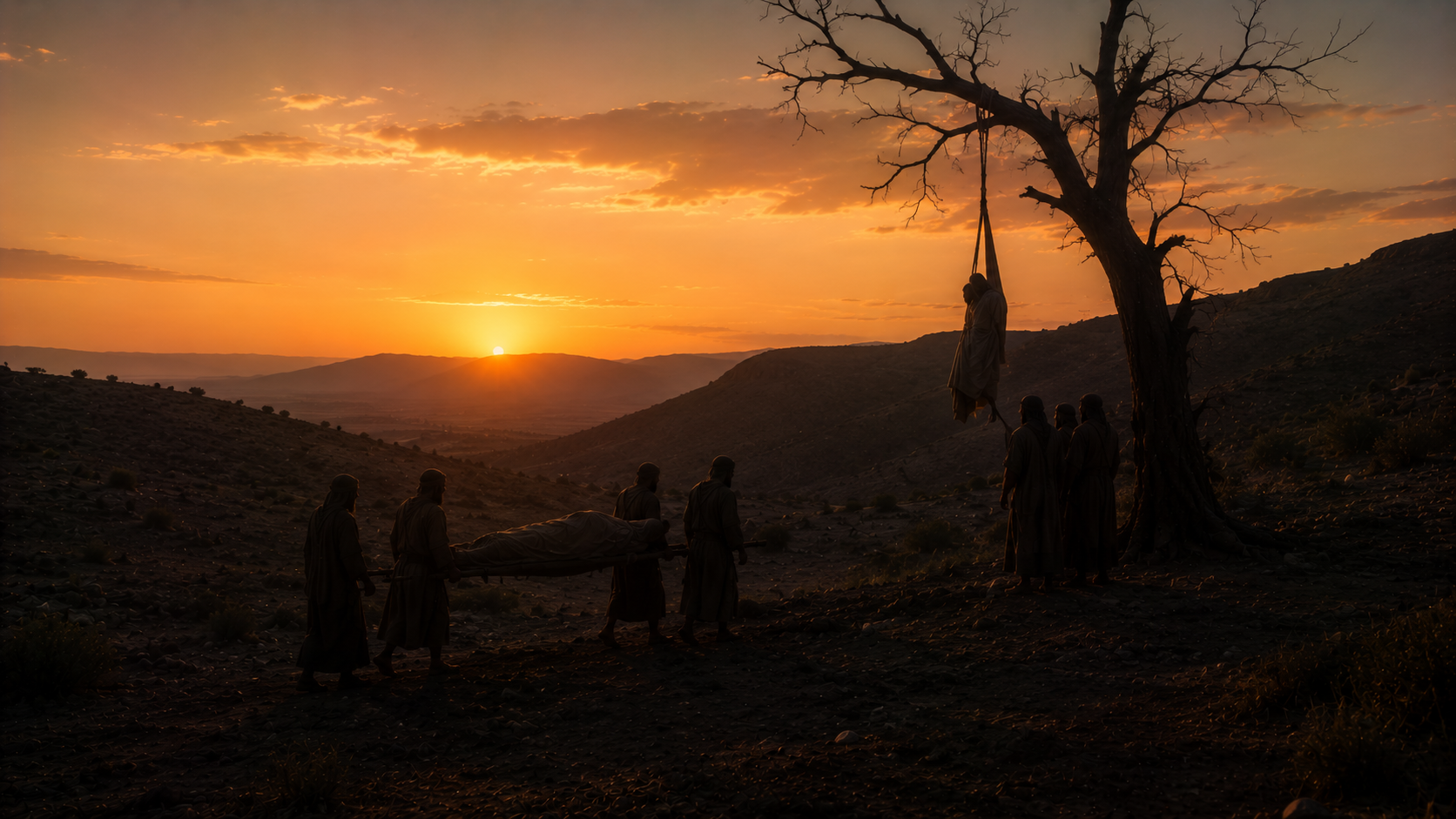
¹⁸ If a man has a stubborn and rebellious son who will not obey the voice of his father or the voice of his mother, and though they chasten him, will not listen to them, ¹⁹ then his father and his mother shall take hold of him and bring him out to the elders of his city and to the gate of his place. ²⁰ They shall tell the elders of his city, “This our son is stubborn and rebellious. He will not obey our voice. He is a glutton and a drunkard.” ²¹ All the men of his city shall stone him to death with stones. So you shall remove the evil from among you. All Israel shall hear, and fear. ²² If a man has committed a sin worthy of death, and he is put to death, and you hang him on a tree, ²³ his body shall not remain all night on the tree, but you shall surely bury him the same day; for he who is hanged is accursed of God. Don’t defile your land which Yahweh your God gives you for an inheritance. (Deuteronomy 21:18–23, World English Bible)
- A stubborn and rebellious son… all the men of his city shall stone him (verses 18-21). This is among the most disturbing laws in the Torah, and it should not be smoothed over. Two things frame it. First, even here the parents cannot act alone, the case goes to the elders and the whole community, removing it from private rage; this is the opposite of honor-killing. Second, the later Jewish tradition surrounded the law with so many conditions (both parents must agree, the son must be a precise age, the evidence exacting) that the rabbis concluded it had never been carried out and never would be (“there never was a ‘stubborn and rebellious son’ and never will be,” Sanhedrin 71a), reading it as a deterrent teaching about the gravity of a life given over to gluttony and rebellion rather than a statute to enforce. The law’s blunt severity is meant to make a community feel the deadly seriousness of a heart that will not be led, the same “stiff neck” the whole book diagnoses (9:6).
Influence callout: “cursed is everyone who hangs on a tree” (21:23 → Galatians 3:13)
Verses 22-23 are, on the surface, a law about dignity in death: an executed criminal’s body must not be left hanging overnight but buried the same day, because he who is hanged is accursed of God and an unburied corpse defiles the land. Even the condemned retains a basic dignity; even judgment has a limit. But this verse became one of the hinges of the gospel. Paul, in Galatians 3:13, quotes it directly: “Christ redeemed us from the curse of the law, having become a curse for us. For it is written, ‘Cursed is everyone who hangs on a tree.’” Jesus was crucified, hung on a tree, and Paul reads Deuteronomy 21:23 as the very Scripture the cross fulfills: the Messiah voluntarily took on himself the covenant curse that the law pronounces, absorbing it so that the blessing of Abraham could flow to the nations (see the cruciform hermeneutic). And the detail that the body must come down the same day is no accident either, it is why Jesus’ body was taken from the cross before nightfall (John 19:31). The law that closes this chapter about innocent blood and accursed death points straight to the One who became the curse to end it.
Reflection prompts
- An unsolved death was no one’s fault, yet the nearest community still had to grieve it and seek cleansing for innocent blood. Where are you tempted to shrug off violence or suffering “in your midst” because no single person is to blame? What would corporate responsibility look like?
- The captive-woman law bent an ugly practice toward mercy one brake at a time, dignity, time to grieve, protection from being discarded. Where might God be calling you to restrain a harm you can’t instantly abolish, bending a bad situation toward mercy rather than doing nothing?
- Christ “became a curse for us” by hanging on the tree this chapter describes. Sit with that exchange: the curse you and I earned, absorbed by him. What does it stir to know the worst verdict has already fallen on the One who loves you?
Frameworks at play in this chapter: the cry of the oppressed, the firstborn / bechor, holy war and herem, the cruciform hermeneutic.