
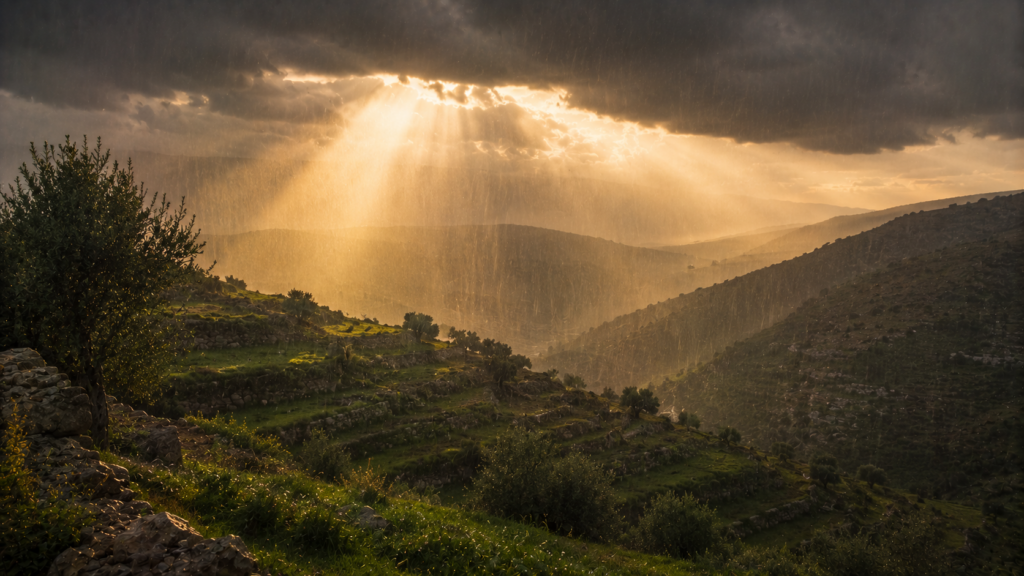
Chapter 11 is the closing crescendo of the great sermon that began with the Shema (chapters 6 to 11). Moses gathers up his three themes, love, remember, choose, and presses them home one last time before the law code proper begins in chapter 12. The pivot of the chapter is a piece of geography turned into theology: the land Israel is entering is not like Egypt. Egypt waters itself from the Nile, irrigation you control “with your foot”; Canaan drinks rain from the sky, water no one controls. To live in such a land is to live in daily dependence on heaven, so that rain itself becomes the barometer of the covenant.
The chapter restates the Shema’s command to bind and teach the words (the very paragraph Jews still recite daily after Deuteronomy 6:4-9), and then ends by staging the whole covenant as a stark, public choice: a blessing and a curse, to be proclaimed across a valley from two facing mountains. It is the two ways made into a landscape, life on one slope, death on the other, and Israel told to choose.
A · Deuteronomy 11:1-12 · Love and remember: a land that drinks rain from heaven
¹ Therefore you shall love Yahweh your God, and keep his instructions, his statutes, his ordinances, and his commandments, always. ² Know this day—for I don’t speak with your children who have not known, and who have not seen the chastisement of Yahweh your God, his greatness, his mighty hand, his outstretched arm, ³ his signs, and his works, which he did in the middle of Egypt to Pharaoh the king of Egypt, and to all his land; ⁴ and what he did to the army of Egypt, to their horses, and to their chariots; how he made the water of the Red Sea to overflow them as they pursued you, and how Yahweh has destroyed them to this day; ⁵ and what he did to you in the wilderness until you came to this place; ⁶ and what he did to Dathan and Abiram, the sons of Eliab, the son of Reuben—how the earth opened its mouth and swallowed them up, with their households, their tents, and every living thing that followed them, in the middle of all Israel; ⁷ but your eyes have seen all of Yahweh’s great work which he did. ⁸ Therefore you shall keep the entire commandment which I command you today, that you may be strong, and go in and possess the land that you go over to possess; ⁹ and that you may prolong your days in the land which Yahweh swore to your fathers to give to them and to their offspring, a land flowing with milk and honey. ¹⁰ For the land, where you go in to possess isn’t like the land of Egypt that you came out of, where you sowed your seed and watered it with your foot, as a garden of herbs; ¹¹ but the land that you go over to possess is a land of hills and valleys which drinks water from the rain of the sky, ¹² a land which Yahweh your God cares for. Yahweh your God’s eyes are always on it, from the beginning of the year even to the end of the year. (Deuteronomy 11:1–12, World English Bible)
- Your eyes have seen all of Yahweh’s great work (verses 1-7). Moses again leans on memory, but with a candid aside: he is speaking to the adults who saw (the plagues, the sea, the swallowing of Dathan and Abiram), not to the children who only heard. Faith built on what you have witnessed must now be handed to those who weren’t there, which is the whole anxiety, and project, of the book.
- Not like the land of Egypt… but a land which drinks water from the rain of the sky (verses 10-12). The contrast is doing theological work. Egypt’s agriculture ran on the predictable Nile, watered “with your foot” (treadle irrigation), a system you manage yourself. Canaan depends on rain, which falls from a heaven no farmer controls. So the Promised Land is, by design, a land that keeps Israel looking up. Verse 12 is tender: it is a land which Yahweh your God cares for, his eyes always on it. Dependence is not a bug of the gift; it is the point of it.
B · Deuteronomy 11:13-21 · Rain for obedience, and the words bound to heart and home
¹³ It shall happen, if you shall listen diligently to my commandments which I command you today, to love Yahweh your God, and to serve him with all your heart and with all your soul, ¹⁴ that I will give the rain for your land in its season, the early rain and the latter rain, that you may gather in your grain, your new wine, and your oil. ¹⁵ I will give grass in your fields for your livestock, and you shall eat and be full. ¹⁶ Be careful, lest your heart be deceived, and you turn away to serve other gods and worship them; ¹⁷ and Yahweh’s anger be kindled against you, and he shut up the sky so that there is no rain, and the land doesn’t yield its fruit; and you perish quickly from off the good land which Yahweh gives you. ¹⁸ Therefore you shall lay up these words of mine in your heart and in your soul. You shall bind them for a sign on your hand, and they shall be for frontlets between your eyes. ¹⁹ You shall teach them to your children, talking of them when you sit in your house, when you walk by the way, when you lie down, and when you rise up. ²⁰ You shall write them on the door posts of your house and on your gates; ²¹ that your days and your children’s days may be multiplied in the land which Yahweh swore to your fathers to give them, as the days of the heavens above the earth. (Deuteronomy 11:13–21, World English Bible)
- The early rain and the latter rain (verses 13-17). The covenant blessing is spelled out as weather. The early rain (autumn, to soften the ground for plowing) and the latter rain (spring, to swell the grain before harvest) are exactly the two rains a Levantine farmer prays for, and Israel is told they come with covenant love and stop with covenant betrayal. This is the agricultural form of the two ways: the same land that flows with milk and honey can become bronze sky and iron ground. Later prophets and Jesus will deepen this so it is never crude tit-for-tat (rain falls “on the just and the unjust,” Matt 5:45), but the basic grammar stands: a people who forget the Giver eventually starve in the gift.
Influence callout: the second paragraph of the Shema (11:13-21)
Verses 13-21 are not a new command but a near-repeat of 6:4-9, and the repetition is the point. In Jewish practice these verses became the second paragraph of the Shema, recited every morning and evening right after the first (6:4-9), with Numbers 15:37-41 as the third (see the Shema). Again the words must be laid up in the heart, bound on the hand (tefillin), set between the eyes (frontlets), taught to the children, and written on the doorposts (mezuzah). What chapter 6 commanded for the individual heart, chapter 11 reissues for the whole community standing on the threshold. The genius of it is that the creed is engineered to survive: hand it to the children, speak it into the rhythm of the ordinary day, wear it, post it, until forgetting becomes almost impossible. A people is only ever one un-taught generation from amnesia, and this is the antidote.
Word study: yarah, the rain that teaches
11:14 promises Israel “the rain of your land in its season, the yoreh and the malqosh“, the early rain (autumn) and the latter rain (spring). The word for “early rain,” yoreh, comes from the verbal root yarah, “to throw, to shoot, to instruct.” This is also the root of Torah (instruction, teaching). In Hebrew, the rain teaches. In Deuteronomy’s worldview that is not whimsy: a land that drinks rain from heaven (11:11) is a land that cannot survive on its own, every season the people are taught their dependence again by the sky. Torah and yoreh share more than letters: the same God who instructs the people with his word instructs them with the weather. To learn from Torah and to learn from the rain are the same act, two languages of the same instruction. Egypt’s foot-irrigation could make its farmers proud of their own labor; Israel’s rain-fed terraces could only ever make them grateful, or anxious. The pun is the theology. Deuteronomy hides a sermon inside the word for autumn shower.
C · Deuteronomy 11:22-32 · A blessing and a curse, set on two mountains
²² For if you shall diligently keep all these commandments which I command you—to do them, to love Yahweh your God, to walk in all his ways, and to cling to him— ²³ then Yahweh will drive out all these nations from before you, and you shall dispossess nations greater and mightier than yourselves. ²⁴ Every place on which the sole of your foot treads shall be yours: from the wilderness and Lebanon, from the river, the river Euphrates, even to the western sea shall be your border. ²⁵ No man will be able to stand before you. Yahweh your God will lay the fear of you and the dread of you on all the land that you tread on, as he has spoken to you. ²⁶ Behold, I set before you today a blessing and a curse: ²⁷ the blessing, if you listen to the commandments of Yahweh your God, which I command you today; ²⁸ and the curse, if you do not listen to the commandments of Yahweh your God, but turn away out of the way which I command you today, to go after other gods which you have not known. ²⁹ It shall happen, when Yahweh your God brings you into the land that you go to possess, that you shall set the blessing on Mount Gerizim, and the curse on Mount Ebal. ³⁰ Aren’t they beyond the Jordan, behind the way of the going down of the sun, in the land of the Canaanites who dwell in the Arabah near Gilgal, beside the oaks of Moreh? ³¹ For you are to pass over the Jordan to go in to possess the land which Yahweh your God gives you, and you shall possess it and dwell in it. ³² You shall observe to do all the statutes and the ordinances which I set before you today. (Deuteronomy 11:22–32, World English Bible)
- To love Yahweh your God, to walk in all his ways, and to cling to him (verses 22-25). The covenant verbs stack up, and the last one is intimate: cling (dabaq), the same word used for a husband and wife becoming “one flesh” (Gen 2:24). To keep the commandments is, finally, to hold on to God himself, not merely to follow rules but to stay attached to a person.
Influence callout: the blessing and the curse, set before you (the two ways)
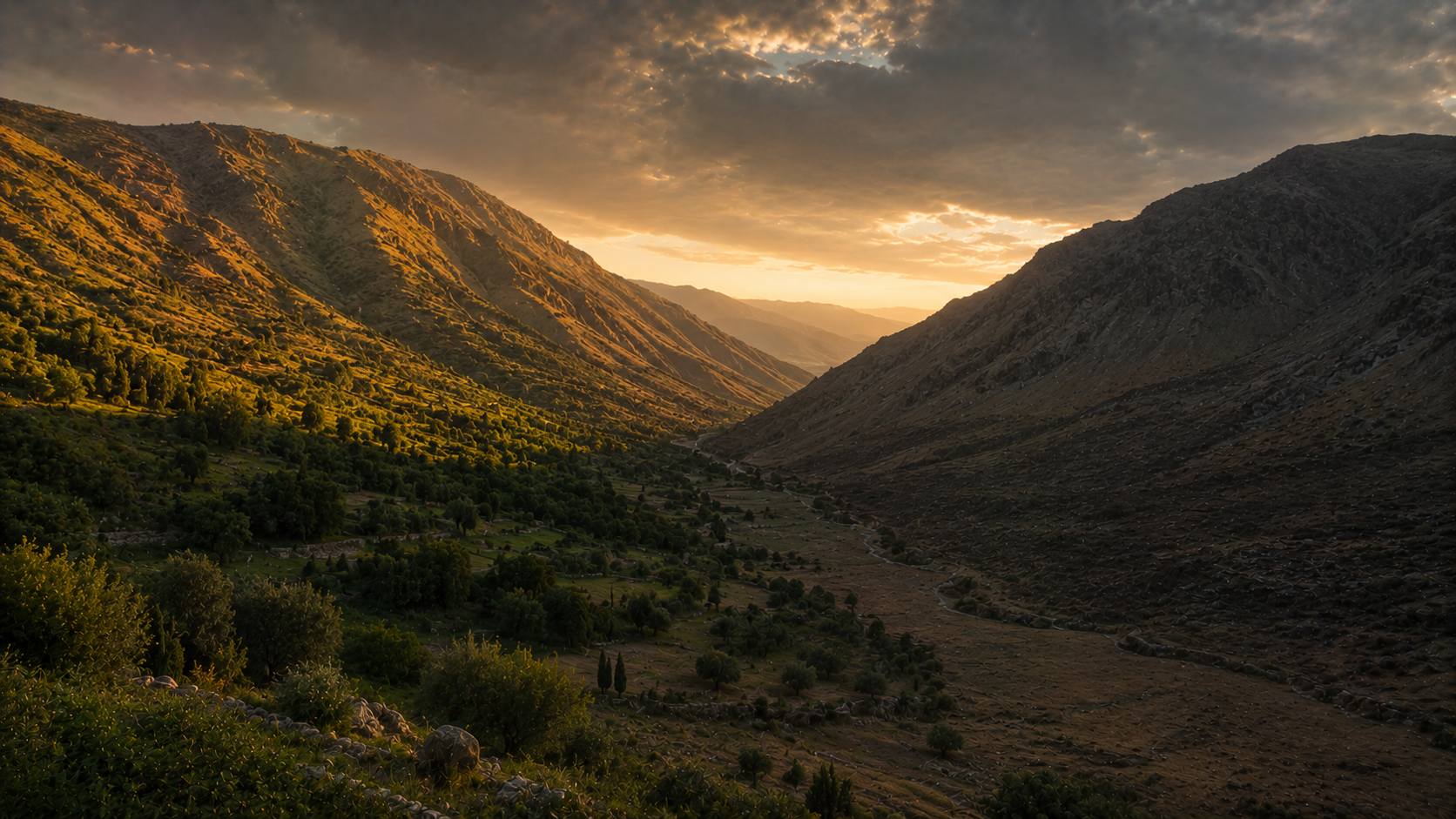
Verses 26-28 give the book one of its defining images: I set before you today a blessing and a curse. The translations all keep its directness, NLT even frames it as “the choice between a blessing and a curse.” This is the two ways framework in its purest covenant form, two paths, two outcomes, and a people summoned to choose, the structure that runs forward through Psalm 1 to Jesus’ two roads, two builders, and two trees in the Sermon on the Mount (Matt 7), and on into the early church’s Didache. And Deuteronomy makes it theater: the blessing is to be shouted from Mount Gerizim and the curse from Mount Ebal, two peaks facing each other across the valley at Shechem (the ceremony is carried out in Joshua 8:30-35). Stand in that valley and you are literally between the two ways, the green slope and the barren one, hearing both. The choice is not abstract; it is the ground under your feet. Chapter 30 will return to it and name what Israel should choose: therefore choose life (30:19).
- Set the blessing on Mount Gerizim, and the curse on Mount Ebal (verses 29-32). The sermon ends by pointing across the river to the very place the choice will be ratified, and then hands off to the law code: you shall observe to do all the statutes and the ordinances which I set before you today. The preaching is done; the stipulations begin in chapter 12.
Reflection prompts
- Canaan was a land that drinks rain from heaven, designed to keep Israel dependent and looking up, unlike self-watered Egypt. Where in your life have you engineered an “Egypt”, a system you fully control, precisely to avoid the vulnerability of depending on God?
- The Shema’s words were to be bound, taught, and posted until forgetting became almost impossible. What are the actual practices, repeated and physical, that keep faith alive in your home and not just in your head?
- Moses set a blessing and a curse before the people and staged it on two facing mountains so the choice would be unavoidable. Where are you treating as vague and far-off a choice that Scripture frames as immediate and clear, today?
Frameworks at play in this chapter: two ways, the Shema, Torah as gift.