
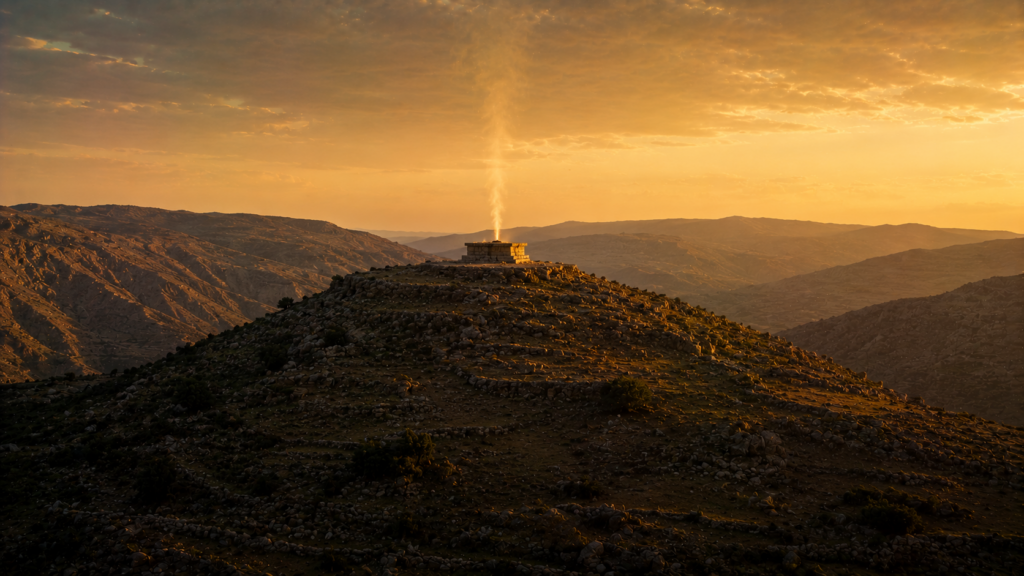
With chapter 12 the law code proper begins, and it opens with the single law that will organize everything after it: there is to be one place of worship. Israel must surely destroy the Canaanite shrines scattered “on the high mountains, and on the hills, and under every green tree,” and instead bring its worship to the place which Yahweh your God shall choose… to put his name there. The scattered, local, do-it-yourself religion of Canaan is to be replaced by one altar, one sanctuary, one name (see the place YHWH will choose).
The reasons are bound up with the whole sermon. Centralization guards exclusive loyalty (the cultic side of the Shema), and it protects Israel from a worship that was not morally neutral, Canaanite religion included burning children in the fire (12:31). Yet the chapter is anything but grim. Its refrain is joy, “you shall rejoice before Yahweh your God,” and it makes a generous concession (you may eat meat in your own towns) hedged by one absolute line that runs to the heart of the Bible’s theology of sacrifice: never eat the blood, for the blood is the life.
A · Deuteronomy 12:1-14 · One place, one altar: tear down theirs, seek his
¹ These are the statutes and the ordinances which you shall observe to do in the land which Yahweh, the God of your fathers, has given you to possess all the days that you live on the earth. ² You shall surely destroy all the places in which the nations that you shall dispossess served their gods: on the high mountains, and on the hills, and under every green tree. ³ You shall break down their altars, dash their pillars in pieces, and burn their Asherah poles with fire. You shall cut down the engraved images of their gods. You shall destroy their name out of that place. ⁴ You shall not do so to Yahweh your God. ⁵ But to the place which Yahweh your God shall choose out of all your tribes, to put his name there, you shall seek his habitation, and you shall come there. ⁶ You shall bring your burnt offerings, your sacrifices, your tithes, the wave offering of your hand, your vows, your free will offerings, and the firstborn of your herd and of your flock there. ⁷ There you shall eat before Yahweh your God, and you shall rejoice in all that you put your hand to, you and your households, in which Yahweh your God has blessed you. ⁸ You shall not do all the things that we do here today, every man whatever is right in his own eyes; ⁹ for you haven’t yet come to the rest and to the inheritance which Yahweh your God gives you. ¹⁰ But when you go over the Jordan and dwell in the land which Yahweh your God causes you to inherit, and he gives you rest from all your enemies around you, so that you dwell in safety, ¹¹ then it shall happen that to the place which Yahweh your God shall choose, to cause his name to dwell there, there you shall bring all that I command you: your burnt offerings, your sacrifices, your tithes, the wave offering of your hand, and all your choice vows which you vow to Yahweh. ¹² You shall rejoice before Yahweh your God—you, and your sons, your daughters, your male servants, your female servants, and the Levite who is within your gates, because he has no portion nor inheritance with you. ¹³ Be careful that you don’t offer your burnt offerings in every place that you see; ¹⁴ but in the place which Yahweh chooses in one of your tribes, there you shall offer your burnt offerings, and there you shall do all that I command you. (Deuteronomy 12:1–14, World English Bible)
- You shall surely destroy all the places… but to the place which Yahweh your God shall choose (verses 1-5). The contrast is total. The Canaanite sanctuaries are plural and scattered, one on every hilltop and under every leafy tree; YHWH’s worship is to be singular and chosen. Israel does not get to pick where God is worshiped; God chooses the place and puts his name there.
Influence callout: “the place… to put his name there” (the central sanctuary)
Verse 5 introduces the phrase that will echo through the rest of the book and the whole Deuteronomistic History: the place which Yahweh your God shall choose… to put his name there (see the place YHWH will choose). Notably, Deuteronomy never names the place, the openness leaves room for the story to find Shiloh, then Jerusalem. The translations render the “name” idiom variously, to put his name there for his dwelling (CSB), to establish His name there for His dwelling (NASB), the place where his name will be honored (NLT). Moshe Weinfeld read “to cause his name to dwell” as a careful theology of presence: God himself is enthroned in heaven (1 Kings 8:27), and it is his Name that dwells in the sanctuary, guarding both nearness and transcendence. Sandra Richter argues the phrase is an ancient idiom for claiming ownership (planting one’s name, like a king’s victory monument). Either way, the single sanctuary is the cultic outworking of the Shema: one God, worshiped in one place, in one way, by an undivided people. The trajectory runs to Jesus, the temple where God’s name finally dwells (John 2:19-21), and to worship “in spirit and truth” no longer bound to one mountain (John 4:21-24).
- Every man whatever is right in his own eyes… you shall rejoice before Yahweh (verses 8-14). Two notes set the tone of the whole code. First, the warning against everyone doing what is right in his own eyes (verse 8), the phrase that will become the verdict on the chaos of Judges; worship is not freelance. Second, the recurring command to rejoice: the centralized worship is not a somber duty but a festival, you, and your sons, your daughters, your servants, and the Levite, all included in the joy. Even the landless Levite is folded into the celebration.
Influence callout: Bernard Levinson on Deut 12 as legal revision
Levinson’s Deuteronomy and the Hermeneutics of Legal Innovation (1997) argues that the central law code of Deuteronomy is not a stand-alone production but a deliberate, programmatic re-reading of the older Exodus law code (the “Covenant Code,” Exod 20:22-23:33). Chapter 12 is the showpiece. Exodus 20:24 had said: “An altar of earth you shall make for me… in every place where I cause my name to be remembered, I will come to you and bless you.” Many places, many altars. Deuteronomy 12 keeps the phrase, “the place where Yahweh chooses to put his name”, but inverts what it means: one place, one altar, anywhere else forbidden. Levinson reads this as Deuteronomy’s hermeneutic of lemma: quote the older law’s distinctive language, then reframe its meaning by surrounding it with new sentences. The older text is preserved and changed. It is the same move the New Testament will make on the Hebrew Bible (the Sermon on the Mount’s “you have heard it said… but I say to you”; Paul’s reworking of Habakkuk and Genesis 15). Deut 12 is one of the Bible’s clearest in-house demonstrations that scripture re-reads scripture, that the canon develops not by replacement but by quotation and reframing. The bones of how the gospel will later read the Torah are visible already in how the Torah reads itself.
B · Deuteronomy 12:15-28 · Meat in your towns, blood poured out, worship at the place
¹⁵ Yet you may kill and eat meat within all your gates, after all the desire of your soul, according to Yahweh your God’s blessing which he has given you. The unclean and the clean may eat of it, as of the gazelle and the deer. ¹⁶ Only you shall not eat the blood. You shall pour it out on the earth like water. ¹⁷ You may not eat within your gates the tithe of your grain, or of your new wine, or of your oil, or the firstborn of your herd or of your flock, nor any of your vows which you vow, nor your free will offerings, nor the wave offering of your hand; ¹⁸ but you shall eat them before Yahweh your God in the place which Yahweh your God shall choose: you, your son, your daughter, your male servant, your female servant, and the Levite who is within your gates. You shall rejoice before Yahweh your God in all that you put your hand to. ¹⁹ Be careful that you don’t forsake the Levite as long as you live in your land. ²⁰ When Yahweh your God enlarges your border, as he has promised you, and you say, “I want to eat meat,” because your soul desires to eat meat, you may eat meat, after all the desire of your soul. ²¹ If the place which Yahweh your God shall choose to put his name is too far from you, then you shall kill of your herd and of your flock, which Yahweh has given you, as I have commanded you; and you may eat within your gates, after all the desire of your soul. ²² Even as the gazelle and as the deer is eaten, so you shall eat of it. The unclean and the clean may eat of it alike. ²³ Only be sure that you don’t eat the blood; for the blood is the life. You shall not eat the life with the meat. ²⁴ You shall not eat it. You shall pour it out on the earth like water. ²⁵ You shall not eat it, that it may go well with you and with your children after you, when you do that which is right in Yahweh’s eyes. ²⁶ Only your holy things which you have, and your vows, you shall take and go to the place which Yahweh shall choose. ²⁷ You shall offer your burnt offerings, the meat and the blood, on Yahweh your God’s altar. The blood of your sacrifices shall be poured out on Yahweh your God’s altar, and you shall eat the meat. ²⁸ Observe and hear all these words which I command you, that it may go well with you and with your children after you forever, when you do that which is good and right in Yahweh your God’s eyes. (Deuteronomy 12:15–28, World English Bible)
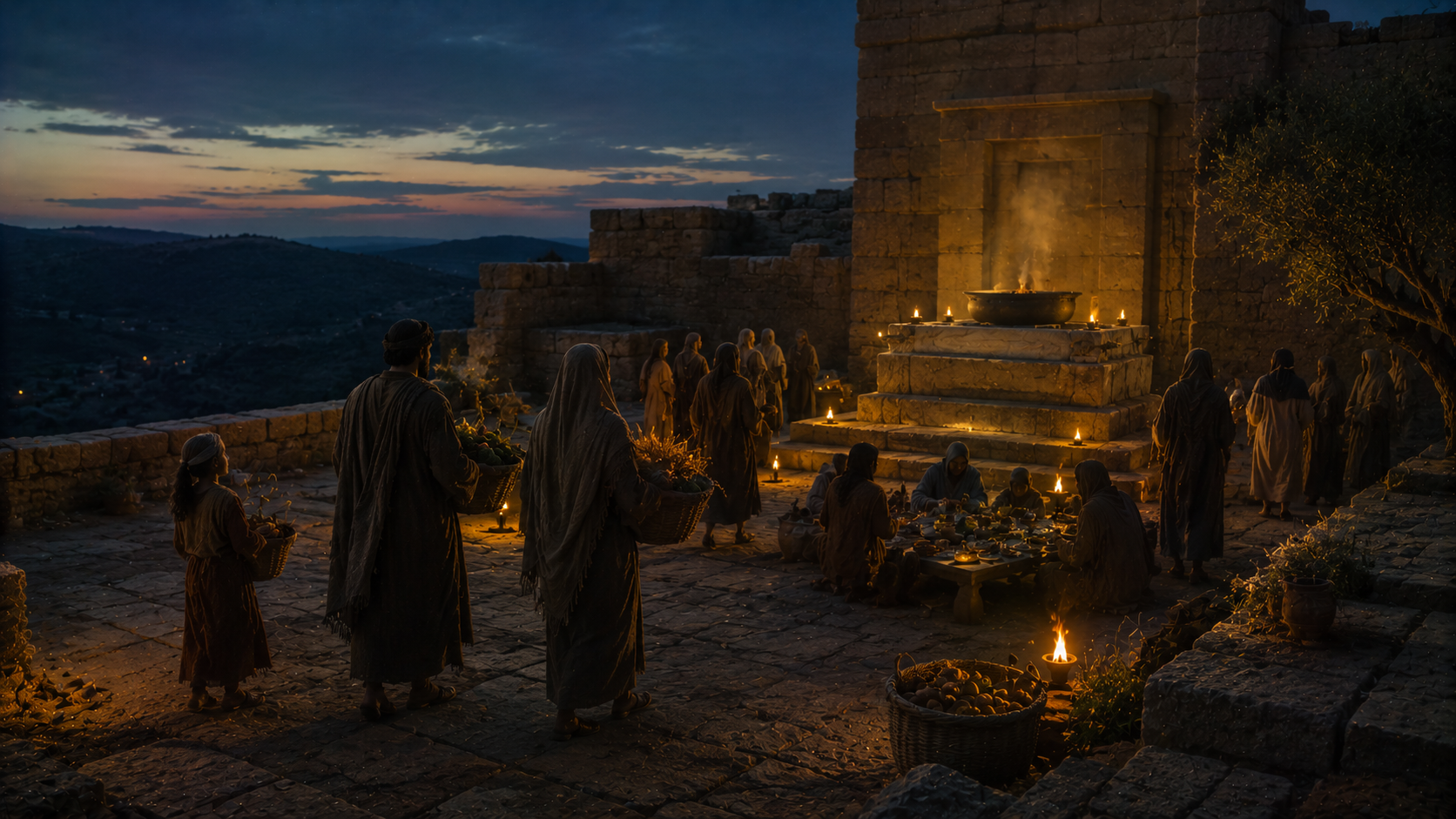
- You may kill and eat meat within all your gates (verses 15-21). Centralization created a practical problem: if all sacrifice must happen at one distant sanctuary, can a family in a far-off town never eat meat? Deuteronomy answers with a humane concession, profane (non-sacrificial) slaughter is permitted anywhere. You may eat meat in your own town whenever you like, treating it like the meat of a hunted gazelle or deer. The law bends toward ordinary life; not every meal is a sacrifice.
- Only you shall not eat the blood; for the blood is the life (verses 16, 23-25). The one absolute limit on this freedom is the blood.
Word study: “the blood is the life” (ki ha-dam hu ha-nephesh, 12:23)
The blood prohibition is older than Israel (it goes back to Noah, Gen 9:4) and runs through the whole Torah, but Deuteronomy gives the reason with unusual clarity: the blood is the life (Hebrew ha-dam hu ha-nephesh, “the blood, it is the life/soul”). To eat the blood would be to consume the life that belongs to God alone, so the blood is poured out on the earth like water, returned to the Giver. This is the same logic that makes blood the means of atonement in Leviticus 17:11 (“the life of the flesh is in the blood… it is the blood that makes atonement”): life, surrendered, covering sin. The thread runs straight to the cross and the table, where Jesus takes the cup and says this is my blood of the covenant, poured out (Mark 14:24). The life poured out, which Israel could never consume, the Messiah gives his people to drink, which is exactly why it was so shocking (John 6:53-56). Reverence for blood-as-life is the deep grammar that makes the gospel’s central image legible.
- That it may go well with you and with your children (verses 25-28). Twice the blood law is tied to that it may go well with you and with your children after you. Even this stark prohibition is framed as a gift, a boundary set for the flourishing of generations, not an arbitrary taboo.
C · Deuteronomy 12:29-32 · Don’t ask how the nations served their gods
²⁹ When Yahweh your God cuts off the nations from before you where you go in to dispossess them, and you dispossess them and dwell in their land, ³⁰ be careful that you are not ensnared to follow them after they are destroyed from before you, and that you not inquire after their gods, saying, “How do these nations serve their gods? I will do likewise.” ³¹ You shall not do so to Yahweh your God; for every abomination to Yahweh, which he hates, they have done to their gods; for they even burn their sons and their daughters in the fire to their gods. ³² Whatever thing I command you, that you shall observe to do. You shall not add to it, nor take away from it. (Deuteronomy 12:29–32, World English Bible)
- Don’t inquire after their gods, saying, “How do these nations serve their gods?” (verses 29-30). A subtle warning: the danger is not only outright apostasy but curiosity that drifts into imitation, “I’ll just borrow their methods.” Israel is not to reverse-engineer its worship from the surrounding cultures, because the form of worship is not neutral; how you worship shapes who you become.
- They even burn their sons and their daughters in the fire to their gods (verse 31). Here the chapter names the moral horror lurking behind the bland phrase “the nations’ gods.” Canaanite religion included child sacrifice. This is part of why the whole apparatus, the torn-down high places, the single sanctuary, the absolute lines, exists: not arbitrary religious turf-war but the protection of a people from a worship that consumed its own children. The translations are unflinching, they even burn their sons and daughters in the fire as sacrifices to their gods (NIV). What Deuteronomy is fencing Israel away from is, at its end, the death of children, and the God who “loves the foreigner” and the orphan (10:18) will have none of it.
- You shall not add to it, nor take away from it (verse 32). The chapter closes by guarding the covenant’s integrity (echoing 4:2): the worship God commands is sufficient and not to be edited, neither padded with imported practices nor trimmed to taste.
Reflection prompts
- Canaanite worship was scattered and self-styled, “every man doing what is right in his own eyes”; God called for one place, one way. Where does your own spirituality drift toward “whatever feels right to me,” and what would it mean to let God, rather than your preference, set the terms of worship?
- The blood is the life, too sacred to consume, poured out to God, and yet the Messiah gives his own blood-life for his people to receive. Sit with that reversal: the life you could never take, given to you as gift. What does it stir?
- The chapter warns against curiosity that becomes imitation, “how do they do it? I’ll do likewise.” Where are you tempted to reverse-engineer your life or worship from the surrounding culture without asking whether its forms are shaping you into someone you don’t want to become?
Frameworks at play in this chapter: the place YHWH will choose, bearing God’s name.