
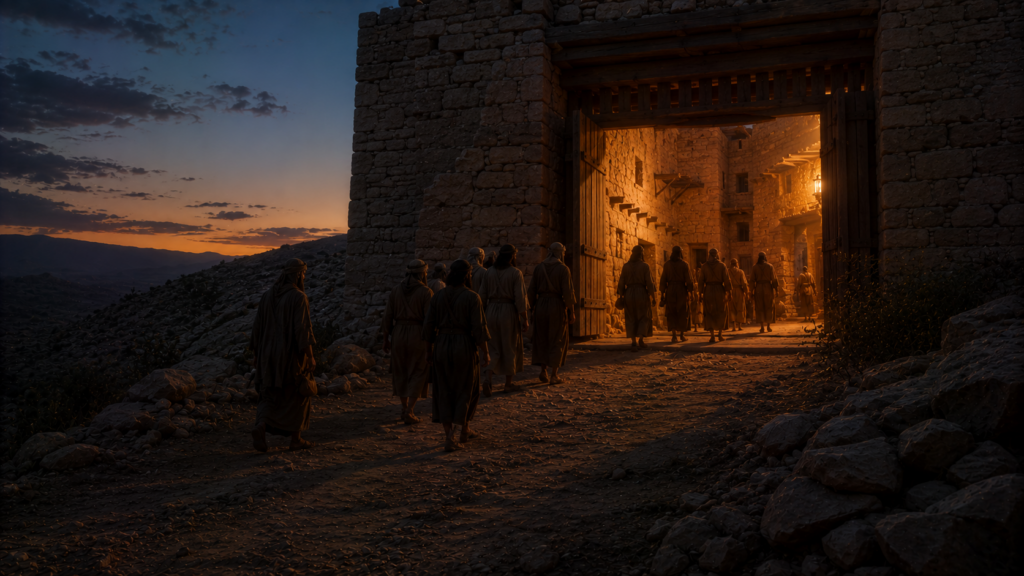
Chapter 23 opens with a list that unsettles modern readers: who may not “enter the assembly of Yahweh”, the emasculated, those of forbidden birth, Ammonites and Moabites (named “forever”), with Edomites and Egyptians admitted after three generations. It then turns to the holiness of the war-camp (down to where you dig the latrine, because Yahweh walks in your camp), and closes with a scatter of social laws, several of them remarkably humane: refuge for a runaway slave, a ban on charging a brother interest, the freedom to eat your fill from a neighbor’s field.
The exclusions feel hard, and they are. But the striking thing is that the Bible itself refuses to leave them as the last word. Isaiah 56 will deliberately overturn this very chapter, promising the eunuch a name better than sons and daughters and the foreigner a place in “a house of prayer for all peoples.” Ruth the Moabite becomes King David’s great-grandmother, and so an ancestor of Jesus. And in Acts 8 an Ethiopian eunuch goes down into the baptismal water rejoicing. The wall Deuteronomy 23 builds is, in the gospel, taken down, and that movement is itself part of how Scripture teaches us to read this chapter (see outside the camp).
A · Deuteronomy 23:1-8 · Who may enter the assembly
¹ He who is emasculated by crushing or cutting shall not enter into Yahweh’s assembly. ² A person born of a forbidden union shall not enter into Yahweh’s assembly; even to the tenth generation shall no one of his enter into Yahweh’s assembly. ³ An Ammonite or a Moabite shall not enter into Yahweh’s assembly; even to the tenth generation shall no one belonging to them enter into Yahweh’s assembly forever, ⁴ because they didn’t meet you with bread and with water on the way when you came out of Egypt, and because they hired against you Balaam the son of Beor from Pethor of Mesopotamia, to curse you. ⁵ Nevertheless Yahweh your God wouldn’t listen to Balaam, but Yahweh your God turned the curse into a blessing to you, because Yahweh your God loved you. ⁶ You shall not seek their peace nor their prosperity all your days forever. ⁷ You shall not abhor an Edomite, for he is your brother. You shall not abhor an Egyptian, because you lived as a foreigner in his land. ⁸ The children of the third generation who are born to them may enter into Yahweh’s assembly. (Deuteronomy 23:1–8, World English Bible)
- Shall not enter into Yahweh’s assembly… but the Edomite and Egyptian… (verses 1-8). “The assembly” (qahal) is the gathered worshiping-and-governing body of Israel, and the chapter sets boundaries on full participation: the ritually-marred, those of irregular birth, and two specific hostile peoples (Ammon and Moab, who refused Israel hospitality and hired Balaam). Yet even here the exclusion is not blanket xenophobia: the Edomite is welcomed “for he is your brother,” and the Egyptian, of all people, is welcomed “because you lived as a foreigner in his land”, memory of having been an outsider softens the boundary. The lines are about specific histories and ritual wholeness in worship, not racial purity.
Influence callout: the wall, and how the gospel takes it down (Isaiah 56, Ruth, Acts 8)
The most important thing about Deuteronomy 23:1-8 is what the rest of Scripture does with it (see outside the camp). The chapter draws a boundary around the worshiping assembly, and then the canon itself begins, deliberately, to move that boundary. Isaiah 56:3-5 takes up the two excluded figures by name: “let not the eunuch say, ‘I am a dry tree,’” for God promises eunuchs who keep his covenant “a name better than sons and daughters,” and the “foreigners who join themselves to Yahweh” he will bring to “my holy mountain… for my house shall be called a house of prayer for all peoples”, a direct reversal of 23:1-3. Ruth, a Moabite, the very nation barred “forever,” becomes the great-grandmother of David and an ancestor of the Messiah (Ruth 4; Matt 1:5). And Acts 8 stages the reversal as gospel: an Ethiopian eunuch, doubly excluded by this chapter, reads Isaiah, hears the good news, and is baptized rejoicing. Paul names what has happened: in Christ “the dividing wall of hostility” is broken down and the far-off are “brought near” (Eph 2:13-14). Deuteronomy 23 is not the Bible’s last word on who belongs; it is the wall the cross removes. The trajectory from this chapter to that baptismal water is the gospel in miniature, the assembly’s doors swinging open to exactly the people who were once kept out.
Word study: qahal, “assembly”
The word at the heart of 23:1-8, qahal Yahweh (“the assembly of the LORD”), is one of the most theologically loaded nouns in the Hebrew Bible. Qahal is more than a crowd; it is the gathered, covenant community, the people assembled for worship, for legal decision, for war, for hearing the word. The list of those excluded from the qahal (mutilated men, certain national lineages) is at first glance harsh, and the prophets and the New Testament will both re-open these doors as the story unfolds (Isaiah 56’s eunuchs with names in the temple; Ruth the Moabite as the great-grandmother of David; the Ethiopian eunuch baptized in Acts 8 reading Isaiah 56). The Greek translators of the LXX rendered qahal with ekklēsia, the same word the New Testament uses for church. That is not a coincidence; it is a continuity. The “qahal of the LORD” of Deut 23 and the “ekklēsia of the LORD” of Acts and the Epistles are the same family of word, and one of the central New Testament moves is to claim that in Christ the ekklēsia‘s boundaries have been graciously widened to include exactly the kinds of people Deut 23 once kept outside (cf. Eph 2:11-22). To know the word qahal is to feel the weight of what the New Testament is doing every time it says church.
B · Deuteronomy 23:9-14 · A holy camp, because God walks in it
⁹ When you go out and camp against your enemies, then you shall keep yourselves from every evil thing. ¹⁰ If there is among you any man who is not clean by reason of that which happens to him by night, then shall he go outside of the camp. He shall not come within the camp; ¹¹ but it shall be, when evening comes, he shall bathe himself in water. When the sun is down, he shall come within the camp. ¹² You shall have a place also outside of the camp where you go relieve yourself. ¹³ You shall have a trowel among your weapons. It shall be, when you relieve yourself, you shall dig with it, and shall turn back and cover your excrement; ¹⁴ for Yahweh your God walks in the middle of your camp, to deliver you, and to give up your enemies before you. Therefore your camp shall be holy, that he may not see an unclean thing in you, and turn away from you. (Deuteronomy 23:9–14, World English Bible)
- You shall have a trowel… for Yahweh your God walks in the middle of your camp (verses 9-14). The most striking thing about this law is its reason. Even the placement of the latrine and the burying of waste is regulated, not for hygiene as such, but because God himself walks in the camp (see outside the camp). The presence of the holy God among the people makes the whole camp sacred space, and so even the most mundane bodily realities are handled with reverence. There is no zone of life cordoned off from God’s nearness; the soldier with his trowel is living in the presence of the One who “walks in the middle of the camp.” It is a remarkable dignifying of ordinary life, and a sober reminder that holiness is comprehensive, reaching all the way down to the most humble human acts.
C · Deuteronomy 23:15-25 · Refuge, fair lending, and a neighbor’s field
¹⁵ You shall not deliver to his master a servant who has escaped from his master to you. ¹⁶ He shall dwell with you, among you, in the place which he shall choose within one of your gates, where it pleases him best. You shall not oppress him. ¹⁷ There shall be no prostitute of the daughters of Israel, neither shall there be a sodomite of the sons of Israel. ¹⁸ You shall not bring the hire of a prostitute, or the wages of a male prostitute, into the house of Yahweh your God for any vow; for both of these are an abomination to Yahweh your God. ¹⁹ You shall not lend on interest to your brother: interest of money, interest of food, interest of anything that is lent on interest. ²⁰ You may charge a foreigner interest; but you shall not charge your brother interest, that Yahweh your God may bless you in all that you put your hand to, in the land where you go in to possess it. ²¹ When you vow a vow to Yahweh your God, you shall not be slack to pay it, for Yahweh your God will surely require it of you; and it would be sin in you. ²² But if you refrain from making a vow, it shall be no sin in you. ²³ You shall observe and do that which has gone out of your lips. Whatever you have vowed to Yahweh your God as a free will offering, which you have promised with your mouth, you must do. ²⁴ When you come into your neighbor’s vineyard, then you may eat your fill of grapes at your own pleasure; but you shall not put any in your container. ²⁵ When you come into your neighbor’s standing grain, then you may pluck the ears with your hand; but you shall not use a sickle on your neighbor’s standing grain. (Deuteronomy 23:15–25, World English Bible)
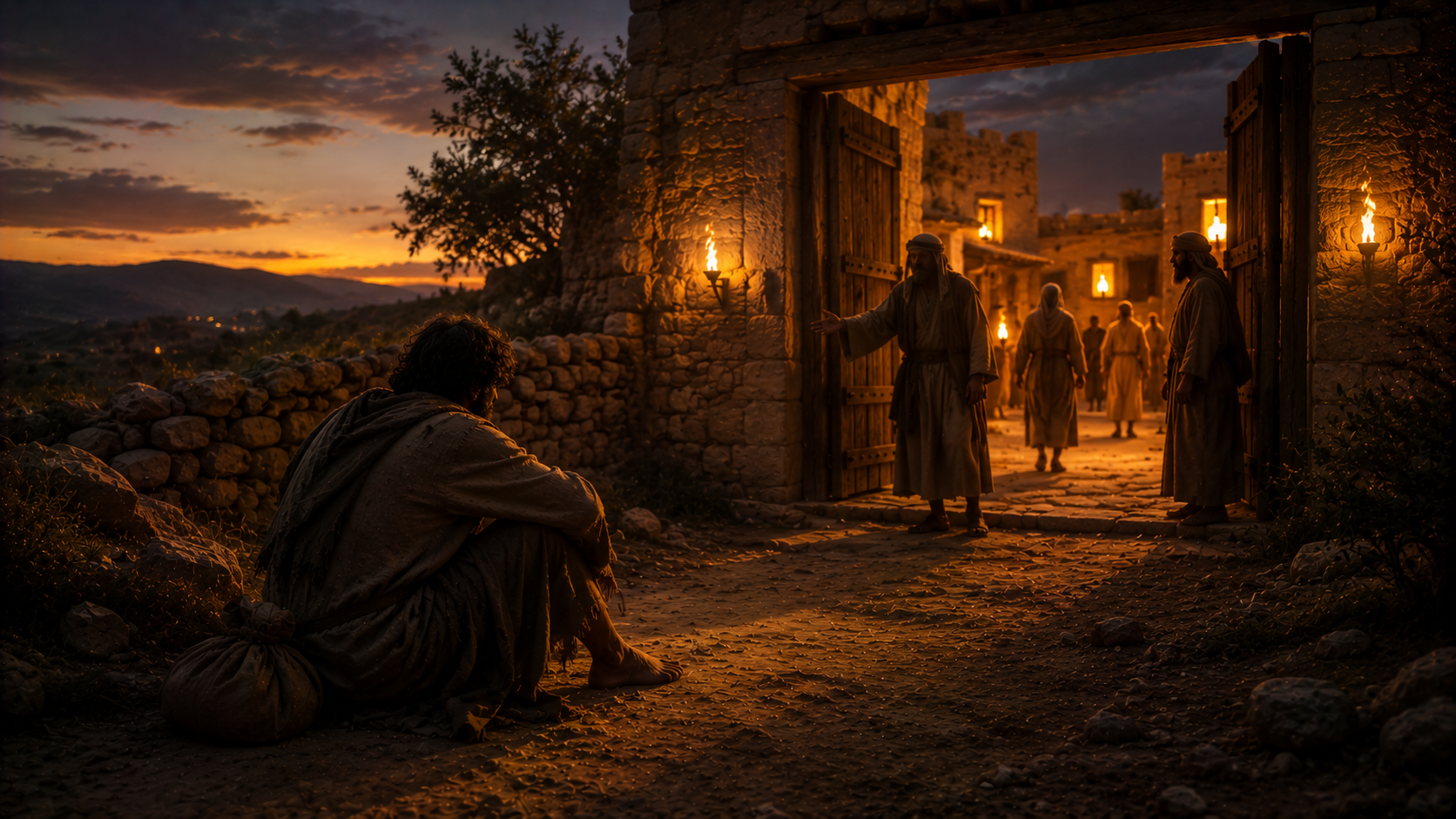
- You shall not deliver… a servant who has escaped… you shall not oppress him (verses 15-16). This is one of the most counter-cultural laws in the ancient world. Every surrounding legal code (Hammurabi, the Hittites) required returning a runaway slave and punished those who harbored one; international treaties had extradition clauses for escaped slaves. Deuteronomy commands the opposite: a slave who flees to Israel is not to be handed back. He may settle wherever he chooses, and “you shall not oppress him.” A nation born in escape from slavery becomes, by law, a sanctuary for the escaping slave (see the cry of the oppressed). It is the exodus turned into immigration policy.
- No cult prostitution… no interest to your brother (verses 17-20). Two more guards on the community’s life. The ban on the qadesh/qedeshah (verses 17-18) targets the sacred prostitution woven into Canaanite fertility religion, money earned that way may never fund a vow, worship cannot be financed by exploitation. And the ban on charging interest to a fellow Israelite (verses 19-20) protects the poor from debt-spirals: within the covenant family, lending is mercy, not a profit center (the same impulse as the seventh-year release of chapter 15). You may transact with outsiders at interest, but you do not get rich off your struggling brother’s need.
- Keep your vows… eat your fill in a neighbor’s field (verses 21-25). Two final notes round out the chapter. Be careful with vows, better not to vow than to vow and not pay (a wisdom Jesus deepens into “let your yes be yes,” Matt 5:37, and Ecclesiastes echoes, Eccl 5:4-5). And a charming provision: a hungry traveler may eat his fill of a neighbor’s grapes or grain by hand, just not harvest it into a container. Generosity is built into property itself; the land’s bounty is meant to feed the passerby, not only its owner. (This is the very law Jesus’ disciples invoke when they pluck grain on the Sabbath, Matt 12:1.)
Pushback note: Deut 23:15-16, runaway slaves, and the antebellum reading
23:15-16 reads: “You shall not deliver to his master a servant who has escaped from his master to you. He shall dwell with you, among you, in the place which he shall choose within one of your gates, where it pleases him best. You shall not oppress him.” This is one of the most striking laws in the ANE world. Most law codes of the time (Hammurabi, the Hittite Laws, Middle Assyrian Laws) required the return of fugitive slaves, with severe penalties for harboring them. Deuteronomy commands the opposite: not only do not return the runaway, let him live where he chooses, do not oppress him. The chapter quietly subverts the entire ANE legal logic of slavery: a fleeing slave is to be received and settled. The antebellum American South had Deut 23:15-16 in its Bibles. So did the abolitionists. The defenders of the Fugitive Slave Act (which required Northern citizens to return escaped slaves to their Southern masters under federal penalty, 1850) had to twist the text past recognition, often arguing it applied only to Israelite slaves escaping foreign masters (the text gives no such limit) or that “this place” meant outside the United States. The abolitionists, especially Frederick Douglass and the Quaker conductors of the Underground Railroad, cited this very passage to argue that biblical fidelity required defying federal law and harboring the fugitive. Antebellum white Southern evangelicalism’s tortured exegesis of Deut 23 is one of the cleanest historical examples of how a politically captured church can rewrite its own scriptures to legitimize what those scriptures plainly forbid. Naming that out loud is not anti-American or anti-evangelical; it is simply faithful exegesis. The text says: do not return the runaway. Let him live where he chooses. Do not oppress him. The faithful reading of those sentences puts the church on a particular side of certain questions whether the church wants to be there or not.
Reflection prompts
- Deuteronomy 23 draws a wall around the assembly, and the gospel deliberately takes it down, welcoming the eunuch, the foreigner, the Moabite. Who do you quietly assume is “outside,” and how does the trajectory toward Isaiah 56 and the Ethiopian eunuch challenge that assumption?
- The camp was holy because God walks in its middle, all the way down to where you dig the latrine. Is there a zone of your life you treat as cordoned off from God’s presence, too mundane, too private, to matter? What changes if he “walks in the middle” of even that?
- A nation freed from slavery became a sanctuary that would not return the runaway. Where might your own experience of being rescued call you to offer refuge rather than send someone back to their bondage?
Frameworks at play in this chapter: outside the camp, the cry of the oppressed, clean and unclean.