

Chapter 24 is a string of seemingly unrelated laws held together by a single, steady concern: the dignity and survival of people who can easily be crushed, the divorced woman, the debtor, the day-laborer, the foreigner, the orphan, the widow. It opens with the famous certificate of divorce (a regulation of divorce, not an endorsement of it, the text Jesus will later reinterpret), and then moves through a remarkable run of protections for the poor: do not seize a man’s millstone or his cloak, do not humiliate a debtor in his own home, pay the wage-worker before the sun goes down. It closes with the gleaning laws that deliberately leave the edges of every harvest for those with no field of their own.
The engine running underneath, stated twice (verses 18, 22), is memory: you shall remember that you were a slave in Egypt. A people that keeps its own poverty and bondage in view legislates tenderly for the poor and the bound. This is Deuteronomy’s “humanism” at its clearest, the recurring motive clauses, the relentless tilt toward the vulnerable (see the cry of the oppressed). Mercy here is not charity offered from above; it is justice owed by people who were once at the bottom themselves.
A · Deuteronomy 24:1-5 · A certificate of divorce, and a year to cheer a wife
¹ When a man takes a wife and marries her, then it shall be, if she finds no favor in his eyes because he has found some unseemly thing in her, that he shall write her a certificate of divorce, put it in her hand, and send her out of his house. ² When she has departed out of his house, she may go and be another man’s wife. ³ If the latter husband hates her, and writes her a certificate of divorce, puts it in her hand, and sends her out of his house; or if the latter husband dies, who took her to be his wife; ⁴ her former husband, who sent her away, may not take her again to be his wife after she is defiled; for that would be an abomination to Yahweh. You shall not cause the land to sin, which Yahweh your God gives you for an inheritance. ⁵ When a man takes a new wife, he shall not go out in the army, neither shall he be assigned any business. He shall be free at home one year, and shall cheer his wife whom he has taken. (Deuteronomy 24:1–5, World English Bible)
- He shall write her a certificate of divorce (verses 1-4). It is easy to misread this as Deuteronomy commanding divorce; it does not. The law assumes divorce already happens and regulates it, requiring a formal written certificate (which actually protected the woman, giving her legal proof of her freedom to remarry) and forbidding a man from taking back a wife he divorced after she has married another. The “some unseemly thing” (verse 1) was famously debated in Jesus’ day, the school of Shammai read it narrowly (sexual immorality), the school of Hillel broadly (almost anything).
Influence callout: Jesus reads Deuteronomy 24 (Matthew 19; Mark 10)
When the Pharisees ask Jesus whether a man may divorce his wife “for any cause,” they are asking him to take a side in the Hillel-Shammai debate over this very verse (Matt 19:3-9; Mark 10:2-12). His answer reframes the whole question. He distinguishes what Moses commanded from what Moses permitted: “Because of your hardness of heart Moses allowed you to divorce your wives, but from the beginning it was not so” (Matt 19:8). Deuteronomy 24, on Jesus’ reading, is not God’s ideal but God’s accommodation to human brokenness, a legal limit placed on a practice that already existed in a fallen world, designed (among other things) to protect the woman from being discarded without recourse. Jesus then points back behind the law of Moses to the creation pattern of Genesis 2, “the two shall become one flesh”, as the deeper truth. This is a crucial lens for reading much of Deuteronomy’s social law: some of it regulates and restrains evils it does not endorse, bending a hard reality toward protection while the deeper will of God waits to be fully revealed. The law cares for the divorced woman; the gospel calls marriage back to its origin. (And verse 5’s tender provision, a newly married man exempt from war and business for a full year simply to “cheer his wife”, shows the same God who regulates divorce also delights in a young marriage’s flourishing.)
B · Deuteronomy 24:6-15 · Never take a person’s livelihood, or their dignity
⁶ No man shall take the mill or the upper millstone as a pledge, for he takes a life in pledge. ⁷ If a man is found stealing any of his brothers of the children of Israel, and he deals with him as a slave, or sells him, then that thief shall die. So you shall remove the evil from among you. ⁸ Be careful in the plague of leprosy, that you observe diligently and do according to all that the Levitical priests teach you. As I commanded them, so you shall observe to do. ⁹ Remember what Yahweh your God did to Miriam, by the way as you came out of Egypt. ¹⁰ When you lend your neighbor any kind of loan, you shall not go into his house to get his pledge. ¹¹ You shall stand outside, and the man to whom you lend shall bring the pledge outside to you. ¹² If he is a poor man, you shall not sleep with his pledge. ¹³ You shall surely restore to him the pledge when the sun goes down, that he may sleep in his garment and bless you. It shall be righteousness to you before Yahweh your God. ¹⁴ You shall not oppress a hired servant who is poor and needy, whether he is one of your brothers or one of the foreigners who are in your land within your gates. ¹⁵ In his day you shall give him his wages, neither shall the sun go down on it, for he is poor and sets his heart on it, lest he cry against you to Yahweh, and it be sin to you. (Deuteronomy 24:6–15, World English Bible)
Influence callout: the dignity of the poor (the pledge and the wage)
Verses 6-15 are a masterclass in protecting people who can be exploited, and what stands out is how the laws guard not just survival but dignity (see the cry of the oppressed). You may not take a millstone in pledge (verse 6), because grinding grain is how a family eats, “he takes a life in pledge”; you cannot collateralize someone’s means of living. You may not enter a debtor’s house to seize the pledge (verses 10-11), the creditor must wait outside while the borrower brings it out, refusing to let the powerful invade the vulnerable’s home and shame them. If a poor man pledges his cloak, you must return it every sundown (verses 12-13), because that cloak is his blanket, “that he may sleep in his garment and bless you”; the lender’s security is overridden nightly by the borrower’s basic need to stay warm. And the day-laborer’s wage must be paid the same day (verses 14-15), “for he is poor and sets his heart on it”, a worker living hand-to-mouth cannot wait for payday, and to withhold his pay is to gamble with his family’s supper. Notice the recurring safeguard: the wronged poor person can cry out to Yahweh, “and it be sin to you” (verse 15). The same divine ear that heard Israel’s groaning in Egypt is tuned to the cry of every exploited worker; God himself is the poor’s collection agency. (James 5:4 makes exactly this point against unpaid laborers, “the wages… which you kept back by fraud cry out.”)
C · Deuteronomy 24:16-22 · Each for his own sin, and the gleanings left behind
¹⁶ The fathers shall not be put to death for the children, neither shall the children be put to death for the fathers. Every man shall be put to death for his own sin. ¹⁷ You shall not deprive the foreigner or the fatherless of justice, nor take a widow’s clothing in pledge; ¹⁸ but you shall remember that you were a slave in Egypt, and Yahweh your God redeemed you there. Therefore I command you to do this thing. ¹⁹ When you reap your harvest in your field, and have forgotten a sheaf in the field, you shall not go again to get it. It shall be for the foreigner, for the fatherless, and for the widow, that Yahweh your God may bless you in all the work of your hands. ²⁰ When you beat your olive tree, you shall not go over the boughs again. It shall be for the foreigner, for the fatherless, and for the widow. ²¹ When you harvest your vineyard, you shall not glean it after yourselves. It shall be for the foreigner, for the fatherless, and for the widow. ²² You shall remember that you were a slave in the land of Egypt. Therefore I command you to do this thing. (Deuteronomy 24:16–22, World English Bible)
- Every man shall be put to death for his own sin (verse 16). A landmark of justice: no vicarious punishment, fathers are not executed for their children’s crimes, nor children for their fathers’. Each person answers for their own guilt. This was not universal in the ancient world (whole families and households were often destroyed for one member’s offense), and Israel’s later history honors it explicitly (2 Kings 14:6 cites this verse), as do the prophets (“the soul who sins shall die,” Ezek 18). Individual moral responsibility is written into the law.
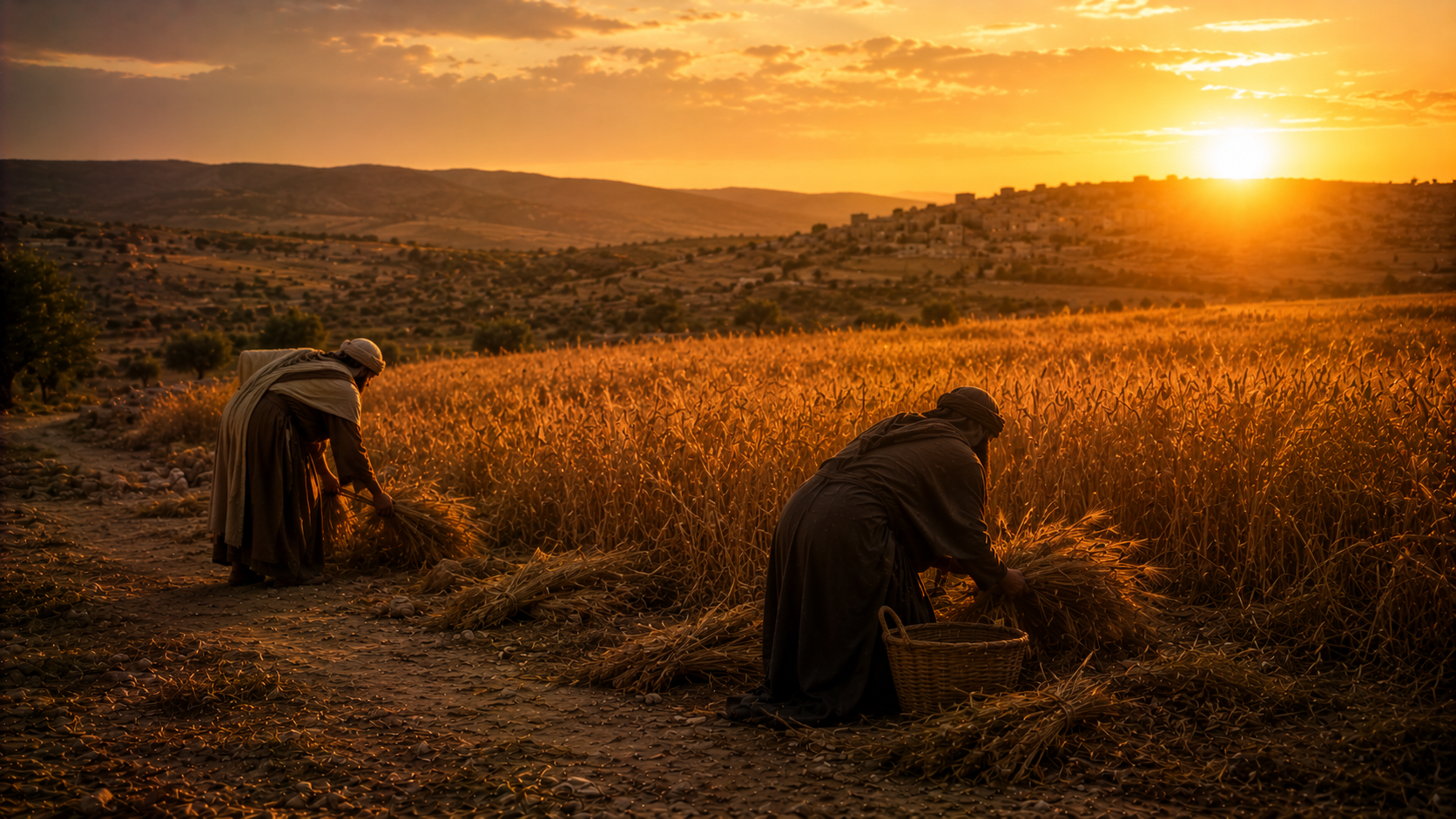
- The forgotten sheaf… shall be for the foreigner, the fatherless, and the widow (verses 17-22). The chapter ends with the gleaning laws, and they are beautiful. When you harvest, you are not to maximize: leave the forgotten sheaf, don’t strip the olive boughs twice, don’t pick the vineyard clean. The leftovers are not waste or generosity-as-afterthought; they are the legal right of the landless, the foreigner, orphan, and widow get to come and gather. It is welfare with dignity, the poor work for their food rather than receiving a handout, and built right into the rhythm of the harvest. This is the very law under which Ruth, a foreign widow, gleans in Boaz’s field and is drawn into the family of David and, ultimately, of Jesus (Ruth 2). And once more the motive: remember that you were a slave in Egypt. A redeemed people leaves the edges of its abundance for those still on the margins, because it remembers being on the margins itself.
Pushback note: the ger / yathom / ‘almanah triad and modern American Christianity
The triad ger / yathom / ‘almanah (foreigner, fatherless, widow) runs through Deuteronomy 24 like a refrain (24:14-15, 17, 19-21) and across the whole book (10:18; 14:29; 16:11, 14; 26:12-13; 27:19). It is not three categories that happen to coincide; it is Israel’s threefold ethical center, the three vulnerabilities that any covenant community is judged by how it treats. The Torah’s repetition is its own commentary: this is the load-bearing list. Modern American Christianity often inverts the triad’s logic and sometimes quietly drops a member of it. Widow is uncontroversial; the church still cares for widows. Fatherless is acceptable as long as the framing is foster care and adoption, both genuinely good. Foreigner is where many American Christians silently drop out. The political bandwidth available for caring for the ger in 21st-century America has narrowed sharply, and not from the side of the text. (Wright is acute on this; Brueggemann is sharper.) A Christianity that recites “religion that is pure and undefiled before God the Father is this: to visit orphans and widows in their distress” (James 1:27, the New Testament’s echo of the Deuteronomic triad, minus the foreigner) and quietly omits the ger even from its own apostles’ summary is not the church Deuteronomy is forming. The triad is not optional weight. The three rise and fall together. Where the ger falls out of the church’s social ethic, the yathom and ‘almanah are usually next.
Reflection prompts
- Jesus read some of Moses’ law as accommodation to “hardness of heart,” a limit on an evil rather than God’s ideal. Where might you be treating a permitted compromise as if it were God’s best, when he is calling you back toward the deeper pattern?
- These laws protect not just the poor’s survival but their dignity, the creditor waits outside, the cloak comes back each night, the wage is paid before supper. Where do your dealings with people who have less power than you guard their dignity, and where might they quietly diminish it?
- The harvest was to be left deliberately incomplete, its edges reserved for the vulnerable to gather. What would it look like to build “gleanings” into your own abundance, margins left on purpose for someone else to gather, rather than maximizing everything for yourself?
Frameworks at play in this chapter: the cry of the oppressed, the Jubilee year.