

Just as Jacob gathered his sons to bless them before he died (Gen 49), so Moses, “the man of God,” blesses the twelve tribes of Israel before his own death. The blessing opens with a soaring theophany, Yahweh coming “from Sinai… from the ten thousands of holy ones,” a king crowned “in Jeshurun”, and then moves tribe by tribe in compact poetic blessings: Levi the teaching priest, Joseph crowned with the horns of the wild ox, Asher dipping his foot in oil. It is a father’s last good word over his children, spoken not in anxiety about their failures (the Song of chapter 32 has already faced those) but in hope for their flourishing.
The chapter’s most enduring gift is its closing comfort, words that have steadied the people of God for three thousand years: “There is none like God… The eternal God is your dwelling place. Underneath are the everlasting arms” (33:26-27). After all the law and all the warning, Moses’ parting word over Israel is not a command but a refuge: your security is not in your performance but in the everlasting arms that hold you. The book that has demanded so much ends its blessing by giving the deepest thing of all, God himself as home.
A · Deuteronomy 33:1-5 · The God who came from Sinai
¹ This is the blessing with which Moses the man of God blessed the children of Israel before his death. ² He said, “Yahweh came from Sinai, and rose from Seir to them. He shone from Mount Paran. He came from the ten thousands of holy ones. At his right hand was a fiery law for them. ³ Yes, he loves the people. All his saints are in your hand. They sat down at your feet. Each receives your words. ⁴ Moses commanded us a law, an inheritance for the assembly of Jacob. ⁵ He was king in Jeshurun, when the heads of the people were gathered, all the tribes of Israel together. (Deuteronomy 33:1–5, World English Bible)
- Yahweh came from Sinai… from the ten thousands of holy ones… he loves the people (verses 1-5). The blessing opens not with the tribes but with God, arriving in blazing theophany “from the ten thousands of holy ones” (the heavenly host of the divine council; see the divine council), with “a fiery law” at his right hand. Yet the towering majesty resolves into intimacy, verse 3: “he loves the people.” The same God who comes with ten thousand holy ones holds his saints “in your hand” and bends to let them “sit at your feet” and receive his words. And the law itself is named not as a burden but as inheritance, “Moses commanded us a law, an inheritance for the assembly of Jacob”, a treasure handed down, not a yoke imposed.
B · Deuteronomy 33:6-25 · The blessing of the tribes
⁶ “Let Reuben live, and not die; Nor let his men be few.” ⁷ This is for Judah. He said, “Hear, Yahweh, the voice of Judah. Bring him in to his people. With his hands he contended for himself. You shall be a help against his adversaries.” ⁸ About Levi he said, “Your Thummim and your Urim are with your godly one, whom you proved at Massah, with whom you contended at the waters of Meribah. ⁹ He said of his father, and of his mother, ‘I have not seen him.’ He didn’t acknowledge his brothers, nor did he know his own children; for they have observed your word, and keep your covenant. ¹⁰ They shall teach Jacob your ordinances, and Israel your law. They shall put incense before you, and whole burnt offering on your altar. ¹¹ Yahweh, bless his skills. Accept the work of his hands. Strike through the hips of those who rise up against him, of those who hate him, that they not rise again.” ¹² About Benjamin he said, “The beloved of Yahweh will dwell in safety by him. He covers him all day long. He dwells between his shoulders.” ¹³ About Joseph he said, “His land is blessed by Yahweh, for the precious things of the heavens, for the dew, for the deep that couches beneath, ¹⁴ for the precious things of the fruits of the sun, for the precious things that the moon can yield, ¹⁵ for the best things of the ancient mountains, for the precious things of the everlasting hills, ¹⁶ for the precious things of the earth and its fullness, the good will of him who lived in the bush. Let this come on the head of Joseph, on the crown of the head of him who was separated from his brothers. ¹⁷ Majesty belongs to the firstborn of his herd. His horns are the horns of the wild ox. With them he will push all the peoples to the ends of the earth. They are the ten thousands of Ephraim. They are the thousands of Manasseh.” ¹⁸ About Zebulun he said, “Rejoice, Zebulun, in your going out; and Issachar, in your tents. ¹⁹ They will call the peoples to the mountain. There they will offer sacrifices of righteousness, for they will draw out the abundance of the seas, the hidden treasures of the sand.” ²⁰ About Gad he said, “He who enlarges Gad is blessed. He dwells as a lioness, and tears the arm and the crown of the head. ²¹ He provided the first part for himself, for the lawgiver’s portion was reserved for him. He came with the heads of the people. He executed the righteousness of Yahweh, His ordinances with Israel.” ²² About Dan he said, “Dan is a lion’s cub that leaps out of Bashan.” ²³ About Naphtali he said, “Naphtali, satisfied with favor, full of Yahweh’s blessing, Possess the west and the south.” ²⁴ About Asher he said, “Asher is blessed with children. Let him be acceptable to his brothers. Let him dip his foot in oil. ²⁵ Your bars will be iron and bronze. As your days, so your strength will be. (Deuteronomy 33:6–25, World English Bible)
- Levi the teacher, Joseph the firstborn (verses 6-25). The tribal blessings repay slow reading, but two stand out. Levi (verses 8-11) is blessed for fierce covenant loyalty (even over family ties, recalling the calf, Ex 32:26-29) and given a vocation: “they shall teach Jacob your ordinances… put incense before you.” The landless priestly tribe (18:1-2) is the teaching tribe, the keeper and explainer of the word. And Joseph (verses 13-17) gets the longest, most lavish blessing, “the precious things of heaven… the everlasting hills”, and is explicitly crowned with firstborn honor: “majesty belongs to the firstborn of his herd; his horns are the horns of the wild ox” (see the firstborn / bechor). Joseph, sold and “separated from his brothers,” receives the double portion of the firstborn (through Ephraim and Manasseh), the displaced one exalted, a pattern the whole Bible loves. The verse on Asher catches the eye too, “as your days, so your strength will be” (verse 25), strength measured out to match each day’s need.
Influence callout: Daniel Block on the tribal blessings as theological geography
Block’s reading of the blessing of Moses in chapter 33 keeps insisting that the order and length and language of each tribal blessing are theological geography, a quiet map of how each tribe will live out the covenant in its place. Reuben (33:6) is named first because he is the firstborn, but his blessing is the briefest and most defensive (“let Reuben live and not die”), a quiet acknowledgment that his place in the order has been complicated by the past. Judah (33:7) comes second and is given the prayer of return and victory, the tribe of kingship is already being foregrounded. Levi (33:8-11), unusually long, is given the work of teaching the law and of priestly mediation, the landless tribe is the teaching tribe, the keeper and explainer of the covenant. Joseph (33:13-17) is given the longest, most lavish blessing, “the precious things of the heavens, of the deep, of the ancient mountains”, the firstborn’s double portion through Ephraim and Manasseh, the displaced son crowned (see the firstborn / bechor). And the closing image, “as your days, so your strength will be” (33:25), spoken over Asher, has steadied countless readers since: strength rationed to each day’s actual demand. Block: the blessings are not poetic flourish; they are the theological topography of the land, each tribe given a vocation that the geography of its allotted territory will help carry. The map is the message.
C · Deuteronomy 33:26-29 · The eternal God is your dwelling place
²⁶ “There is no one like God, Jeshurun, who rides on the heavens for your help, in his excellency on the skies. ²⁷ The eternal God is your dwelling place. Underneath are the everlasting arms. He thrust out the enemy from before you, and said, ‘Destroy!’ ²⁸ Israel dwells in safety, the fountain of Jacob alone, In a land of grain and new wine. Yes, his heavens drop down dew. ²⁹ You are happy, Israel! Who is like you, a people saved by Yahweh, the shield of your help, the sword of your excellency? Your enemies will submit themselves to you. You will tread on their high places.” (Deuteronomy 33:26–29, World English Bible)
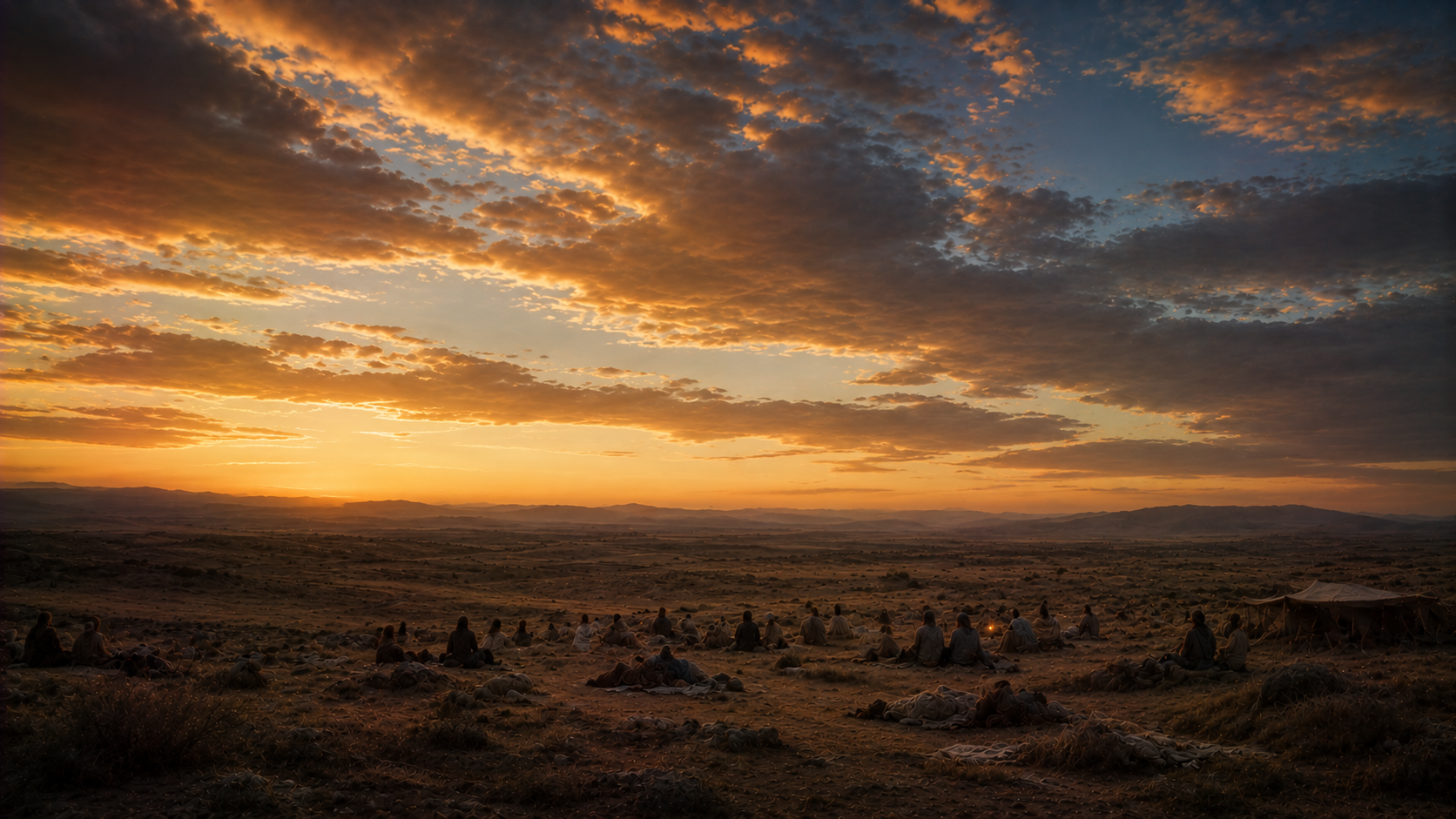
Influence callout: “the eternal God is your dwelling place; underneath are the everlasting arms” (33:26-27)
The blessing’s closing lines are among the most beloved in all of Scripture, and they reframe everything the book has said. After thirty-two chapters of covenant, law, blessing, and curse, Moses’ final word over Israel is not another command but a refuge: “There is none like God… the eternal God is your dwelling place. Underneath are the everlasting arms.” Two images carry it. God is a dwelling place (me’onah), a home, the same word Moses uses in Psalm 90:1 (“Lord, you have been our dwelling place in all generations”, traditionally “a prayer of Moses”); Israel’s true security is not the land it is about to enter but the God it lives in. And underneath are the everlasting arms, the same arms that “bore them on eagles’ wings” (32:11) and carried the people “as a man carries his son” (1:31), now named as the floor beneath everything, you cannot fall lower than the arms that hold you. The book that demanded an undivided heart, faced the certainty of failure, and pronounced terrible curses, ends its blessing here: with a people held. “You are happy, Israel! Who is like you, a people saved by Yahweh?” (verse 29). The last note of the blessing is not “try harder” but “you are held, and you are happy”, grace beneath the law, all the way down.
Reflection prompts
- The God who comes “from the ten thousands of holy ones” in blazing majesty also “loves the people” and lets them “sit at his feet.” How easily do you hold those two together, the God of overwhelming greatness and the God who bends low in love? Which do you most need to recover?
- Joseph, the brother sold and “separated,” receives the firstborn’s double honor, the displaced one exalted. Where in your own story does this pattern give you hope, that what was taken or lost is not the last word God speaks over you?
- The eternal God is your dwelling place; underneath are the everlasting arms. Sit with the image: you cannot fall lower than those arms. Where are you afraid of falling right now, and what changes if the floor beneath you is not your own strength but God himself?
Frameworks at play in this chapter: the firstborn / bechor, the new Moses, the divine council.