

The great central address of Deuteronomy begins here, and it begins where any covenant renewal must, with the Ten Words. But before Moses recites them, he makes a claim that should stop the reader cold: Yahweh didn’t make this covenant with our fathers, but with us, even us, who are all of us here alive today (5:3). It is not literally true on the surface, the people listening were mostly children, or unborn, when the fire fell on Sinai. That is exactly the point. Deuteronomy collapses the decades and sets every generation at the foot of the mountain. The covenant is never a museum piece inherited from the ancestors; it is always being made with us, today.
Then come the Ten Words themselves, restated with small but telling differences from the version in Exodus 20, the Sabbath command most of all. They are the core stipulations of the covenant-treaty (see the Sinai covenant), and they open not with a demand but with a rescue: I am Yahweh your God, who brought you out of… Egypt. The chapter ends with the people too terrified to bear God’s voice, and with one of the most poignant lines God ever speaks: a wish that they had a heart to match the words they had just promised to keep.
A · Deuteronomy 5:1-5 · The covenant made with us: every generation at Horeb
¹ Moses called to all Israel, and said to them, “Hear, Israel, the statutes and the ordinances which I speak in your ears today, that you may learn them, and observe to do them.” ² Yahweh our God made a covenant with us in Horeb. ³ Yahweh didn’t make this covenant with our fathers, but with us, even us, who are all of us here alive today. ⁴ Yahweh spoke with you face to face on the mountain out of the middle of the fire, ⁵ (I stood between Yahweh and you at that time, to show you Yahweh’s word; for you were afraid because of the fire, and didn’t go up onto the mountain) saying, (Deuteronomy 5:1–5, World English Bible)
- Hear, Israel, the statutes… that you may learn them, and observe to do them (verses 1-2). The address opens with shema, “hear”, the verb that will become Israel’s creed in the next chapter. To hear, in Deuteronomy, is always to learn and do; the covenant is for keeping, not just admiring.
- Not with our fathers, but with us… here alive today (verses 3-5). The translations all preserve the startling immediacy, not with our ancestors… but with us, with all of us who are alive here today (NIV, NRSVue). Moses’ point is liturgical and pastoral: a covenant you only inherited is a covenant you can disown as someone else’s. So Deuteronomy refuses the distance. The same insistence runs through the Passover Haggadah’s “in every generation a person must see themselves as having come out of Egypt.” The events of Horeb are addressed to the present tense.
Influence callout: every generation stands at Horeb (Solomon, the Jewish tradition)
Verse 3 is one of Deuteronomy’s signature moves, and it explains the strange second-person “you” that runs through the whole book (you saw, you rebelled, you stood at the mountain) even when the literal hearers were not there. Marty Solomon (Bema) and the Jewish liturgical tradition both read this as deliberate actualization: the text is built to be re-preached, so that each generation hears the covenant as made with itself. This is why Deuteronomy reads so much like a sermon and so little like an archive (see the Sinai covenant). It also shapes how the site reads Scripture generally: the words were spoken to particular people in a particular place, and they are addressed, across the centuries, to whoever is reading “today.” The covenant is never merely back then; it is always also now.
Influence callout: Daniel Block on the catechetical “us”
5:3 is one of Deuteronomy’s most theologically loaded sentences: “Yahweh did not make this covenant with our fathers, but with us, who are all of us here alive today.” Block (NIVAC) reads this as the rhetorical fingerprint of the whole book. Strictly speaking it is not true in the historical sense, most of those listening were children or unborn at Sinai. Moses knows that. What he is doing is catechetical: he is collapsing forty years and making Sinai contemporary. The covenant is not a museum artifact; it is a live word still spoken to you. The rabbinic tradition will later say it the same way (“every Jew was at Sinai”; cf. m. Pesachim 10:5 in spirit), and the Christian liturgical tradition will repeat the move every Easter when the church confesses “we” did the things long-dead people did. Read this way, the long quotation of the Ten Words that follows is not a refresher course in old material. It is an address: the LORD says you, and Moses is making sure you know he means you.
B · Deuteronomy 5:6-21 · The Ten Words restated
⁶ “I am Yahweh your God, who brought you out of the land of Egypt, out of the house of bondage. ⁷ “You shall have no other gods before me. ⁸ “You shall not make a carved image for yourself—any likeness of what is in heaven above, or what is in the earth beneath, or that is in the water under the earth. ⁹ You shall not bow yourself down to them, nor serve them, for I, Yahweh your God, am a jealous God, visiting the iniquity of the fathers on the children and on the third and on the fourth generation of those who hate me ¹⁰ and showing loving kindness to thousands of those who love me and keep my commandments. ¹¹ “You shall not misuse the name of Yahweh your God; for Yahweh will not hold him guiltless who misuses his name. ¹² “Observe the Sabbath day, to keep it holy, as Yahweh your God commanded you. ¹³ You shall labor six days, and do all your work; ¹⁴ but the seventh day is a Sabbath to Yahweh your God, in which you shall not do any work—neither you, nor your son, nor your daughter, nor your male servant, nor your female servant, nor your ox, nor your donkey, nor any of your livestock, nor your stranger who is within your gates; that your male servant and your female servant may rest as well as you. ¹⁵ You shall remember that you were a servant in the land of Egypt, and Yahweh your God brought you out of there by a mighty hand and by an outstretched arm. Therefore Yahweh your God commanded you to keep the Sabbath day. ¹⁶ “Honor your father and your mother, as Yahweh your God commanded you, that your days may be long and that it may go well with you in the land which Yahweh your God gives you. ¹⁷ “You shall not murder. ¹⁸ “You shall not commit adultery. ¹⁹ “You shall not steal. ²⁰ “You shall not give false testimony against your neighbor. ²¹ “You shall not covet your neighbor’s wife. Neither shall you desire your neighbor’s house, his field, or his male servant, or his female servant, his ox, or his donkey, or anything that is your neighbor’s.” (Deuteronomy 5:6–21, World English Bible)
- I am Yahweh your God, who brought you out (verse 6). Before a single command comes the preamble, and it is pure grace. God does not introduce himself as the lawgiver who will punish but as the rescuer who already freed them. Every command that follows is the response of the already-redeemed, never the price of redemption (see Torah as gift). The structure is the gospel’s own order: rescue first, then the life that fits it.
- No other gods… no carved image… not misuse the name (verses 7-11). The first words bind Israel to the one God alone, in worship (no rivals), in representation (no images; see the discussion at 4:15-19), and in reputation (not bearing his name emptily; see bearing God’s name). These are not three rules but three faces of undivided loyalty, the covenant version of the love the Shema will command in chapter 6.
- Observe the Sabbath day… you were a servant in the land of Egypt (verses 12-15). Here the Deuteronomy version diverges most sharply from Exodus, and the difference is the most theologically loaded variation in the whole Decalogue.
Word study: “observe” and “remember”, the Sabbath of slaves (5:12-15)
Two differences from Exodus 20 stand out. First, the verb: Exodus says remember (zakhor) the Sabbath; Deuteronomy says observe (shamor), which is why the translations here read “Observe the Sabbath day” (WEB, NIV, NLT, NRSVue) or “Keep” it (NASB), where Exodus reads “Remember.” The rabbinic tradition refused to choose: a beloved Sabbath hymn, Lekha Dodi, sings that shamor v’zakhor, “observe and remember”, were spoken by God b’dibbur echad, “in a single utterance.” Second, and deeper, the reason. Exodus grounds the Sabbath in creation (God rested on the seventh day). Deuteronomy grounds it in the exodus: you shall remember that you were a servant in the land of Egypt… therefore Yahweh your God commanded you to keep the Sabbath (5:15). The Sabbath here is liberation legislation. A people who were once worked without rest now must give rest, to their sons and daughters, their servants, their animals, and the foreigner inside their gates. The list in verse 14 is pointed: that your male servant and your female servant may rest as well as you. Sabbath is how former slaves make sure they never run a slave economy of their own (see Sabbath rest).
- Honor your father and mother… you shall not murder… covet (verses 16-21). The second table governs the life of the community, beginning with honor for parents (to which Deuteronomy adds that it may go well with you) and ending with coveting. A small difference closes the list: where Exodus 20 names the neighbor’s house first, Deuteronomy puts the neighbor’s wife first and the house, field, and the rest after, a subtle elevation of the person over the property. The commands move from the heart of worship outward to the secret desires of the heart, and they end where sin begins, in wanting.
C · Deuteronomy 5:22-33 · The voice that terrified, and the heart God longed for
²² Yahweh spoke these words to all your assembly on the mountain out of the middle of the fire, of the cloud, and of the thick darkness, with a great voice. He added no more. He wrote them on two stone tablets, and gave them to me. ²³ When you heard the voice out of the middle of the darkness, while the mountain was burning with fire, you came near to me, even all the heads of your tribes, and your elders; ²⁴ and you said, “Behold, Yahweh our God has shown us his glory and his greatness, and we have heard his voice out of the middle of the fire. We have seen today that God does speak with man, and he lives. ²⁵ Now therefore, why should we die? For this great fire will consume us. If we hear Yahweh our God’s voice any more, then we shall die. ²⁶ For who is there of all flesh who has heard the voice of the living God speaking out of the middle of the fire, as we have, and lived? ²⁷ Go near, and hear all that Yahweh our God shall say, and tell us all that Yahweh our God tells you; and we will hear it, and do it.” ²⁸ Yahweh heard the voice of your words when you spoke to me; and Yahweh said to me, “I have heard the voice of the words of this people which they have spoken to you. They have well said all that they have spoken. ²⁹ Oh that there were such a heart in them that they would fear me and keep all my commandments always, that it might be well with them and with their children forever! ³⁰ “Go tell them, ‘Return to your tents.’ ³¹ But as for you, stand here by me, and I will tell you all the commandments, and the statutes, and the ordinances, which you shall teach them, that they may do them in the land which I give them to possess.” ³² You shall observe to do therefore as Yahweh your God has commanded you. You shall not turn away to the right hand or to the left. ³³ You shall walk in all the way which Yahweh your God has commanded you, that you may live and that it may be well with you, and that you may prolong your days in the land which you shall possess. (Deuteronomy 5:22–33, World English Bible)
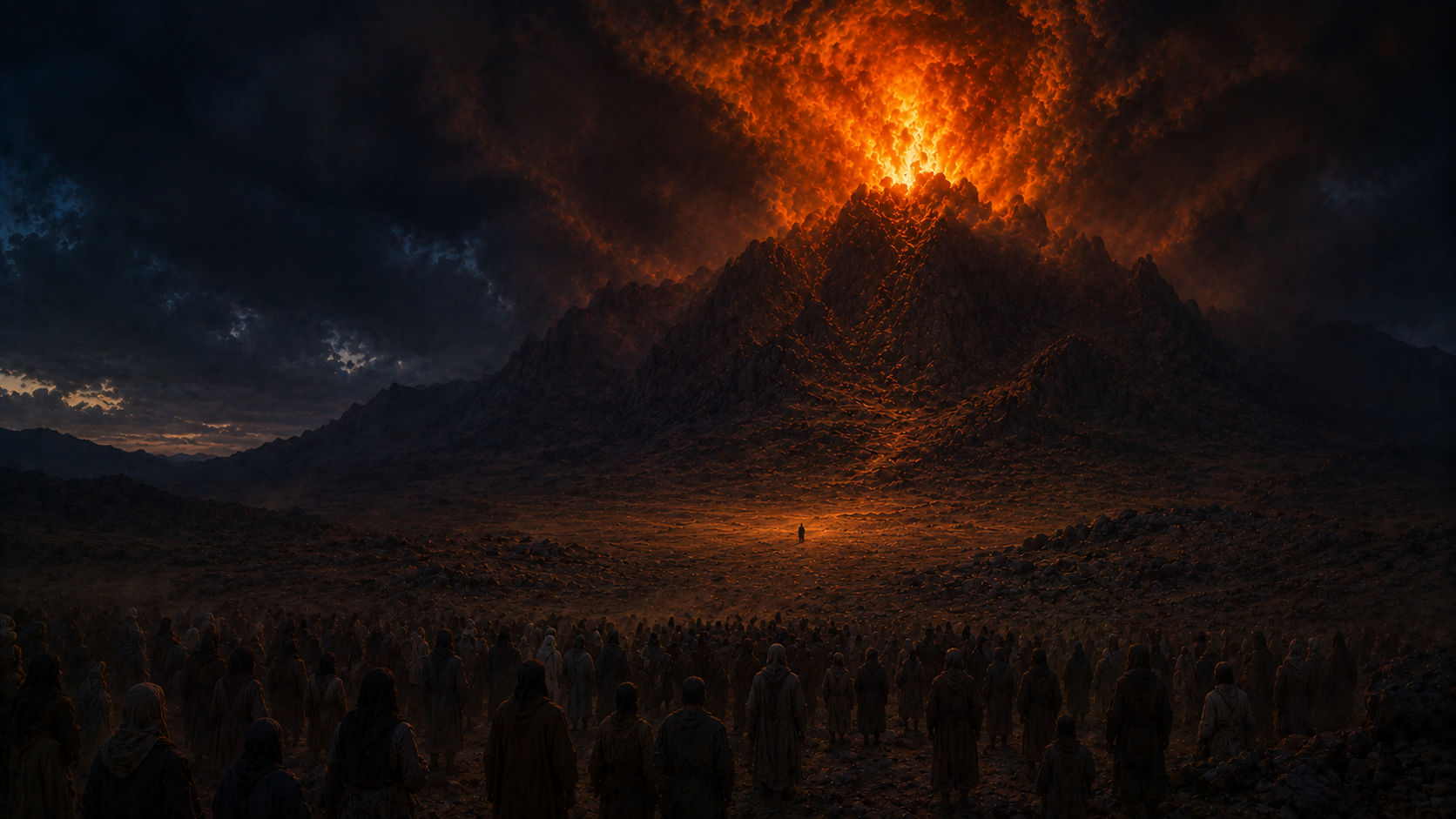
- Why should we die? For this great fire will consume us (verses 22-27). Israel hears the voice of God from the fire and is undone. They have discovered something true and terrifying, God does speak with man, and he lives (5:24), and they cannot bear it. So they ask Moses to stand between: you go near and hear… and we will hear it, and do it. The request for a mediator is not cowardice the text rebukes; God will call it well said (5:28). To know you cannot stand in the unmediated presence of God is the beginning of wisdom.
- Oh that there were such a heart in them (verses 28-29). And then the line that opens onto the whole rest of the Bible. God grants the request, then sighs a wish: oh that there were such a heart in them that they would fear me and keep all my commandments always. It is the most tender and the most revealing sentence in the chapter.
Influence callout: the heart God wished for, and the heart he promised (5:29 → 30:6)
Notice what God does not do here. He does not say “make yourselves such a heart.” He longs for it, oh that there were such a heart in them, as if naming a gap that the people, for all their sincere “we will hear it and do it,” cannot close themselves. This is the law’s honest limit: it can command love and obedience, but it cannot manufacture the heart that would render them. Deuteronomy knows this about itself, and it does not leave the longing unanswered. The same book that voices God’s wish here (5:29) will, by chapter 30, turn the wish into a promise: Yahweh your God will circumcise your heart… to love Yahweh your God with all your heart (30:6). What God yearns for in chapter 5, God pledges to give in chapter 30 (see circumcision of the heart). The prophets will name the same gift (a new heart, the law written within, the Spirit poured out; Jer 31:33, Ezek 36:26), and the New Testament will announce it has arrived. The ache of 5:29 is the seed of the new covenant.
- You shall walk in all the way… that you may live (verses 30-33). The chapter ends by setting the people on a road. You shall walk in all the way which Yahweh your God has commanded you, that you may live and that it may be well with you. This is the language of the two ways, the path that leads to life, neither swerving to the right hand or to the left. The Ten Words are not a cage; they are a way to walk, and the way leads home.
Reflection prompts
- Not with our fathers, but with us. Where do you treat faith as something inherited from previous generations rather than a covenant being made with you, today? What changes if the words are addressed to you?
- Deuteronomy roots the Sabbath in having been a slave: rest is how freed people refuse to build a world that never lets anyone stop. Where is your own life (or the lives of those who work for you) still running on a slave economy of relentless work? What would a Sabbath of liberation look like?
- God longed for a heart in them they could not produce, and later promised to give it. Where are you straining to manufacture by willpower a heart you can only receive as a gift? What would it mean to ask God for the heart instead of trying to forge it?
Frameworks at play in this chapter: the Sinai covenant, Sabbath rest, circumcision of the heart, two ways.