

Chapter 26 closes the long law code (chapters 12 to 26) the way Deuteronomy does everything, by turning law back into worship and story. When a farmer carries his first basket of produce to the sanctuary, he does not merely hand it over; he recites a creed: “a wandering Aramean was my father… we cried to Yahweh… he brought us out… and gave us this land.” It is the oldest compact summary of Israel’s gospel, the whole exodus story said over a basket of fruit (see the exodus pattern).
Then comes the declaration that goes with the third-year tithe (the one stored to fill the landless), and the chapter’s climax: a mutual declaration in which Israel declares that Yahweh is its God and Yahweh declares that Israel is his treasured possession. It reads like vows exchanged. The law code ends not with one more rule but with something closer to a wedding, two parties solemnly choosing each other, “today.”
A · Deuteronomy 26:1-11 · The basket of firstfruits and the wandering-Aramean creed
¹ It shall be, when you have come in to the land which Yahweh your God gives you for an inheritance, possess it, and dwell in it, ² that you shall take some of the first of all the fruit of the ground, which you shall bring in from your land that Yahweh your God gives you. You shall put it in a basket, and shall go to the place which Yahweh your God shall choose to cause his name to dwell there. ³ You shall come to the priest who shall be in those days, and tell him, “I profess today to Yahweh your God, that I have come to the land which Yahweh swore to our fathers to give us.” ⁴ The priest shall take the basket out of your hand, and set it down before Yahweh your God’s altar. ⁵ You shall answer and say before Yahweh your God, “My father was a Syrian ready to perish. He went down into Egypt, and lived there, few in number. There he became a great, mighty, and populous nation. ⁶ The Egyptians mistreated us, afflicted us, and imposed hard labor on us. ⁷ Then we cried to Yahweh, the God of our fathers. Yahweh heard our voice, and saw our affliction, our toil, and our oppression. ⁸ Yahweh brought us out of Egypt with a mighty hand, with an outstretched arm, with great terror, with signs, and with wonders; ⁹ and he has brought us into this place, and has given us this land, a land flowing with milk and honey. ¹⁰ Now, behold, I have brought the first of the fruit of the ground, which you, Yahweh, have given me.” You shall set it down before Yahweh your God, and worship before Yahweh your God. ¹¹ You shall rejoice in all the good which Yahweh your God has given to you, and to your house, you, and the Levite, and the foreigner who is among you. (Deuteronomy 26:1–11, World English Bible)
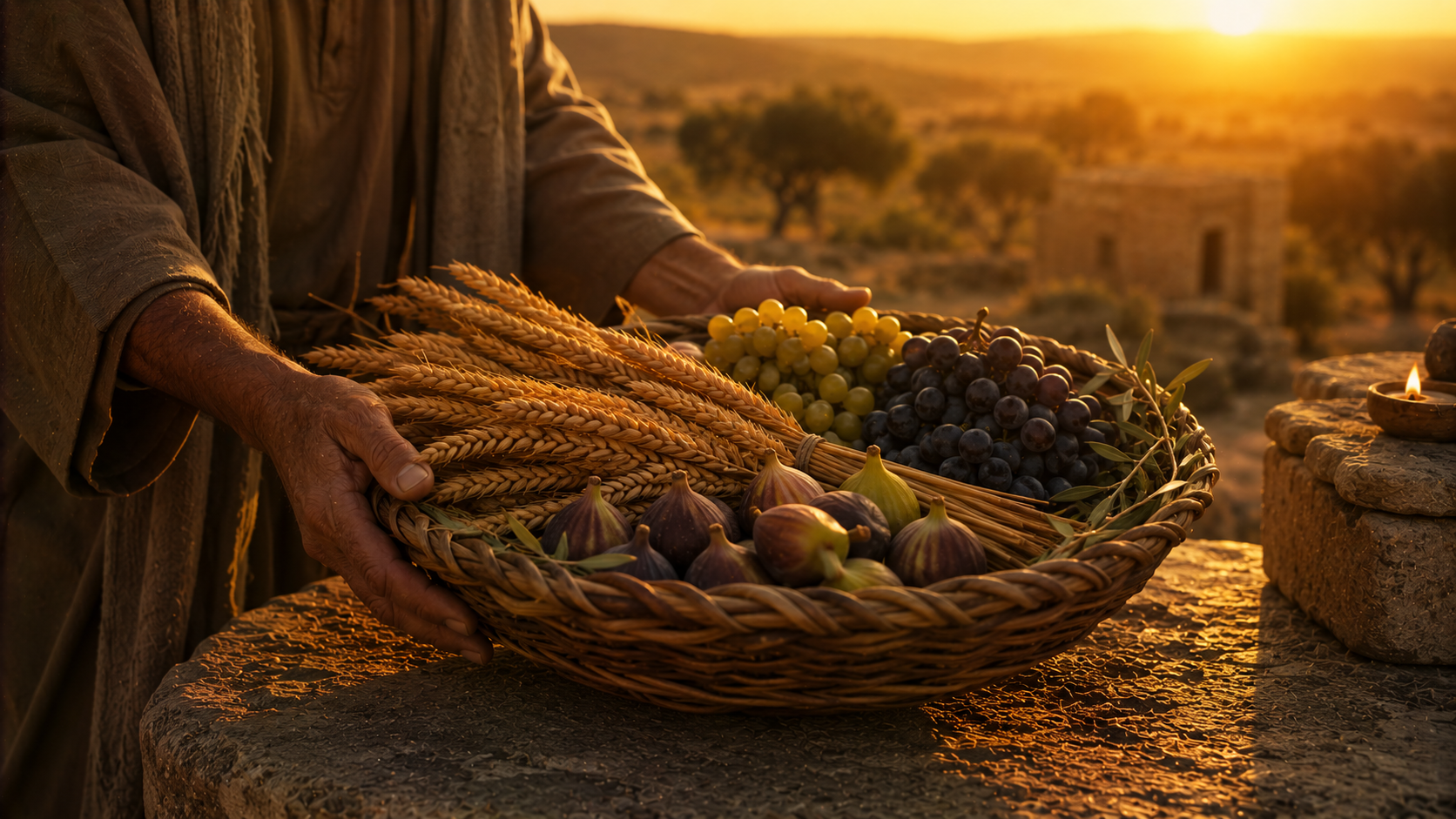
- Take some of the first of all the fruit… put it in a basket (verses 1-4). The firstfruits offering enacts a truth in produce: the first and best belongs to the Giver (the same logic as the firstborn; see the firstborn / bechor). You don’t give God the leftovers after you’ve seen whether there’s enough; you give the first, an act of trust that the rest will come. And it must be brought to the place YHWH chooses (see the place YHWH will choose), gratitude gathered to the center.
Influence callout: “a wandering Aramean was my father” (Israel’s oldest creed)
Verses 5-9 are one of the most important paragraphs in the Hebrew Bible. As he sets down his basket, every Israelite farmer recites a confession: “My father was a Syrian [Aramean] ready to perish. He went down into Egypt… few in number… The Egyptians mistreated us… Then we cried to Yahweh… Yahweh brought us out… and has given us this land.” This is the exodus in miniature, the whole story of descent, slavery, cry, deliverance, and gift compressed into a creed any farmer could say over a basket (see the exodus pattern). Scholars have long called it one of Israel’s earliest credal summaries, the “core gospel” of the Hebrew Bible, and it became the very text the Passover Haggadah expounds line by line to this day. Notice three things. It is corporate and personal at once, “my father” and “us”; the worshiper inserts himself into a story centuries older than he is (the same move as 5:3, “the covenant… with us”). It is grateful, the gift in the basket is the answer to the rescue in the creed. And it is inclusive, verse 11 has the worshiper rejoice “you, and the Levite, and the foreigner,” the landless and the outsider folded into the thanksgiving. To bring firstfruits is to tell the story of grace and then live generously out of it.
Influence callout: Walter Brueggemann on the wandering-Aramean creed
Walter Brueggemann reads the brief creed of Deuteronomy 26:5-9, “A wandering Aramean was my father, and he went down to Egypt and sojourned there, few in number… and the Egyptians dealt ill with us… and we cried unto Yahweh… and Yahweh brought us out… and brought us into this place”, as Israel’s oldest theological self-description, the earliest in-text statement of who we are. Two things matter for him. First, the confession identifies Israel as a foreign-origin, dispossessed, oppressed people whom God acted on. There is no claim of greatness, ancient title, or self-made success; the confession is “we were nothing, and the LORD did this for us.” Second, the confession is liturgical: it is to be recited every harvest, by every Israelite farmer, holding the basket of firstfruits at the central sanctuary. The memory is staged into the rhythm of agricultural success. The most prosperous moment of the Israelite year (the harvest is in) is the moment the farmer is required to say out loud, I am the descendant of a wandering foreigner, and none of this is from me. Brueggemann’s prophetic-imagination reading: this is the engine of an alternative consciousness over against empire. Empire teaches its citizens to forget their origins; the Deuteronomic creed teaches Israel to recite them at the very moment empire would have them celebrate their arrival. A people that confesses “a wandering Aramean was my father” cannot become a people of self-made greatness, and that is exactly the point.
Pushback note: immigration and the firstfruits creed
The pushback note in chapter 10 named the central problem; chapter 26 sharpens it. The Deuteronomic firstfruits liturgy makes Israel rehearse, every harvest, that they descend from a wandering foreign-origin family. “A wandering Aramean was my father, and he went down into Egypt and sojourned there” (26:5). The very form of Israelite thanksgiving is a confession of foreign-origin and a memory of having been a stranger. A Christianity descended from this liturgy that has hardened its borders, dismissed its migrants, and reframed welcome as weakness is in direct conflict with the liturgy of the people it claims to be the heir of. The point is not that any one modern policy is dictated by Deut 26:5; the point is that the posture of the firstfruits confession, we were wanderers, and the LORD brought us in, is the posture of a hospitable people, and the church that loses that posture has lost the chapter. The American church, especially the white American evangelical church, has often recited a foreign-origin creed (we were strangers; God acted; God brought us in) and then refused to extend the very logic of that creed to the strangers next door. Deuteronomy 26, every time the basket is brought, asks the question. Are you still that people? The answer the firstfruits liturgy wants is not abstract; it is whether the immigrant is welcome at the altar where you are reciting that your ancestor was an immigrant.
B · Deuteronomy 26:12-15 · The tithe declaration, and an honest conscience
¹² When you have finished tithing all the tithe of your increase in the third year, which is the year of tithing, then you shall give it to the Levite, to the foreigner, to the fatherless, and to the widow, that they may eat within your gates and be filled. ¹³ You shall say before Yahweh your God, “I have put away the holy things out of my house, and also have given them to the Levite, to the foreigner, to the fatherless, and to the widow, according to all your commandment which you have commanded me. I have not transgressed any of your commandments, neither have I forgotten them. ¹⁴ I have not eaten of it in my mourning, neither have I removed any of it while I was unclean, nor given of it for the dead. I have listened to Yahweh my God’s voice. I have done according to all that you have commanded me. ¹⁵ Look down from your holy habitation, from heaven, and bless your people Israel, and the ground which you have given us, as you swore to our fathers, a land flowing with milk and honey.” (Deuteronomy 26:12–15, World English Bible)
- Given them to the Levite, the foreigner, the fatherless, and the widow… that they may eat and be filled (verses 12-15). The third-year tithe (the local welfare store of 14:28-29) gets its own liturgy. The worshiper declares before God that he has actually done it, given the tithe to the four landless figures, kept it holy, not skimmed it. It is a striking ritual of accountability: generosity to the poor is not private and unverifiable but confessed openly before God, who is then asked to “look down… and bless.” The prayer for blessing follows the practice of justice; you do not ask God to bless what you have withheld from his poor.
C · Deuteronomy 26:16-19 · The day two parties declared each other
¹⁶ Today Yahweh your God commands you to do these statutes and ordinances. You shall therefore keep and do them with all your heart and with all your soul. ¹⁷ You have declared today that Yahweh is your God, and that you would walk in his ways, keep his statutes, his commandments, and his ordinances, and listen to his voice. ¹⁸ Yahweh has declared today that you are a people for his own possession, as he has promised you, and that you should keep all his commandments. ¹⁹ He will make you high above all nations that he has made, in praise, in name, and in honor, and that you may be a holy people to Yahweh your God, as he has spoken. (Deuteronomy 26:16–19, World English Bible)
- You have declared… Yahweh has declared (verses 16-19). The law code ends with a mutual exchange, and the parallel verbs (verses 17, 18) are deliberate: you have declared that Yahweh is your God; Yahweh has declared that you are his treasured possession (segullah, as in 7:6). Each party solemnly claims the other “today.” It is covenant language at its most intimate, closer to wedding vows than to legislation (the same lens as the Sinai covenant, where the treaty is a marriage). After twelve chapters of statutes, Deuteronomy reminds us what the statutes were always for: not a contract of compliance but a bond of belonging, two who have chosen each other. And the goal (verse 19) is vocation, Israel made “high… in praise, name, and honor” not for its own glory but to be “a holy people,” God’s showcase of what life with him looks like before all the nations.
Reflection prompts
- The firstfruits ritual gave God the first of the harvest, before you’d seen whether there was enough, an act of trust, not surplus. Where do you give God (your time, money, energy) only the leftovers, and what would offering the “first” require you to trust?
- Every worshiper recited the same story, “a wandering Aramean was my father… he brought us out,” inserting himself into a rescue older than he was. What is the story you rehearse to remember who you are and whose you are? Could you say it over a basket of your own “firstfruits”?
- The covenant ends with two parties declaring each other, you declare him your God, he declares you his treasured possession. Sit with the second half: that God has declared you his prized possession. What changes if that declaration, not your performance, is the ground you stand on?
Frameworks at play in this chapter: the exodus pattern, the place YHWH will choose, the firstborn / bechor, the Sinai covenant.