
Numbers
The wilderness, year by year.
All 36 chapters drafted.
Numbers
How to read it
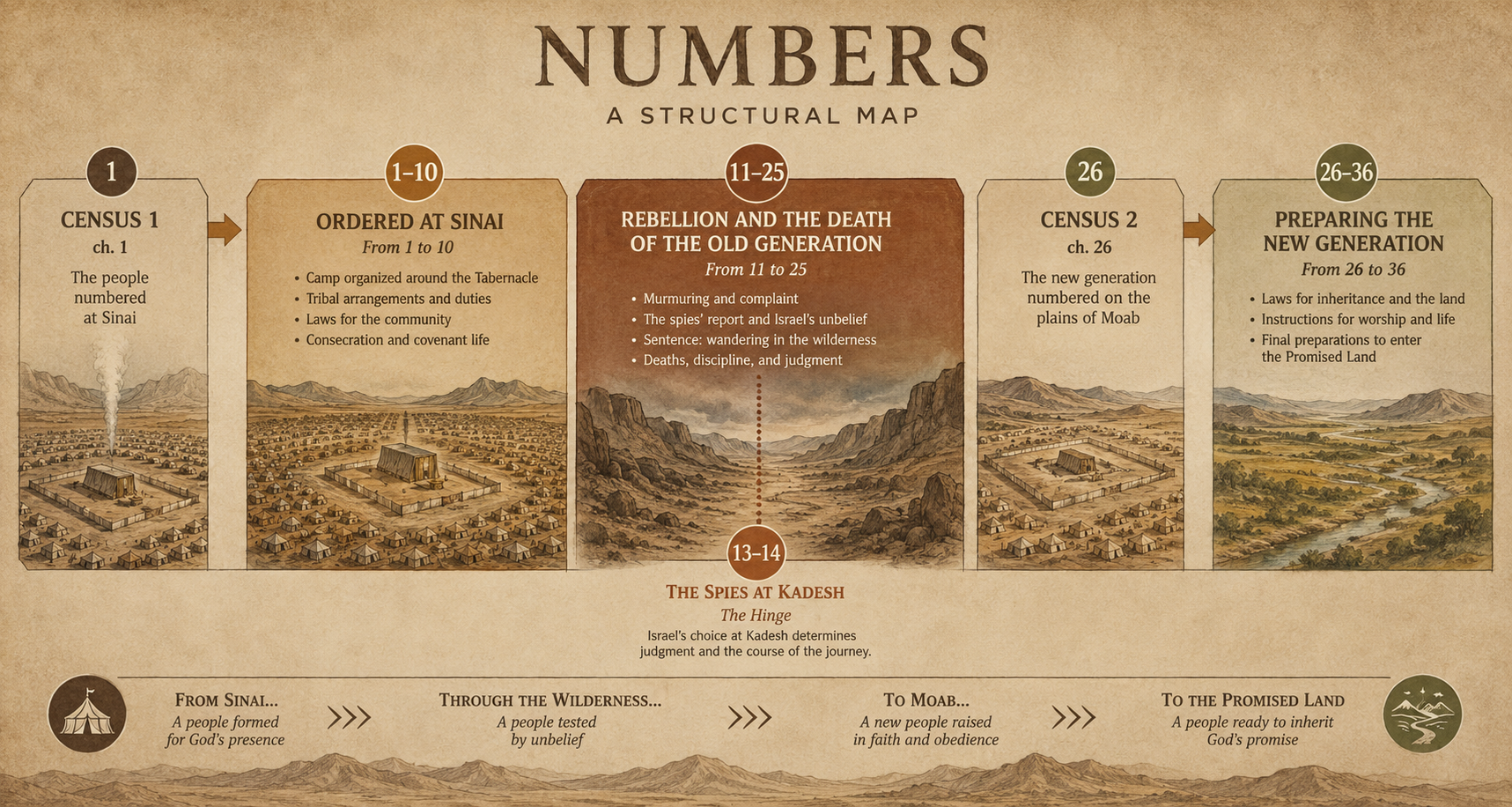
Themes: the wilderness as Israel’s identity workshop · the death of the exodus generation and the birth of the new · ordered life around the dwelling presence · holiness, rebellion, and intercession · the slow formation of a people who can inherit · faithfulness held out across a generational gap Literary design: two military censuses (chs. 1 and 26) framing the book; a three-part journey (Sinai, the wilderness, the plains of Moab); the spies at Kadesh (chs. 13-14) as the hinge; an embedded travel itinerary (ch. 33) that re-tells the whole journey as a list Frameworks at play: the two generations · wilderness and liminality · outside the camp · holy war and herem · bearing God’s name · the firstborn / bechor · clean and unclean · the tabernacle as cosmic temple · the divine council · the cruciform hermeneutic · the exodus pattern
Numbers is the book people think they know and have usually never read. Its English name comes from the two censuses that open and reopen it, by way of the Greek Arithmoi and the Latin Numeri, and that name has done the book a quiet disservice. It makes the book sound like a registry. Readers brace for tribal head-counts and skip to the dramatic parts: the spies, the talking donkey, the bronze serpent.
The Hebrew name is truer. The book is called Bemidbar, “in the wilderness,” from the fifth word of its first verse. That is the book’s real subject. Numbers is the wilderness book, the long middle of the Torah where a rescued people learns, slowly and at great cost, whether it can become the people God rescued it to be. The censuses are not the point. They are the frame around the point.
This page is a “how to read it” overview, meant to be read alongside the chapter commentaries (linked at the bottom). If you want the verse-by-verse work, follow a chapter link. If you want the lay of the land before you walk it, you’re in the right place.
The storyline
Numbers tells the story of the journey from Mount Sinai to the edge of the Promised Land, a journey that should have taken weeks and instead took forty years. The book divides cleanly into three movements, and the seam between the second and third is the most important hinge in the book.
Chapters 1-10 organize the first generation at Sinai. The book opens with a military census (1), arranges the twelve tribes in concentric order around the tabernacle (2), sets the Levites apart in place of the firstborn (3-4), and then purifies and orders the camp for the march: the test of the suspected wife (5), the Nazirite vow and the priestly blessing (6), the offerings of the tribal leaders (7), the consecration of the Levites (8), a second Passover and the cloud of guidance (9), and the silver trumpets (10). At the end of chapter 10 the cloud lifts, the trumpets sound, and the ordered camp sets out from Sinai in good order and high hope. Everything is ready. The land is close.
Chapters 11-25 record the rebellions and the death of that generation. Almost immediately the hope curdles. The people complain about the food (11); Miriam and Aaron challenge Moses (12); and at Kadesh the spies return from the land and ten of the twelve counsel retreat (13-14). The generation refuses to enter out of fear, and the verdict falls: forty years in the wilderness, until every fighting man of that generation has died (14:26-35). This is the hinge of the book. Everything after Numbers 14 is a long funeral. Korah’s rebellion and the plague (16-17), the law of the red heifer (19), Moses’s own failure at Meribah (20), the death of Aaron (20), the bronze serpent (21), the strange episode of Balaam and his oracles (22-24), and the apostasy at Baal-Peor (25) carry the first generation, almost to the last person, to its grave.
Chapters 26-36 prepare the new generation for the land. A second census (26) counts a different people and notes that not one of those numbered in the first census remained, except Caleb and Joshua. From here the book turns toward the future: the inheritance of the daughters of Zelophehad (27 and 36), the commissioning of Joshua (27), the calendar of offerings and the law of vows (28-30), the war with Midian (31), the settlement of the Transjordan tribes (32), the itinerary of the whole journey (33), the boundaries of the land (34), the Levitical towns and the cities of refuge (35). The book ends not in the land but on its threshold, on the plains of Moab, with a new generation poised to do what the old one would not.
Why the book matters
Numbers supplies the New Testament with some of its most load-bearing images. The wilderness generation becomes the canon’s standing warning: Paul writes that these things happened to them as an example, but they were written down for our instruction (1 Corinthians 10:11), and Hebrews builds an entire exhortation on the generation that would not enter my rest (Hebrews 3:7-4:11). The bronze serpent Moses lifts up in the wilderness (21:8-9) becomes Jesus’s own image of the cross: as Moses lifted up the serpent in the wilderness, so must the Son of Man be lifted up (John 3:14). The star that Balaam sees rising out of Jacob (24:17) feeds the expectation that brings magi to Bethlehem following a star. The Nazirite vow of chapter 6 shapes Samson, Samuel, and John the Baptist. And the priestly blessing of 6:24-26, the LORD bless you and keep you, is the most-spoken benediction in the history of the people of God, recovered on a silver amulet from seventh-century BCE Jerusalem that is the oldest fragment of biblical text ever found.
The book also matters for what it teaches about formation. Numbers is the most sustained biblical meditation on the truth that deliverance is not the same as transformation. Israel walked out of Egypt in a night; getting Egypt out of Israel took forty years and cost a generation. The book is honest about how slow the work is, how often the rescued long to go back, and how the promise survives even the failure of the people it was given to. It refuses both the triumphalism that pretends the Christian life is a steady march and the despair that reads failure as the end of the story. There is always, the book insists, a next generation.
Literary architecture
Numbers is built around its two censuses, and reading the book through them is the key that turns it from a miscellany into a coherent story. This is Dennis Olson’s structural thesis, and it is the backbone of the two generations framework. The first census (1) counts the generation of the exodus, the people who saw the Red Sea. The second census (26), taken nearly forty years later, counts a different generation entirely, and the text says so in as many words: among these there was not one of those who were counted by Moses and Aaron… For the LORD had said of them, “They shall surely die in the wilderness” (26:64-65). Between the two lists, the old generation dies and the new one rises. The censuses are not boring lists. They are the literary frame that interprets everything between them.
The geography reinforces the structure. The book moves from Sinai (the place of the covenant, chs. 1-10), into the wilderness (the place of testing and death, chs. 11-21), to the plains of Moab (the place of preparation, chs. 22-36), where the new generation waits at the threshold. Chapter 33 then re-tells the entire journey as a single itinerary of forty-two stages, the book’s own retrospective summary, a list that reads, in light of the whole, like the stations of a long pilgrimage.
The frameworks at play
Numbers extends frameworks already established in Genesis and Exodus and introduces several of its own.
The two generations is the book’s structural spine: the death of the old and the birth of the new, framed by the two censuses, with the canonical payoff in 1 Corinthians 10 and Hebrews 3-4.
Wilderness and liminality, built in Exodus, comes into its own here. Numbers is the wilderness book; the grumbling, the manna, the spies, Meribah, and the bronze serpent are the formative middle of the exodus pattern, the in-between where a people is made.
Outside the camp is diagrammed in chapters 1-5, where the tribes are arranged in concentric rings of holiness around the tabernacle, the Levites form a buffer, and the unclean are placed outside the camp because YHWH dwells in its midst.
The firstborn / bechor framework is keyed to chapter 3, where the Levites are taken “in place of” the firstborn of Israel, the firstborn whom God claimed on Passover night.
Bearing God’s name reaches its clearest statement in the priestly blessing of chapter 6, which ends with God saying they shall put my name on the children of Israel.
Holy war and herem is introduced in the wars of chapter 21 and the war with Midian in chapter 31, the hardest chapter in the book, read on this site through the cross rather than weaponized or dismissed.
The divine council hovers over the Balaam narrative (22-24), where a pagan diviner is overruled by the God of Israel, and over the strange interplay of spirits and oracles in those chapters.
The cruciform hermeneutic governs how the commentary reads the book’s violence and its bronze serpent, the object of judgment that becomes the means of healing and the image Jesus claims for his own death.
What this site does with Numbers
The commentary takes the wilderness seriously as the book’s real subject, not as dead space between Sinai and Canaan. It reads the censuses and camp-arrangements as theology in the form of lists rather than skipping to the narratives. It sits honestly with the book’s hard chapters rather than softening or weaponizing them. And it keeps the generational structure in view throughout, so that the rebellions are not isolated morality tales but episodes in a single story about whether a rescued people can be formed into a people who trust.
Specifically, the commentary:
- Reads the book through the two generations framework, treating the two censuses as the structural key rather than as filler.
- Treats the wilderness as the formative middle of the spiritual life, drawing on wilderness and liminality, rather than as mere punishment.
- Works the census-and-camp chapters (1-4) as a spatial theology of holiness, using outside the camp.
- Engages the Jewish interpretive tradition (Rashi, Ramban, the Talmud) and the ANE background (the Mesha Stele, the Deir ‘Alla Balaam inscription, the Ketef Hinnom amulets) where the rabbinic memory and the archaeology keep modern readers from misreading.
- Names the Christ-typological readings the tradition has found here (the bronze serpent, the rock that followed, the star of Jacob, the firstborn redeemed) without flattening the book into a Christian-prefiguration document. Numbers has its own Hebrew Bible weight to honor first.
- Handles the hard chapters with the site’s standard posture: take the text seriously, take the readers seriously, lay out the faithful options, and refuse to make any single solution a hill to die on.
Approaching the hard chapters
Numbers has several chapters modern readers find difficult.
Chapter 5 (the ordeal of the suspected wife, the sotah): the only trial-by-ordeal in the Torah raises real questions about gender and justice. The commentary works the ritual in its ANE context, names the ways the rabbinic tradition both limited and eventually suspended it, and is honest about what is and is not comfortable in the text.
Chapter 15:32-36 (the man gathering wood on the Sabbath): a death sentence for Sabbath-breaking sits jarringly beside the surrounding grace. The commentary reads it within the camp’s holiness logic and the high stakes of the wilderness covenant without pretending the severity is easy.
Chapter 16 (Korah’s rebellion): the earth swallowing Korah and the plague that follows raise the problem of divine judgment. The commentary reads the episode through the book’s generational structure and its concern for the holiness of the dwelling presence.
Chapter 25 (Baal-Peor and Phinehas): Phinehas’s spear and the “covenant of peace” that follows are among the most disturbing rewards in Scripture. The commentary names the difficulty plainly and reads the episode against the larger trajectory toward the God revealed at the cross.
Chapter 31 (the war with Midian): the hardest chapter in the book. The commentary handles it through holy war and herem, setting it in its ANE world, laying out the range of faithful readings, and keeping the cross at the center, neither softening the text nor turning it into a license.
The census numbers: the enormous totals (603,550 fighting men, implying a population of two million or more) are historically and logistically difficult. The commentary surveys the main proposals (the Hebrew eleph as a clan-unit rather than a literal “thousand”; hyperbolic or schematic counting in the ANE manner) without forcing a single conclusion.
Chapters
- Numbers 1 · The census of the first generation, and the army that will never fight
- Numbers 2 · The camp arranged around the presence: four divisions, four standards, one center
- Numbers 3 · The Levites taken in place of the firstborn, and the price of the rest
- Numbers 4 · The burden of the holy: the Levites who carry what must not be touched
- Numbers 5 · A camp that cannot hide: purity, restitution, and the hard ritual of the suspected wife
- Numbers 6 · Lay holiness and the placing of the Name: the Nazirite vow and the priestly blessing
- Numbers 7 · The leaders' gifts, the carts, and the voice from between the cherubim
- Numbers 8 · Light before the dwelling, and the Levites wholly given
- Numbers 9 · A second chance at Passover, and a people who move at the command of God
- Numbers 10 · Silver trumpets, the departure from Sinai, and the war-cry of the ark
- Numbers 11 · Craving, the burden of leadership, and a wish that all would prophesy
- Numbers 12 · When the challenge comes from the top: Miriam, Aaron, and the meekness of Moses
- Numbers 13 · Twelve spies, one good land, and the report that lost a generation
- Numbers 14 · The refusal, Moses's boldest intercession, and the forty-year verdict
- Numbers 15 · Laws for a land they will reach, and tassels for eyes that wandered
- Numbers 16 · Korah's rebellion, and a priest who stood between the dead and the living
- Numbers 17 · Dead wood that blossomed: how God settled the priesthood by giving life
- Numbers 18 · Who may draw near, who carries the danger, and a priesthood whose only inheritance is God
- Numbers 19 · The red heifer: ashes that cleanse, a death outside the camp, and a statute no one could explain
- Numbers 20 · The death of Miriam, the rock at Meribah, and the barring of Moses
- Numbers 21 · The bronze serpent, a victory at Hormah, and the first conquests east of the Jordan
- Numbers 22 · A king hires a curse, and a seer is out-seen by his own donkey
- Numbers 23 · A hired prophet keeps blessing: God is not a man, and there is no curse against Jacob
- Numbers 24 · How lovely are your tents, and a star out of Jacob: a pagan seer prophesies the king
- Numbers 25 · Baal-Peor, the wound from within, and the hard story of Phinehas
- Numbers 26 · The second census: the old generation gone, the new one counted for inheritance
- Numbers 27 · Five daughters who changed the law, and a shepherd for the people
- Numbers 28 · The rhythm of worship: the daily offering and the calendar given to a people about to settle
- Numbers 29 · The seventh month: trumpets, atonement, and seventy bulls for the nations
- Numbers 30 · The weight of a word: vows, oaths, and the binding power of what comes out of the mouth
- Numbers 31 · The war against Midian: the hardest chapter in the book, read honestly and through the cross
- Numbers 32 · Settling east of the Jordan: solidarity, the shared fight, and the danger of stopping short
- Numbers 33 · The whole journey written down: forty-two stages from Egypt to the edge of the land
- Numbers 34 · The shape of the gift: the borders of the land and the men who will divide it
- Numbers 35 · Levites scattered through the land, refuge for the manslayer, and a death that sets the guilty free
- Numbers 36 · The daughters of Zelophehad again, and a book that ends on the threshold