

Chapter 10 is the launch. Two silver trumpets are made to coordinate the camp, and then, after roughly eleven months at Sinai, the cloud lifts and Israel sets out toward the land in exactly the order chapters 1 and 2 prescribed. Everything is ready. The people are counted, arranged, purified, and consecrated; the dwelling is built, dedicated, lit, and staffed; God is present and speaking; and now the column moves out behind the ark with a war-cry on Moses’s lips. The chapter is the high point of the whole first section, the moment of maximum hope.
It is worth feeling that hope, because it does not last. The very next chapter opens with the people complaining, and from there the road runs downhill to Kadesh and the forty-year verdict (see the two generations). Chapter 10 is the hinge. Read it knowing what comes next, and the ordered, hopeful departure from Sinai becomes almost unbearably poignant: this is the generation setting out in perfect formation toward a land it will refuse to enter.
A · Numbers 10:1-10 · The two silver trumpets
² “Make two trumpets of silver. You shall make them of beaten work. You shall use them for the calling of the congregation, and for the journeying of the camps. … ⁹ When you go to war in your land against the adversary who oppresses you, then you shall sound an alarm with the trumpets. Then you will be remembered before Yahweh your God, and you will be saved from your enemies.”
- Two trumpets of silver (v. 2). The trumpets coordinate a camp of enormous size. Different blasts mean different things: assemble the whole congregation, summon only the leaders, signal each division to break camp and march. In a host this large, communication is itself a form of order, and the silver trumpets are how the ordered camp stays ordered on the move.
- Sound an alarm… then you will be remembered before Yahweh (v. 9). The trumpets are also for war and for worship. In battle, the alarm-blast is not merely a military signal; it is a way of being remembered before YHWH, a cry to God woven into the sound. On feast days and new moons, the trumpets sound over the offerings, again for a memorial before your God (v. 10). The same instrument that organizes the march also calls God’s attention in crisis and in celebration. Sound, in this chapter, is a form of prayer.
Word study: teruah (תְּרוּעָה), “the alarm blast”
The trumpets produce two kinds of sound: a sustained blast for assembly and a broken, staccato teruah for breaking camp and for war (10:5-6, 9). Teruah is the urgent, pulsing alarm, the sound that means move or danger or shout. The word carries through the rest of the Bible: it is the blast of the ram’s horn that brings down Jericho’s walls (Joshua 6:5, 20), the shout of acclamation when God is enthroned (Psalm 47:5), and the name of the festival that opens the high holy days, Yom Teruah, the Day of the Blast (Leviticus 23:24), later called Rosh Hashanah. The New Testament reaches for the same image at the end: the Lord descends with the trumpet call of God (1 Thessalonians 4:16), and the dead are raised at the last trumpet (1 Corinthians 15:52). The teruah of Numbers 10, the sound that musters Israel for the march and remembers them before God in battle, becomes the sound that musters the whole creation at the end.
B · Numbers 10:11-28 · The cloud lifts
¹¹ In the second year, in the second month, on the twentieth day of the month, the cloud was taken up from over the tabernacle of the Testimony. ¹² The children of Israel went forward on their journeys out of the wilderness of Sinai; and the cloud stayed in the wilderness of Paran.
- On the twentieth day of the second month (v. 11). The chapter dates the departure precisely. Israel arrived at Sinai in the third month of the first year (Exodus 19:1) and leaves on the twentieth of the second month of the second year, nearly eleven months later. That long stay was not delay; it was formation. Sinai is where the people received the covenant, built the dwelling, and were ordered into a nation. Now, formed, they move.
- Out of the wilderness of Sinai… into the wilderness of Paran (v. 12). They set out at the cloud’s leading, exactly as chapter 9 described, moving al pi YHWH, at the command of God. The destination is Paran, the staging ground from which the spies will be sent (chapter 13). The geography is already pointing toward the crisis.
- They set out in order (vv. 13-28). The march unfolds in the precise arrangement chapters 1 and 2 laid down: Judah’s division first, then the Gershonites and Merarites carrying the tabernacle, then Reuben’s division, then the Kohathites carrying the holy things, then Ephraim’s, then Dan’s as rear guard. The camp at rest and the camp on the move are the same shape. The order the book spent ten chapters establishing now does exactly what it was for: it carries the presence of God through the wilderness in a single, coherent body. The tragedy is that good order is not the same as a faithful heart, and the chapters ahead will expose the difference.
C · Numbers 10:29-36 · An outsider’s eyes, and the ark that leads
³⁵ When the ark went forward, Moses said, “Rise up, Yahweh, and let your enemies be scattered! Let those who hate you flee before you!” ³⁶ When it rested, he said, “Return, Yahweh, to the ten thousands of the thousands of Israel.”
- Come with us… you can be our eyes (vv. 29-32). Moses invites Hobab, his Midianite father-in-law’s family, to travel with Israel: you know how we are to encamp in the wilderness, and you can be our eyes. There is a striking honesty here. Israel is led by the cloud, and yet Moses also wants Hobab’s local knowledge of the terrain. The two are not in competition. Divine guidance does not make human wisdom and partnership pointless; the people led by God still welcome the outsider who knows the land. As in chapter 9’s provision for the foreigner, the camp has room for the one from outside who will throw in their lot with Israel.
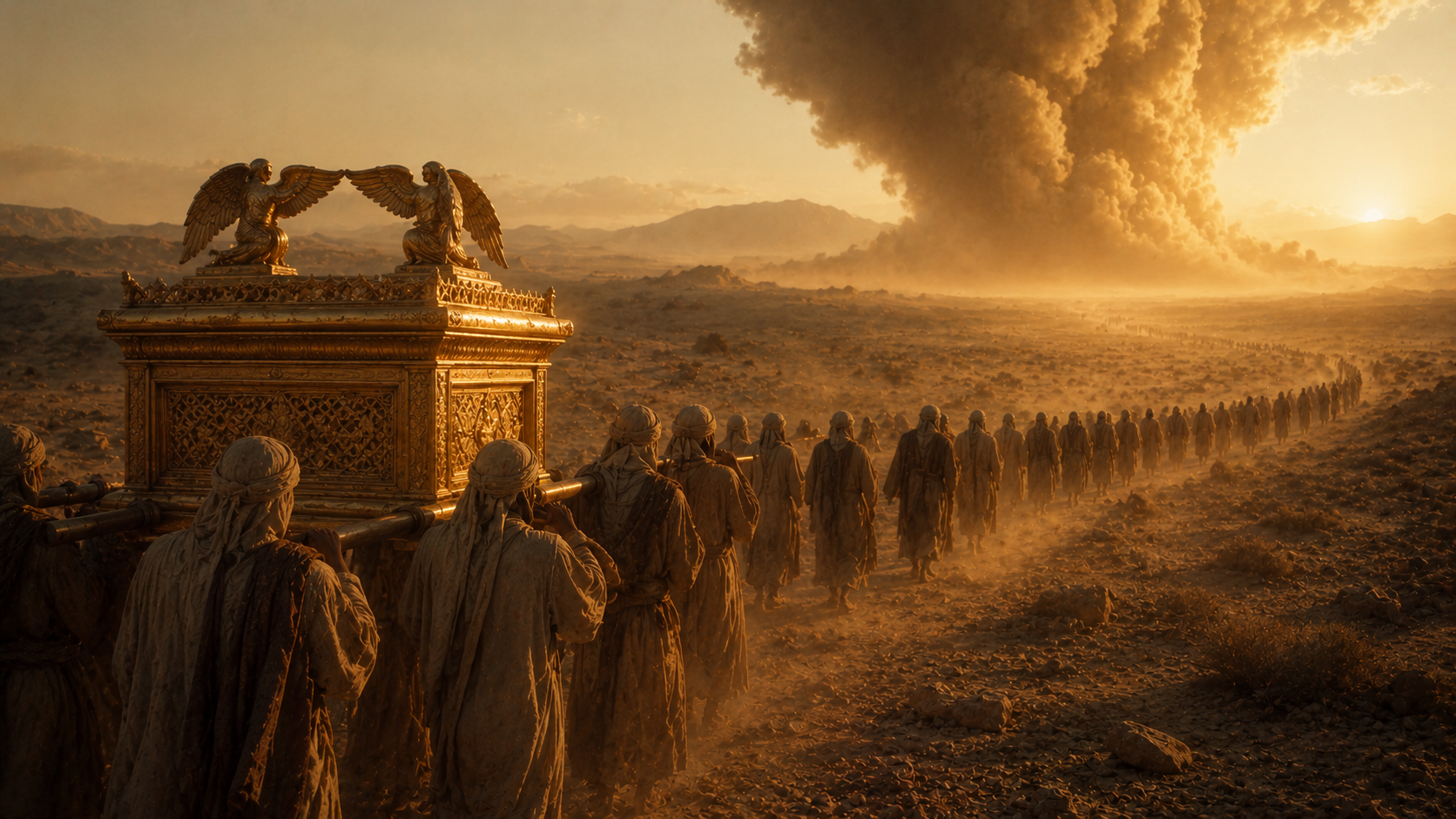
- The ark of the covenant went before them (v. 33). The ark, normally carried in the protected center of the column (chapter 2), goes ahead of the people on this first leg, seeking out a resting place for them. The throne of the unseen King leads the way into the unknown. The image is of a God who does not send his people ahead of himself but goes before them.
- Rise up, Yahweh, and let your enemies be scattered (vv. 35-36). As the ark sets out, Moses cries out a war-chant: Rise up, YHWH, scatter your enemies! and when it rests, Return, YHWH, to the ten thousands of Israel. The ark is the warrior-throne of God, leading his people into the contested land. This is the divine-warrior motif in its earliest form (see holy war and herem): the battle is God’s, and Israel’s role is to follow the throne that goes before them. The same cry opens Psalm 68 (Let God arise, let his enemies be scattered), and the trajectory of the warrior-God runs, on this site’s reading, all the way to the cross, where the enemy finally scattered is death itself.
Influence callout: the inverted nun and the divine-warrior ark (the Jewish scribal tradition)
In the Masoretic text, verses 35 and 36 are bracketed by two inverted Hebrew letters nun, a unique scribal mark found almost nowhere else in the Torah. The rabbis noticed and debated it. The Talmud (Shabbat 115b to 116a) preserves the striking view of Rabban Shimon ben Gamliel that these two verses form a separate little “book,” set off by the inverted marks, so that the Torah is in a sense seven books rather than five: Numbers is split into three by this two-verse book about the ark going out to war. Whatever the marks originally signified (scribal uncertainty about placement, or a deliberate framing), the tradition’s instinct is sound: these verses are doing something distinct and weighty. They name the ark as the war-throne of God leading his people, and they give the divine-warrior theme its liturgical voice. The same God who travels in the protected center of the camp also rides out ahead of it; the presence that dwells among them is also the presence that fights for them.
Reflection prompts
- Israel sets out from Sinai in flawless order, and within a chapter the complaining begins. Good order is not the same as a faithful heart. Where in your life is everything well-organized on the outside while the heart underneath is unready or unwilling?
- Led by the cloud, Moses still wants Hobab to “be our eyes.” Trusting God’s guidance and welcoming human wisdom are not opposites. Where have you treated them as either-or, when the moment called for both?
- The ark goes before the people into the unknown, the throne of God leading the way. As you face whatever is next, can you picture God not sending you ahead of himself but going before you? What would change if you actually believed he had gone first?
Frameworks at play in this chapter: wilderness and liminality, the two generations, holy war and herem.