

The cloud lifts, the ordered camp marches out from Sinai in chapter 10, and almost immediately, in chapter 11, the hope begins to come apart. The people complain. Fire flares at the edge of the camp. A craving for meat spreads, fueled by a nostalgic fantasy of Egypt, and the complaint grows so heavy that Moses, the meekest man on earth, breaks down and asks God to kill him rather than carry this people one more step alone. God responds on two fronts: he distributes Moses’s burden by putting his Spirit on seventy elders, and he gives the people their meat, in a way that turns into judgment.
This is the first of the wilderness rebellions, and it sets the tone for the whole tragic middle of the book (see the two generations). But it also holds one of the most luminous lines in the Torah. When Joshua wants Moses to silence two men prophesying in the camp, Moses refuses with a wish that runs ahead of his whole age: would that all the LORD’s people were prophets, that the LORD would put his Spirit on them. The chapter that begins with craving and judgment also plants the seed of Pentecost.
A · Numbers 11:4-9 · The craving and the fantasy of Egypt
⁴ The mixed multitude that was among them lusted exceedingly, and the children of Israel also wept again, and said, “Who will give us meat to eat? ⁵ We remember the fish, which we ate in Egypt for nothing; the cucumbers, and the melons, and the leeks, and the onions, and the garlic; ⁶ but now we have lost our appetite. There is nothing at all except this manna to look at.”
- We remember the fish we ate in Egypt for nothing (v. 5). The craving is built on a lie they have told themselves. They remember Egypt as a place of free fish and fresh vegetables, and forget that Egypt was the house of slavery, the place of the whip and the brick quota and the drowned infants. Nostalgia has sweetened the memory of bondage. This is the wilderness’s recurring temptation: to misremember the past as better than the freedom that costs something now.
- Free (v. 5). The Hebrew is chinnam, “for nothing,” and it is a grim irony. The food in Egypt was anything but free; it was the ration of slaves, paid for with their labor and their lives. The craving mistakes the cost. The manna, by contrast, is genuinely free, given daily by grace, and they despise it precisely because it is given rather than earned and controlled.
- Nothing at all except this manna (v. 6). The provision that is the daily miracle of the wilderness (see wilderness and liminality) has become contemptible to them through familiarity. This is the scarcity-lie at work (see abundance vs. scarcity): surrounded by daily provision, they read it as not enough, as deprivation. The manna has not changed; their hearts have. Gratitude curdled into entitlement is its own kind of bondage.
Word study: Kibroth-hattaavah (קִבְרוֹת הַתַּאֲוָה), “the graves of craving”
The episode ends with a place-name that summarizes it. After the quail come (vv. 31-34), the greediest gorge themselves, and a plague strikes “while the meat was still between their teeth”; the dead are buried there, and the place is named Kibroth-hattaavah, “the graves of craving.” The root avah means “to crave, to desire intensely,” and the noun ta’avah is the craving itself; verse 4 literally says they “craved a craving” (hit’avu ta’avah). The name preserves the lesson the way a tombstone preserves a date: this is what unchecked craving buries you in. The same word for craving stands in the tenth commandment’s prohibition against coveting, and the New Testament’s vocabulary of epithymia, disordered desire, runs along the same line (James 1:14-15, desire conceives and gives birth to death). The wilderness names a real grave for the appetite that will not be governed.
B · Numbers 11:11-17 · Moses at the end of himself, and the shared Spirit
¹⁴ “I am not able to bear all this people alone, because it is too heavy for me. ¹⁵ If you treat me this way, please kill me right now, if I have found favor in your sight; and don’t let me see my wretchedness.” … ¹⁷ “I will take of the Spirit which is on you, and will put it on them; and they shall bear the burden of the people with you, that you not bear it yourself alone.”
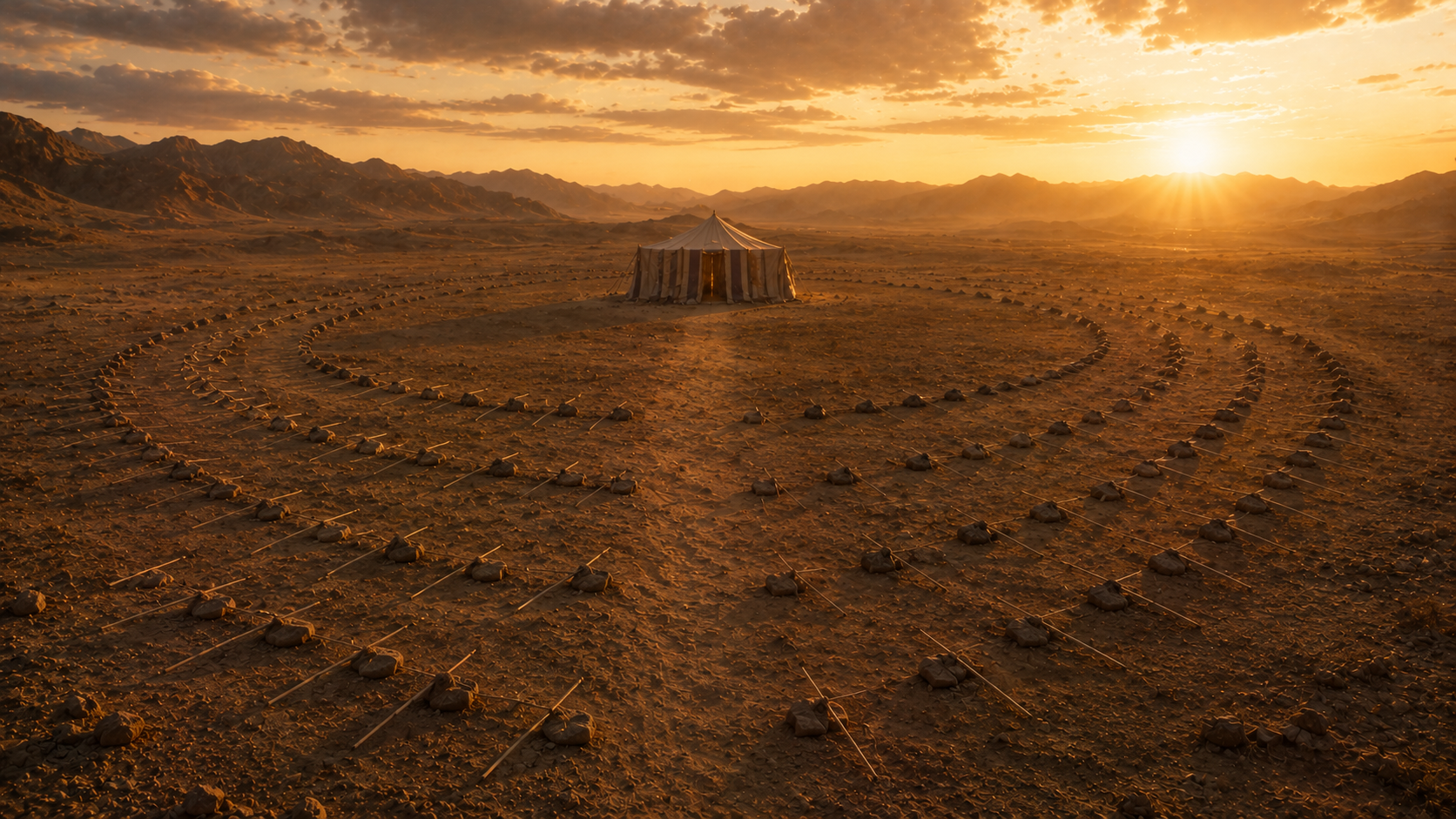
- It is too heavy for me (v. 14). Moses, named in the next chapter as the humblest man on earth, here hits bottom. He complains to God as bitterly as the people do, asking why the whole weight of this nation has been laid on him and begging to die rather than carry it alone. The chapter is honest that even the great mediator has a breaking point. Leadership in the wilderness is genuinely crushing, and Scripture does not pretend its heroes are tireless.
- Please kill me right now (v. 15). Moses’s despair is real and raw, and the text records it without rebuke. He joins a line of worn-out servants who ask God for death (Elijah under the broom tree, 1 Kings 19:4; Jonah, Jonah 4:3). God’s response to Moses, as to Elijah, is not condemnation but provision: he does not scold the exhaustion; he addresses its cause.
- I will take of the Spirit which is on you, and put it on them (v. 17). God’s solution is to distribute the burden. Seventy elders receive a share of the same Spirit that rests on Moses, so they can carry the people with him. The point is not that Moses was deficient but that the load was never meant for one person. The same instinct will shape the New Testament church: leadership is shared, gifts are distributed, the body has many members (Acts 6:1-7, the appointing of the seven; 1 Corinthians 12). The cure for the crushed leader is not heroic endurance but a community that shares the weight.
C · Numbers 11:24-30 · “Would that all were prophets”
²⁹ Moses said to him, “Are you jealous for my sake? I wish that all Yahweh’s people were prophets, that Yahweh would put his Spirit on them!”
- They prophesied (vv. 24-25). The Spirit comes on the seventy elders and they prophesy. But two men, Eldad and Medad, who had stayed in the camp rather than going out to the tent, receive the Spirit too and prophesy in the middle of the camp, outside the official setting. The Spirit refuses to stay where the procedure expected it.
- My lord Moses, forbid them! (v. 28). Joshua, zealous for Moses’s authority, wants the two unauthorized prophets stopped. His instinct is the institutional one: the Spirit should operate through the proper channel and not break out wherever it pleases. It is the same instinct that will recur whenever God’s Spirit moves outside the lines someone has drawn.
- Would that all the LORD’s people were prophets (v. 29). Moses’s answer is breathtaking. He is not threatened by the Spirit landing on others; he longs for it to land on everyone. The wish runs centuries ahead of him. Joel will prophesy that God will pour out his Spirit on all flesh, sons and daughters, old and young, male and female slaves (Joel 2:28-29). At Pentecost, Peter announces that the day has come (Acts 2:16-18). Moses, weighed down by carrying the people alone, dreams of the day when the Spirit will rest on all of them, and the New Testament says that day arrived. The most generous heart in the chapter belongs to the man most entitled to guard his turf, and he refuses to guard it.
Influence callout: Marty Solomon and Tim Mackie (the Spirit poured out)
Solomon and Mackie both trace the line that runs from this verse to Pentecost. Moses’s wish, that all God’s people would carry the Spirit, is not granted in his lifetime; in the Old Testament the Spirit rests on particular people for particular tasks, prophets, judges, kings, the seventy elders here. But the prophets pick up Moses’s longing and turn it into promise (Joel 2; Ezekiel 36:26-27, a new heart and a new Spirit), and the New Testament announces its fulfillment: at Pentecost the Spirit falls on the whole gathered community, and Peter quotes Joel to explain it (Acts 2). The seventy elders prophesying in Numbers 11 are, on this reading, a small preview of the church. Mackie’s pastoral note is that the burden Moses could not carry alone is, in the end, carried by a Spirit-filled people, exactly as Moses wished. The chapter that buries the cravers at the graves of craving also opens, in Moses’s wish, onto the upper room.
Reflection prompts
- The people remember Egypt as a place of free fish and forget it was the house of slavery. Where do you find yourself sweetening the memory of a bondage you were rescued from, and craving your way back toward it?
- Moses, the humblest man alive, hits a wall and asks to die, and God’s answer is to share the load, not to demand more endurance. Where are you carrying alone a weight that was never meant for one person? Who could share it?
- Moses wishes the Spirit rested on everyone, while Joshua wants it kept in the proper channel. When God’s Spirit moves outside the lines you would have drawn, is your instinct closer to Moses’s or to Joshua’s?
Frameworks at play in this chapter: wilderness and liminality, abundance vs. scarcity, the two generations.