
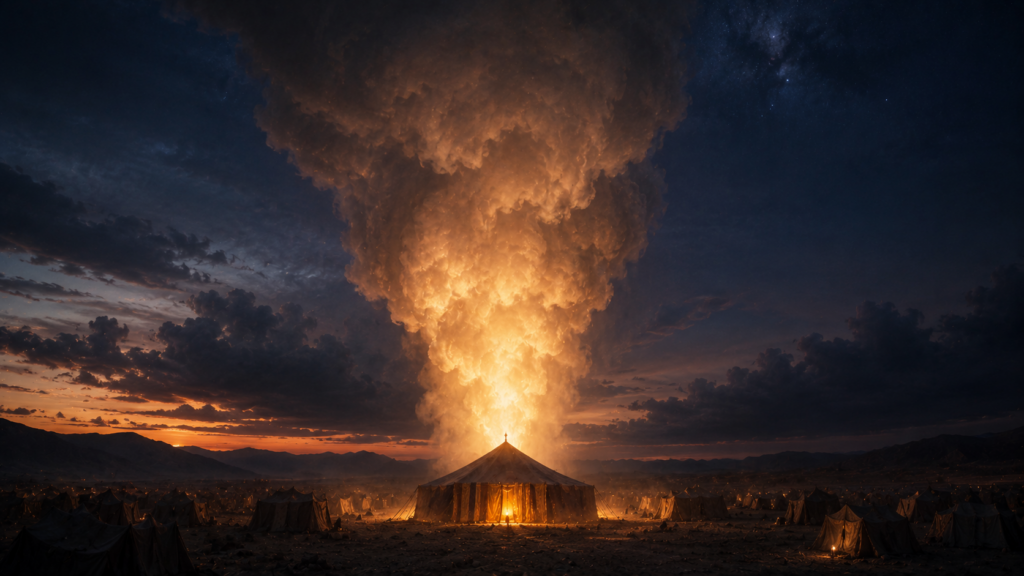
Chapter 9 has two halves, and both are about how a rescued people keeps living as a rescued people. In the first, Israel celebrates the Passover at Sinai, one year after leaving Egypt, and a problem arises: some men are ritually unclean and cannot keep it on the appointed day. Rather than simply excluding them, God provides a second date a month later, and extends the same provision to the resident foreigner. In the second half, the cloud settles over the newly finished tabernacle, and the chapter describes the strange, dependent rhythm of a people who move and stop entirely according to when the cloud lifts.
Together the halves teach a single lesson about trust. Remembering the exodus keeps Israel’s identity alive in the wilderness; following the cloud keeps Israel’s life surrendered to God’s timing. The chapter shows a God who makes room for those circumstance would shut out, and who asks his people to live without controlling the schedule. Both are forms of the same wilderness discipline (see wilderness and liminality): a people learning to live by memory and by obedience rather than by their own command.
A · Numbers 9:1-5 · Passover in the wilderness
² “Moreover let the children of Israel keep the Passover in its appointed season. ³ On the fourteenth day of this month, at evening, you shall keep it in its appointed season. You shall keep it according to all its statutes and according to all its ordinances.”
- Keep the Passover in its appointed season (v. 2). One year after the first Passover in Egypt, Israel keeps it again, now in the wilderness of Sinai. The festival is the engine of Israel’s memory (see the exodus pattern). By re-enacting the night of deliverance every year, the people keep their founding event present, telling themselves who they are: a people YHWH brought out. In the disorienting in-between of the wilderness, the Passover is an anchor to the story.
- According to all its statutes and ordinances (v. 3). The chapter stresses that the festival is kept exactly as prescribed. The memory is not improvised; it is rehearsed in a fixed form. There is wisdom in this: identity that depends on feeling is fragile, but identity rehearsed in a reliable practice survives the wilderness. Israel does not have to feel like a redeemed people to keep the Passover; keeping it is part of how they remain one.
B · Numbers 9:6-14 · A second date, and a place for the outsider
⁷ …those men said to him, “We are unclean because of the dead body of a man. Why are we kept back, that we may not offer the offering of Yahweh in its appointed season among the children of Israel?” ⁸ Moses answered them, “Wait, that I may hear what Yahweh will command concerning you.”
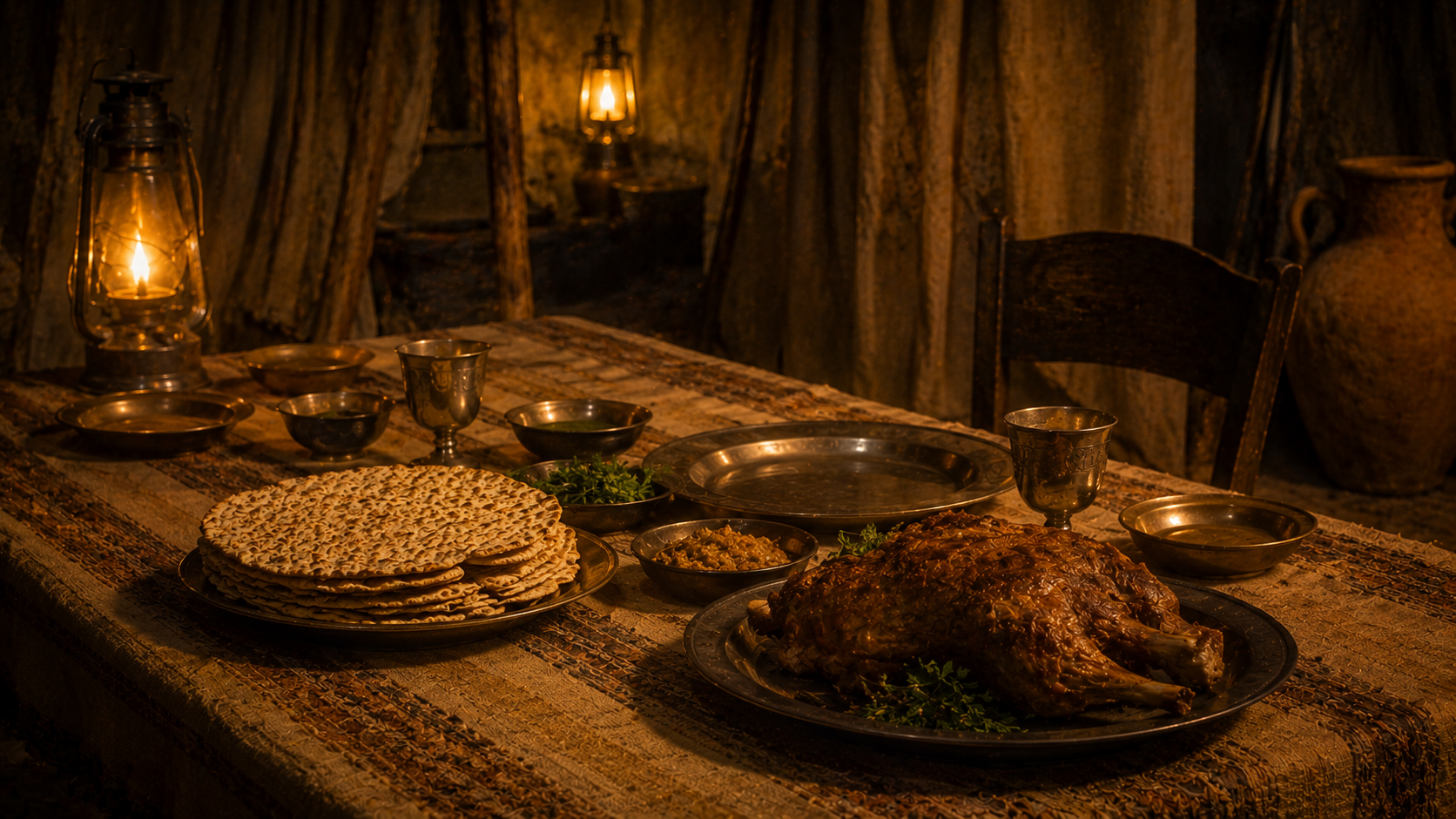
- Why are we kept back? (v. 7). Some men are ritually unclean from contact with a corpse and so cannot keep the Passover on the appointed day. Notice their complaint: it is not resentment at the rules but grief at being excluded from the worship. They want in. Their question is the cry of people who long to belong and find themselves shut out by circumstances beyond their control.
- Wait, that I may hear what Yahweh will command (v. 8). Moses does not improvise an answer, and he does not simply enforce the existing rule. He brings the question to God. The verse models a posture worth noticing: when a sincere desire to belong runs into a real obstacle, the leader’s instinct is to inquire of God rather than to default to exclusion. The pattern recurs through Numbers (27:5; 36:5): hard cases are taken back to YHWH.
- They shall keep it in the second month (vv. 10-11). God’s answer is a second Passover, Pesach Sheni, a month later, for anyone who was unclean or away on a journey. The provision is remarkable: the calendar itself bends to make room for those circumstance excluded. There is a real boundary (the one who is able and simply neglects the Passover is cut off, v. 13), but for those genuinely prevented, God opens a second door. The God of this chapter would rather adjust the schedule than lose the worshipper who wants to come.
- One statute, for the foreigner and the native (v. 14). The provision extends to the resident foreigner (ger) who wants to keep the Passover: one statute, both for the foreigner and for him who is born in the land. The festival of Israel’s deliverance is open to the outsider who casts their lot with Israel. The instinct that will later let gentiles be grafted into the covenant family without first becoming ethnic Israel (see the olive tree) is already budding here: the table of deliverance has room for the one from outside who wants to belong.
C · Numbers 9:15-23 · The cloud, and the command of God
²² Whether it was two days, or a month, or a year that the cloud stayed on the tabernacle, remaining on it, the children of Israel remained encamped, and didn’t travel; but when it was taken up, they traveled. ²³ At the commandment of Yahweh they encamped, and at the commandment of Yahweh they traveled. They kept Yahweh’s command, at the commandment of Yahweh by Moses.
- The cloud covered the tabernacle (vv. 15-16). On the day the tabernacle is set up, the cloud settles over it, and by night it looks like fire. The visible presence that led Israel out of Egypt now rests on the dwelling at the center of the camp. The God who travels with his people marks his presence and his will in something they can see.
- When the cloud lifted, they set out; when it settled, they camped (vv. 17-21). The rhythm of Israel’s life is now entirely tied to the cloud. They move when it moves and stop when it stops, with no say in the timing. Sometimes the cloud stays a single night; sometimes it stays a year. The people never know in advance. Their job is simply to be ready to go and willing to stay.
- Two days, or a month, or a year (v. 22). The chapter lingers on the unpredictability. Israel cannot plan the itinerary, cannot pack for a known duration, cannot schedule the journey. This is the heart of wilderness formation (see wilderness and liminality): learning to live without controlling the timetable, holding plans loosely, trusting that the One who leads knows when to move and when to wait. The discipline is not comfortable, and it is exactly the trust the next chapters will show Israel failing to sustain.
Word study: al pi YHWH (עַל־פִּי יְהוָה), “at the mouth of the LORD”
The phrase that governs the whole second half of the chapter is al pi YHWH, usually translated “at the commandment of the LORD” but literally “at the mouth of the LORD.” It drumbeats through verses 18 to 23: they camped at the mouth of YHWH and they traveled at the mouth of YHWH. The image is intimate and total: the people move as if breathing in time with God’s spoken word. The same phrase describes how decisions are made by the priestly oracle and how Moses dies “at the mouth of YHWH” (Deuteronomy 34:5, where the rabbis read it as God taking Moses with a kiss). To live al pi YHWH is to order even your geography by God’s word, to be a people whose movements are dictated not by strategy or convenience but by the mouth of God. It is the Old Testament’s most concrete picture of what it means to be led, and the standard against which Israel’s coming refusals will be measured.
Reflection prompts
- The men who were unclean grieved being kept back from worship; their problem was that they wanted in. When you have felt excluded from the life of God’s people, was your longing like theirs, and how did you, or others, respond to it?
- God bends the calendar to make room for those circumstance shut out, while still keeping a real boundary for those who simply neglect. Where do you need to extend a “second date” to someone, and where is genuine commitment actually being asked of you?
- Israel moved and stopped entirely at the cloud’s unpredictable timing, sometimes a night, sometimes a year. Where in your life are you trying to control a timetable that is not yours to set? What would it look like to live at the mouth of the LORD in that area?
Frameworks at play in this chapter: the exodus pattern, wilderness and liminality, the two generations.