
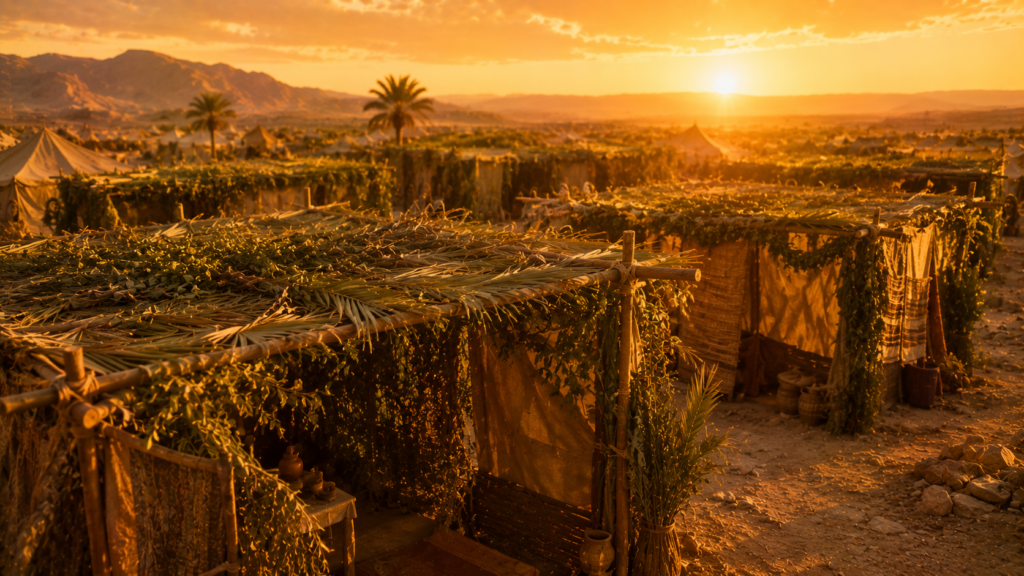
The calendar reaches its peak in the seventh month, the holiest cluster of the year. Three observances crowd into it: the Day of Blasts on the first (the festival later called Rosh Hashanah), the Day of Atonement on the tenth (Yom Kippur, the most solemn day of the year), and the seven-day Feast of Tabernacles beginning on the fifteenth (Sukkot), capped by a closing assembly on the eighth day. The public offerings escalate to their annual maximum here. If chapter 28 established that worship saturates ordinary time, chapter 29 shows where the year’s worship builds to its climax: the season of trumpet, fast, and booth.
The chapter holds a detail the tradition has long treasured. Across the seven days of Tabernacles, the number of bulls offered descends, thirteen, twelve, eleven, and so on down to seven, totaling seventy over the week. The rabbis counted those seventy bulls and saw the seventy nations of the world (Genesis 10): Israel, at its greatest festival, offering sacrifice not only for itself but for all the peoples of the earth. The worship of the new generation, given here as it prepares to enter the land, turns out to face outward, toward the whole world God means to bless through Abraham’s family.
A · Numbers 29:1-11 · Blasts and atonement
¹ “In the seventh month, on the first day of the month, you shall have a holy convocation… It is a day of blowing of trumpets to you. … ⁷ On the tenth day of this seventh month you shall have a holy convocation. You shall afflict your souls. You shall do no kind of work.”
- A day of blowing of trumpets (v. 1). The seventh month opens with the Yom Teruah, the Day of the Blast (see the teruah word study in chapter 10). The same trumpet-sound that mustered Israel for the march and remembered them before God in battle now summons the nation into its holiest season. The blast is a call to attention, a sounding of alarm and assembly that says: the great days are here.
- On the tenth day… you shall afflict your souls (vv. 7-11). The tenth day is the Day of Atonement (Yom Kippur), the only commanded fast in the Torah and the most solemn day of the year, when the high priest enters the most holy place with blood to cleanse the sanctuary and the people (Leviticus 16; see kipper / atonement). The offerings here are the public counterpart to that great ritual. Once a year the whole nation humbles itself and is made clean. Hebrews reads this day as the deepest shadow of the cross: where Israel’s high priest entered the earthly holy place yearly with the blood of animals, Christ entered the greater and more perfect tent once for all with his own blood (Hebrews 9:7-12). The year’s holiest day points beyond itself to the once-for-all atonement.
- The seventh month gathers the themes of the whole calendar into one season: the trumpet (assembly and alarm), the fast (atonement and humility), and, next, the booths (joy and ingathering). It is the year’s spiritual summit, and the new generation is given it before they ever set foot in the land, so that the rhythm of repentance and rejoicing is in place before the harvests begin.
B · Numbers 29:12-40 · Tabernacles, and the seventy bulls
¹³ “You shall offer a burnt offering, an offering made by fire, of a pleasant aroma to Yahweh: thirteen young bulls… ³⁵ On the eighth day you shall have a solemn assembly. You shall do no regular work.”
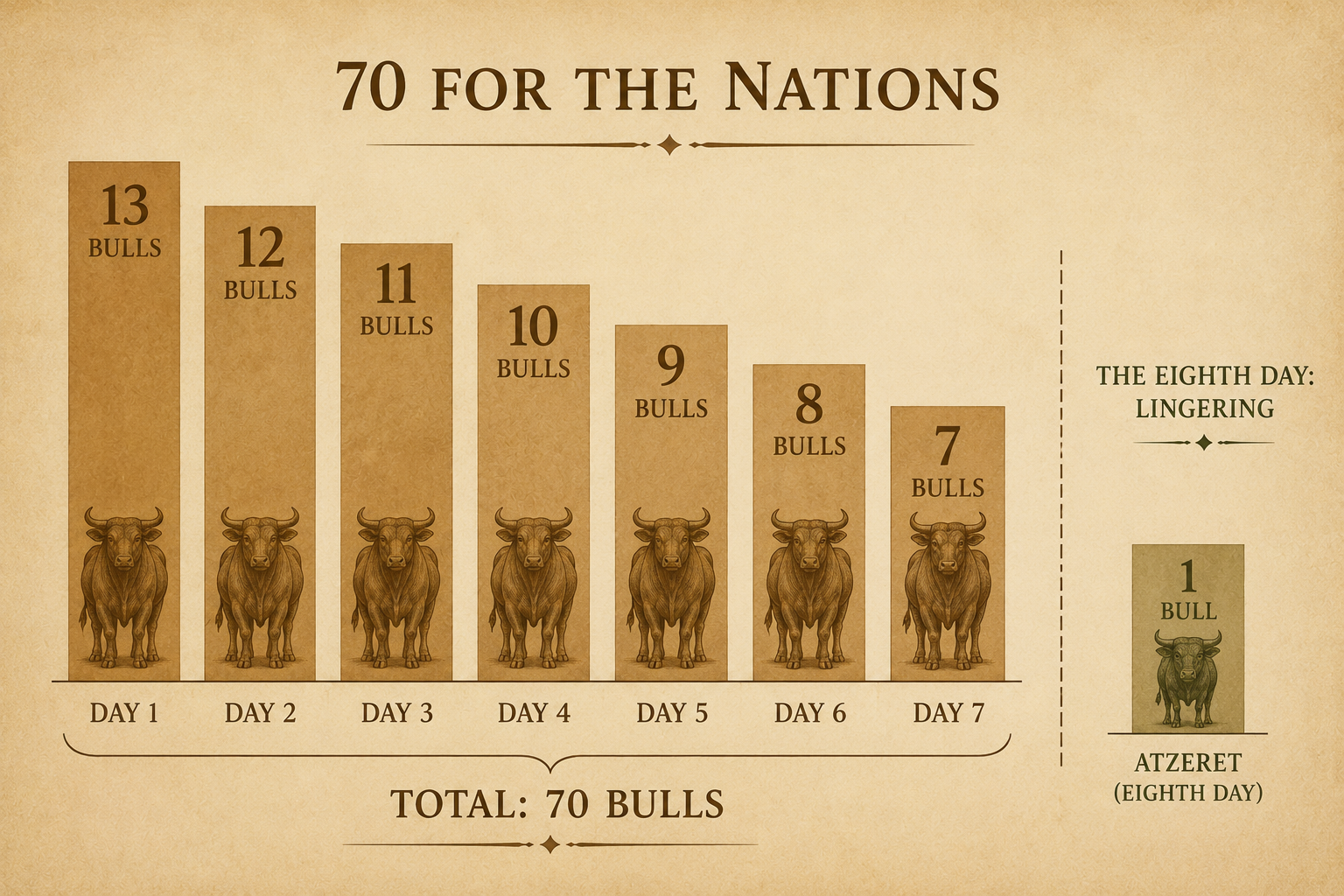
- The Feast of Tabernacles (vv. 12-34). Beginning on the fifteenth, Israel keeps the seven-day Feast of Booths (Sukkot), living in temporary shelters to remember the wilderness journey (Leviticus 23:42-43). It is the most joyful festival of the year, the great ingathering after the harvest. And its offerings are the most lavish in the calendar, with a striking pattern: the bulls decrease day by day, thirteen on the first, twelve on the second, down to seven on the seventh, seventy bulls in all.
- The descending count (vv. 13-32). The deliberate descent from thirteen to seven has invited interpretation for millennia. The total, seventy, is the number of the nations of the world in the table of nations (Genesis 10), and the rabbinic tradition drew the obvious conclusion: Israel offers these seventy bulls for the seventy nations (Talmud, Sukkah 55b). At its greatest feast, Israel’s worship reaches beyond itself to intercede for the whole world. This is the Abrahamic vocation in liturgical form: a people blessed so that all the families of the earth would be blessed (Genesis 12:3), standing as priests for the nations (see the olive tree). Israel’s election was never for Israel alone; the seventy bulls embody a worship that holds the world before God.
- On the eighth day, a solemn assembly (vv. 35-38). After the seven days comes a final, eighth day, the atzeret, with a single bull. The festival of the nations narrows back to one. The tradition reads this tenderly: having hosted a feast that embraced the whole world, God asks Israel to stay one more day, just the two of them. The intimacy of the one returns after the breadth of the seventy. The God who blesses the nations through Israel also wants Israel, alone, to linger with him.
Word study: atzeret (עֲצֶרֶת), “solemn assembly, lingering”
The eighth day of the festival season is the atzeret, usually translated “solemn assembly,” from a root meaning “to hold back, to restrain, to detain.” The word carries a sense of lingering, of being asked to stay. The rabbinic tradition heard great tenderness in it: after the long, crowded festival with its seventy bulls for the nations, God says, in effect, your leaving is hard for me; stay with me one more day (a reading preserved in Rashi on Leviticus 23:36, drawing on the Midrash). The atzeret is the small, intimate close to the great public feast, a day not of grand offerings but of simply remaining in God’s presence a little longer. The same instinct runs through Scripture’s vision of the end, when the festival of all nations gives way to God dwelling with his people and they see his face (Revelation 22:4), the eternal atzeret in which the lingering never ends. The word teaches that beneath all the calendar’s activity is a God who simply wants his people to stay with him.
Influence callout: Sukkot, the nations, and the festival Jesus filled
The Feast of Tabernacles became, in the prophets, the festival of the world’s future worship: Zechariah foresees the day when all the nations will come up to Jerusalem to keep Sukkot (Zechariah 14:16), the seventy bulls fulfilled in the nations themselves coming to worship. The Gospel of John stages two of Jesus’s great self-revelations during this very feast. Sukkot featured a daily water-drawing ceremony and a great lighting of lamps in the temple court; on the last day of the feast Jesus stood and cried, if anyone thirsts, let him come to me and drink (John 7:37-38), and soon after declared, I am the light of the world (John 8:12). He took the festival’s own water and light and claimed to be their reality. The feast that offered seventy bulls for the nations, and looked forward to the nations streaming in, found in Jesus the one who would draw all peoples (John 12:32). The new generation receiving this calendar could not have seen all of that. But the shape was there from the start: a worship that reached toward the whole world, waiting for the one who would gather it in.
Reflection prompts
- Israel’s greatest feast offered seventy bulls for the seventy nations. Even at its most particular, its worship reached outward for the whole world. Does your own life with God ever reach beyond yourself and your people to hold the wider world before him?
- After the vast public festival, the eighth-day atzeret is God asking Israel to linger with him one more day, just the two of them. Beneath all your activity for God, is there room simply to stay with him, with nothing to accomplish?
- The seventh month moves through alarm (trumpets), humility (atonement), and joy (booths). Which of those three does your spiritual life most need to recover right now, the wake-up call, the honest reckoning, or the rejoicing?
Frameworks at play in this chapter: the festival calendar, the olive tree, kipper / atonement.