
With the new generation counted and a successor named, the book turns to time. Chapters 28 and 29 lay out the calendar of public offerings, the sacrifices the whole nation brings together at the appointed times: every day, every Sabbath, every new moon, and every festival through the year. Where Leviticus 23 gave the festivals their meaning and their human observance, Numbers 28 and 29 give the precise national offerings for each occasion, the worship Israel renders corporately as one people. It is a fitting subject here. The generation about to leave the wilderness and settle in the land is being handed the rhythm that will keep God at the center of its new, ordinary life.
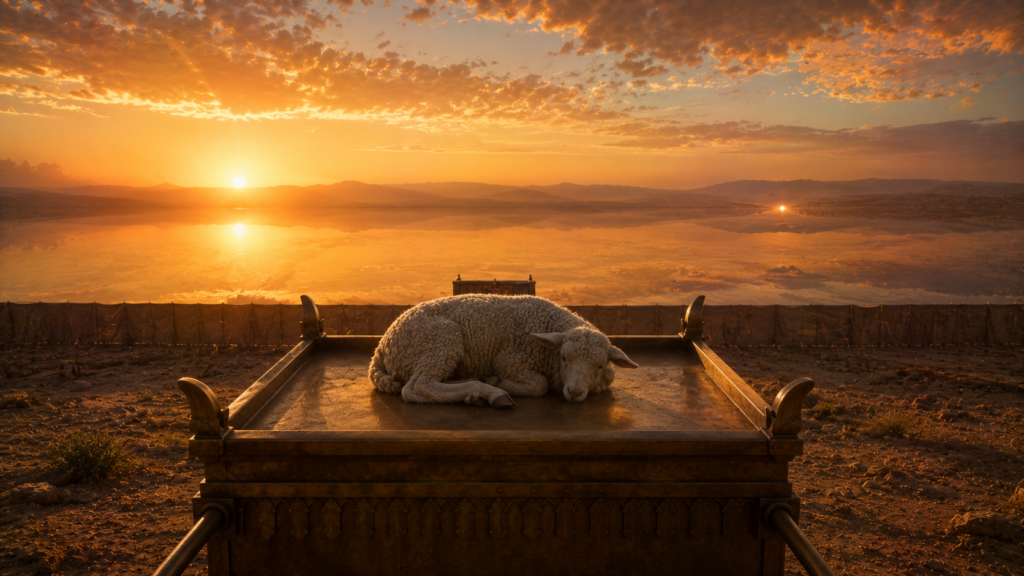
The calendar begins with the tamid, the continual offering, a lamb every morning and a lamb every evening, the unbroken heartbeat of Israel’s worship. Everything else, the Sabbath additions, the festival sacrifices, is layered on top of this daily baseline. The chapter teaches that worship is first a steady, daily, unspectacular constancy, and only then a calendar of special days. Before the feasts, the lamb at dawn and the lamb at dusk, every day, without fail.
A · Numbers 28:1-8 · The continual offering
³ “This is the offering made by fire which you shall offer to Yahweh: male lambs a year old without defect, two day by day, for a continual burnt offering. ⁴ You shall offer the one lamb in the morning, and the other lamb you shall offer at evening.”
- Two lambs, day by day (vv. 3-4). The foundation of the whole calendar is the tamid, the continual burnt offering: one lamb at morning, one at evening, every single day, with its grain and drink offerings. It is not tied to any festival or crisis; it simply never stops. The sanctuary’s fire is never cold, the worship never lapses. This daily offering is the baseline on which every special occasion is built.
- A continual burnt offering… a pleasant aroma (v. 6). The olah, the ascending whole offering (see the five offerings), is what is offered daily: the gift that goes up entirely to God. The nation begins and ends each day by sending up an unreserved gift. Morning and evening, Israel’s first and last corporate act is worship. The day is framed, dawn and dusk, by the ascending lamb.
- The tamid teaches that real worship is mostly daily and unspectacular. The festivals are glorious, but they sit on a foundation of plain, repeated, faithful constancy, the same lamb, the same hour, the same gift, day after day after day. The New Testament keeps the rhythm while changing its form: pray continually (1 Thessalonians 5:17), present your body as a living sacrifice as your daily worship (Romans 12:1), and rest in the one sacrifice offered once for all that makes the endless daily offerings unnecessary (Hebrews 10:11-14). The heartbeat the tamid established, ceaseless devotion, continues; its fulfillment is a life given continually to God.
Word study: tamid (תָּמִיד), “continual, perpetual, always”
The daily offering is the olah tamid, the “continual burnt offering,” and the word tamid means “continually, perpetually, always.” It governs the most important furniture of Israel’s worship: the continual bread on the table of the presence (Exodus 25:30), the lamp kept burning continually (Exodus 27:20), and this continual offering. Tamid names what never stops, the worship that is not occasional but constant, woven into the fabric of every day. Later Judaism named the daily offering itself simply the Tamid, and a whole tractate of the Mishnah describes it. When the daily offering was cut off, in the crises of Daniel and again at the temple’s destruction, it was felt as a wound at the center of national life: the tamid had ceased, the heartbeat had stopped. The word teaches that the deepest worship is not the high feast but the faithful daily return, the gift offered always, whether or not the day is special. The New Testament’s call to continual prayer and a life of unceasing offering takes its texture from this word.
B · Numbers 28:9-15 · Sabbath and new moon
⁹ “On the Sabbath day, two male lambs a year old without defect, and two tenths of an ephah of fine flour for a meal offering… ¹⁰ this is the burnt offering of every Sabbath, in addition to the continual burnt offering and its drink offering.”
- In addition to the continual burnt offering (vv. 10, 15). The phrase repeats and matters: the Sabbath and new-moon offerings are added on top of the daily tamid, never instead of it. The weekly and monthly rhythms intensify the worship without interrupting the daily baseline. The calendar layers special days over constant days; the extraordinary is built on the ordinary.
- On the Sabbath… at the new moons (vv. 9-15). The week is marked by a doubled offering on the Sabbath; the month is marked by a fuller offering at each new moon (Rosh Chodesh). Israel’s time is thus structured at every scale, day, week, month, by returning to God. The new generation is being given a way to keep the whole of time oriented toward the presence at its center (see the festival calendar). Settled life in the land, with its harvests and seasons, will still revolve around the worship of YHWH.
C · Numbers 28:16-31 · The spring festivals
¹⁶ “In the first month, on the fourteenth day of the month, is Yahweh’s Passover. … ²⁶ Also in the day of the first fruits… you shall have a holy convocation.”
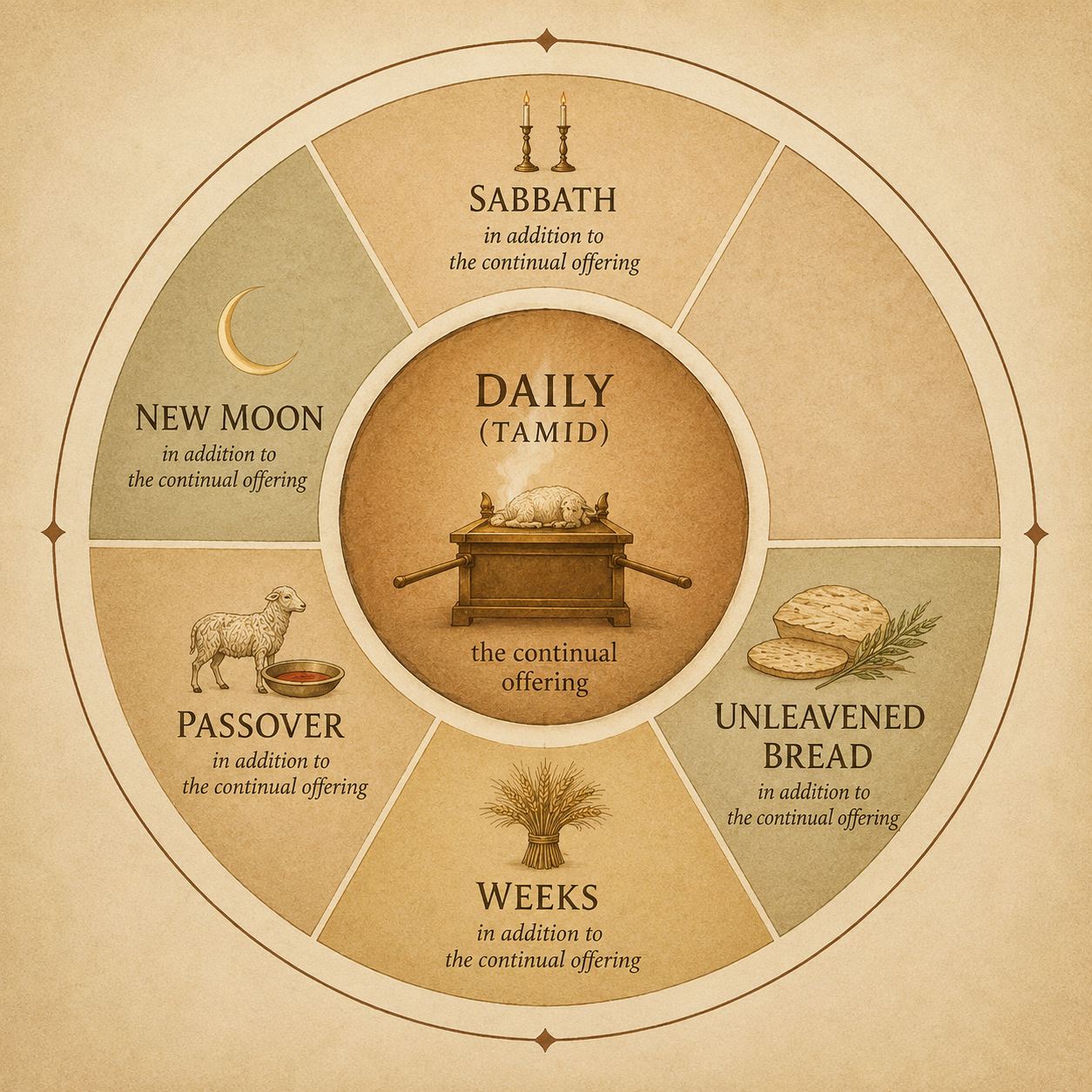
- Passover and Unleavened Bread (vv. 16-25). The chapter prescribes the public offerings for the spring festival that opens Israel’s sacred year: Passover, and the seven days of Unleavened Bread that follow, each day with its own substantial national sacrifice added to the tamid. The festival of deliverance (see the exodus pattern), which the new generation has kept only in the wilderness, will now anchor the spring of every year in the land.
- The day of the first fruits (vv. 26-31). Fifty days later comes the Feast of Weeks (Shavuot), the firstfruits of the wheat harvest, again with its prescribed offerings. This is the festival the New Testament knows as Pentecost, the day the Spirit was poured out on the whole gathered community (Acts 2), fulfilling Moses’s wish from chapter 11 that all God’s people would carry the Spirit. The calendar Israel was given here became the calendar in which God acted: the Spirit fell on the very feast Numbers 28 prescribes.
- The chapter’s logic, repeated at every level, is that worship saturates time. The day has its tamid; the week has its Sabbath; the month has its new moon; the year has its festivals, each adding to the daily baseline. A people whose time is so ordered cannot drift far from God, because every sunrise, every seventh day, every new moon, and every season calls them back. The calendar is a discipline of remembering, given to a generation that had watched its parents forget.
Reflection prompts
- The whole calendar rests on the tamid, the daily, unspectacular offering that never stops. Is your own life with God built on a faithful daily baseline, or only on occasional high points? What is your “lamb at morning and evening”?
- Every special offering is added to the continual one, never instead of it. Where have you let the extraordinary (a retreat, a crisis, a mountaintop) substitute for the ordinary daily return, rather than build on it?
- Israel’s time was structured at every scale to keep returning to God. What rhythms (daily, weekly, seasonal) actually orient your time toward God, and which ones have quietly fallen away?
Frameworks at play in this chapter: the festival calendar, the five offerings, the two generations.