
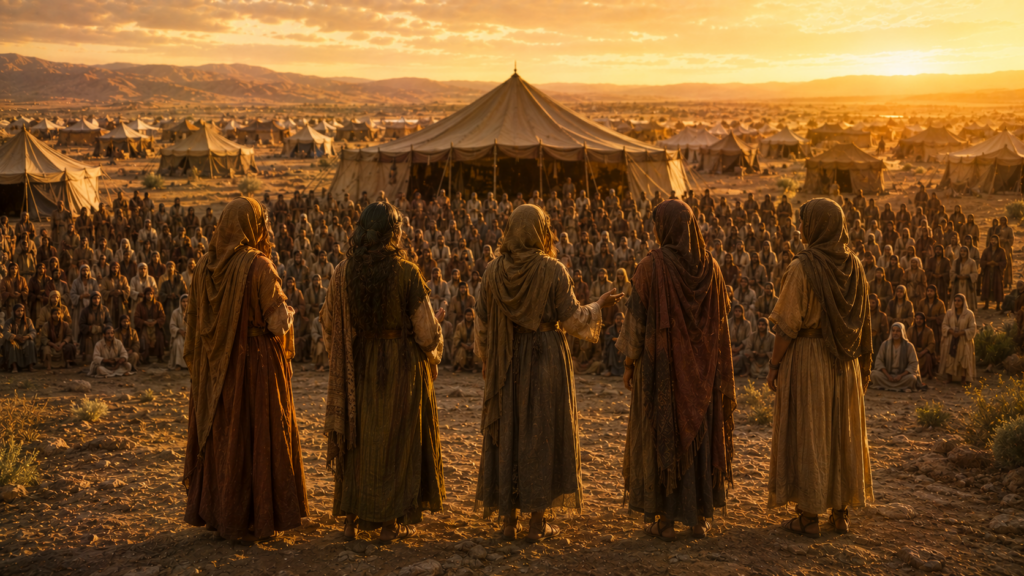
Chapter 27 secures two things the new generation will need: a just way to receive the land, and a leader to take them into it. First, five sisters, the daughters of Zelophehad, step forward with a problem the inheritance laws had not addressed. Their father died in the wilderness with no sons, and under the existing rules his family’s land would simply vanish from the tribal map. They petition Moses for their father’s inheritance, and Moses, rather than ruling on his own, brings their case to God, who declares: the daughters of Zelophehad are right. A landmark for women’s standing in Israel is established not over the women’s objection but in answer to their faithful, bold request.
Second, Moses, told again that he will die without entering the land, does not protest his own fate. He asks instead that God provide a successor, so that the people will not be like sheep without a shepherd. Joshua, the spy who trusted, the man in whom is the Spirit, is commissioned by the laying on of hands. The chapter is about the future of a people poised at the threshold: their inheritance justly secured, their leadership faithfully handed on.
A · Numbers 27:1-11 · The daughters who changed the law
⁴ “Why should the name of our father be taken away from among his family, because he had no son? Give to us a possession among the brothers of our father.” … ⁷ Yahweh spoke to Moses, saying, “The daughters of Zelophehad speak right. You shall surely give them a possession of an inheritance among their father’s brothers.”
- Five sisters step forward (vv. 1-2). Mahlah, Noah, Hoglah, Milcah, and Tirzah, named individually here as they were flagged in the census (26:33), come to the tent of meeting and stand before Moses, Eleazar, the leaders, and the whole assembly. It is a public, courageous act: five women without a male advocate, pressing a legal claim before the entire leadership of Israel. They do not complain or rebel; they make a reasoned appeal.
- Why should our father’s name be taken away? (v. 4). Their argument is precise and faithful. Their father died in the wilderness for his own sin (not in Korah’s rebellion, they carefully note), and with no son, his name and his portion in the land would simply be erased. They ask for an inheritance so that their father’s name is not lost. They are not grasping for themselves; they are seeking to preserve a family’s place in the promise. Their petition assumes the land really will be given, an act of faith in the very promise the spies’ generation despised.
- Moses brought their cause before YHWH (v. 5). Moses does not rule from his own authority, and he does not dismiss them. He takes the hard case to God, the same pattern as the second-Passover question (chapter 9). And God’s verdict is unambiguous: the daughters of Zelophehad speak right. Their claim becomes binding law for all Israel (vv. 8-11). Five women, by a bold and faithful appeal, change the inheritance law of the nation. (The case will be revisited and balanced in chapter 36, but the principle stands: they were right.)
Word study: shem (שֵׁם), “name,” and the inheritance that keeps a name alive
The daughters’ argument turns on shem, “name”: why should our father’s name be taken away? In Israel, a person’s name lived on through their inheritance in the land, the family plot that carried their identity into the future generations. To lose the land was to have the name blotted out, to disappear from the people of God’s story. The daughters are fighting for their father’s continued presence in the inheritance of Israel, and God honors the fight. The concern threads through the whole Hebrew Bible: the levirate marriage exists to raise up a name for the dead (Deuteronomy 25:6-7; the heart of the book of Ruth), and the prophets promise the faithful eunuch and the foreigner a name better than sons and daughters, an everlasting name that will not be cut off (Isaiah 56:4-5). The longing of Zelophehad’s daughters, that their father not be erased, is answered finally in the gospel’s promise that those who belong to God receive a new name and are written in a book that is never blotted out (Revelation 2:17; 3:5). To be remembered by God is to have a name that the loss of land, or even death, cannot take away.
Influence callout: the daughters of Zelophehad and the honoring of women’s agency
The tradition has long held these five sisters in high regard. Dean Ulrich’s study of their narrative notes how their story frames the inheritance legislation, the case appearing here and again in chapter 36, bracketing the whole section about the land with the question of those the system might leave out. The rabbis praised the daughters as wise and as skilled interpreters of Torah, women who perceived a gap in the law and addressed it rightly, and whose reading God himself vindicated. For a site that reads Scripture attentive to the women in the story (in the lane of scholars like Nijay Gupta on women in the early church), this episode matters: it is a moment where female agency is not merely tolerated but rewarded, where women’s faithful initiative changes the law of the nation, and where God’s own voice declares them right over against the existing custom. The daughters of Zelophehad are not a footnote to the inheritance laws; they are the reason a whole class of those laws exists, and the text honors them by name, five times, twice.
B · Numbers 27:12-23 · A shepherd for the people
¹⁶ “Let Yahweh, the God of the spirits of all flesh, appoint a man over the congregation, ¹⁷ who may go out before them, and who may come in before them, and who may lead them out, and who may bring them in; that the congregation of Yahweh not be as sheep which have no shepherd.”
- Go up… and you shall be gathered to your people (vv. 12-14). God tells Moses to climb the mountain and view the land he will not enter, then die, because of Meribah (chapter 20). Moses receives the sentence again without protest. The greatest leader in Israel’s history will see the promise from a distance and be buried outside it. The judgment stands, even on Moses.
- That the congregation not be as sheep without a shepherd (vv. 16-17). Moses’s response to his own death sentence is striking for what it is not about. He does not bargain for himself or lament his fate; he turns immediately to the people’s need. His one request is that God appoint a successor so Israel will not be leaderless, sheep without a shepherd. It is the prayer of a true shepherd: concerned for the flock’s future more than his own. The phrase will echo through Scripture, in the prophets’ indictment of Israel’s failed shepherds (Ezekiel 34) and supremely in Jesus, who saw the crowds harassed and helpless, like sheep without a shepherd, and was moved with compassion (Matthew 9:36; Mark 6:34). The need Moses names here is the need the Good Shepherd finally meets.
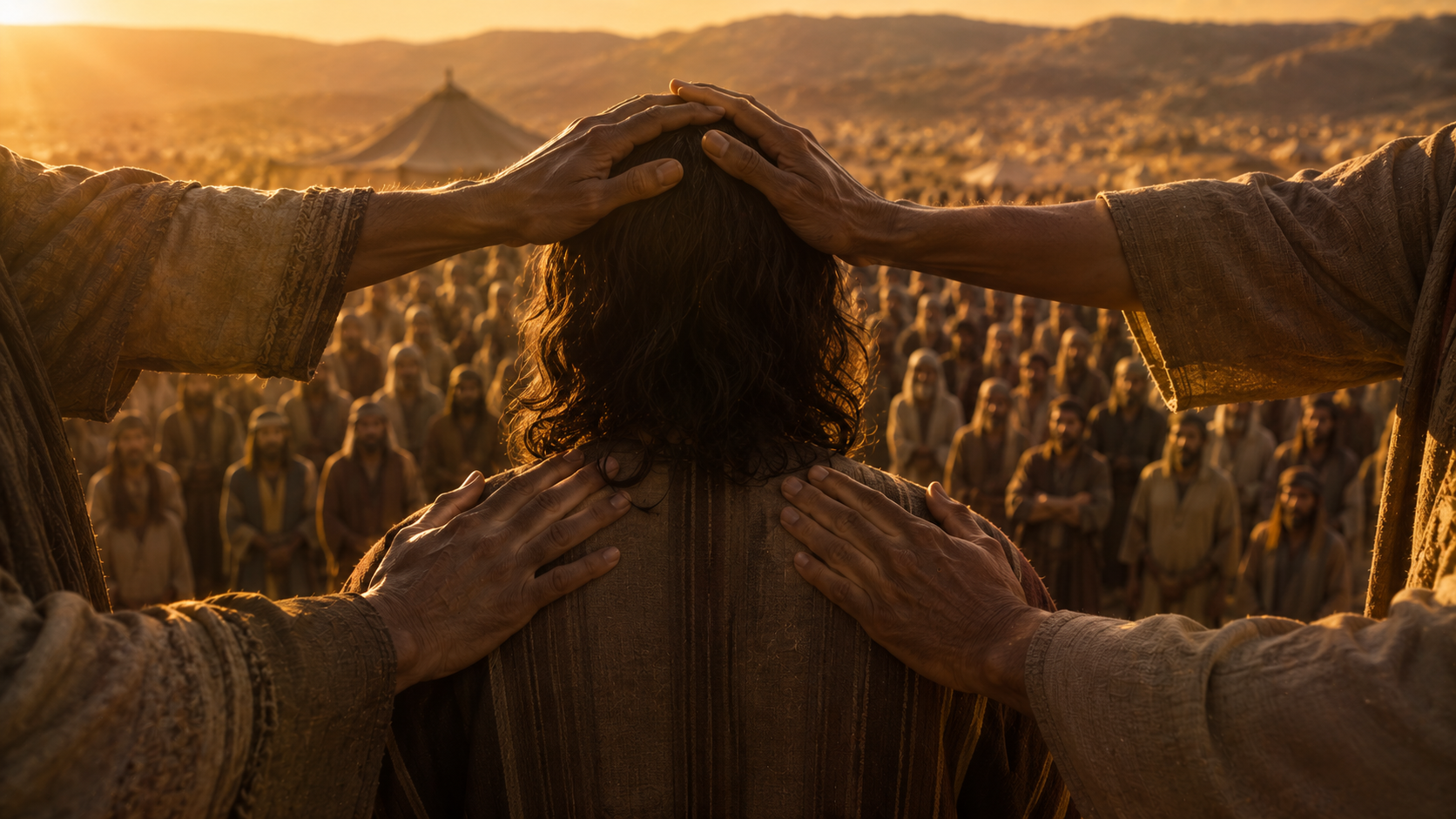
- Joshua, a man in whom is the Spirit (vv. 18-23). God names Joshua, the spy who trusted and one of the only two survivors of the old generation. Moses lays his hands on him before the whole assembly and invests him with authority, and the Spirit that rested on Moses now rests on his successor. The laying on of hands becomes the enduring pattern of commissioning in the people of God (the appointing of leaders in Acts 6:6; 13:3; the ordination language of the pastoral letters). Leadership is handed on, publicly, prayerfully, with the Spirit, so that the work outlives the leader. Moses will die, but the people will not be abandoned. The shepherd has provided a shepherd.
Reflection prompts
- Five women without an advocate made a bold, faithful appeal, and God declared them right, changing the law of the nation. Where might a gap or injustice need someone to step forward and ask, faithfully and publicly, rather than stay silent? Could that someone be you?
- Facing his own death, Moses’s first concern is not himself but that the people not be left like sheep without a shepherd. When you think about what you will leave behind, are you preparing well for those who come after, or assuming it depends on you staying?
- The daughters fought so their father’s name would not be erased, and Scripture answers that longing with a name God never blots out. What does it mean to you that being remembered by God is a security that the loss of everything else cannot touch?
Frameworks at play in this chapter: the two generations, wilderness and liminality.