
Chapter 21 turns a corner. After ten chapters of death and rebellion, the new generation starts to fight, and win. When the Canaanite king of Arad attacks, Israel vows the place to God and is given victory at Hormah, the very place where the old generation had been beaten back after the spy debacle (14:45). Same place, opposite outcome, because this time God is with them. By the chapter’s end, Israel has defeated Sihon and Og and taken the first territory east of the Jordan. The mood of the book is shifting from the graves of the old generation toward the inheritance of the new.
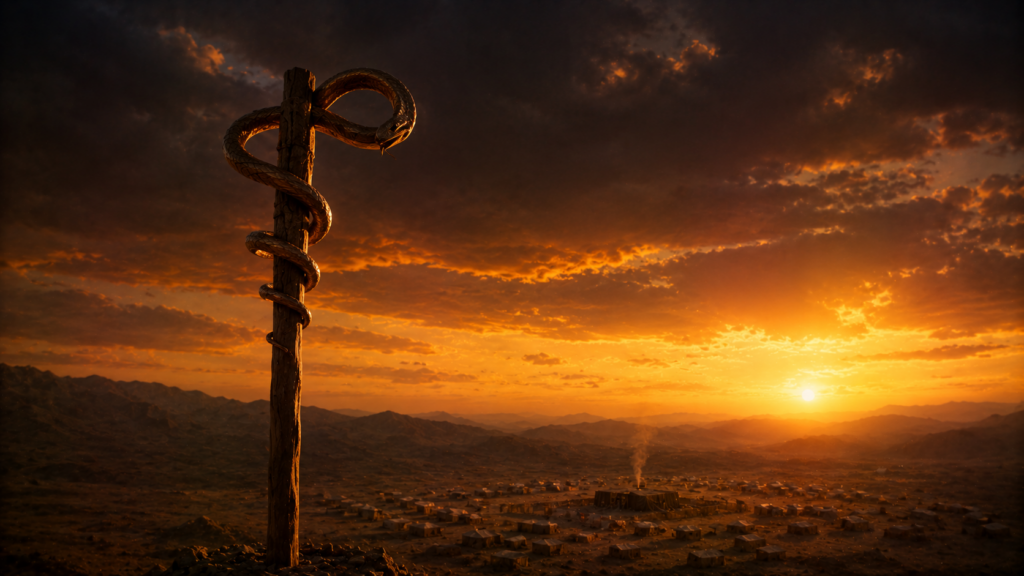
At the center of the chapter sits one of Scripture’s strangest and most important images. When the people complain again and venomous serpents strike the camp, God’s remedy is not to remove the serpents but to have Moses lift up a bronze serpent on a pole, so that everyone who looks at it lives. The image of the very thing killing them, raised up, becomes the means of their healing. Jesus will reach for this picture to explain his own death: as Moses lifted up the serpent in the wilderness, so must the Son of Man be lifted up. The chapter that turns toward life does so through a lifted-up sign of the curse.
A · Numbers 21:1-9 · Hormah won, and the serpent lifted up
⁵ The people spoke against God and against Moses: “Why have you brought us up out of Egypt to die in the wilderness? For there is no bread, there is no water, and our soul loathes this disgusting food.” … ⁸ Yahweh said to Moses, “Make a venomous snake, and set it on a pole. It shall happen that everyone who is bitten, when he sees it, shall live.”
- They utterly destroyed them… Hormah (vv. 1-3). The chapter opens with a battle that rewrites an earlier shame. Arad attacks; Israel vows the cities to God (the herem vow, see holy war and herem) and prevails, naming the place Hormah. The reader who remembers chapter 14 feels the reversal: at Hormah the old generation, charging up without God after the verdict, was crushed (14:45); here, going up with God, the new generation wins. The difference, again, is not the enemy or the terrain. It is whether YHWH goes with them.
- Our soul loathes this disgusting food (v. 5). Then the old reflex returns. The people complain about the manna in the ugliest terms yet, calling God’s daily provision disgusting. Venomous serpents come among them and many die. The wilderness is not finished testing this people, and contempt for grace still has consequences.
- Everyone who is bitten, when he sees it, shall live (vv. 8-9). The remedy is bizarre and pointed. God does not remove the serpents; he tells Moses to forge a bronze serpent and lift it on a pole, so that anyone bitten who looks at it lives. The cure is an image of the curse itself, raised up where all can see it. Healing comes not by fleeing the serpent but by looking at the lifted-up serpent in faith. The bitten are saved by a gaze.
Word study: nachash / nechoshet (נָחָשׁ / נְחֹשֶׁת), “serpent” and “bronze,” and the saving look
The Hebrew puns. The serpent is nachash; the bronze is nechoshet; Moses makes a nechash nechoshet, a bronze serpent, the words almost echoing each other. (The same root nachash also means to practice divination, the serpent being the ancient symbol of hidden, dangerous power.) But the chapter’s deepest word is the verb of looking. Where the spies’ eyes failed them (chapter 13, “we were grasshoppers in our own sight”) and the tassels were given so Israel would see and remember (chapter 15), here the bitten are told to look and live. The gaze that saves is a gaze of trust, fixing the eyes on the remedy God has provided rather than on the wound. The whole movement of the wilderness, from eyes that failed, to eyes retrained by a thread of blue, to eyes that look up and live, runs through this verb. Salvation, in the bronze-serpent story, is what happens when a dying person looks at what God has lifted up.
Influence callout: John 3:14 and the lifted-up serpent (with a Nehushtan caution)
Jesus makes this chapter the key to his own death. As Moses lifted up the serpent in the wilderness, so must the Son of Man be lifted up, that whoever believes in him may have eternal life (John 3:14-15). The parallel is exact and startling: the image of the curse (a serpent, the very thing killing them; for Jesus, a Roman cross, the very emblem of the curse, Galatians 3:13) is lifted up, and those who look in faith live. Looking becomes believing; the gaze becomes trust. The 1517 writers (Jeffrey Pulse, and others in that stream) press the cruciform reading: at the cross we look at the thing that should kill us and find it has become the source of life (see the cruciform hermeneutic). But the chapter carries a sharp caution too. Centuries later, Israel kept the bronze serpent and began to worship it, burning incense to it, until King Hezekiah broke it in pieces, calling it Nehushtan, “just a bronze thing” (2 Kings 18:4). The God-given sign of grace had been turned into an idol. The warning lands on every age: even the truest means of grace can be corrupted into an object of worship in its own right. The serpent was meant to point the eyes to God, not to capture them. What heals when it directs us to God destroys when it replaces him.
B · Numbers 21:10-20 · A song at the well
¹⁷ Then Israel sang this song: “Spring up, well! Sing to it,”

- The Book of the Wars of YHWH (v. 14). The chapter quotes a fragment from a now-lost collection of war poetry, the Book of the Wars of YHWH. The reference is a small window onto Israel’s wider literary world: there were songs and poems celebrating God’s victories that did not all make it into Scripture (see holy war and herem). The Bible knows itself to be drawing on a larger tradition of remembering what God had done in battle.
- Spring up, well! (vv. 16-18). Then, remarkably, Israel sings. At Beer (“well”), God gives water, and the people respond not with complaint but with a work-song, calling the well to spring up as the leaders dig. After chapters of grumbling, the new generation sings over a gift of water. The small shift in tone is the chapter’s quiet evidence that a different spirit is rising. The same provision that occasioned bitter quarreling at Meribah (chapter 20) here occasions a song.
C · Numbers 21:21-35 · Sihon and Og
³⁴ Yahweh said to Moses, “Don’t fear him, for I have delivered him into your hand, with all his people, and his land. You shall do to him as you did to Sihon king of the Amorites, who lived at Heshbon.”
- Sihon… Og (vv. 21-35). When Sihon king of the Amorites refuses passage and attacks, Israel defeats him and takes his land; the same happens with Og king of Bashan, a giant of the old Rephaim line (Deuteronomy 3:11 remembers his enormous iron bed). The conquest east of the Jordan has begun. The new generation does what the old refused: it faces the fortified cities and the giants, and with God it wins.
- Don’t fear him, for I have delivered him into your hand (v. 34). God’s word to Israel about Og is the exact antidote to the spies’ report. The ten had said we are not able because of the giants; God now says do not fear, I have given him to you. The new generation hears the same kind of opposition described and responds with trust instead of terror. The contrast with chapters 13 and 14 is the point: this is what it looks like when a people does the math with God in it (see the two generations).
- These victories are also the beginning of the herem texts the book will not let the reader rush past. Chapter 21 introduces the conquest, and chapter 31 will bring its hardest form. The site reads these wars through holy war and herem: set in their ANE world, held honestly, and finally read through the cross, where the divine warrior conquers the last enemy by dying rather than killing. For now, the chapter’s note is simpler and hopeful: the generation that will inherit the land has begun to trust the God who fights for them.
Reflection prompts
- The bitten were healed not by looking away from the serpent but by looking at the lifted-up remedy God provided. Where are you fixated on the wound, when God is asking you to fix your eyes on what he has lifted up?
- The same bronze serpent that healed later became an idol Israel had to destroy. Where might a genuine means of grace in your life (a practice, a leader, a tradition) have quietly become an object you cling to instead of the God it was meant to point you toward?
- Hormah was a defeat for the old generation and a victory for the new, same place, opposite outcome, because of whether God was with them. Where are you tempted to charge ahead on your own strength, and where are you invited to go forward only with God?
Frameworks at play in this chapter: holy war and herem, the cruciform hermeneutic, the two generations.