

Chapter 6 has two halves that look unrelated and are deeply joined. The first is the Nazirite vow, the way an ordinary Israelite, man or woman, could take on a priest-like consecration for a season. The second is the priestly blessing, the most famous benediction in the history of the people of God, by which the priests place YHWH’s Name on the whole community. Both halves are about the same thing: holiness reaching beyond the priesthood. In the first, a layperson draws near to God like a priest; in the second, the entire people receives the Name the way the high priest wears it on his forehead.
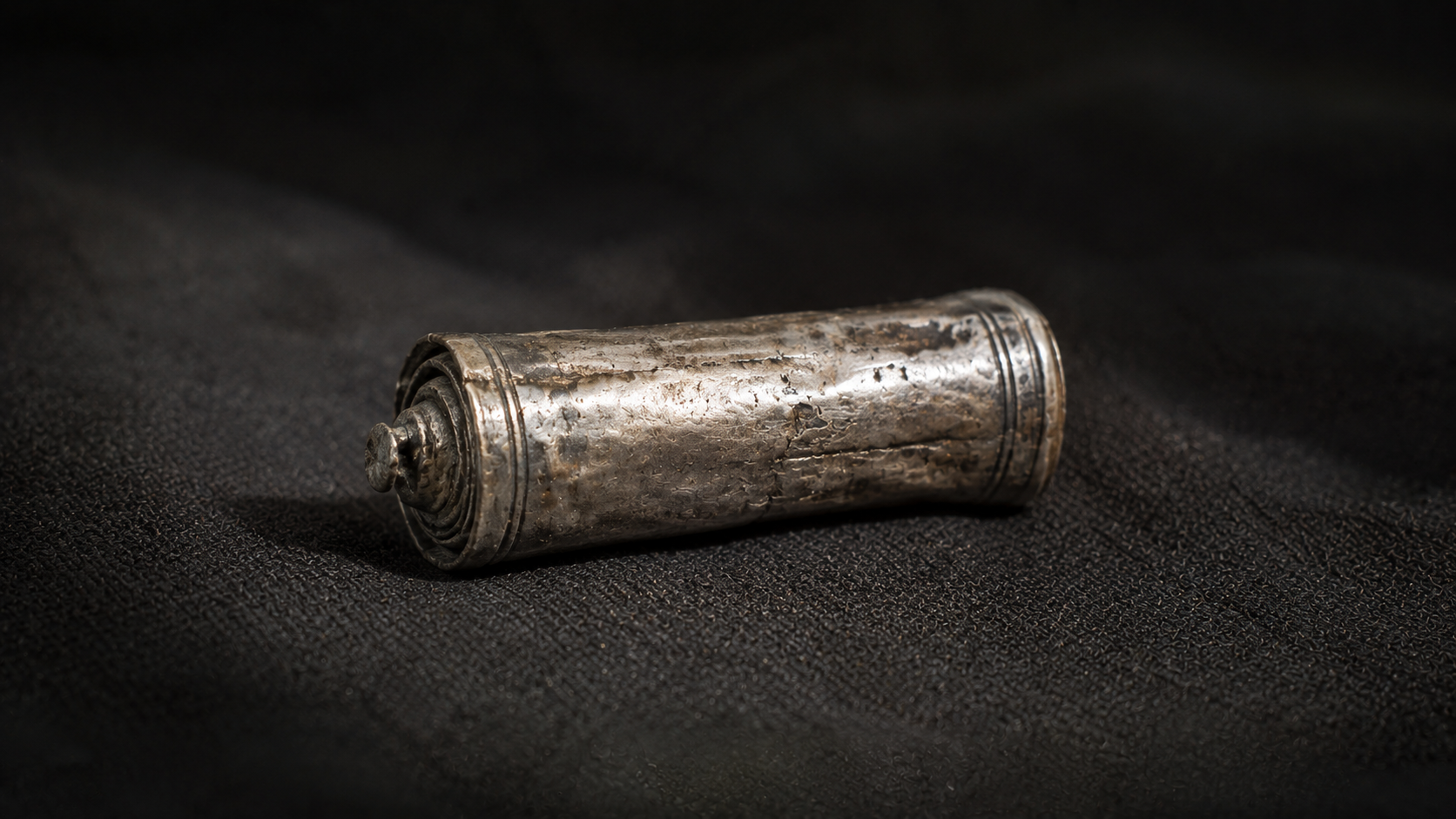
That second half is also where the chapter touches the ground in a remarkable way. In 1979, two tiny silver scrolls were found in a burial cave on the shoulder of the Hinnom Valley in Jerusalem, inscribed with versions of this blessing. They date to around the seventh century BCE, which makes them the oldest fragments of biblical text ever discovered, older than the Dead Sea Scrolls by some four hundred years. People wore these words on their bodies. The chapter’s theology, that the Name is placed on the people, turns out to have been literally true: Israelites carried the blessing as silver against the skin.
A · Numbers 6:1-8 · The Nazirite vow
² “Speak to the children of Israel, and tell them: ‘When either man or woman shall make a special vow, the vow of a Nazirite, to separate himself to Yahweh, ³ he shall separate himself from wine and strong drink. He shall drink no vinegar of wine, or vinegar of fermented drink, neither shall he drink any juice of grapes, nor eat fresh grapes or dried. … ⁵ “‘All the days of his vow of separation no razor shall come on his head, until the days are fulfilled in which he separates himself to Yahweh. He shall be holy. He shall let the locks of the hair of his head grow long.’”
- Either man or woman (v. 2). The vow is open to anyone. This is its quiet radicalism: a layperson, of either sex, can voluntarily take on a degree of holiness normally reserved for priests. The priesthood is inherited and male; the Nazirite vow is chosen and open to all. The chapter democratizes consecration, making nearness to God available to whoever will separate themselves for it.
- To separate himself to Yahweh (v. 2). The word Nazirite comes from the Hebrew nazar, “to separate, to consecrate, to set apart.” The vow is defined by three abstentions: nothing from the grapevine (no wine, no grapes, not even the seeds or skins), no razor on the head, and no contact with a corpse, even for a parent who dies. Each abstention marks a boundary the Nazirite will not cross for the duration of the vow.
- He shall let the locks of the hair of his head grow long (v. 5). The uncut hair is the visible sign, and the chapter’s vocabulary is striking: the long hair is later called the nezer, the same word used for the high priest’s golden crown or consecration-plate (6:7; compare Exodus 29:6). The Nazirite wears his consecration as hair the way the high priest wears it as gold. A person walking through the camp with long, uncut hair is, in effect, wearing a crown that says set apart for YHWH. The consecration is not hidden in the heart; it is grown out in public.
Word study: nazir / nezer (נָזִיר / נֵזֶר), “consecrated one” / “crown”
The vow’s name, nazir, and its sign, the nezer (the uncut hair, named with the word for a royal or priestly crown), come from the root nazar, “to separate, dedicate.” The cluster ties three images together: separation (the Nazirite is set apart), consecration (dedicated to YHWH), and crown (the visible mark of that dedication worn on the head). The same nezer sits on the high priest’s turban as the gold plate engraved “Holy to the LORD” (Exodus 28:36; 39:30), and it crowns the king at his coronation (2 Kings 11:12). The Nazirite, then, wears a layperson’s version of priestly and royal consecration. The whole later New Testament image of believers as a royal priesthood (1 Peter 2:9) and as those who will be given a crown (2 Timothy 4:8; Revelation 2:10) draws on this fusion of priestly, royal, and consecrated identity, made available, already in Numbers 6, to any Israelite willing to take the vow.
B · Numbers 6:9-21 · Fragility and completion
⁹ “‘If any man dies very suddenly beside him, and he defiles the head of his separation, then he shall shave his head in the day of his cleansing. On the seventh day he shall shave it.’”
- If any man dies very suddenly beside him (v. 9). The vow is fragile. A single accident, someone dropping dead nearby, defiles the Nazirite through corpse-contact, and the days already completed are lost; he must shave, wait, bring offerings, and start over (6:9-12). The chapter is honest that consecration in a world full of death and accident is precarious. Holiness is not a possession you secure once; it is a state that can be interrupted by circumstances entirely outside your control.
- The completion (vv. 13-20). When the vow’s term is fulfilled, the Nazirite brings offerings, shaves the consecrated head at the door of the Tent, and burns the hair under the peace offering. The consecration that grew out in public is returned to God in smoke. The vow has a clean beginning and a clean end; it is a season of intensified devotion, not a permanent caste.
- The lifelong Nazirites. While most vows were temporary, Scripture knows three figures consecrated as Nazirites from birth, each by divine designation: Samson (Judges 13:5), Samuel (1 Samuel 1:11), and John the Baptist (Luke 1:15, he shall drink no wine or strong drink). Paul himself appears to take a temporary Nazirite-style vow (Acts 18:18, cutting his hair at the vow’s end) and pays for others’ vows to be completed (Acts 21:23-26). The vow threads through the whole canon as the form available to anyone who wants to draw nearer for a time, and the form God sometimes lays on those he sets apart for a life.
Influence callout: Jay Sklar (Story of God; the reach of holiness)
Sklar reads the Nazirite vow as evidence of one of the deepest currents in the Torah: holiness is not meant to stay quarantined in the priesthood but to spread. The whole nation is called a kingdom of priests (Exodus 19:6), and the Nazirite vow is a concrete way that calling becomes available to individuals. An ordinary Israelite, by vow, could live for a season under priest-like constraints and priest-like nearness to God. Sklar’s pastoral point is that the longing to draw nearer is not presumption to be discouraged but desire to be honored, and the Torah makes structured room for it. The vow says that consecration is not only assigned (as the priesthood is) but can also be chosen, and that God receives the one who chooses it. The trajectory runs straight to the New Testament’s insistence that nearness to God is now open to all (Hebrews 10:19-22): the reach of holiness that Numbers 6 opens to the willing layperson becomes, in Christ, the standing invitation to everyone.
C · Numbers 6:22-27 · The priestly blessing
²⁴ “‘Yahweh bless you, and keep you. ²⁵ Yahweh make his face to shine on you, and be gracious to you. ²⁶ Yahweh lift up his face toward you, and give you peace.’ ²⁷ “So they shall put my name on the children of Israel; and I will bless them.”
- The ascending structure (vv. 24-26). The blessing is built as a deliberate crescendo. In Hebrew the three lines grow line by line, three words, then five, then seven, widening like arms opening progressively further. The movement runs from protection (bless and keep), to grace (the shining face, favor), to peace (the lifted face, shalom). Each line names YHWH as the subject; each adds a fuller gift; and the whole arrives at shalom, wholeness, the comprehensive flourishing of life put right. The blessing does not merely wish the people well. It maps the shape of God’s good intent toward them, from safety to favor to peace.
- Yahweh make his face to shine on you (v. 25). The “shining face” is the language of welcome and favor; a face turned toward you and lit up is the opposite of a face hidden or turned away (the dread of Psalm 13:1, how long will you hide your face?). For God’s face to shine is for God to be glad to see you. The 1517 writers in this stream put it simply: for God to shine his face on us is another way of saying that Christ is with us, the favor of God made personal and present.
- They shall put my name on the children of Israel (v. 27). This is the verse that interprets the whole blessing, and it is the heart of bearing God’s name. The priests do not generate the blessing; they place the Name on the people, and then God says, and I will bless them. The blessing is the ritual by which Israel is marked as YHWH’s, the way the high priest is marked by the plate on his forehead. The people do not seize the Name; it is laid on them as a gift, and with the Name comes the blessing. The vocation and the gift are the same act: to belong to God and to be blessed by God are one thing.
Influence callout: the Ketef Hinnom amulets (the oldest Scripture, worn on the body)
The two silver scrolls found at Ketef Hinnom in 1979 are inscribed with versions of this blessing and date to roughly the seventh century BCE, the oldest known fragments of biblical text by a margin of centuries. They were rolled tight and almost certainly worn as amulets, words of blessing carried against the skin. The find lands precisely on the chapter’s own claim. Numbers 6:27 says the Name is placed on the people; the amulets show Israelites doing exactly that, literally wearing the blessing and the Name on their bodies. The archaeology and the theology meet: to be blessed is to carry the Name. The trajectory completes in the last vision of Scripture, where the servants of God see his face and his name will be on their foreheads (Revelation 22:4). The high priest’s plate, the Nazirite’s crown, the silver amulet, and the blessing placed on the wilderness camp all converge there: a people who carry the Name of the God whose face, at last, shines fully on them.
Reflection prompts
- The Nazirite vow let an ordinary person choose a season of intensified nearness to God. Is there a season or a practice you have wanted to take on, not as a permanent identity but as a chosen time of drawing nearer? What has kept you from it?
- The blessing moves from being kept, to being favored, to being given peace, and God himself is the one who blesses. Sit with the three lines slowly. Which of the three, protection, favor, or wholeness, do you most need to hear spoken over you right now?
- The Name is placed on the people as a gift, and to carry it is both an honor and a responsibility (see bearing God’s name). If you bear God’s name, where is your life making that Name weighty and good to the people watching, and where might it be emptying it?
Frameworks at play in this chapter: bearing God’s name, the two generations.