

In the middle of a book about a generation dying in the wilderness, chapter 19 provides the ritual for the most common impurity that death produces: contact with a corpse. A red heifer, unblemished and never yoked, is slaughtered and burned outside the camp, and its ashes are mixed with fresh water to make the water of cleansing, sprinkled on anyone defiled by a dead body. Given how many will die in the coming chapters, this is not an abstract law. It is the maintenance procedure for a camp surrounded by graves.
The ritual is famous for two puzzles. First, it works backward from intuition: the same ashes that cleanse the unclean person defile the clean people who prepare them. Death-purification itself carries a trace of death. Second, the Torah introduces it as the supreme example of a chukkah, a statute given without a stated reason, and the Jewish tradition treats it as the law whose logic eludes even the wisest. The chapter teaches obedience to a God whose holiness is not always explicable, and it hands the New Testament one of its richest pictures of the cross.
A · Numbers 19:1-10 · The heifer burned outside the camp
² “This is the statute of the law which Yahweh has commanded. Tell the children of Israel that they bring you a red heifer without spot, in which is no defect, and which was never yoked.”
- A red heifer without spot… never yoked (v. 2). The animal is specific: a red (reddish-brown) cow, flawless, that has never borne a yoke, never been put to ordinary labor. Like every sacrifice it must be unblemished, and like a few special offerings it must be unworked, set apart from common use for this single purpose. Its rarity made it precious; the rabbinic tradition counted only a handful of qualifying heifers in all of Israel’s history.
- Outside the camp… burned (vv. 3-6). The heifer is slaughtered and burned entirely outside the camp (see outside the camp), with cedar, hyssop, and scarlet thrown into the fire. This is the zone of impurity and bearing-away, the same zone where the scapegoat went and where, Hebrews will note, Jesus suffered (Hebrews 13:11-13). The cleansing for death is produced in the place death belongs, outside the boundary of the holy camp.
- Kept for the water of cleansing… it is a sin offering (v. 9). The ashes are gathered and stored, to be mixed with living water (fresh, running water) whenever someone needs purifying. The text calls the heifer a chatta’t, a sin/purification offering (see the five offerings and kipper / atonement): its death deals with the contamination that contact with death produces. A single animal’s death yields a supply of cleansing that serves the whole community for years.
B · Numbers 19:11-22 · The paradox of the cleansing
¹¹ “He who touches the dead body of any man shall be unclean seven days.”
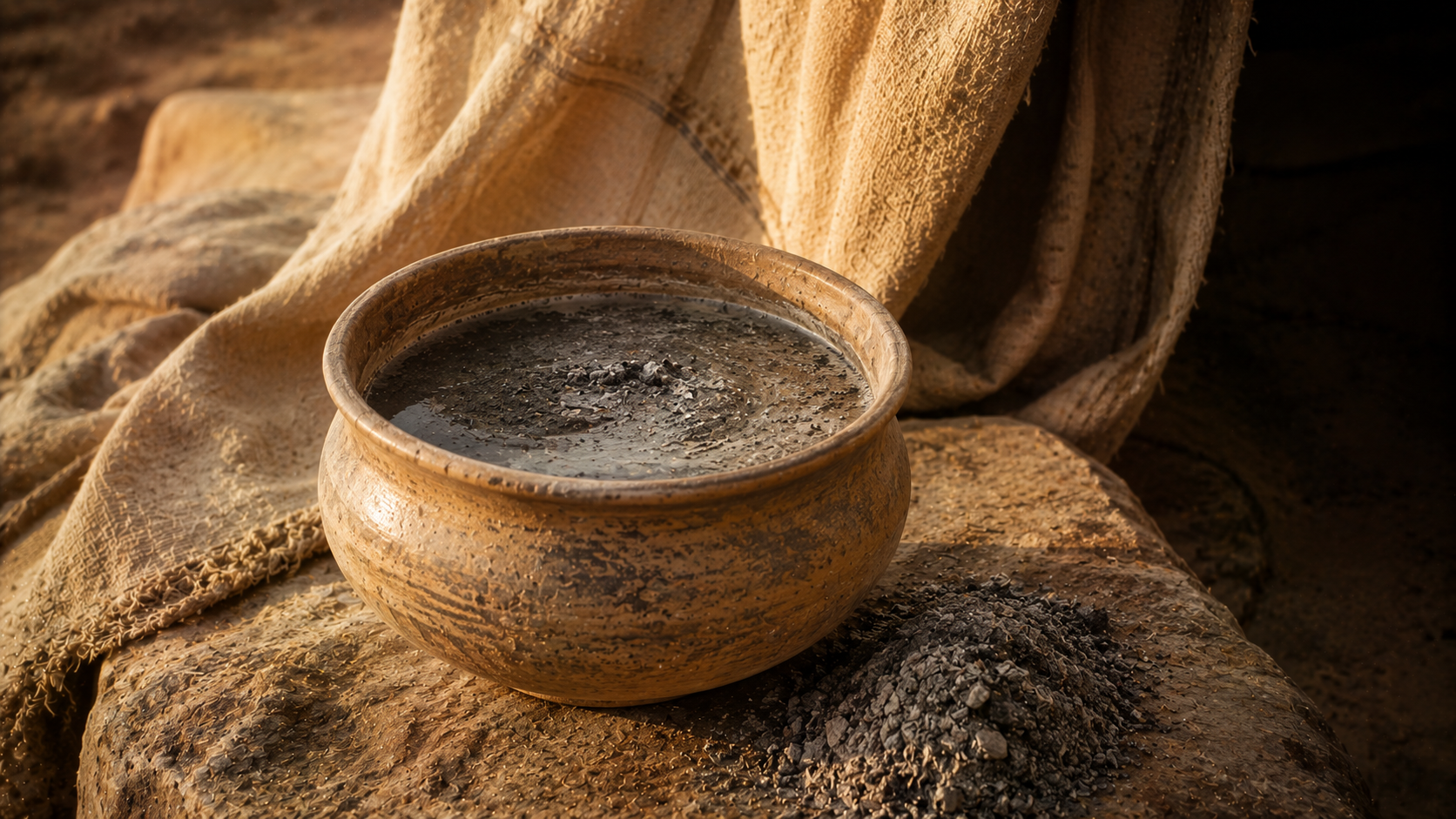
- Contact with death is the deepest impurity (vv. 11-16). To touch a corpse, or even to be in the tent where someone dies, or to touch a grave, makes a person unclean for seven days. Death is the great enemy and the great contaminant; proximity to it pushes a person to the far edge of the purity system. In a wilderness generation under sentence of death, this is the impurity that will touch nearly everyone, repeatedly.
- The water cleanses the unclean and defiles the clean (vv. 17-22). Here is the chapter’s strangest feature. The water of cleansing, sprinkled on the corpse-defiled person on the third and seventh days, purifies them. But the clean person who prepares the heifer, gathers the ashes, or sprinkles the water becomes unclean by handling it. The remedy carries a trace of what it remedies. The death that cleanses death also touches those who administer it. The ritual enacts a costly truth: dealing with death’s defilement is not free; it transfers something to the one who does the cleansing.
- This paradox is exactly what makes the heifer such a fertile image for the cross. The one who cleanses takes the defilement onto himself. The clean one is made unclean so the unclean can be made clean. The New Testament will say it directly of Christ, who knew no sin yet was made sin for us (2 Corinthians 5:21), bearing the contamination outside the camp so the defiled could be cleansed (see the cruciform hermeneutic).
Word study: chukkah (חֻקָּה), “statute,” and the law no one could explain
Verse 2 introduces the red heifer as zot chukkat ha-Torah, “this is the statute of the law.” A chukkah (or chok) is a decree given without a stated reason, distinguished in the tradition from a mishpat (a judgment whose justice is evident, like laws against theft). The red heifer became the paradigm of the inexplicable statute. A famous rabbinic tradition has Solomon, wisest of men, confessing that this one law defeated him: I said, I will be wise, but it was far from me (Ecclesiastes 7:23, read by the rabbis as Solomon’s surrender before the red heifer). The chapter is therefore a school of trust. Some of God’s holiness can be reasoned out; some of it must simply be obeyed because he is God and his ways are higher (Isaiah 55:8-9). The red heifer stands in Scripture as the law that humbles the wise, the place where even Solomon’s wisdom bows to a holiness it cannot fully map. That posture, obedience that outruns explanation, is itself part of what the chapter teaches.
Influence callout: Hebrews 9 and the ashes of the heifer
The book of Hebrews seizes on this ritual to make its central argument about the cross. If the blood of goats and bulls and the ashes of a heifer, sprinkling those who have been defiled, sanctify for the purification of the flesh, how much more will the blood of Christ, who through the eternal Spirit offered himself without blemish to God, purify our conscience from dead works to serve the living God (Hebrews 9:13-14). Hebrews reads the heifer as a true and God-given cleansing that nonetheless reached only the outside, the flesh, and pointed beyond itself to a cleansing that reaches the conscience. Several threads of the chapter converge in that reading: the unblemished victim, the death outside the camp, the cleansing specifically from contact with death (“dead works”), and the paradox by which the one who cleanses takes the defilement on. The patristic tradition saw the same thing, reading the red heifer’s reddish color, its burning outside the city, and even the cedar, hyssop, and scarlet (the materials of the crucifixion scene) as figures of Christ. The site honors the heifer’s own weight in Israel’s life first; but the trajectory Hebrews draws is undeniable, and it begins here, with ashes that cleanse those who live among the graves.
Reflection prompts
- The water that cleanses the defiled also defiles the one who administers it. Cleansing death’s contamination was never free. Where have you seen someone take on a cost in order to make another person clean or whole? What does that reveal about the cross?
- The red heifer is the law the wise could not explain, and Israel obeyed it anyway. Where in your life is God asking for trust that outruns your ability to reason out the why?
- The ritual exists because the camp is surrounded by death and still has to live near a holy God. Where does death (loss, grief, mortality) touch your life, and what would it mean to bring even that to God rather than letting it keep you at a distance?
Frameworks at play in this chapter: outside the camp, kipper / atonement, the cruciform hermeneutic.