
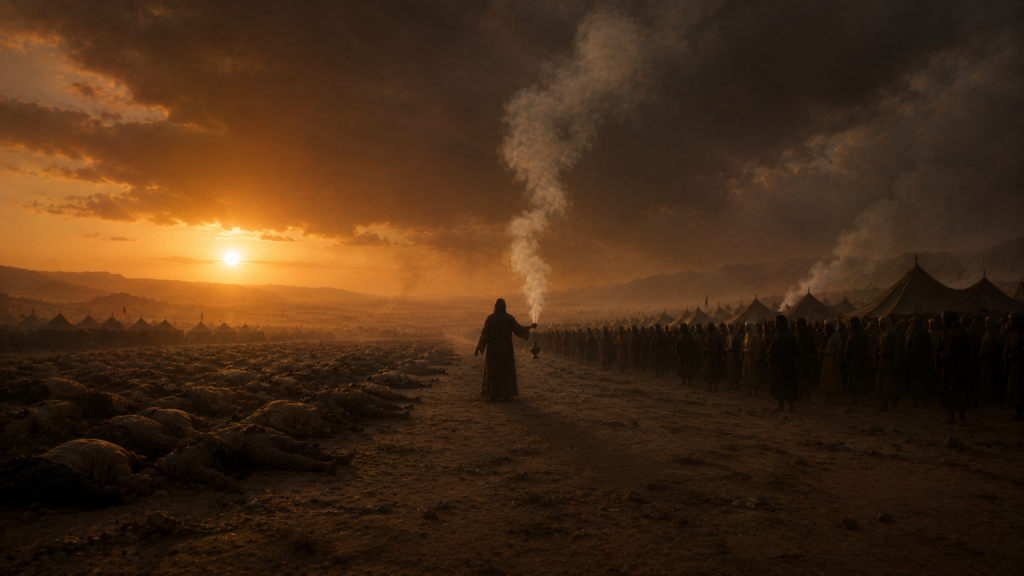
Korah, a Levite, gathers Dathan, Abiram, and two hundred fifty leaders of the congregation and confronts Moses and Aaron with a slogan that sounds unimpeachable: all the congregation is holy, every one of them, and YHWH is among them. Why then do you exalt yourselves above the assembly? It is the language of equality, and it masks a grasp for an office that was never offered. Korah is not content with the genuine honor of Levitical service; he wants the priesthood too. The chapter is a study in how rebellion against God-given order can wear the costume of fairness.
The judgment that follows is among the most severe in the Torah: the earth opens and swallows the ringleaders, fire consumes the two hundred fifty, and a plague breaks out the next day when the congregation blames Moses for the deaths. This commentary will not soften the severity. But it will also not miss where the chapter’s heart finally lands, on Aaron running into the middle of the dying with a censer of incense and standing between the dead and the living until the plague stops. The chapter that begins with a grab for the priesthood ends with the true priest spending himself to save the very people who turned on him.
A · Numbers 16:1-11 · Rebellion in the language of equality
³ They assembled themselves together against Moses and against Aaron, and said to them, “You take too much on yourself, since all the congregation are holy, everyone of them, and Yahweh is among them! Why then do you lift yourselves up above Yahweh’s assembly?”
- All the congregation are holy (v. 3). The slogan is, in one sense, true. Israel is a holy nation (Exodus 19:6); God is among them. Korah weaponizes a true premise for a false conclusion. Because all are holy, he argues, no one should hold a distinct office, and Moses and Aaron are merely self-promoters. The rhetoric is seductive precisely because it borrows the language of Israel’s real dignity to attack the order God himself established.
- You take too much on yourselves (v. 3). Korah accuses Moses and Aaron of grasping. The irony is total: the man accusing the leaders of seizing power is the one actually seizing for power. Projection is the rebellion’s native tongue. Korah’s complaint describes Korah.
- Is it a small thing… that you seek the priesthood also? (vv. 8-11). Moses exposes the real motive. Korah is a Levite, already set apart for the honored service of the tabernacle (chapters 3, 8). That is not enough for him; he wants the priesthood. Moses names it: you and all your company have gathered together against YHWH. The rebellion is not finally against Moses’s leadership style but against God’s assignment of roles. To despise the place God gave you while grasping for the place he gave another is, Moses says, to set yourself against God.
Word study: rav lakem (רַב־לָכֶם), “you have gone too far” / “enough!”
Korah’s opening charge is rav lakem, literally “much to you,” an idiom meaning “you take too much on yourselves, you have gone too far” (v. 3). Moses throws the very same phrase back: rav lakem, you sons of Levi (v. 7), “you have gone too far.” The two-word volley frames the whole conflict. Korah says Moses has overreached; Moses says Korah has. The same phrase later closes Moses’s own story: when Moses begs to enter the land, God says rav lakh, “enough from you, speak no more of this matter” (Deuteronomy 3:26). The idiom marks the boundary line of presumption, the point past which a demand becomes rebellion. The chapter turns on who has actually crossed it, and the answer is the one who claimed everyone else had.
B · Numbers 16:12-35 · The inversion, and the judgment
¹³ “Is it a small thing that you have brought us up out of a land flowing with milk and honey, to kill us in the wilderness, but you must also make yourself a prince over us?”

- A land flowing with milk and honey (v. 13). Dathan and Abiram refuse even to come when Moses summons them, and their refusal contains a staggering inversion. They apply the Bible’s signature phrase for the Promised Land (a land flowing with milk and honey) to Egypt. The house of slavery has become, in their rhetoric, the good land, and the journey to the actual good land has become a death march. This is the craving of chapter 11 hardened into doctrine: Egypt re-imagined as paradise, God’s deliverance recast as cruelty. The rebellion has rewritten reality.
- The earth opened its mouth (vv. 31-33). The judgment is swift and terrible: the ground splits and swallows Korah, Dathan, Abiram, and their households, and fire consumes the two hundred fifty who offered incense. The severity is undeniable, and the commentary does not explain it away. Two things belong in an honest reading. First, the stakes in the wilderness camp were uniquely high: a holy God was dwelling in the middle of the people, and a rebellion that struck at the order protecting that nearness threatened the whole community’s survival (the logic of outside the camp). Second, this is narrated as an extraordinary, divinely-direct judgment at a founding moment, not as a model for how God’s people settle leadership disputes. The text records a hard event; it does not license imitation.
- The censers… a sign (vv. 36-40). The bronze censers of the dead rebels, having been brought before YHWH, are now holy and cannot return to common use. They are hammered into a plating for the altar, a permanent warning: no outsider, who is not of the offspring of Aaron, should come near to burn incense before YHWH, that he not become like Korah. The rebellion is memorialized in the very furniture of worship.
C · Numbers 16:41-50 · Between the dead and the living
⁴⁸ He stood between the dead and the living, and the plague was stopped.
- You have killed the people of YHWH (v. 41). The morning after the judgment, the whole congregation turns on Moses and Aaron, blaming them for the deaths. The refusal to learn is staggering: having just watched rebellion swallowed by the earth, they immediately take up the rebels’ cause. The grumbling generation cannot stop grumbling. A plague breaks out among them.
- Aaron… ran into the middle of the assembly (vv. 46-47). Moses tells Aaron to take a censer of incense and make atonement, fast. Aaron does not hesitate to help the people who are at that moment accusing him of murder. He runs into the plague, toward the dying, carrying incense, the same incense the rebels misused now wielded to save.
- He stood between the dead and the living, and the plague was stopped (v. 48). The image is the chapter’s redemptive center. The high priest plants himself in the gap between the dead and the living, and the dying stops where he stands. This is priestly intercession in its purest form (see kipper / atonement): the mediator who places his own body in the breach so that wrath does not consume the people. It is the same shape as Moses’s intercession in chapter 14 and Phinehas’s in chapter 25, and it points forward to the great High Priest who stands between the living and the dead by entering death himself and stopping it from the inside (Hebrews 7:25, he always lives to make intercession). The chapter that opens with a man grasping for the priesthood closes with the true priest spending himself for his enemies.
Influence callout: Jude 11 and the priesthood that serves rather than grasps
The New Testament remembers this chapter as the archetype of a particular sin. Jude warns of false teachers who perished in Korah’s rebellion (Jude 11), pairing Korah with Cain and Balaam as patterns of self-serving corruption. What makes Korah’s sin so durable a warning is its disguise: it speaks the language of equality and the priesthood of all while actually grasping for status and power. The chapter’s answer to Korah is not a defense of hierarchy for its own sake but the picture of Aaron in verse 48. True priesthood, the office Korah coveted, turns out to mean running toward the dying with your life in your hands, standing in the gap, spending yourself for the people. Korah wanted the honor; Aaron bore the cost. The contrast is the chapter’s deepest teaching about authority among the people of God: the office exists to be poured out, not to be possessed, which is exactly why the one who grasped for it had so badly misunderstood it.
Reflection prompts
- Korah’s rebellion wears the language of fairness (“we’re all holy”) while actually grasping for status. Where have you seen, or used, the vocabulary of equality to mask a grab for position? How do you tell the real thing from the counterfeit?
- Dathan and Abiram call Egypt the land flowing with milk and honey. Rebellion rewrites the past. Where might resentment be rewriting your own history, recasting a bondage as a paradise you were wrongly taken from?
- Aaron runs toward the dying, carrying the means of atonement, to save people who were accusing him. Where is God asking you to stand in a gap for people who have not earned it, or have even turned on you?
Frameworks at play in this chapter: outside the camp, kipper / atonement, the two generations.