
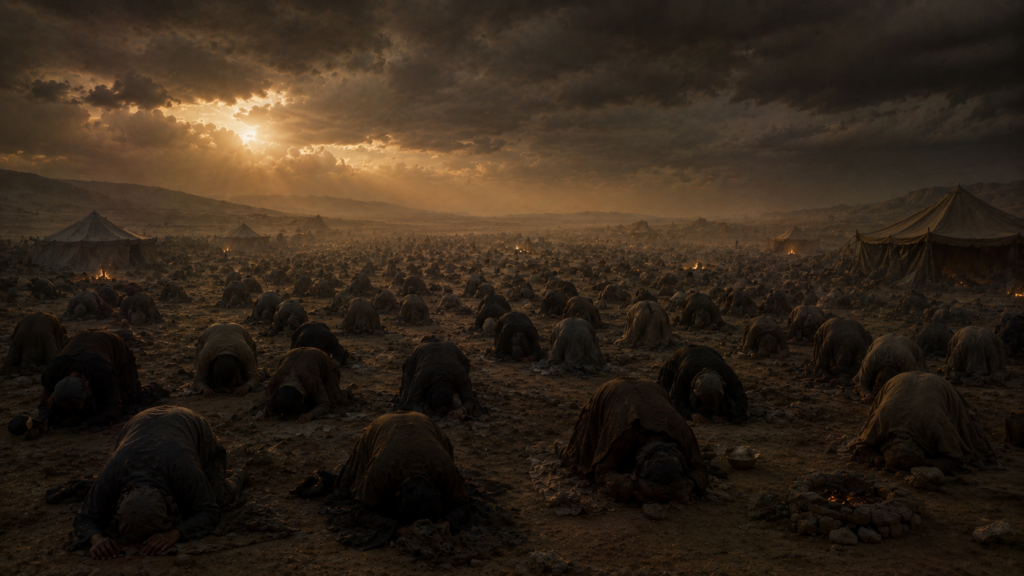
This is the hinge of the book. The ten spies’ fearful report does its work: the whole congregation weeps through the night, decides God brought them out to die, and proposes choosing a new leader to take them back to Egypt. Joshua and Caleb plead with them; the people pick up stones to kill them. Then the glory of YHWH appears, and the story turns on Moses’s intercession. God offers to destroy the nation and start over with Moses; Moses refuses the offer and instead pleads for the people on the ground of God’s own reputation and character. God pardons, and yet the verdict still falls: the generation that refused the land will not enter it. Forty years in the wilderness, one for each day the spies explored, until the whole generation has died, except Caleb and Joshua.
Read against chapter 7’s high point (the voice from between the cherubim) and chapter 10’s hopeful departure, this chapter is the fall the whole book has been building toward. It establishes the two-generation structure (see the two generations) and it does something else just as important: it shows the most honest picture in the Torah of how mercy and judgment hold together. God genuinely pardons. And the consequence genuinely stands.
A · Numbers 14:1-10 · The refusal
³ “Why does Yahweh bring us to this land, to fall by the sword? Our wives and our little ones will be captured or killed! Wouldn’t it be better for us to return into Egypt?” ⁴ They said to one another, “Let’s choose a leader, and let’s return into Egypt.”
- Wouldn’t it be better to return to Egypt? (v. 3). The craving of chapter 11 becomes a program. The people now want to undo the exodus itself, to reverse the rescue, to go back to slavery on purpose. They accuse God of malice (he brought us out to kill us) and propose replacing Moses with a captain who will lead them back. It is the deepest possible rejection: not just complaint about the journey but a vote to abandon the destination and the deliverer together.
- The land is exceedingly good… do not rebel (vv. 6-9). Joshua and Caleb tear their clothes and make one last appeal. The land is good, they insist; if YHWH delights in us he will bring us in; only do not rebel against YHWH, and do not fear the people of the land, for they are bread for us. Their defense is removed from over them, and YHWH is with us. They name the exact issue: the giants have lost their protection because YHWH is on Israel’s side. The whole question is whether God is with them, and Joshua and Caleb stake everything on the answer being yes.
- All the congregation said to stone them (v. 10). The people’s response to faith is violence. They move to kill the two who told the truth, and only the appearing of God’s glory stops them. The pattern is grimly familiar across Scripture: the messengers who call a frightened people to trust are the ones the people most want to silence (the prophets, and ultimately the one who came to his own and was not received). Faith, spoken into fear, gets met with stones.
B · Numbers 14:11-19 · The intercession
¹⁵ “Now if you killed this people as one man, then the nations which have heard the fame of you will speak, saying, ¹⁶ ‘Because Yahweh was not able to bring this people into the land which he swore to them, therefore he has slain them in the wilderness.’” … ¹⁹ “Please pardon the iniquity of this people according to the greatness of your loving kindness, and just as you have forgiven this people, from Egypt even until now.”
- I will make of you a nation greater than they (v. 12). God offers Moses the same thing he offered after the golden calf (Exodus 32:10): destroy this people, and begin again with you. It is a real offer, and it is also a test of the mediator’s heart. A lesser leader would take it, the chance to be the new Abraham, rid of the rabble that has tormented him. Moses refuses without hesitation.
- The nations will say YHWH was not able (vv. 13-16). Moses’s first argument is stunning: he appeals not to Israel’s worth (they have none to plead) but to God’s reputation among the nations. If God destroys Israel, Egypt and the surrounding peoples will conclude that YHWH could not finish what he started, that he was strong enough to get them out but too weak to bring them in. Moses defends the name of God in the watching world (see bearing God’s name). Israel’s whole vocation is to make God’s character known among the nations; to destroy them would, in the world’s eyes, defame the very Name they were called to carry.
- Slow to anger, abundant in loving kindness (v. 18). Moses’s second argument is to quote God’s own self-revelation back to him. He recites the character formula of Exodus 34:6-7, YHWH is slow to anger and abundant in loving kindness, forgiving iniquity and transgression, and asks God to act according to who he has said he is. This is the boldest move in biblical prayer: holding God to God’s own stated character. Pardon this people according to the greatness of your loving kindness. Moses does not minimize the sin; he appeals over it to a mercy larger than it.
Word study: salach (סָלַח), “to pardon, forgive”
Moses asks God to pardon (selach) the people (v. 19), and God answers, I have pardoned (salachti) according to your word (v. 20). The verb salach is striking because in the entire Hebrew Bible it takes only one subject: God. Human beings forgive one another with other verbs; salach is reserved for the divine act of pardon. It names a forgiveness only God can extend, the wiping-clean of covenant offense. The same root stands behind the great promise of the new covenant, I will forgive (salach) their iniquity and remember their sin no more (Jeremiah 31:34). When God says salachti, “I have pardoned,” he is doing the thing only he can do. And the chapter’s hard genius is what comes next: the pardon is real, and the consequence still stands. Forgiveness, here, does not mean the erasure of every result.
C · Numbers 14:20-38 · Pardon, and verdict
²⁰ Yahweh said, “I have pardoned according to your word; ²¹ but in very deed, as I live, and as all the earth shall be filled with Yahweh’s glory; ²² because all those men who have seen my glory and my signs, which I worked in Egypt and in the wilderness, yet have tested me these ten times, and have not listened to my voice; ²³ surely they shall not see the land which I swore to their fathers.”

- I have pardoned… but they shall not see the land (vv. 20-23). God grants Moses’s plea: he will not destroy the nation. And in the same breath, the verdict falls. The generation that has tested me these ten times and refused to trust will not enter the land. Both halves are true at once. God is genuinely merciful (the people survive, the covenant continues, the promise is not revoked) and the refusal genuinely costs them the thing they refused. This is not a contradiction; it is the most realistic theology of consequence in Scripture. Forgiveness restores the relationship; it does not always rewind the clock.
- My servant Caleb… has followed me fully (v. 24). The two exceptions are named: Caleb (and Joshua, v. 30), who had another spirit and followed God fully. The verdict is not arbitrary or generational in the biological sense; it falls on unbelief, and the two who believed are spared. Faith, again, is the dividing line (see the two generations).
- Forty days… forty years (v. 34). The sentence is measured to the crime: a year of wandering for each day the spies explored. The generation will live out its natural span in the wilderness until it has died off, and their children, the ones they feared would become prey (v. 3), will be the ones to inherit. The ten spies who spread the evil report die immediately by plague (v. 37). The new generation will rise in their place (the second census of chapter 26).
Influence callout: Dennis Olson and the rabbinic memory of the Ninth of Av
Olson marks this chapter as the structural pivot of Numbers: here the old generation is sentenced, and from here the book turns toward the new (see the two generations). The Jewish tradition felt the weight of this night and gave it a date. The rabbis held that Israel’s faithless weeping over the spies’ report happened on the Ninth of Av (Tisha b’Av), and that God said, in effect, you have wept a weeping for nothing; I will establish this night as a weeping for the generations (b. Taanit 29a). On the traditional reckoning, that same date later saw the destruction of both the first and second temples, and it became the great fast of Jewish grief. Whether or not one presses the chronology, the tradition’s instinct is profound: the refusal to trust God and enter the good land is the archetype of every later catastrophe, the night the people wept themselves out of the promise. Numbers 14 is, in the rabbinic memory, the wound underneath all the others.
D · Numbers 14:39-45 · Presumption at Hormah
⁴⁴ But they presumed to go up to the top of the mountain. Nevertheless, the ark of Yahweh’s covenant and Moses didn’t depart out of the camp. ⁴⁵ Then the Amalekites came down, and the Canaanites who lived in that mountain, and struck them and beat them back, even to Hormah.
- They presumed to go up (v. 44). When they hear the verdict, the people swing to the opposite error. Having refused to go up when God commanded it, they now insist on going up when God forbids it. They mourn, then they grab their weapons and charge the hill country, determined to take the land after all. It looks like repentance; it is actually the same unbelief in a new costume.
- The ark… did not depart out of the camp (v. 44). The decisive detail. They go to war without the ark, without Moses, without God. In chapter 10 the ark went before them with the cry Rise up, YHWH, and let your enemies be scattered (see holy war and herem); here it stays behind. A war fought without the divine warrior is not a holy war but a presumption, and it ends exactly as it must: they are beaten back to Hormah. The episode is the mirror image of the refusal. Fear would not move when God said go; presumption moves when God says wait. Both are forms of not listening to God’s voice, and both fail.
- The chapter closes the hinge. The generation has refused, been pardoned, and been sentenced; their first attempt to reverse the verdict by force only confirms it. From here the book is a long wandering toward the graves of the old and the rising of the new. Everything that follows, the rebellions of Korah, the failure at Meribah, the bronze serpent, the plains of Moab, unfolds under the shadow of this day at Kadesh.
Reflection prompts
- The people are pardoned and still do not enter the land. Forgiveness restored the relationship but did not erase the consequence. Where have you confused being forgiven with having every result undone, and what would it look like to receive mercy and still carry the cost honestly?
- Moses intercedes not on the basis of Israel’s worth but on the basis of God’s name and God’s character. When you pray for people who do not deserve it (including yourself), what do you appeal to? Could you learn to plead God’s character rather than anyone’s merit?
- The same people fail by fear (refusing to go when God says go) and then by presumption (going when God says wait). Both are not listening. Which error is more your temptation right now, holding back when you should move, or charging ahead when you should wait?
Frameworks at play in this chapter: the two generations, bearing God’s name, holy war and herem.