
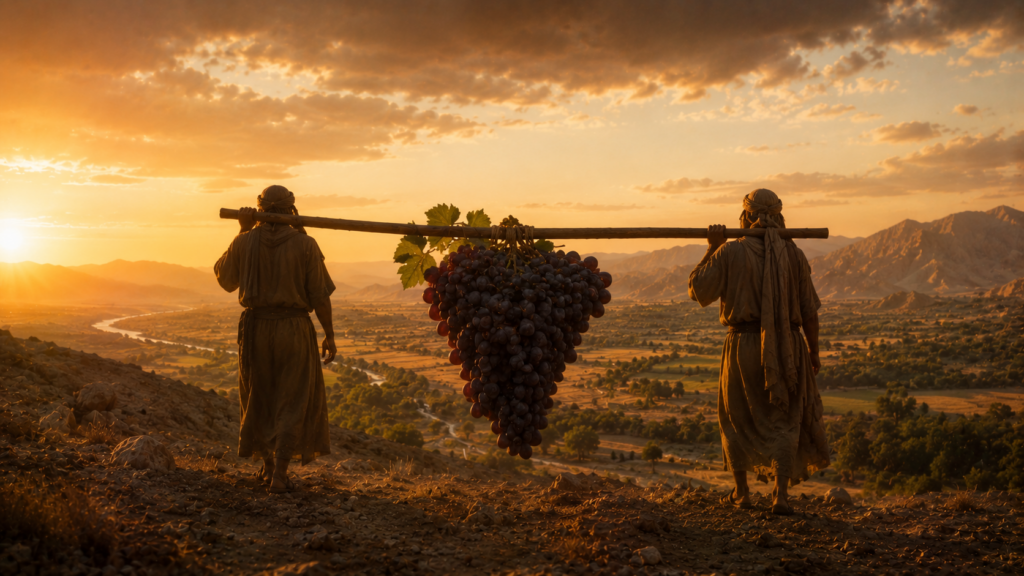
Israel reaches the edge of the land. Twelve men, one from each tribe, are sent to scout it, and they come back forty days later carrying a single cluster of grapes so heavy it takes two men and a pole to carry, proof that the land is everything God promised. Then the report splits in two. All twelve agree the land is good. But ten of them add a fatal however: the people are too strong, the cities too fortified, the inhabitants too large. Two of them, Caleb and Joshua, look at the same facts and say we are well able. The difference between the two reports is not the data. It is whether God is included in the math.
This is the chapter that loses the exodus generation. The fearful report of the ten will trigger the refusal and the forty-year verdict of chapter 14, the hinge that gives the whole book its two-generation shape (see the two generations). Chapter 13 is where the refusal is rehearsed: a good land, a true account of its dangers, and a failure of nerve dressed up as realism.
A · Numbers 13:17-25 · Into the land, and the cluster of Eshcol
²³ They came to the valley of Eshcol, and cut down from there a branch with one cluster of grapes, and they bore it on a staff between two. They also brought some of the pomegranates and figs.
- See the land, what it is (vv. 17-20). Moses sends the spies with a clear assignment: assess the land, the people, the cities, the soil, and bring back fruit. The mission is reasonable reconnaissance. Nothing in the instructions suggests the trip is a test of whether to go; God has already given the land (v. 2). The spies are scouting how, not whether.
- A branch with one cluster of grapes… borne on a staff between two (v. 23). At the Valley of Eshcol (the name means “cluster”) they cut a single bunch of grapes so large it must be slung on a pole and carried by two men. The image is almost comic in its abundance, and it is the chapter’s first witness: the land is staggeringly good, exactly as promised. They also bring pomegranates and figs. The evidence of God’s faithfulness is literally on their shoulders.
- They returned after forty days (v. 25). The forty days of scouting will become forty years of wandering (14:34), a year for each day. The number is not incidental; the chapter is quietly laying the groundwork for the verdict. The same span that should have been the prelude to entering becomes the measure of the exile from entering.
B · Numbers 13:26-30 · The good report, and Caleb’s nerve
²⁷ They told him, and said, “We came to the land where you sent us. Surely it flows with milk and honey, and this is its fruit. ²⁸ However, the people who dwell in the land are strong, and the cities are fortified and very large. Moreover, we saw the children of Anak there.” … ³⁰ Caleb stilled the people before Moses, and said, “Let’s go up at once, and possess it; for we are well able to overcome it.”
- Surely it flows with milk and honey… however (vv. 27-28). The report begins with the truth: the land is everything God said. Then comes the word that turns the whole nation: however. The people are strong, the cities fortified, the giants present. Every fact the ten report is true. The land does have powerful inhabitants. Their failure is not lying about the geography; it is what they do with it.
- Caleb stilled the people… we are well able (v. 30). Caleb hears the identical facts and draws the opposite conclusion. Let us go up at once, for we are well able to overcome it. He is not naive about the giants; he simply does the math with God in it. The promise that God will give the land is the decisive factor, and against that, fortified cities are a detail. The chapter sets Caleb’s confidence directly against the ten’s fear, with the same data on the table, so the reader sees that the dividing line is faith, not information.
- The contrast defines the two generations in advance. Caleb and Joshua are the two men who will survive the coming verdict and enter the land (14:30). Their dissent here is why. The line between the generation that dies and the generation that enters is drawn, in this chapter, between two readings of the same scouting report.
C · Numbers 13:31-33 · Giants, and grasshoppers
³² They brought up an evil report of the land which they had spied out to the children of Israel, saying, “The land, through which we have gone to spy it out, is a land that eats up its inhabitants; and all the people who we saw in it are men of great stature. ³³ There we saw the Nephilim, the sons of Anak, who come from the Nephilim. We were in our own sight as grasshoppers, and so we were in their sight.”
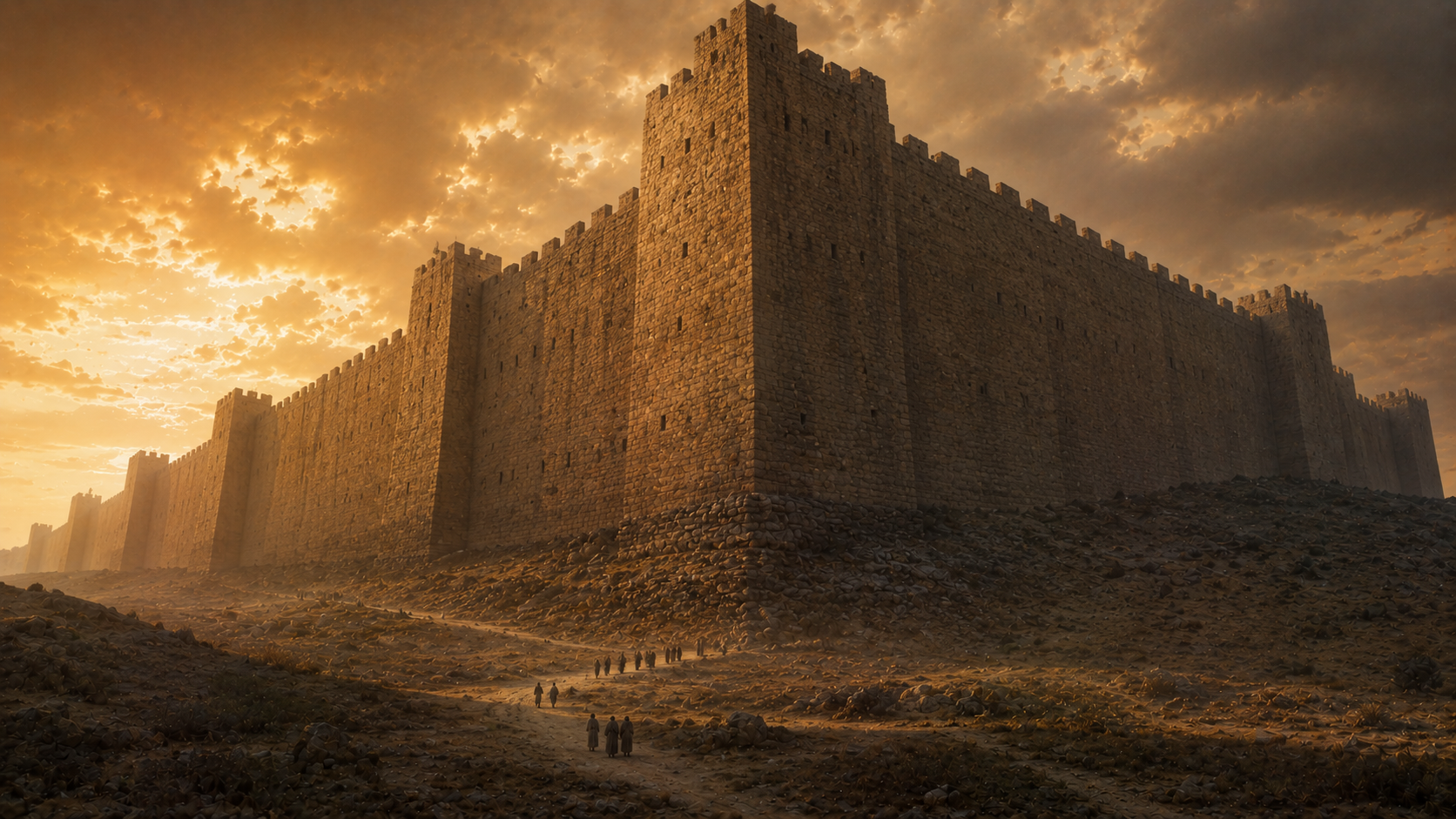
- A land that eats up its inhabitants (v. 32). The ten escalate from caution to catastrophe. The good land of verse 27 has become, in their fear, a land that devours people. Fear distorts the report into the opposite of the truth: the land flowing with milk and honey is recast as a land that consumes. Their dread has rewritten the facts.
- We were in our own sight as grasshoppers (v. 33). This is the chapter’s diagnostic line. The ten’s defeat happens first in their self-perception. They saw themselves as grasshoppers, and so we were in their sight, projecting their own smallness onto the giants’ eyes. The failure is an identity failure: they had a true report of the giants and a false report of themselves and of God. Forgetting whose people they were, they shrank to insects in their own imagination. Caleb and Joshua saw the same giants and remembered that the God who split the sea was with them.
Word study: dibbah (דִּבָּה), “an evil report, slander”
Verse 32 says the ten brought up a dibbah ra’ah, an “evil report,” about the land. The word dibbah does not mean a false factual statement; it means a defaming whisper, a slander, the kind of report that poisons by its framing. The same word describes the slander Joseph’s brothers feared (Genesis 37:2) and the “whispering” of enemies in the Psalms (Psalm 31:13). The point is sharp: the spies’ sin is not that they reported giants who were not there. The giants were real. Their sin is that they framed the truth in a way that defamed the land God called good and impugned the God who promised it. A dibbah can be built entirely of true facts and still be a lie, because it tells the truth in the service of fear and against faith. The ten slandered the promise.
Influence callout: Michael Heiser (the Nephilim, the Anakim, and the divine council)
Heiser’s reading connects the giants of this chapter to the wider biblical-supernatural story (see the divine council). The spies report Nephilim, the sons of Anak, and the text explicitly links the Anakim to the Nephilim of Genesis 6:4, the giant offspring associated with the rebellion of the “sons of God.” On Heiser’s reading, the conquest of Canaan is not merely a land-grab but, in the biblical writers’ own framing, a confrontation with the lingering clans of these giant bloodlines, the Anakim, the Rephaim, the inhabitants of fortified cities whose very size signals their connection to the old rebellion. This is why the Anakim loom so large in the spies’ report and in Deuteronomy’s memory of the conquest (Deuteronomy 2-3). Whatever a reader concludes about the historical and supernatural questions, Heiser’s framework explains why the text dwells on the giants: for the biblical authors, the land’s most fearsome inhabitants represented the deepest opposition to God’s purposes, and Israel’s refusal to face them was a refusal to trust the God who had already overcome the powers at the sea.
Reflection prompts
- Ten spies and two spies saw the same land and the same giants and brought back opposite reports. The difference was whether they included God in the calculation. Where are you doing the math of a hard situation with God left out?
- The ten saw themselves “as grasshoppers.” Their defeat began in how they saw themselves. Where has a shrunken self-image, forgetting whose you are, made a challenge look impossible before you even tried?
- A dibbah can be made of true facts and still be a faithless lie. Where have you told the truth in a way that served fear and undermined faith, in yourself or others?
Frameworks at play in this chapter: the two generations, the divine council, wilderness and liminality.