
Leviticus
Holiness made livable.
All 27 chapters drafted.
Leviticus
How to read it
Themes: holiness as the central category · the sacrificial system as the architecture of nearness · sacred space and graded purity · priestly mediation · the rhythms of atonement, festivals, and Sabbath · holiness as ethical and social, not only ritual · “I am YHWH” as the chapter-by-chapter refrain Literary design: chiastic architecture centered on the Day of Atonement (chapter 16); two major halves (chs. 1-16 priestly handbook, chs. 17-26 holiness code) with chapter 27 as appendix; the Tetragrammaton speech formula (the LORD spoke to Moses, saying) opens nearly every unit Frameworks at play: the five offerings · kipper / atonement · clean and unclean · the festival calendar · the jubilee year · the tabernacle as cosmic temple · garden as sanctuary · the divine council · the cry of the oppressed · chiastic structure
Leviticus is, by reputation, the book where most Bible-in-a-year reading plans die. The plot stalls. The verbs become sprinkle, wave, burn, separate, examine. The diet shifts to liver fat and goat hides. The reader who climbed up through Genesis and Exodus on the strength of a story finds that the story has stopped to write a manual.
That reputation is partly earned and entirely beside the point. Leviticus is not failing to be Genesis. It is doing something Genesis cannot do. The God who has finally moved into the camp in Exodus 40 now teaches the camp how to live with him. The book is the operating instructions for life in the immediate presence of the Holy. It is not a digression from the story; it is the story’s necessary technical chapter, the part where the world is rebuilt around the new fact that YHWH is here.
This page is a “how to read it” overview, meant to be read alongside the chapter commentaries (linked at the bottom). If you want the verse-by-verse work, follow a chapter link. If you want the lay of the land before you walk it, you’re in the right place.
The storyline
Leviticus has very little plot. What plot there is concentrates in chapters 8-10 (the ordination of the priests, the inauguration of the sacrificial system, and the death of Aaron’s sons Nadab and Abihu) and in scattered moments where named figures appear and disappear. The rest is instructional. But the instructions are organized with deliberate literary care into seven major movements, structured around a central chapter that holds the whole book together.
Chapters 1-7 lay out the five major sacrifices: the burnt offering (olah, the ascending offering, 1:1-17), the grain offering (minchah, the tribute, 2:1-16), the peace offering (shelamim, the communion meal, 3:1-17), the sin offering (chatta’t, the purification sacrifice, 4:1-5:13), and the guilt offering (asham, the reparation sacrifice, 5:14-6:7). Each is described first from the worshipper’s perspective (chs. 1-5), then from the priest’s perspective (chs. 6-7). The sacrificial system has a grammar, and the first seven chapters are the grammar book.
Chapters 8-10 record the inauguration of the system. Aaron and his sons are ordained (8) according to the seven-day pattern Moses received in Exodus 29. The new altar is consecrated and the first sacrifices are made (9). Fire comes out from before YHWH and consumes the offering, and the people fall on their faces in worship. The very next chapter records the catastrophe: Nadab and Abihu offer strange fire and are consumed by the same fire that consumed the offering (10:1-3). The book pauses, in chapter 10, to record what holiness looks like when it is mishandled. The lesson is not optional and not subtle.
Chapters 11-15 establish the purity system: clean and unclean animals (11), childbirth (12), skin diseases and house mildew (13-14), genital discharges (15). The system is concerned with maintaining the boundary between the camp (where YHWH dwells) and the wilderness (where chaos and death operate). Ritual impurity is not moral failure; it is contact with death or with the disordered, requiring re-entry into the rhythm of life-with-God. The whole later prophetic tradition’s metaphors of cleansing (Isa 1:18; Ezek 36:25) and the New Testament’s vocabulary of purification take their semantic field from these chapters.
Chapter 16 is the literary and theological center of the book: the Day of Atonement (Yom Kippur). The high priest enters the most holy place once a year, with the blood of a bull and a goat, to make atonement for the holy place itself, for the priests, and for the people. A second goat (the scapegoat, Hebrew Azazel) bears the sins of the people into the wilderness. The chapter is the book’s annual reset and the canonical seed of the New Testament’s whole atonement theology.
Chapters 17-26 are the Holiness Code (so-named by modern scholars because of the chapter-opening formula be holy because I, YHWH your God, am holy, 19:2). The Holiness Code applies the priestly framework of chapters 1-16 to all of Israel’s life: sexual ethics (18, 20), social ethics (19, 23-25), worship of YHWH alone (17, 26), and the great festivals and Sabbath years (23-25). The famous love your neighbor as yourself (19:18) sits in the middle of the Holiness Code. The book that started with sacrifices ends with the ethical shape of the whole community, framed by the deepest theological refrain of the Hebrew Bible: I am YHWH.
Chapter 27 is an appendix on vows and dedications. Whatever has been promised to YHWH must be honored or redeemed at a known price. The book closes not with poetic crescendo but with administrative law, which is in fact the book’s truest voice: here is how to live as a people whose God dwells with them.
Why the book matters
Leviticus is, on the New Testament’s own reckoning, the most theologically referenced book in the entire Old Testament. Be holy because I am holy (Lev 11:44-45; 19:2) is quoted directly at 1 Pet 1:16. Love your neighbor as yourself (Lev 19:18) is named by Jesus as the second commandment that summarizes the law (Mt 22:39). The entire book of Hebrews reads as a sustained commentary on Leviticus’s sacrificial and priestly system, with Christ as the better priest (Heb 4:14-5:10; 7:1-28), the better sacrifice (Heb 9:11-14; 10:11-14), and the better atonement (Heb 9:24-28). The Day of Atonement in Leviticus 16 is the structural foundation of every Christian theology of the cross. Whatever atonement model a Christian tradition holds (Christus Victor, penal substitution, moral influence, recapitulation), the vocabulary of that model is Leviticus’s vocabulary. To read the New Testament’s account of Christ’s death without Leviticus is to read a translation without the original.
The book also matters for what it teaches about holiness. The English word “holy” tends to suggest moral purity or religious specialness. The Hebrew qodesh names something more specific: set apart for a particular use within a graded system of access to the divine. Holiness in Leviticus is not first an attribute of personal character. It is a zoning category. There is common (Hebrew chol) and there is holy (qodesh); within the holy there are gradations (the camp, the courtyard, the holy place, the most holy place); and there are clean (tahor) and unclean (tame’) states that determine which of those zones a person, animal, or object can enter at a given time. The book is building a map of sacred space, and the map’s purpose is to teach Israel how to live in the immediate presence of YHWH without being consumed by him (the fate that nearly fell on Israel at Sinai in Exodus 19, and that fell on Nadab and Abihu in Leviticus 10).
The deeper theological move is that the book’s whole architecture exists because YHWH is in the camp. The dwelling that Exodus 40 ended with creates the problem that Leviticus solves. A holy God living in the middle of a sinful people is the most dangerous situation in the Hebrew Bible. The sacrificial system, the purity system, the holiness code, the Day of Atonement: all of them are answers to the same question, how can we live with him without dying? And the book’s answer is consistent across all twenty-seven chapters: by the architecture of nearness. The blood, the smoke, the washing, the separation, the festivals, the love of neighbor are all part of the same answer.
Literary architecture
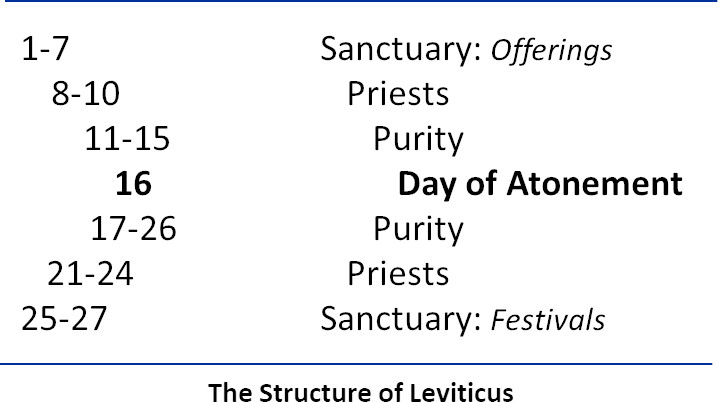
Leviticus is not formless. The book has been carefully edited into a chiastic structure with the Day of Atonement at its center:
- A. Sacrifices (chs. 1-7)
- B. Priestly inauguration and Nadab/Abihu (chs. 8-10)
- C. Purity laws: bodies and the camp (chs. 11-15)
- D. Day of Atonement (ch. 16)
- C’. Holiness Code: bodies and the camp re-framed (chs. 17-20)
- B’. Priestly conduct and special offerings (chs. 21-22)
- A’. Festival calendar and concluding instructions (chs. 23-27)
The chiasm is not artificial. Each side of the structure mirrors its counterpart. Chapters 1-7 deal with the ritual mechanics of sacrifice; chapters 23-27 deal with the calendar of sacrifice and the year’s holiness rhythm. Chapters 8-10 record priestly consecration; chapters 21-22 record priestly conduct. Chapters 11-15 deal with bodily and household purity; chapters 17-20 re-frame the same material in terms of communal-ethical holiness. The Day of Atonement (16) sits at the center, holding everything together.
The chiastic reading is the framework Mackie and the BibleProject teaching tradition use, and it lines up cleanly with the rabbinic tradition’s instinct that the Day of Atonement is the book’s load-bearing chapter. Read it that way and Leviticus is not a disorganized law-code; it is a deliberate work of literary-theological architecture.
The frameworks at play
Leviticus extends several frameworks already established in Genesis and Exodus.
The tabernacle as cosmic temple framework (built in Genesis 1, deepened in Exodus 25-40) provides the architectural backdrop for the entire book. The graded holiness of the cosmos (Eden as inner sanctum; the land of promise as the outer sanctuary; the rest of the earth as common space) maps directly onto the camp’s graded holiness (the most holy place inside the tent; the holy place; the courtyard; the camp; outside the camp). The book is teaching how to navigate that map without violating its boundaries.
The garden as sanctuary framework grounds the book’s anthropology. Adam was a priest in the garden-sanctuary; Aaron is a priest in the wilderness-sanctuary; both vocations involve the same vocabulary (avad, to serve; shamar, to keep). The whole later biblical theology of worship as priestly service takes its shape here.
The divine council framework appears at the strangest moment in the book: the scapegoat of chapter 16, sent to Azazel in the wilderness. Heiser reads Azazel not as a goat-related noun but as the name of a rebel divine being exiled to the wilderness (cf. 1 Enoch 8-10). The chapter is, on Heiser’s reading, the only place in the Hebrew Bible where Israel symbolically sends sin back to the chaos-being who first introduced it. Whether or not one accepts Heiser’s reading in full, the chapter’s geography is striking: sin goes out of the camp, into the wilderness where the chaos powers operate. The dwelling-place is being cleansed by export.
The cry of the oppressed framework, which ran through Exodus, threads through Leviticus 19 and 25 in particular: the wages of the day-laborer must be paid the same day (19:13); the alien, the orphan, and the widow must not be afflicted (19:33-34); the year of Jubilee returns ancestral land to its original owners (25:8-13). Holiness in Leviticus is not separable from social justice. The same God who hears the cry of the oppressed has built that hearing into the calendar.
The chiastic structure framework is operative at the book’s macro level (as described above) and also at the micro level of individual chapters. Several Levitical passages are themselves chiastically structured (cf. ch. 11; ch. 24:10-23). The book rewards close reading of its literary form.
The five offerings, kipper / atonement, clean and unclean, festival calendar, and jubilee year frameworks are introduced by Leviticus and provide the technical-theological vocabulary the rest of the Bible uses. Read those pages first if you are coming to the book without prior background; they give the grammar the chapter commentaries will assume.
What this site does with Leviticus
The site does not try to extract Leviticus’s “timeless principles” while skipping the ritual specifics. The ritual specifics are the point. Leviticus is teaching that embodied practice and concrete material gesture are the means by which Israel’s life-with-God is sustained. Modern Christianity has tended to spiritualize the book into “what it really means” while losing what the book actually says. This commentary works the other direction: it stays with the text’s actual concerns (blood, fat, smoke, skin, fields, calendar) and lets the theological payoff emerge from inside those concerns rather than around them.
Specifically, the commentary:
- Names each sacrifice in its Hebrew vocabulary and walks through its mechanics, then locates each in the broader sacrificial economy.
- Reads the purity laws as a map of sacred space rather than as a list of hygiene rules or arbitrary taboos.
- Centers the Day of Atonement (chapter 16) as the book’s structural heart and links it forward into the New Testament’s atonement theology.
- Reads the Holiness Code (chapters 17-26) as Israel’s most concentrated theological-ethical instruction, including the famously hard sexual ethics chapters (18, 20), without softening the difficulty or weaponizing it.
- Pays attention to Christ-typological readings (the patristic tradition reads the sacrifices, the priesthood, and the Day of Atonement as foreshadowings of the cross) without reducing the book to a Christian-prefiguration document. Leviticus has its own Hebrew Bible weight that must be honored on its own terms before any typological reading.
- Engages the Jewish interpretive tradition (Rashi, Maimonides, Talmud) on the points where Christian readers most need the rabbinic memory to keep them from misreading.
Approaching the hard chapters
Leviticus has several chapters that modern readers find difficult.
Chapter 10 (Nadab and Abihu): the death of Aaron’s sons by divine fire raises the problem of holiness as deadly. The chapter is honest about what proximity to the holy actually costs, and the rest of the book is, in part, an attempt to keep that catastrophe from repeating.
Chapter 11 (clean and unclean animals): the dietary laws can read as arbitrary. The commentary works the function of these laws (boundary maintenance, identity-marking, theological pedagogy) rather than trying to discover hidden ancient health science (which they are not).
Chapter 12 (postpartum impurity): the longer impurity period for a daughter than a son has produced multiple readings, none entirely satisfying. The commentary surveys the major options without forcing closure.
Chapter 13-14 (skin diseases): the Hebrew tzara’at is often translated leprosy but covers a wider range of skin conditions. The commentary keeps the Hebrew vocabulary and treats the chapters as a portrait of visible bodily disorder requiring social-ritual response, not as ancient medical advice.
Chapter 18 and 20 (sexual ethics): these chapters contain some of the most contested verses in modern Christian debate. The commentary names the contested texts honestly, locates them in their ancient Near Eastern context, presents the major modern readings (traditional, revisionist, and the various positions in between), and refuses to weaponize the chapters against any group of readers. The commentary’s posture: take the text seriously, take the people who read it seriously, and acknowledge the genuine disagreements within faithful Christian interpretation.
Chapter 27 (vows, dedications, and the redemption of consecrated persons): the chapter assigns monetary values to persons “consecrated” to YHWH and creates the impression that the book is ending with a price-list for human worth. The commentary works the chapter’s actual concern, which is the redemption of consecrated vows, and locates the value-table inside the wider economy of consecration the rest of the book has built.
Chapters
- Leviticus 1 · The ascending offering, the *olah*, and the architecture of total gift
- Leviticus 2 · The grain offering, the *minchah*, and the gift of ordinary food
- Leviticus 3 · The peace offering, the *shelamim*, and the architecture of the shared meal
- Leviticus 4 · The sin / purification offering, the *chatta't*, and the graduated theology of inadvertent failure
- Leviticus 5 · Specific cases of inadvertence, the poor person's graduated offering, and the *asham* of sacrilege
- Leviticus 6 · The *asham* for fraud against neighbor, and the priests' regulations for the daily offerings
- Leviticus 7 · The priests' regulations for the *asham* and *shelamim*, the prohibition on fat and blood, and the closing colophon
- Leviticus 8 · The consecration of Aaron and his sons, the seven-day ordination at the door of the Tent
- Leviticus 9 · The eighth day, Aaron's first sacrifices, and the fire that came out from YHWH
- Leviticus 10 · Nadab and Abihu, the strange fire, Aaron's silence, and the priesthood's first interpretive moment
- Leviticus 11 · Clean and unclean animals, the food laws as identity markers, and the capstone 'be holy, for I am holy'
- Leviticus 12 · Purification after childbirth, the two periods, and the offering that placed Mary and Joseph in the Levitical poor
- Leviticus 13 · The examination of *tzaraat* on skin and on garments, the priest as patient diagnostician
- Leviticus 14 · The cleansing rituals for *tzaraat*, the two-bird rite, and the same blood-and-oil pattern that ordained the priests
- Leviticus 15 · Bodily discharges, the symmetry of male and female impurity, and the woman who touched Jesus's garment
- Leviticus 16 · The Day of Atonement, the high priest entering the Most Holy Place, and the two goats
- Leviticus 17 · The blood theology of Leviticus, the *se'irim* prohibition, and *the life of the flesh is in the blood*
- Leviticus 18 · Sexual relations, the *arayot* prohibitions, and the land that vomits out its inhabitants
- Leviticus 19 · The heart of the Holiness Code: love your neighbor, leave gleanings, honor the elderly, welcome the stranger
- Leviticus 20 · The penalties for offenses in the Holiness Code, the *karet*, and *I have separated you from the peoples to be mine*
- Leviticus 21 · Priestly purity, the high priest's specific restrictions, and the priest with a physical defect
- Leviticus 22 · The priest's purity when handling the holy food, unblemished offerings, and the closing of the priestly unit
- Leviticus 23 · The annual festival calendar, the *mo'adim*, and the architecture of sacred time
- Leviticus 24 · The perpetual lamp, the showbread, the blasphemer story, and the *lex talionis* as proportional limit
- Leviticus 25 · The Sabbath year and the Jubilee, the land's release, and the structural interruption of generational poverty
- Leviticus 26 · The covenant blessings and curses, the seven escalating judgments, and the mercy that arrives when Israel confesses
- Leviticus 27 · Vow valuations, dedicated property, the tithe, and the book's closing colophon