

Leviticus 23 is the book’s master calendar. After the Holiness Code’s commands on conduct (chs. 18-22), the chapter sets out the temporal architecture of Israel’s year: the mo’adim (appointed times), the chaggim (pilgrim festivals), the Sabbath, the day of trumpets, the day of atonement, the feast of booths. The chapter names seven major appointed times (the weekly Sabbath plus six annual festivals) and sets out for each its date, its required rituals, and its required rest from work. The chapter is the most concentrated single statement of what time looks like when YHWH has put a calendar on it.
The chapter must be read inside the festival calendar framework, which develops the longer-arc theology of time as worship and the chapter’s afterlife in the Christian liturgical year. What this commentary does on top of the framework is walk through the chapter’s specific verses, noting the distinctive moves of each festival, the structural patterns the chapter builds across the year, and the points where each festival has had a specific Christological development in the New Testament’s reading.
The chapter is, in many ways, the most often-recovered chapter of Leviticus for the modern Christian. The Christian liturgical calendar (Advent, Christmas, Lent, Holy Week, Easter, Ascension, Pentecost, Ordinary Time) is the gradual transformation of this chapter’s pattern into the church’s annual rhythm. To read the chapter is to read the foundation of the worshipping life every liturgical tradition has built on. The site reads this with the Paul Within Judaism lane: the festivals are not retired for Jewish believers in Messiah; they continue. For Gentile believers, the principle of time-marked-by-worship is preserved in the Christian calendar’s transformation of the same chapter’s pattern.
A · Leviticus 23:1-8 · The Sabbath and Passover
¹ Yahweh spoke to Moses, saying, ² “Speak to the children of Israel, and tell them, ‘The set feasts of Yahweh, which you shall proclaim to be holy convocations, even these are my set feasts. ³ “‘Six days shall work be done: but on the seventh day is a Sabbath of solemn rest, a holy convocation; you shall do no kind of work. It is a Sabbath to Yahweh in all your dwellings. ⁴ “‘These are the set feasts of Yahweh, even holy convocations, which you shall proclaim in their appointed season. ⁵ In the first month, on the fourteenth day of the month in the evening, is Yahweh’s Passover. ⁶ On the fifteenth day of the same month is the feast of unleavened bread to Yahweh. Seven days you shall eat unleavened bread. ⁷ In the first day you shall have a holy convocation. You shall do no regular work. ⁸ But you shall offer an offering made by fire to Yahweh seven days. In the seventh day is a holy convocation: you shall do no regular work.’”
- The set feasts of Yahweh, which you shall proclaim to be holy convocations, even these are my set feasts (v. 2). The chapter opens with the foundational claim. The Hebrew is mo’adei YHWH asher tiqre’u otam miqra’ei qodesh elleh hem mo’aday. The word mo’ed (appointed time) is the same word the Hebrew Bible uses for the Tent of Meeting (ohel mo’ed, the tent of appointment). The chapter is teaching that YHWH has appointments with Israel — both spatial (the Tent) and temporal (the festival days). The Hebrew Bible’s deepest theology of YHWH meeting Israel is enacted at the intersection of appointed place and appointed time.
- Six days shall work be done: but on the seventh day is a Sabbath of solemn rest (v. 3). The chapter starts with the weekly anchor before listing the annual festivals. The Sabbath is not one of the seven annual festivals but is the weekly minimum that grounds the whole calendar. The Hebrew is shabbat shabbaton, the intensified form — the Sabbath of sabbaths. The chapter is teaching that every week’s seventh day is a mini-version of the holiest annual day. The whole later Christian theology of Sunday as the Lord’s Day and as the new Sabbath (whether read as displacement or transformation of the seventh-day Sabbath) takes its cosmic structure from this verse.
- Yahweh’s Passover … the feast of unleavened bread (vv. 5-6). The chapter’s first annual festival. The combination Pesach + Matzot (Passover plus the seven-day Feast of Unleavened Bread that follows it) commemorates the Exodus night and the seven-day flight from Egypt. The chapter’s date is precise: 14 Nisan (Passover) and 15-21 Nisan (Unleavened Bread). The whole later New Testament’s identification of Christ as the Passover lamb (1 Cor 5:7, Christ, our Passover, has been sacrificed; Jn 19:14, the day of preparation for the Passover; Jn 19:36, not one of his bones shall be broken, quoting Ex 12:46 / Num 9:12) gathers around this annual festival.
B · Leviticus 23:9-22 · Firstfruits and Pentecost
⁹ Yahweh spoke to Moses, saying, ¹⁰ “Speak to the children of Israel, and tell them, ‘When you have come into the land which I give to you, and shall reap its harvest, then you shall bring the sheaf of the first fruits of your harvest to the priest: ¹¹ and he shall wave the sheaf before Yahweh, to be accepted for you. On the next day after the Sabbath the priest shall wave it. ¹² On the day when you wave the sheaf, you shall offer a male lamb without defect a year old for a burnt offering to Yahweh. ¹³ The meal offering with it shall be two tenths of an ephah of fine flour mingled with oil, an offering made by fire to Yahweh for a pleasant aroma; and the drink offering with it shall be of wine, the fourth part of a hin. ¹⁴ You shall eat neither bread, nor roasted grain, nor fresh grain, until this same day, until you have brought the offering of your God. This is a statute forever throughout your generations in all your dwellings. ¹⁵ “‘You shall count from the next day after the Sabbath, from the day that you brought the sheaf of the wave offering; seven Sabbaths shall be complete: ¹⁶ even to the next day after the seventh Sabbath you shall number fifty days; and you shall offer a new meal offering to Yahweh. ¹⁷ You shall bring out of your habitations two loaves of bread for a wave offering made of two tenths of an ephah of fine flour. They shall be baked with yeast, for first fruits to Yahweh. ¹⁸ You shall present with the bread seven lambs without defect a year old, one young bull, and two rams. They shall be a burnt offering to Yahweh, with their meal offering, and their drink offerings, even an offering made by fire, of a pleasant aroma to Yahweh. ¹⁹ You shall offer one male goat for a sin offering, and two male lambs a year old for a sacrifice of peace offerings. ²⁰ The priest shall wave them with the bread of the first fruits for a wave offering before Yahweh, with the two lambs. They shall be holy to Yahweh for the priest. ²¹ You shall make proclamation on the same day. There shall be a holy convocation to you. You shall do no regular work. This is a statute forever in all your dwellings throughout your generations. ²² “‘When you reap the harvest of your land, you shall not wholly reap into the corners of your field, neither shall you gather the gleanings of your harvest. You shall leave them for the poor and for the foreigner. I am Yahweh your God.’”
- Bring the sheaf of the first fruits of your harvest to the priest (v. 10). The chapter’s firstfruits offering (Hebrew omer, the sheaf). The first cut of barley from the spring harvest is brought to the sanctuary on the day after the Passover-week Sabbath. The whole later Pauline theology of Christ as the firstfruits of those who have fallen asleep (1 Cor 15:20-23) reads forward from this verse: Christ rose on the day after the Sabbath during Passover week — the omer-day itself, in the Jewish liturgical calendar. Paul’s metaphor of firstfruits presupposes this chapter precisely.
- Seven Sabbaths shall be complete: even to the next day after the seventh Sabbath you shall number fifty days (vv. 15-16). The chapter’s seven-weeks plus one counting that leads to Shavuot (Weeks) or Pentecost (Greek for fiftieth). The seven-times-seven pattern is the Sabbath’s fractal: the calendar’s deeper Sabbath arrives every fifty days. The whole later Acts 2 pouring out of the Holy Spirit on the day of Pentecost (Acts 2:1, where the Greek is en to symplerousthai ten hemeran tes pentekostes, as the day of Pentecost was being fulfilled) presupposes this chapter precisely. The Spirit is poured out on the fiftieth day after the Passover firstfruits, fulfilling the chapter’s seven-weeks-plus-one pattern.
- They shall be baked with yeast, for first fruits to Yahweh (v. 17). The chapter’s only leavened offering. The two Pentecost loaves are leavened — uniquely, in the whole Levitical system (cf. Lev 2:11). The loaves are not burned on the altar (where leaven cannot ascend); they are waved before YHWH and given to the priest. The Christian Pentecost reading: the two loaves prefigure the Spirit being poured out on Jews and Gentiles together (Acts 10, the Cornelius household), the two communities together becoming one risen-bread offered to the Father.
- When you reap the harvest of your land, you shall not wholly reap into the corners of your field, neither shall you gather the gleanings of your harvest. You shall leave them for the poor and for the foreigner (v. 22). The chapter places the gleaning law (from Lev 19:9-10) inside the festival calendar. The festival is incomplete without the economic-justice practice. The chapter is teaching that celebrating the firstfruits requires leaving the gleanings. The whole pattern of the cry of the oppressed framework is preserved here: festivals and justice are not separate concerns.
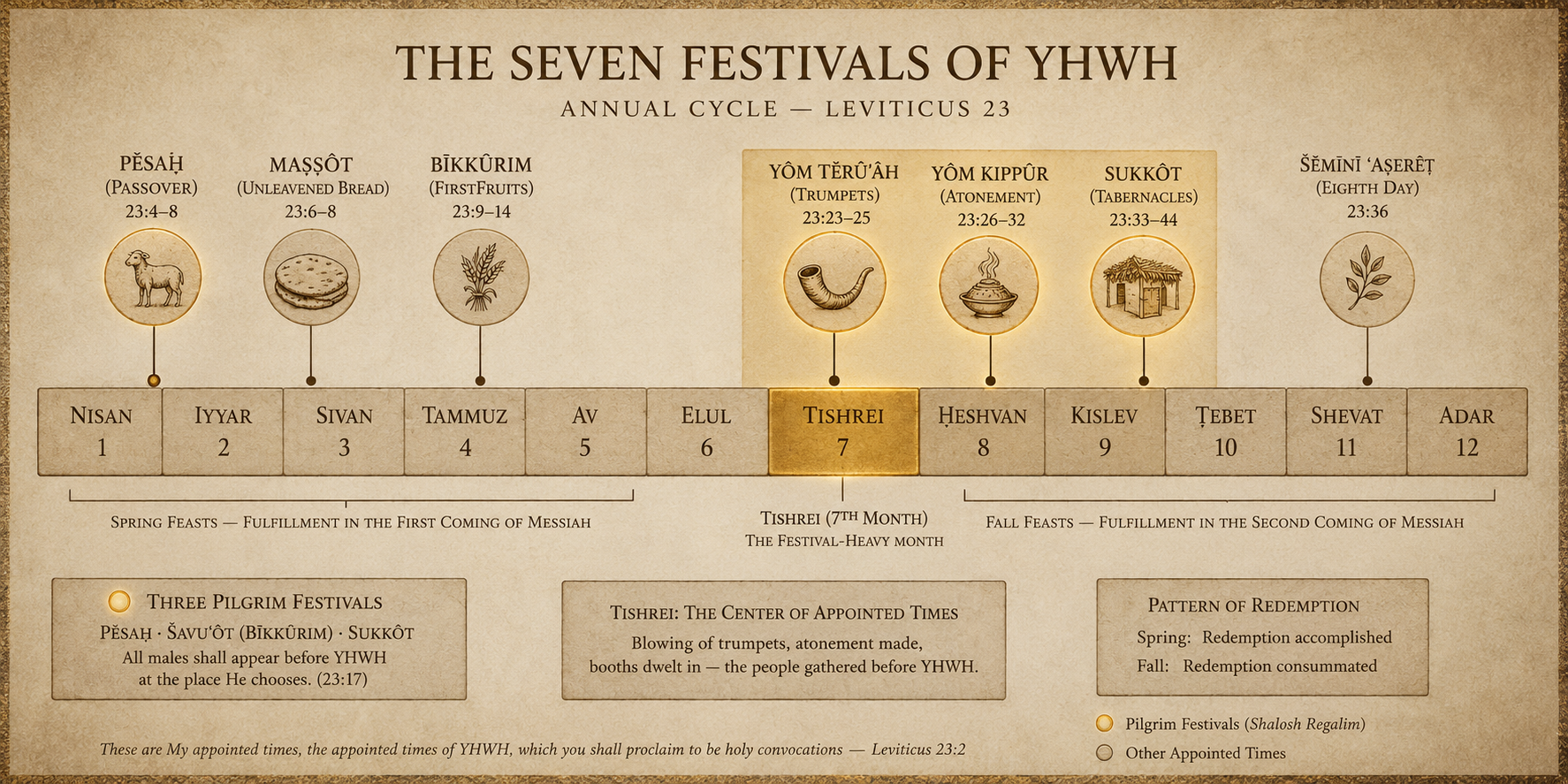
C · Leviticus 23:23-32 · Trumpets and Day of Atonement
²³ Yahweh spoke to Moses, saying, ²⁴ “Speak to the children of Israel, saying, ‘In the seventh month, on the first day of the month, shall be a solemn rest to you, a memorial of blowing of trumpets, a holy convocation. ²⁵ You shall do no regular work; and you shall offer an offering made by fire to Yahweh.’” ²⁶ Yahweh spoke to Moses, saying, ²⁷ “However on the tenth day of this seventh month is the day of atonement: it shall be a holy convocation to you, and you shall afflict yourselves; and you shall offer an offering made by fire to Yahweh. ²⁸ You shall do no manner of work in that same day; for it is a day of atonement, to make atonement for you before Yahweh your God. ²⁹ For whoever it is who shall not deny himself in that same day; shall be cut off from his people. ³⁰ Whoever it is who does any kind of work in that same day, that person I will destroy from among his people. ³¹ You shall do no kind of work: it is a statute forever throughout your generations in all your dwellings. ³² It shall be a Sabbath of solemn rest for you, and you shall deny yourselves. In the ninth day of the month at evening, from evening to evening, you shall keep your Sabbath.”
- In the seventh month, on the first day of the month, shall be a solemn rest to you, a memorial of blowing of trumpets (v. 24). The chapter’s Yom Teru’ah (Day of Blowing) on 1 Tishrei. The festival is later developed by the rabbinic tradition into Rosh Hashanah (the New Year), with the shofar (ram’s horn) blown a hundred times across the day’s services. The chapter itself does not name the festival as new year; that development comes later. What the chapter does name is the seventh month opening with a public sounding. The Hebrew Bible’s deepest seventh-month concentration (Trumpets, Atonement, and Booths all fall in this month) is opened by the trumpet-blast.
- On the tenth day of this seventh month is the day of atonement (v. 27). The chapter places Yom Kippur in its calendar context. See the kipper / atonement framework and the Leviticus 16 chapter for the full development. The chapter here adds one important emphasis: you shall afflict yourselves (Hebrew ve’innitem et-nafshoteichem, the standard Jewish reading: fasting and self-denial). The day is the year’s most solemn, marked by complete cessation of work and complete fast.
- It shall be a Sabbath of solemn rest for you, and you shall deny yourselves. In the ninth day of the month at evening, from evening to evening, you shall keep your Sabbath (v. 32). The chapter notes that the day’s reckoning begins at evening, not at morning. The Hebrew Bible’s evening-to-evening day-structure (Gen 1:5, there was evening and there was morning, the first day) is preserved at Yom Kippur with particular emphasis. The fast begins at sundown the night before and continues until sundown the next day.
D · Leviticus 23:33-44 · Booths and the chapter’s closing
³³ Yahweh spoke to Moses, saying, ³⁴ “Speak to the children of Israel, and say, ‘On the fifteenth day of this seventh month is the feast of booths for seven days to Yahweh. ³⁵ On the first day shall be a holy convocation: you shall do no regular work. ³⁶ Seven days you shall offer an offering made by fire to Yahweh. On the eighth day shall be a holy convocation to you; and you shall offer an offering made by fire to Yahweh. It is a solemn assembly; you shall do no regular work. ³⁷ “‘These are the appointed feasts of Yahweh, which you shall proclaim to be holy convocations, to offer an offering made by fire to Yahweh, a burnt offering, and a meal offering, a sacrifice, and drink offerings, each on its own day; ³⁸ besides the Sabbaths of Yahweh, and besides your gifts, and besides all your vows, and besides all your freewill offerings, which you give to Yahweh. ³⁹ “‘So on the fifteenth day of the seventh month, when you have gathered in the fruits of the land, you shall keep the feast of Yahweh seven days: on the first day shall be a solemn rest, and on the eighth day shall be a solemn rest. ⁴⁰ You shall take on the first day the fruit of majestic trees, branches of palm trees, and boughs of thick trees, and willows of the brook; and you shall rejoice before Yahweh your God seven days. ⁴¹ You shall keep it a feast to Yahweh seven days in the year: it is a statute forever throughout your generations; you shall keep it in the seventh month. ⁴² You shall dwell in temporary shelters for seven days. All who are native-born in Israel shall dwell in temporary shelters, ⁴³ that your generations may know that I made the children of Israel to dwell in temporary shelters, when I brought them out of the land of Egypt. I am Yahweh your God.’” ⁴⁴ Moses declared to the children of Israel the appointed feasts of Yahweh.
- On the fifteenth day of this seventh month is the feast of booths for seven days to Yahweh (v. 34). The chapter’s final and longest annual festival: Sukkot, the Feast of Booths. Seven days of dwelling in temporary shelters, plus an eighth-day atzeret (solemn assembly). The festival commemorates the wilderness journey: Israel lived in temporary shelters for forty years, and the yearly week of sukkah-living re-performs that period in compressed form.
- You shall take on the first day the fruit of majestic trees, branches of palm trees, and boughs of thick trees, and willows of the brook (v. 40). The chapter’s most distinctive ritual element. The Hebrew names four plant species: peri etz hadar (the fruit of beautiful tree, traditionally identified as the etrog / citron), kappot temarim (palm branches, the lulav), anaf etz avot (boughs of leafy trees, traditionally hadassim / myrtle), and arvei nachal (willows of the brook, the aravot). The four together become the rabbinic arba’at ha-minim (the four species) of Sukkot. The whole later Jewish tradition’s careful Sukkot observance (the lulav and etrog shaken in six directions during prayer) is built on this verse.
- You shall dwell in temporary shelters for seven days. All who are native-born in Israel shall dwell in temporary shelters, that your generations may know that I made the children of Israel to dwell in temporary shelters, when I brought them out of the land of Egypt (vv. 42-43). The chapter’s purpose statement for the festival. The temporary shelters are re-narration of the wilderness. The chapter is teaching that Israel’s identity is built on a continuous re-performance of the foundational story. The whole later Jewish principle of each generation must see itself as if it personally came out of Egypt (Passover Haggadah) reads forward from this verse and from the chapter’s broader festival-as-re-performance structure.
- On the eighth day shall be a solemn rest (v. 39). The chapter’s final calendar note. Shemini Atzeret, the eighth-day assembly, closes the festival cycle. The whole later Jewish Simchat Torah (the festival of rejoicing in the Torah, when the annual cycle of Torah reading is completed and re-begun) is celebrated on this day. The eighth day pattern again: the seven-day Sukkot’s eighth day is the day that closes and opens — the year’s last festival ending and the new year of Torah reading beginning.
Word study: mo’ed (מוֹעֵד) — “appointed time, fixed meeting”
The Hebrew mo’ed names a time appointed in advance for a specific purpose. The same root ya’ad gives the verb to appoint, to fix a meeting, to make a date. The Hebrew Bible uses mo’ed for the festivals (the chapter’s primary usage), for the Tent of Meeting (ohel mo’ed, the tent of appointment), for prophetic appointments (Hab 2:3, the appointed time), and eschatologically for the appointed end-time (Dan 8:19; 11:27, 29, 35). The chapter’s deepest theological claim: time itself is appointed. YHWH has fixed times with Israel; Israel’s calendar is the map of those appointments. The whole later New Testament theology of the fullness of time (Gal 4:4, when the fullness of time had come, God sent his Son) and the appointed times (Acts 1:7, it is not for you to know the times or seasons) reads forward from this Hebrew word. To keep the calendar is to show up for one’s appointments with God. To ignore the calendar is to miss the meetings. The chapter is teaching that time is not commodity; time is summons.
Where this lands: The calendar you actually have
Every life has a calendar. The question is whose calendar it is.
For modern Western people, the calendar is the fiscal year, the quarterly report, the school year, the vacation schedule, the retail seasons (Christmas creep, Black Friday, the summer sales window). The calendar’s rhythm is set by the economy and the institutions that organize the economy. Time is managed, optimized, spent, saved, invested. The vocabulary is borrowed wholesale from finance.
The chapter is teaching that time is not currency; time is appointment. YHWH has fixed meetings with the people, and the calendar’s purpose is to show up for those meetings. Weekly: the Sabbath. Spring: the Exodus re-narration (Passover and Unleavened Bread). Late spring: the firstfruits and the new Spirit (Pentecost). Fall: the trumpet-blast that opens the most solemn month, the Day of Atonement, the seven days of dwelling in temporary shelters as a re-narration of the wilderness. These are the appointments. The chapter is not optional liturgical decoration; it is the architecture of a life that has time to be with God.
The Christian liturgical year — Advent, Christmas, Epiphany, Lent, Holy Week, Easter, Ascension, Pentecost, Ordinary Time — is, structurally, the chapter’s pattern transformed. The Eastern Orthodox tradition has preserved this most fully; the Roman Catholic, Anglican, Lutheran, and many other Western traditions preserve significant portions; the modern evangelical and non-denominational traditions have, in many cases, dispensed with almost all of it. The result is communities whose only calendar is the secular-commercial one. The chapter would not recognize this as a faithful Christian life. These are my mo’adim, YHWH says (v. 2). Whose calendar are you actually keeping? What appointments are you actually showing up for? The chapter is not asking you to adopt the Jewish calendar (though the Paul Within Judaism lane on this site notes that for Jewish believers in Messiah, the festivals continue). It is asking you to have a calendar shaped by meetings with God rather than by the economy. Whether through the Christian liturgical year, the Hebrew festival cycle, your own community’s marked rhythms, or some combination — the calendar you actually keep tells you whose meeting you are most reliably showing up for.
Influence callout: Tim Mackie (BibleProject; Leviticus 23 as the foundation of biblical time theology)
Mackie’s BibleProject video series on the Sabbath and the festivals develops Leviticus 23 as the foundation of the Hebrew Bible’s whole theology of time. The chapter, Mackie argues, is teaching that time itself is creational gift, not raw resource. The seven-day week mirrors Genesis 1’s creation pattern. The seven-times-seven-plus-one Pentecost mirrors the same. The seven-month structure (Tishrei is the seventh month, the month that holds Trumpets, Atonement, and Booths) mirrors the same. The whole calendar is a fractal of the seven-day creation pattern. To keep the calendar, Mackie argues, is to re-inhabit Genesis 1: to live in the rhythm YHWH established at the world’s beginning. The pastoral payoff: the modern Christian’s loss of a real liturgical calendar is the loss of the Genesis-1 creation pattern’s temporal dimension. The site recognizes this as one of the modern church’s most consequential losses — and one of the easiest to begin to repair, since the chapter and its Christian transformations are openly available to any community willing to recover them.
Reflection prompts
- The chapter teaches that time is appointment, not commodity. YHWH has fixed meetings with Israel. Whose calendar are you actually keeping in your week and year? What meetings with God are you reliably showing up for?
- The chapter places the gleaning law (v. 22) inside the festival cycle. Celebrating the firstfruits requires leaving the gleanings. Where in your own celebrations has the economic-justice practice been omitted? What would it look like to put it back in?
- The chapter’s Sukkot requires Israel to dwell in temporary shelters for seven days, re-performing the wilderness. Modern stable life can erase the memory of formation through liminality. Where in your own life would deliberate annual temporary-dwelling (a campout, a retreat, a different kind of week) re-narrate the deeper story you have been formed by?
Frameworks at play in this chapter: the festival calendar, the kipper / atonement framework, Paul Within Judaism, the wilderness liminality.