
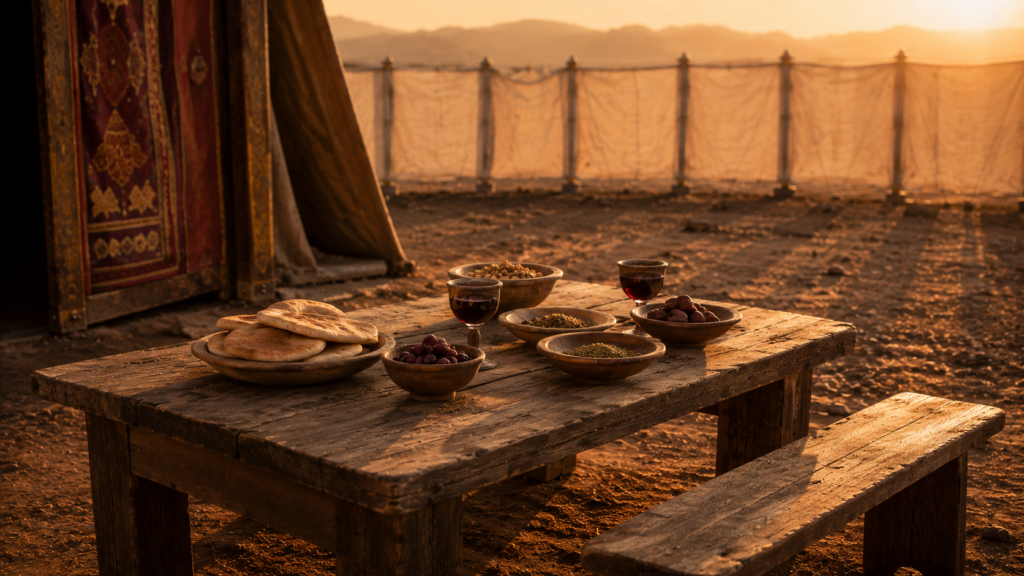
The third of the five offerings is the shelamim: the peace offering, the wellbeing offering, the communion sacrifice. The chapter is short and reads at first like more sacrificial mechanics. What makes the shelamim theologically distinct will be unfolded in chapter 7 (and especially 7:11-21): of all the offerings in chapters 1-7, this is the only one the worshipper eats. The olah (ch. 1) ascends in full to YHWH; the minchah (ch. 2) is split between the altar and the priests; the chatta’t and asham (chs. 4-5) belong to the priests and the altar. The shelamim is the one offering in which the worshipper sits down with his family at the door of the Tent of Meeting and eats. The chapter is laying the groundwork for the sacrificial system’s shared meal.
The word shelamim is plural in form and built on the same root as shalom: peace, completeness, wholeness. The plural may be intensive (a shelamim is an exceedingly peaceful offering) or distributive (a shelamim is an offering that brings all kinds of peace, with God, with the priests, with the worshipping family). Either way, the noun names the offering by its theological effect: the worshipper, the priest, and YHWH all share the same animal. The smoke goes up; the breast and thigh go to the priest (7:30-34); the rest is the worshipper’s table.
The chapter is the first in the book to permit male or female animals (3:1, 6). The earlier olah required a male only (1:3, 10). The chapter is opening up the shelamim to a wider economic and household range. Whatever the family has, the family can bring.
A · Leviticus 3:1-5 · The cattle offering
¹ “‘If his offering is a sacrifice of peace offerings; if he offers it from the herd, whether male or female, he shall offer it without defect before Yahweh. ² He shall lay his hand on the head of his offering, and kill it at the door of the Tent of Meeting. Aaron’s sons, the priests shall sprinkle the blood around on the altar. ³ He shall offer of the sacrifice of peace offerings an offering made by fire to Yahweh; the fat that covers the innards, and all the fat that is on the innards, ⁴ and the two kidneys, and the fat that is on them, which is by the loins, and the cover on the liver, with the kidneys, he shall take away. ⁵ Aaron’s sons shall burn it on the altar on the burnt offering, which is on the wood that is on the fire: it is an offering made by fire, of a pleasant aroma to Yahweh.
- Male or female (v. 1). The chapter’s first distinctive note. The olah required a male; the shelamim takes either. The chapter is opening the offering to the household’s full range of livestock. Practical reading: in a herd, the breeding stock that is no longer producing (older females, retired animals) can be brought; the productive males can be kept. Theological reading: the offering’s acceptability does not depend on the socially-preferred sex of the animal. The chapter is naming, quietly, a feature of the sacrificial economy that will reverberate (the minchah requires no gendered animal at all; the chatta’t of 4:28, 32 also permits female animals).
- Without defect (v. 1). The Hebrew is tamim, the same word as in chapter 1. Whatever the gender, the animal must be whole. The chapter is preserving the universal Levitical standard: nothing damaged is sent to YHWH.
- He shall lay his hand on the head (v. 2). The same gesture as chapter 1. The offerer identifies with the animal; the animal stands in his place. The same Hebrew verb samakh names the pressing-down. The whole sacrificial system, the chapter is teaching by structural repetition, runs on the same physical grammar across the offerings. The mechanics change; the gesture remains.
- Kill it at the door of the Tent of Meeting (v. 2). The offerer kills the animal, just as in chapter 1. The lay agency of the chapter 1 olah is preserved in the shelamim. The Israelite who brings a peace offering also does the killing; he is not delegating the cost of the meal to a temple staff.
- The fat that covers the innards, and all the fat that is on the innards, and the two kidneys, and the fat that is on them, which is by the loins, and the cover on the liver (vv. 3-4). The chapter is anatomically specific. The fat (Hebrew chelev) attached to the digestive viscera, the fat around the kidneys, and the lobe of the liver are all carefully named. These are the internal fatty deposits, the kind that surround the organs and accumulate as the animal feeds well. In the Hebrew Bible’s symbolic anatomy, these are the richest parts of the animal. The richest part is YHWH’s.
Word study: chelev (חֵלֶב) — “the fat, the richest portion”
The Hebrew chelev names the internal fat surrounding the organs of a healthy animal. The word’s semantic range is wider than just fat: it means the best, the richest, the choicest part. The Hebrew Bible uses the word metaphorically for the best of the harvest (Num 18:12, the best of the wine and the grain; the Hebrew is chelev, the fat of) and for the best of the land (Gen 45:18, the fat of the land, the phrase that has passed into modern English idiom). The chapter is using a word that means simultaneously fat and bestness. To give the chelev is, by linguistic structure, to give the best. The peace offering’s grammar is the worshipper gets the meat; YHWH gets the choicest part. The same logic runs through Cain and Abel at Gen 4:4 (Abel brought of the firstborn of his flock, and of their fat; Hebrew, chelev): the chapter’s chelev vocabulary is laying out what Abel did right and what Cain failed to do. The whole later Hebrew Bible’s theological habit of naming the best as what belongs to YHWH (Prov 3:9-10, honor YHWH with the first and best of your wealth) draws on the chelev category.
- Aaron’s sons shall burn it on the altar on the burnt offering (v. 5). The fat of the shelamim is placed on top of the burning olah already on the altar. The chapter is preserving the priority of sacrifice: the olah is the ground layer; the shelamim‘s fat is added to it. The whole later book (and especially the Day of Atonement, Lev 16) will sustain this sequence. The olah establishes the altar; the other offerings layer their portions on it.
- A pleasant aroma to Yahweh (v. 5). The same phrase from chapters 1 and 2. The chapter is teaching that the shelamim‘s burned portion is received by YHWH in the same relational vocabulary as the other offerings. YHWH enjoys the gesture.
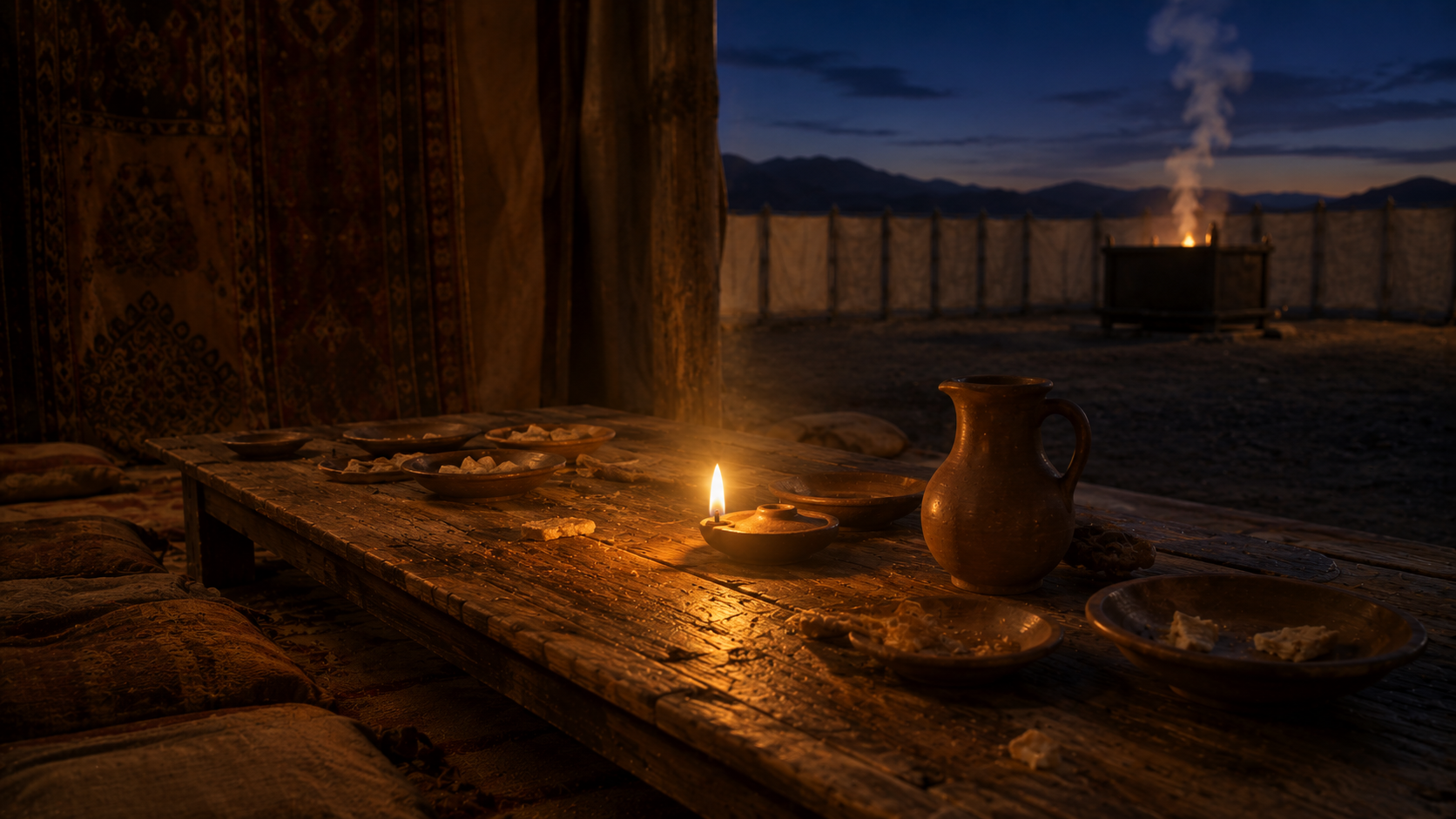
B · Leviticus 3:6-16 · The flock options
⁶ “‘If his offering for a sacrifice of peace offerings to Yahweh is from the flock, either male or female, he shall offer it without defect. ⁷ If he offers a lamb for his offering, then he shall offer it before Yahweh; ⁸ and he shall lay his hand on the head of his offering, and kill it before the Tent of Meeting. Aaron’s sons shall sprinkle its blood around on the altar. ⁹ He shall offer from the sacrifice of peace offerings an offering made by fire to Yahweh; its fat, the entire tail fat, he shall take away close to the backbone; and the fat that covers the inwards, and all the fat that is on the inwards, ¹⁰ and the two kidneys, and the fat that is on them, which is by the loins, and the cover on the liver, with the kidneys, he shall take away. ¹¹ The priest shall burn it on the altar: it is the food of the offering made by fire to Yahweh. ¹² “‘If his offering is a goat, then he shall offer it before Yahweh: ¹³ and he shall lay his hand on its head, and kill it before the Tent of Meeting; and the sons of Aaron shall sprinkle its blood around on the altar. ¹⁴ He shall offer from it as his offering, an offering made by fire to Yahweh; the fat that covers the innards, and all the fat that is on the innards, ¹⁵ and the two kidneys, and the fat that is on them, which is by the loins, and the cover on the liver, with the kidneys, he shall take away. ¹⁶ The priest shall burn them on the altar: it is the food of the offering made by fire, for a pleasant aroma; all the fat is Yahweh’s.
- The entire tail fat (v. 9). The lamb has one additional anatomical specification the bull and goat do not: the entire tail fat. The Middle Eastern fat-tailed sheep (Ovis aries platyura) accumulates a thick fatty deposit in its tail that can weigh several kilograms. This is one of the household’s richest food sources. The chapter is requiring that even this prized eating-fat be given to YHWH, not held back for the family’s feast. The pastoral note is concrete: the worshipper cannot keep the part everyone will look forward to most.
- It is the food of the offering made by fire to Yahweh (v. 11). The Hebrew is lechem isheh la-YHWH, literally “bread of an offering-by-fire to YHWH.” The verb-noun phrase uses lechem (bread, food) metaphorically: the burned fat is YHWH’s food. This is the most anthropomorphic-sacrificial language the chapter uses. The Hebrew Bible is not claiming that YHWH eats; the prophets will later attack any literalizing of this language (Ps 50:12-13, if I were hungry I would not tell you; for the world is mine, and all its fullness). But the language of YHWH having food at the altar is preserved and used. The chapter is using ancient Near Eastern sacrificial vocabulary deliberately, while quietly resisting the ANE pagan reading. YHWH is not fed by the offerings; YHWH is honored by them with the vocabulary of feeding.
- If his offering is a goat (v. 12). The goat is treated like the cattle in v. 1, without the fat-tail specification (goats do not have fat-tails). The chapter is systematic: each animal gets its appropriate anatomical treatment. The system is built for the actual livestock Israelites kept.
- All the fat is Yahweh’s (v. 16). The clinching theological statement of section B. The Hebrew is kol-chelev la-YHWH, all the fat belongs to YHWH. The chapter is moving from anatomical specification to theological principle. What the law’s mechanics have been working out, the verse states directly: the chelev (in the dual sense of fat and bestness) is YHWH’s portion in the worshipping community’s economy. The whole Hebrew Bible’s prophetic critique of withholding the best from YHWH (Mal 1:6-14, where Israel offers blemished animals; Amos 5:21-24, where the worship is loud but the justice is missing) reads this verse forward.
Influence callout: Marty Solomon (Bema; the shelamim as the table that re-builds shalom)
Solomon’s reading of Leviticus 3 places the chapter inside the book’s largest pastoral move. The shelamim is the only offering that produces a shared meal. The smoke goes up to YHWH; the priest’s portion (the breast and thigh, 7:30-34) goes to the priest’s household; the rest stays with the worshipper, who must eat it the same day or the next at the courtyard of the Tent of Meeting (7:15-17). The chapter is teaching that the worshipping family eats with YHWH. The Hebrew Bible’s theology of table fellowship (Ex 24:9-11, where the elders eat and drink in YHWH’s presence on Sinai; Ps 23:5, you prepare a table before me; Isa 25:6-8, the eschatological feast of fat things on the mountain) has its sacrificial-mechanical anchor here. Solomon’s pastoral note: the shelamim is the offering that re-builds shalom by eating together. The disordered relationship is repaired not by the cessation of meals but by the resumption of them. The whole later New Testament theology of the Lord’s Table (1 Cor 10:14-22, where Paul names participation in the blood of Christ and participation in the body of Christ in the same paragraph that names participation in pagan sacrificial meals) reads forward from Leviticus 3. Solomon’s interpretive payoff: the New Testament’s communion meal is not a Christian innovation but a Levitical inheritance; the meal is the chapter’s deepest theology, made eschatological in Christ.
C · Leviticus 3:17 · The perpetual statute
¹⁷ “‘It shall be a perpetual statute throughout your generations in all your dwellings, that you shall eat neither fat nor blood.’”
- A perpetual statute (v. 17). The Hebrew is chuqqat olam, “a statute of perpetuity.” The chapter ends not with a sacrificial detail but with a household-level food law. The fat and the blood, which the altar requires for YHWH, are also prohibited at the family’s table. The chapter is teaching that what YHWH receives in worship, the worshipper does not consume in ordinary eating. The categories of holy and common (see the clean and unclean framework) are kept distinct at the household level. The Israelite cannot eat the fat the altar gets; the Israelite cannot drink the blood the altar receives. The same logic that gives YHWH the chelev of every peace offering animal gives YHWH, by extension, the fat of every animal Israel eats.
- In all your dwellings (v. 17). The Hebrew is be-khol moshvotekhem, “in all your settlements.” The prohibition is not localized to the sanctuary. Even when the worshipper is far from the central altar, the fat-and-blood prohibition still applies. The Hebrew Bible is teaching that Israel’s whole kitchen is part of the sanctuary’s economy. The household’s eating is mediated by the same theological rules that govern the altar.
- Neither fat nor blood (v. 17). The two substances are paired because both belong to YHWH in different ways. The blood belongs to YHWH because it carries life (Lev 17:11, see the kipper / atonement framework for the development of this principle). The fat belongs to YHWH because it is the bestness. The chapter is teaching that life and bestness are both, in their material form, YHWH’s. To eat them is to take what is not the worshipper’s to take. The whole later Hebrew Bible distinction between what is YHWH’s portion and what is Israel’s portion draws on this verse. The same logic underwrites the tithe (Lev 27:30-33, the tithe is YHWH’s), the firstfruits (Ex 23:19), the Sabbath (the seventh day is YHWH’s), the sabbatical year (the seventh year, Lev 25:1-7), and the Jubilee (Lev 25:8-55; see the jubilee year framework). The chapter’s small concluding rule is a microcosm of the book’s whole economy: YHWH’s portion is not the worshipper’s to consume.
Reflection prompts
- The shelamim is the offering of shared eating. The smoke goes up; the priest eats; the worshipper eats; the meal is the architecture of the relationship. Where in your own discipleship is the shared meal missing? What relationship in your life would be repaired by eating together rather than by talking about the rift?
- The chapter says all the fat is YHWH’s. The richest, choicest part of every animal is not the worshipper’s to keep. What in your own income, in your own week, in your own attention represents the chelev, and where is it currently going?
- The closing prohibition extends to all your dwellings. The worship rule reaches into the kitchen. Where in your own home life does worship currently not reach? What everyday-eating practice could be re-imagined as part of the sanctuary’s economy?
Frameworks at play in this chapter: the five offerings, the kipper / atonement framework, the clean and unclean, the jubilee year.