

Leviticus 16 is the book’s structural and theological center. The whole book has been building toward this single day. The sacrifices of chapters 1-7 set up the offerings the chapter requires. The priestly ordination of chapter 8 trained the priest who will perform the day’s work. The disaster of chapter 10 with Nadab and Abihu established the warning of v. 1 that opens this chapter (after the death of the two sons of Aaron). The purity unit of chapters 11-15 mapped the impurities that have built up over a year and that the Day of Atonement now cleanses in a single coordinated event. Whatever else Leviticus is doing, the book is teaching Israel how to perform this day.
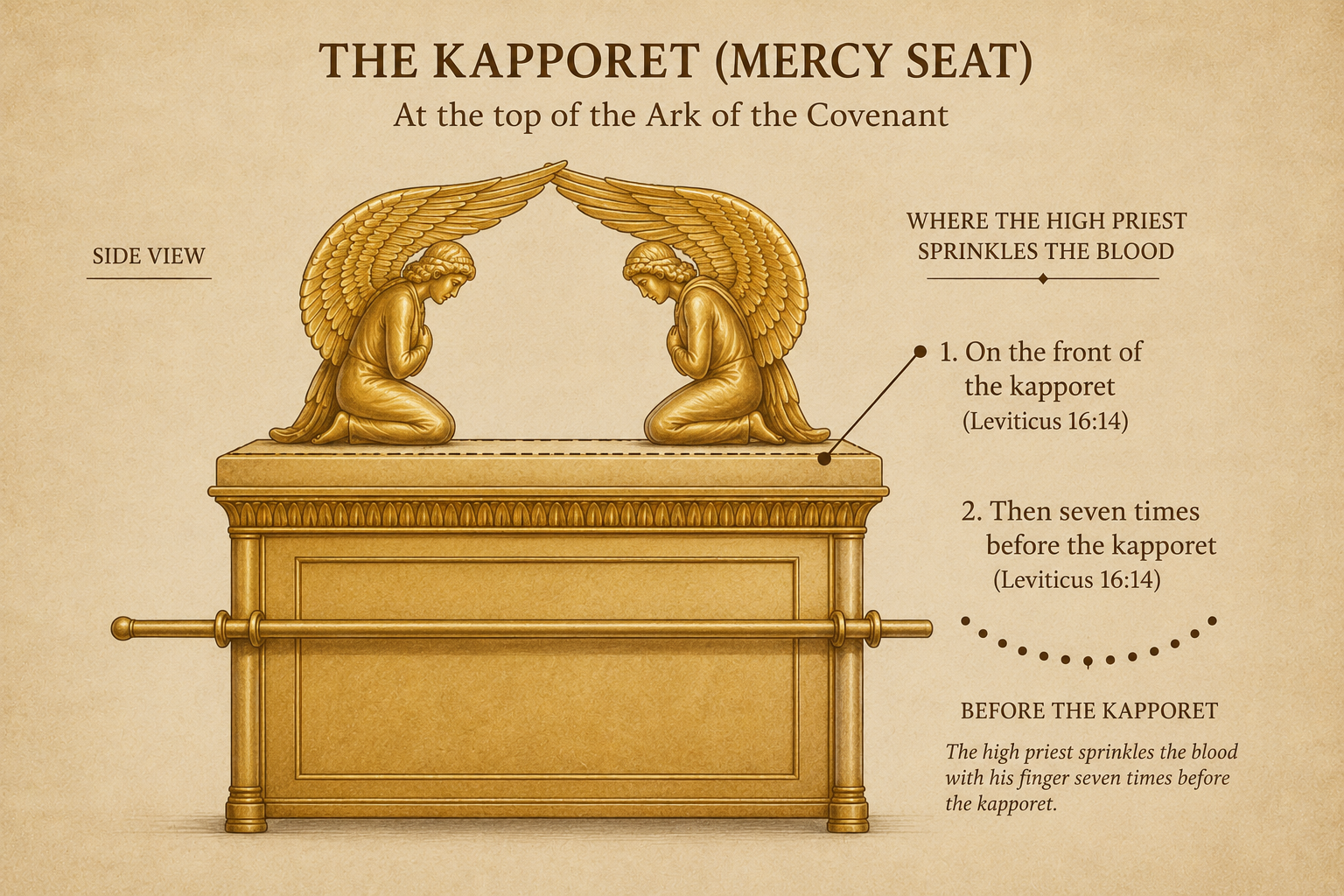
The chapter sets out the ritual mechanics of what the rabbinic tradition will call Yom ha-Kippurim (the Day of Atonements, plural in Hebrew because the day atones for multiple things simultaneously) or Yom Kippur in everyday speech. The day occurs once a year, on the tenth day of the seventh month (Tishrei). The high priest, alone of all Israel, enters the Most Holy Place (the inner sanctum behind the veil where the ark rests) twice in the same day: once with the blood of the bull (his own chatta’t) and once with the blood of the goat (the people’s chatta’t). He sprinkles the blood on the kapporet (mercy seat) and seven times before the kapporet. Then he performs the chapter’s most distinctive single ritual: he lays both hands on the head of a second living goat and confesses over it all the iniquities of the people, and the goat is led away into the wilderness, to Azazel, bearing on itself all their iniquities to a solitary land. The whole congregation observes the day in afflicting the soul (fasting and self-denial) and Sabbath rest. The chapter ends by establishing the day as a perpetual statute (v. 29).
The chapter is the foundation of the New Testament’s entire atonement theology. The book of Hebrews (especially Heb 9-10) re-reads this chapter Christologically point by point: Christ as the better high priest, Christ’s blood as the better blood, Christ’s entry into the heavenly Most Holy Place as the fulfillment of the chapter’s annual entry, Christ’s once for all as the resolution of the chapter’s once a year. The whole later Christian theology of the cross as atonement gathers around this chapter (see the kipper / atonement framework for the full theological development). Whether the chapter is read in its Jewish register (Yom Kippur as Israel’s annual reset) or its Christian register (the type fulfilled in Christ’s death and ascension), the chapter is one of the most consequential in the Hebrew Bible.
A · Leviticus 16:1-10 · The framing and the two goats
¹ Yahweh spoke to Moses, after the death of the two sons of Aaron, when they drew near before Yahweh, and died; ² and Yahweh said to Moses, “Tell Aaron your brother not to come at all times into the Most Holy Place within the veil, before the mercy seat which is on the ark; lest he die: for I will appear in the cloud on the mercy seat. ³ “Aaron shall come into the sanctuary with this: with a young bull for a sin offering, and a ram for a burnt offering. ⁴ He shall put on the holy linen coat, and he shall have the linen breeches on his body, and shall put on the linen sash, and he shall be clothed with the linen turban. They are the holy garments. He shall bathe his body in water, and put them on. ⁵ He shall take from the congregation of the children of Israel two male goats for a sin offering, and one ram for a burnt offering. ⁶ “Aaron shall offer the bull of the sin offering, which is for himself, and shall make atonement for himself and for his house. ⁷ He shall take the two goats, and set them before Yahweh at the door of the Tent of Meeting. ⁸ Aaron shall cast lots for the two goats; one lot for Yahweh, and the other lot for the scapegoat. ⁹ Aaron shall present the goat on which the lot fell for Yahweh, and offer him for a sin offering. ¹⁰ But the goat, on which the lot fell for the scapegoat, shall be presented alive before Yahweh, to make atonement for him, to send him away as the scapegoat into the wilderness.
- After the death of the two sons of Aaron, when they drew near before Yahweh, and died (v. 1). The chapter is anchored to chapter 10’s tragedy. The Hebrew Bible is teaching, by deliberate linkage, that what is at stake in this chapter is the same thing that killed Nadab and Abihu. The Most Holy Place is not a casual room. The chapter’s protocols are not arbitrary fastidiousness; they are protective constraints that make safe what is otherwise lethal. The pastoral note is sober: the chapter takes seriously the danger that earlier chapters have named.
- Tell Aaron your brother not to come at all times into the Most Holy Place (v. 2). The Hebrew is al-yavo bekhol-et el-haqodesh, “let him not enter at any time into the holy place.” The Most Holy Place is not available to the high priest as a routine destination. Once a year, on this specific day, with these specific protocols, the high priest enters. Every other day of the year, the Most Holy Place stands closed behind the veil. The chapter is teaching that the holy is precious because access is restrained.
- I will appear in the cloud on the mercy seat (v. 2). YHWH’s presence is located above the kapporet, between the two cherubim (cf. Ex 25:22). The same theophany-cloud that descended on the tabernacle at Ex 40:34-38 now is named as the regular mode of YHWH’s presence in the Most Holy Place. The high priest’s entry is into the cloud. The whole later Hebrew Bible’s theology of the kavod between the cherubim (1 Sam 4:4, YHWH of hosts who is enthroned on the cherubim; Ps 80:1; 99:1) reads forward from this verse.
- The holy linen coat … linen breeches … linen sash … linen turban (v. 4). The high priest’s standard regalia (Ex 28: a colorful ephod with gold thread, jeweled breastpiece, gold plate on the turban) is not worn on this day. Instead, he wears plain linen. The chapter is teaching that the high priest enters the Most Holy Place stripped of every visible mark of his station. He goes in as a simple servant, dressed like the lowest priest. The Hebrew Bible’s later theology of humility before the holy (Isa 6:5, I am a man of unclean lips; Ezek 1:28, the prophet falls on his face) reads forward from this verse. The whole later New Testament theology of Christ who, being in the form of God, did not consider equality with God a thing to be grasped, but emptied himself, taking the form of a servant (Phil 2:6-7) reads forward from this verse.
- Two male goats for a sin offering (v. 5). The chapter’s most distinctive element. Two goats are brought as the people’s chatta’t. One will be sacrificed; the other will not. The chapter is using a two-part mechanism to do the work that on every other day requires only one. The chapter’s logic: a single sacrifice cannot perform both purgation (cleansing the sanctuary) and removal (carrying iniquity away). The two goats together perform both moves. (See the kipper / atonement framework for the theological development.)
- Aaron shall cast lots for the two goats; one lot for Yahweh, and the other lot for the scapegoat (v. 8). The two goats are identical until the lots are cast. The Hebrew is goralot, the same word for the lots cast at Josh 18:6, 8 to assign tribal territories, and at Esth 3:7 (the pur) and 9:24 (the source of the festival of Purim). Lot-casting is the Hebrew Bible’s mechanism for deferring to divine choice. The chapter is teaching that which goat plays which role is not the priest’s decision. Both are equally fit; YHWH chooses.
- One lot for Yahweh, and the other lot for the scapegoat (v. 8). The English scapegoat is the translation of the Hebrew Azazel (עֲזָאזֵל). The word’s etymology is debated. Some readings: ez ozel (the goat that goes away); a place name in the wilderness (the cliff or ridge to which the goat is led); or a proper name, possibly of a wilderness demon or fallen angel (this last reading is preserved in 1 Enoch and in some rabbinic and Second Temple traditions). Michael Heiser and others have argued for the proper name reading: the goat is sent to Azazel, a wilderness power or fallen bene elohim, as a symbolic return to the source of the disorder. The chapter does not interpret itself fully on this point. Whatever Azazel is, the goat is sent there, alive, bearing the people’s iniquities. (See the divine council framework for Heiser’s broader supernatural-worldview reading.)
Word study: Azazel (עֲזָאזֵל)
The Hebrew word Azazel appears only four times in the Hebrew Bible, all in this chapter (vv. 8, 10 [twice], 26). The translation history reveals interpretive disagreement. The Septuagint reads apopompaios (the one sent away); the Vulgate reads caper emissarius (the goat sent out); William Tyndale’s 1530 translation coined the English scape-goat (scape being an archaic spelling of escape); the modern English versions split between scapegoat (NIV, ESV, NRSV, WEB) and Azazel preserved as a proper name (NABRE, JPS Tanakh, NRSVue). Three major readings: (1) Azazel as common noun, derived from ez (goat) and ozel (going away); the goat that goes off. (2) Azazel as place name, naming the wilderness destination, possibly a specific cliff or ridge mentioned in the rabbinic tradition. (3) Azazel as proper name, naming a wilderness power, possibly a fallen bene elohim figure named in 1 Enoch 8-10 as one of the angelic teachers of forbidden knowledge. Michael Heiser’s The Unseen Realm argues vigorously for the third reading, arguing that the Day of Atonement’s two-goat structure is not sending iniquity into a neutral wilderness but returning it to its supernatural source. The chapter does not adjudicate the question. What is clear: the goat is not sacrificed, not killed, not offered on the altar. It is led away alive, with all the iniquities of Israel symbolically placed on its head, into the wilderness, to Azazel. The whole later Hebrew Bible’s image of the carrier of sin who is sent away (Isa 53:6, YHWH has laid on him the iniquity of us all) reads forward from this verse.
B · Leviticus 16:11-19 · The high priest’s entries into the Most Holy Place
¹¹ “Aaron shall present the bull of the sin offering, which is for himself, and shall make atonement for himself and for his house, and shall kill the bull of the sin offering which is for himself. ¹² He shall take a censer full of coals of fire from off the altar before Yahweh, and two handfuls of sweet incense beaten small, and bring it within the veil: ¹³ and he shall put the incense on the fire before Yahweh, that the cloud of the incense may cover the mercy seat that is on the testimony, so that he will not die. ¹⁴ He shall take some of the blood of the bull, and sprinkle it with his finger on the mercy seat on the east; and before the mercy seat he shall sprinkle some of the blood with his finger seven times. ¹⁵ “Then he shall kill the goat of the sin offering, that is for the people, and bring his blood within the veil, and do with his blood as he did with the blood of the bull, and sprinkle it on the mercy seat, and before the mercy seat: ¹⁶ and he shall make atonement for the Holy Place, because of the uncleanness of the children of Israel, and because of their transgressions, even all their sins: and so he shall do for the Tent of Meeting, that dwells with them in the middle of their uncleanness. ¹⁷ No one shall be in the Tent of Meeting when he enters to make atonement in the Holy Place, until he comes out, and has made atonement for himself and for his household, and for all the assembly of Israel. ¹⁸ “He shall go out to the altar that is before Yahweh and make atonement for it, and shall take some of the bull’s blood, and some of the goat’s blood, and put it on the horns of the altar all around. ¹⁹ He shall sprinkle some of the blood on it with his finger seven times, and cleanse it, and make it holy from the uncleanness of the children of Israel.
- Aaron shall present the bull of the sin offering, which is for himself (v. 11). The high priest first addresses his own state. The chapter is preserving the principle from 9:7 (Aaron’s own chatta’t before he offers the people’s): deal with the priest’s own iniquity before mediating the community’s. The whole later book of Hebrews’ careful note that Christ has no need to offer a sin offering for himself (Heb 7:27; 9:7-14) reads forward from this verse.
- A censer full of coals of fire from off the altar … and two handfuls of sweet incense beaten small, and bring it within the veil (vv. 12-13). The high priest’s first entry into the Most Holy Place is with incense, not blood. The cloud of incense, the chapter says, covers the mercy seat … so that he will not die. The incense functions as a protective cloud, blocking direct visual contact between the high priest’s mortal eyes and the kavod dwelling above the kapporet. The whole later prophetic image of the cloud of incense (Ezek 8:11) and the New Testament’s prayers as incense ascending (Rev 5:8; 8:3-4) takes its texture from this verse.
- Sprinkle it with his finger on the mercy seat on the east; and before the mercy seat he shall sprinkle some of the blood with his finger seven times (v. 14). The first blood-sprinkling. On the mercy seat itself (the kapporet, the gold lid of the ark) plus seven times before it. The chapter is following the chapter 4 pattern (the priest’s chatta’t blood was applied to the inner altar’s horns) and extending it: on Yom Kippur, the blood reaches the kapporet itself, the actual meeting place between YHWH and Israel. The whole later New Testament theology of Christ as the kapporet (the hilasterion of Rom 3:25, the Septuagint’s translation of kapporet) reads forward from this verse.
- He shall make atonement for the Holy Place, because of the uncleanness of the children of Israel, and because of their transgressions, even all their sins (v. 16). The chapter’s clearest theological statement. The atonement covers all categories: uncleanness (the tame’ states of chs. 11-15), transgressions (the pesha of intentional rebellion), and sins (the chatta’t of inadvertence). The Day of Atonement cleanses the full year’s worth of accumulated pollution in a single coordinated event. The chapter is the year’s annual reset.
- That dwells with them in the middle of their uncleanness (v. 16). The chapter’s most theologically arresting phrase. The Hebrew is hashshokhen ittam betokh tum-otam. The tabernacle, the kavod, YHWH himself: he dwells with Israel in the middle of their uncleanness. The chapter is teaching that YHWH chose to dwell with a people whose impurities he would have to address by his own provision. The whole later New Testament theology of the Word made flesh dwelling among us (Jn 1:14, where the Greek eskenosen literally is tabernacled among us) reads forward from this verse. The chapter’s logic: YHWH did not wait for Israel to become clean; he came to dwell with them and then provided the means by which they could be cleansed.
- No one shall be in the Tent of Meeting when he enters to make atonement in the Holy Place (v. 17). The high priest does the work alone. The chapter is teaching that the most decisive moment in the year’s worship is performed by one person, in solitude, behind the veil. The whole later New Testament theology of Christ alone on the cross (Mt 27:46, the cry of my God, my God, why have you forsaken me?) reads forward from this verse.
- Make atonement for it, and shall take some of the bull’s blood, and some of the goat’s blood, and put it on the horns of the altar all around (v. 18). After the inner sanctuary cleansing, the high priest returns to the outer altar and applies the mixed blood (bull’s + goat’s) to its horns. The chapter is teaching that every layer of the sanctuary’s holiness gradient (most holy place → holy place → outer altar) needs the same blood-cleansing in different application protocols. The whole sanctuary, top to bottom, is renewed.
C · Leviticus 16:20-22 · The scapegoat
²⁰ “When he has finished atoning for the Holy Place, the Tent of Meeting, and the altar, he shall present the live goat. ²¹ Aaron shall lay both his hands on the head of the live goat, and confess over him all the iniquities of the children of Israel, and all their transgressions, even all their sins; and he shall put them on the head of the goat, and shall send him away into the wilderness by the hand of a man who is in readiness. ²² The goat shall carry all their iniquities on himself to a solitary land, and he shall release the goat in the wilderness.
- Aaron shall lay both his hands on the head of the live goat (v. 21). The chapter’s most distinctive single gesture. Throughout the book, the offerer has laid one hand on the offering’s head (Lev 1:4, 3:2, etc.). Here, on Yom Kippur, the high priest lays both hands. The gesture is doubled. The Hebrew Bible’s later usage will use both hands for the strongest forms of identification: Jacob blessing Joseph’s sons (Gen 48:14, crossing his hands), Moses commissioning Joshua (Num 27:18-23). The chapter is teaching that the transfer of iniquity to the goat is a deliberate, two-handed, formal act. Not a gesture in passing.
- Confess over him all the iniquities of the children of Israel, and all their transgressions, even all their sins (v. 21). The high priest performs a vocal confession. The Hebrew is vehitvaddah, the same verb from Lev 5:5 (see the word study there) and from Lev 26:40 (Israel’s eschatological confession in exile). The chapter is teaching that the goat does not bear iniquity by magic; the high priest names the iniquities aloud as he transfers them. The whole later Hebrew Bible’s theology of spoken confession (Ps 32:5; Prov 28:13; 1 Jn 1:9) is foundationally connected to this verse.
- Send him away into the wilderness … to a solitary land (vv. 21-22). The Hebrew is vehishlach … el-eretz gezerah. The phrase eretz gezerah (the cut-off land, the solitary land) names the wilderness’s specific character: a place cut off from human habitation, a place no one can find again. The goat is taken to where no one is. The whole later Hebrew Bible’s image of iniquity carried far away (Ps 103:12, as far as the east is from the west, so far has he removed our transgressions from us; Mic 7:19, you will hurl all our sins into the depths of the sea) reads forward from this verse.
- The goat shall carry all their iniquities on himself to a solitary land (v. 22). The Hebrew is venasa hassa’ir alav et-kol-avonotam el-eretz gezerah. The verb nasa (to carry, to bear, to lift) is the verb that will run through the Hebrew Bible’s iniquity-bearing theology: Isa 53:4 (surely he has borne our griefs) and Isa 53:11-12 (he shall bear their iniquities, the suffering servant). The chapter is laying down the structural foundation that the prophets will pick up: someone carries iniquity away. The whole later New Testament theology of Christ as the Lamb of God who bears the sin of the world (Jn 1:29, where the Greek airon translates the Hebrew nasa) reads forward from this verse.
D · Leviticus 16:23-34 · The closing rites and the perpetual statute
²³ “Aaron shall come into the Tent of Meeting, and shall take off the linen garments, which he put on when he went into the Holy Place, and shall leave them there. ²⁴ Then he shall bathe himself in water in a holy place, and put on his garments, and come out and offer his burnt offering and the burnt offering of the people, and make atonement for himself and for the people. ²⁵ The fat of the sin offering he shall burn on the altar. ²⁶ “He who lets the goat go for the scapegoat shall wash his clothes, and bathe his flesh in water, and afterward he shall come into the camp. ²⁷ The bull for the sin offering, and the goat for the sin offering, whose blood was brought in to make atonement in the Holy Place, shall be carried outside of the camp; and they shall burn their skins, their flesh, and their dung with fire. ²⁸ He who burns them shall wash his clothes, and bathe his flesh in water, and afterward he shall come into the camp. ²⁹ “It shall be a statute to you forever: in the seventh month, on the tenth day of the month, you shall afflict your souls, and shall do no kind of work, whether native-born or a stranger who lives as a foreigner among you: ³⁰ for on this day shall atonement be made for you, to cleanse you. You shall be clean from all your sins before Yahweh. ³¹ It is a Sabbath of solemn rest to you, and you shall afflict your souls; it is a statute forever. ³² The priest, who is anointed and who is consecrated to be priest in his father’s place, shall make atonement, and shall put on the linen garments, even the holy garments. ³³ Then he shall make atonement for the Holy Sanctuary; and he shall make atonement for the Tent of Meeting and for the altar; and he shall make atonement for the priests and for all the people of the assembly. ³⁴ “This shall be an everlasting statute for you, to make atonement for the children of Israel once a year because of all their sins.” It was done as Yahweh commanded Moses.
- Take off the linen garments, which he put on when he went into the Holy Place, and shall leave them there (v. 23). The high priest leaves the linen garments inside the Holy Place. He does not wear them out. The chapter is teaching that the garments used inside the inner sanctum stay there. The high priest then re-bathes and puts on his ordinary high-priestly garments (the colorful ephod, breastpiece, etc.) for the closing public ceremonies. The chapter is preserving the layered holiness of his role.
- In the seventh month, on the tenth day of the month, you shall afflict your souls, and shall do no kind of work (v. 29). The chapter sets the day’s date (10th of Tishrei) and the day’s people-side obligation: afflict your souls (Hebrew ve’innitem et-nafshoteichem) and do no work. The traditional Jewish reading: afflict your souls requires fasting (no food, no water for the day), abstaining from leather shoes, washing, perfumes, and sexual relations. The day is, in the rabbinic tradition, the most solemn of the entire year. The chapter requires the whole people to participate, native-born or stranger. The day is not the priest’s alone; it is the people’s.
- On this day shall atonement be made for you, to cleanse you. You shall be clean from all your sins before Yahweh (v. 30). The chapter’s most concentrated single promise. On this day, the cleansing reaches all your sins. The chapter is teaching that no sin is outside the day’s scope. The book of Hebrews will pick up this verse and read it forward to Christ: not that he should offer himself often, as the high priest enters the holy places every year with blood not his own … but as it is, he has appeared once for all at the end of the ages to put away sin by the sacrifice of himself (Heb 9:25-28). What that once for all is located in matters: Hebrews does not collapse the kipper into the cross alone, but reads the full Day-of-Atonement structure into Christ’s death-resurrection-ascension as a single movement, with the kipper-making itself occurring when the risen Christ enters the heavenly sanctuary with his own life (Heb 9:11-12, 24). (See the festival calendar framework for the day’s place in the broader Hebrew Bible calendar.)
Influence callout: David Moffitt (Rethinking the Atonement; the kipper in Hebrews is located at Christ’s heavenly entry, not at the cross)
Moffitt’s reading of Hebrews, developed across Atonement and the Logic of Resurrection in the Epistle to the Hebrews (Brill, 2011) and Rethinking the Atonement: New Perspectives on Jesus’s Death, Resurrection, and Ascension (Baker Academic, 2022), has reshaped the contemporary scholarly conversation about how the New Testament reads Leviticus 16. The standard modern Christian assumption locates Christian atonement at the cross: Jesus dies, and at that moment atonement is accomplished. Moffitt argues this is not what Hebrews actually says when read inside its Levitical framework.
Leviticus 16’s kipper (atonement-making) is not the slaughter of the goat at the outer altar. The slaughter, in the chapter, happens before the atonement is made. The kipper itself happens when the high priest carries the blood inside the Most Holy Place and sprinkles it on the kapporet (vv. 14-16). The slaughter is the precondition; the kipper is the bringing-of-the-life-into-the-presence.
Hebrews follows this structure precisely. The cross corresponds to the slaughter at the outer altar: it provides the blood (the life). But the kipper itself happens when Christ, as the risen high priest, enters the heavenly Most Holy Place and presents his life before the Father (Heb 9:11-12, he entered once for all into the holy places, not by means of the blood of goats and calves but by means of his own blood, thus securing an eternal redemption; Heb 9:24, Christ has entered, not into holy places made with hands … but into heaven itself, now to appear in the presence of God on our behalf).
The ascension, on Moffitt’s reading, is not a postscript to atonement; the ascension is the atonement-making moment. The whole movement, cross, resurrection, ascension, is the full Day of Atonement enactment. The cross provides the offering; the resurrection vindicates the offering as accepted; the ascension brings the life into the heavenly presence where the kipper is performed. Moffitt’s pastoral payoff: a Christian theology that locates atonement only at the cross has lost what Hebrews is actually saying. The resurrection and ascension are not optional features attached to a completed atonement; they are constitutive of the atonement itself. The whole Lukan-Pauline emphasis on Christ at the right hand of the Father interceding for us (Rom 8:34; Heb 7:25; 1 Jn 2:1) reads forward from the Day of Atonement’s the high priest inside the sanctuary doing the work of kipper. Moffitt’s reading is fully consistent with the Solomon / Paul Within Judaism lane this site reads from: the Hebrew Bible’s categories are not retired in Christ; they are precisely the categories Hebrews uses to explain what Christ has done, when read on their own terms.
- It is a Sabbath of solemn rest to you (v. 31). The Hebrew is shabbat shabbaton hi lakhem. The same intensified-Sabbath phrase used for the weekly Sabbath (Ex 31:15, shabbat shabbaton qodesh la-YHWH). The chapter is teaching that the Day of Atonement is its own kind of Sabbath: a day of complete rest from work layered with deep self-affliction. The Hebrew Bible’s later prophetic critique of fasting that does not produce justice (Isa 58:3-7) reads this verse forward in a hopeful key: the chapter establishes what fasting is, and the prophets ensure that the fasting does not become a substitute for the deeper work the fasting is meant to lead to.
- An everlasting statute for you, to make atonement for the children of Israel once a year because of all their sins (v. 34). The chapter’s closing seal. The day is once a year, every year, forever. The chapter is teaching that the sanctuary’s annual cleansing is not optional. The whole later Jewish observance of Yom Kippur as the holiest day of the calendar derives from this verse. The whole later Christian theology of Christ’s cross as the eschatological fulfillment of the annual day derives from this verse too.
Where this lands: The annual reset we do not have
Whatever the New Testament’s reading of this chapter (and Hebrews 9-10 develops it more thoroughly than anywhere else in Scripture), the chapter is teaching something most modern Western Christians have functionally lost: the rhythm of the annual reset.
Once a year, on a specific day, the whole community fasts. Stops working. Refrains from the ordinary pleasures (food, water, sexual intimacy, washing). Confesses iniquity aloud and watches a goat carry it away. Sits with the year’s accumulated weight, lets the high priest take it into the Most Holy Place, and emerges at sundown into a fresh year. The chapter is teaching that the human soul needs an annual rhythm of this kind. Not just confession in passing. Not just a quick prayer of repentance. A full day, every year, for the whole community, to bear the weight of what has accumulated and watch it be carried away.
The Christian liturgical year preserves echoes of this in Lent (forty days of fasting culminating in Holy Week), in Ash Wednesday (the ash on the forehead, the remember you are dust), in Maundy Thursday and Good Friday. But many modern evangelical traditions have dispensed with these. The result is communities that have no liturgical place for the year’s accumulated grief, betrayal, anger, sin, and exhaustion. The weight goes nowhere. There is no goat sent into the wilderness; there is just the ordinary week, accumulating year after year.
The chapter is asking: what is your annual reset? When does your soul stop, fast, confess, and watch the weight be carried away? If the answer is I don’t have one, then Leviticus 16 is the chapter that names the gap. Make a Day of Atonement-shaped day somewhere in your year. Lent, if your tradition has it. The week between Christmas and New Year’s, if not. Your own birthday. Your own date of significant loss. Once a year, every year, forever. The chapter is not optional advice; it is a structural commitment to the human soul’s actual needs.
Influence callout: Michael Heiser (The Unseen Realm; the Day of Atonement as the year’s cosmic-court reset)
Heiser’s reading of Leviticus 16 places the chapter inside the broader Hebrew Bible’s divine council worldview (see the divine council framework). The chapter, Heiser argues, is performing a cosmic-court reset, not just a sanctuary-cleansing. The two goats serve two distinct functions: the first goat, sacrificed for YHWH, purges the sanctuary in the manner of the chapter 4 chatta’t (Milgrom’s purgation reading). The second goat, sent to Azazel, returns iniquity to its supernatural source. Heiser reads Azazel as a wilderness power, possibly a fallen bene elohim figure, possibly the Azazel of 1 Enoch 8-10 who is identified there as one of the watchers who taught humanity forbidden knowledge. The chapter, on this reading, is not just cleansing a sanctuary; it is returning the year’s iniquity to the supernatural realm it originated from. The wilderness is, in the Hebrew Bible’s cosmography, the realm of chaos and disorder, the place where the se’irim (goat-demons of Lev 17:7) and Azazel-figures dwell. The goat sent into that realm is not being sacrificed to the wilderness powers; it is delivering iniquity back to its source. Heiser’s pastoral payoff: the Day of Atonement is performing cosmic justice, not just bookkeeping. The iniquity that the people have received from, and contributed to, the cosmic disorder is being returned. The whole later New Testament theology of Christ disarming the principalities and powers (Col 2:15) and binding the strong man (Mt 12:29; Mk 3:27; Lk 11:21-22) reads forward from this chapter’s cosmic-court grammar. Heiser’s reading is contested by other scholars (Milgrom is much more cautious about the Azazel-as-supernatural-being reading), but the cosmic-cleansing scope of the chapter is hard to deny once it is named.
Reflection prompts
- The chapter teaches that YHWH dwells in the middle of Israel’s uncleanness (v. 16). The Holy did not wait for the people to be clean before drawing near. Where in your own life have you been waiting to clean yourself up before letting God draw near? What does this chapter do to that assumption?
- The high priest enters the Most Holy Place alone and does the year’s most decisive work in solitude behind the veil. Where in your own life is there work that only you can do, that no one else can witness, and that requires going behind the veil with the weight of what others cannot see?
- The two-goat structure performs both purgation (cleansing what has been polluted) and removal (carrying iniquity away). Where in your own life have you tried to do only one of these (either cleansing without removal, or removal without cleansing), and what would both moves together look like in practice?
Frameworks at play in this chapter: the kipper / atonement framework, the five offerings, the clean and unclean, the festival calendar, the tabernacle as cosmic temple, the divine council.