
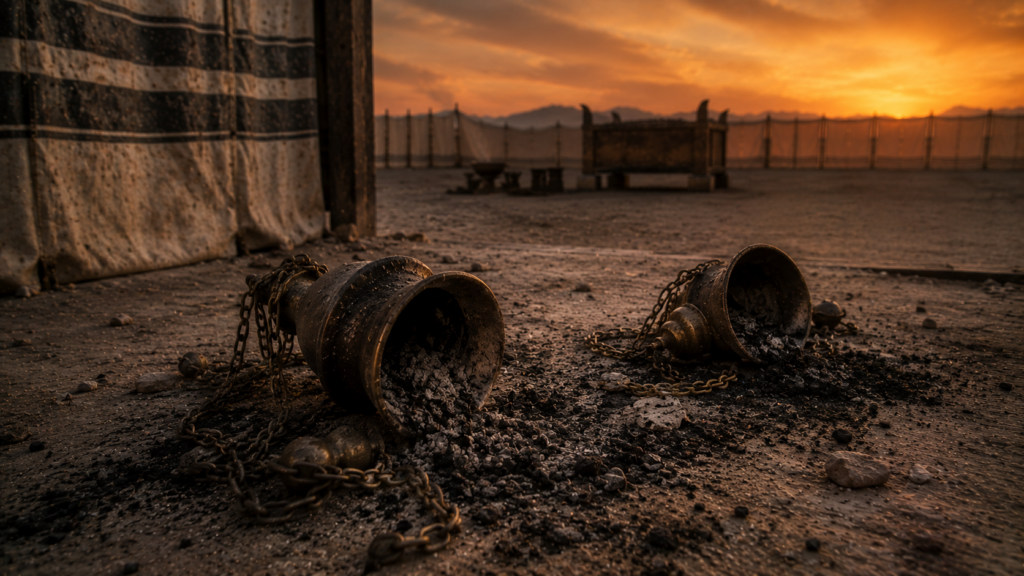
Chapter 10 is the book’s tragedy. On the same day the priesthood begins to function (ch. 9), Aaron’s two oldest sons, Nadab and Abihu, take their censers, put fire in them, lay incense on the fire, and offer strange fire before YHWH which he had not commanded them. Fire comes out from before YHWH (the same fire that had just descended to consume the offering at 9:24) and consumes them. They die before YHWH. Moses speaks; Aaron is silent. The bodies are carried out by cousins. The surviving priests are forbidden to mourn, forbidden to leave the tabernacle, forbidden to drink wine while on duty. The chapter ends with Moses upset about a procedural detail in the chatta’t ritual and Aaron’s wise, gentle response.
The chapter is the dark counterpart to chapter 9. The eighth-day inauguration’s kavod and acceptance fire become, on the same day, the kavod and judgment fire. The chapter is the Hebrew Bible’s first sustained warning about the danger of priesthood. The whole later book of Hebrews’ careful note that our God is a consuming fire (Heb 12:29, quoting Deut 4:24) reads forward from this chapter. The chapter is the foundation of what later Christian theology will call the fear of the Lord (cf. Prov 1:7; 9:10): the recognition that proximity to the holy is dangerous.
The chapter also opens the book’s first sustained instruction about how to make priestly decisions when the system breaks down. After the deaths, after the mourning prohibitions, Aaron and Moses have a small conflict over a procedural matter. Aaron makes a judgment call that goes against the literal procedure. Moses accepts it. The chapter is teaching that the priesthood is not a script-reading job; it requires interpretive wisdom when reality forces the moment.
A · Leviticus 10:1-3 · The strange fire
¹ Nadab and Abihu, the sons of Aaron, each took his censer, and put fire in it, and laid incense on it, and offered strange fire before Yahweh, which he had not commanded them. ² Fire came out from before Yahweh, and devoured them, and they died before Yahweh. ³ Then Moses said to Aaron, “This is what Yahweh spoke of, saying, ‘I will show myself holy to those who come near me, and before all the people I will be glorified.’” Aaron held his peace.
- Nadab and Abihu, the sons of Aaron (v. 1). The two oldest of Aaron’s four sons. They have just been ordained alongside their father (8:13, 24, 30); they have just witnessed the kavod and the fire of acceptance (9:24); they have just shared in the eighth-day inaugural feast. The chapter is teaching, by careful identification, that the priestly office did not protect them. They are named, not anonymous, in the moment of failure. The Hebrew Bible’s whole prophetic tradition of naming failing leaders (the indictments of Hos 5:1; Mic 3:1-12; Mal 2:1-9) reads forward from this verse.
- Each took his censer, and put fire in it, and laid incense on it (v. 1). The Hebrew text is careful: each son acts individually, not as a delegated team. Each takes his own censer; each puts his own fire in it; each lays his own incense on it. The chapter is naming the moment as self-initiated. The censers, fire, and incense are all standard priestly equipment; the initiative is the problem.
- Strange fire before Yahweh, which he had not commanded them (v. 1). The Hebrew is esh zarah asher lo tzivvah otam. The word zarah means strange, alien, foreign. The same word will name an outsider (a zar, a non-Aaronic person) at Num 1:51; 3:10. The chapter is teaching that the fire’s source is the issue: it is not from the altar’s fire-from-YHWH (9:24, which YHWH had given to be the perpetual altar source). It is fire that Aaron’s sons brought from somewhere else. The chapter is precise: it is not that they brought bad fire; it is that they brought uncommanded fire. The very same incense, on the very same kind of censer, with the same physical motions, becomes a fatal offering when its source is wrong.
- Which he had not commanded them (v. 1). The chapter’s most theologically loaded phrase. The Hebrew is asher lo tzivvah otam. The literal translation is that he had not commanded them. The Hebrew Bible’s whole theology of worship-as-response-to-revelation hangs on this phrase. Worship is not the human’s free improvisation in YHWH’s direction. Worship is the human’s specific response to what YHWH has specifically commanded. The whole later Reformation principle of the regulative principle of worship (Calvin: worship only what God commands; cf. Institutes 4.10.8, the most acceptable thing is that we obey his voice rather than offering whatever we please) reads forward from this verse. The whole Anabaptist tradition’s careful resistance to anything in worship not explicitly commanded in Scripture also reads this verse forward.
- Fire came out from before Yahweh, and devoured them, and they died before Yahweh (v. 2). The Hebrew is vatetze esh mi-lifnei YHWH va-tochal otam. The same Hebrew structure as the acceptance fire of 9:24 (vatetze esh mi-lifnei YHWH va-tochal), except in chapter 9 the fire consumed the offering and in chapter 10 the fire consumed the offerers. The chapter is making, by deliberate textual parallelism, the most uncomfortable theological point in the book: the same fire that accepts can destroy. The fire’s character does not change; the offering’s appropriateness does.
- I will show myself holy to those who come near me (v. 3). The Hebrew is bikrovai eqqadesh. The verb qadash (to be holy, to be set apart) is in the reflexive form: YHWH will make himself holy through those who come near him. The chapter is teaching that the holiness of YHWH is not negotiable in his immediate presence. Those who come near must either honor the holiness (and become channels of it) or fail to honor it (and become casualties of it). The same principle will run through the rest of the book: the careful gradient of qodesh / chol (holy / common, see the clean and unclean framework) is not a polite suggestion; it is the operational law of life near the holy.
- Aaron held his peace (v. 3). The Hebrew is vayyiddom Aharon. The verb damam means to be silent, to stand still, to cease motion. The same verb names Joshua’s command to the sun (Josh 10:12, sun, stand still) and the eerie silence at Hab 2:20 (let all the earth keep silence before him). The chapter ends section A with one of the Hebrew Bible’s most devastating two-word descriptions. Aaron has just lost his two oldest sons. Moses has just delivered a theological interpretation of the deaths that, however accurate, can only sound to Aaron’s grief like a justification. Aaron does not argue. Aaron does not protest. Aaron does not collapse. Aaron is silent. The pastoral note runs deep: the chapter is honest about a kind of obedience that has no words for itself. There are moments when the priest cannot speak. Aaron’s silence is itself a form of faithfulness.
Word study: zar / zarah (זָר / זָרָה) — “stranger, outsider, unauthorized”
The Hebrew root zur gives the noun zar (a non-Levitical/non-Aaronic person) and the adjective zarah (strange, foreign, unauthorized). The same root names the zarim (foreigners) that Israel must distinguish from itself in the Hebrew Bible’s identity vocabulary, and the isha zarah (strange/forbidden woman) of Proverbs 5-7 whose path leads to death. The chapter’s esh zarah (strange fire) belongs to this larger semantic field: it is not just unusual fire; it is fire-from-outside-the-authorized-source. The Hebrew Bible’s vocabulary of foreign worship (the elohim achareim, the other gods of Ex 20:3; Deut 5:7; 6:14) draws on the same root grammar. The chapter is teaching that the deepest danger to priesthood is not opposition (a Pharaoh on the throne) but creativity-from-the-wrong-source (a priest taking his own initiative inside the sanctuary). The whole later Hebrew Bible vocabulary of idolatry will be built on this root: the strange god, the strange fire, the strange woman, all share the same theological structure. Each is a creativity-from-the-wrong-source substituting itself for what YHWH has commanded.
B · Leviticus 10:4-7 · The bodies removed, the surviving priests forbidden to mourn
⁴ Moses called Mishael and Elzaphan, the sons of Uzziel the uncle of Aaron, and said to them, “Draw near, carry your brothers from before the sanctuary out of the camp.” ⁵ So they drew near, and carried them in their coats out of the camp, as Moses had said. ⁶ Moses said to Aaron, and to Eleazar and to Ithamar, his sons, “Don’t let the hair of your heads go loose, and don’t tear your clothes; that you don’t die, and that he not be angry with all the congregation: but let your brothers, the whole house of Israel, bewail the burning which Yahweh has kindled. ⁷ You shall not go out from the door of the Tent of Meeting, lest you die; for the anointing oil of Yahweh is on you.” They did according to the word of Moses.
- Moses called Mishael and Elzaphan, the sons of Uzziel the uncle of Aaron (v. 4). The cousins, not the priests themselves, handle the bodies. The Hebrew Bible’s priestly purity rules forbid Aaron and the surviving sons from contact with the dead (the regular priest can attend immediate family funerals per Lev 21:1-3, but only with great care; the high priest cannot defile himself for any corpse per Lev 21:11). The chapter is teaching that grief itself cannot suspend the priestly office’s purity rules. Aaron and his sons must continue to function. The cousins do what the priests cannot do.
- In their coats out of the camp (v. 5). The bodies are carried out in their priestly tunics. The chapter is making, by detail, a quiet pastoral note: Nadab and Abihu died in their consecrated state. Whatever else the chapter is teaching about their failure, it is not teaching that the consecration was cancelled. The bodies leave the camp in the same garments they were robed in eight days earlier. The whole later Hebrew Bible’s careful theology of the dead saints (Heb 11; Rev 6:9-11, the souls under the altar) reads forward from this verse: even those who fall in the line of priestly service remain somehow theirs.
- Don’t let the hair of your heads go loose, and don’t tear your clothes (v. 6). The standard Hebrew Bible mourning gestures (loose hair, torn garments, cf. Gen 37:34; Lev 13:45; 2 Sam 1:11) are forbidden to Aaron and his surviving sons. The chapter is enforcing a costly discipline: the priest cannot publicly mourn his own sons in the middle of priestly service. The pastoral implication is brutal but theologically careful. The priest’s office is public-facing; if the priests collapse into private mourning during the inaugural day, the whole community’s worship collapses. The whole house of Israel will mourn on their behalf (v. 6); the priests must hold the office.
- You shall not go out from the door of the Tent of Meeting, lest you die (v. 7). The seven-day milluim requirement of 8:33-35 continues. Aaron and his sons remain at the doorway. Even in the wake of catastrophe, the system’s commitment to seven days of consecration holds. The whole later Hebrew Bible’s theology of staying put in the day of disaster (Job 1:20-22, Job did not sin or charge God with wrong; Lam 3:25-30, to bow under the yoke is good) reads forward from this verse.

C · Leviticus 10:8-11 · The prohibition on wine and the priestly task of distinguishing
⁸ Yahweh spoke to Aaron, saying, ⁹ “You and your sons are not to drink wine or strong drink whenever you go into the Tent of Meeting, or you will die. This shall be a statute forever throughout your generations. ¹⁰ You are to make a distinction between the holy and the common, and between the unclean and the clean. ¹¹ You are to teach the children of Israel all the statutes which Yahweh has spoken to them by Moses.”
- Yahweh spoke to Aaron (v. 8). The chapter’s most surprising address. Through most of the book, YHWH speaks to Moses, who then speaks to Aaron or the people. Here, YHWH speaks directly to Aaron. Some commentators read this as the chapter’s quiet pastoral note: in the wake of the priestly disaster, YHWH addresses the priest without intermediary, signaling the priest’s continued standing. Others read it as the establishment of Aaron’s direct line: the priesthood will, from this moment, receive its instructions both through Moses and directly.
- Are not to drink wine or strong drink whenever you go into the Tent of Meeting (v. 9). The chapter’s prohibition on priestly intoxication while on duty. The placement of this rule is significant: it comes immediately after Nadab and Abihu’s failure. Some ancient Jewish commentators (Targum Pseudo-Jonathan; Leviticus Rabbah 12) inferred that the sons had been drinking. The text does not say this directly, but the placement allows the inference. The chapter is teaching, at minimum, that the priesthood requires sobriety. The same prohibition will run through the whole later Hebrew Bible’s vocational standards for sacred leaders (Prov 31:4-5, it is not for kings; the Nazirite vow at Num 6:3; the New Testament’s standards at 1 Tim 3:3, 8; Tit 1:7).
- To make a distinction between the holy and the common, and between the unclean and the clean (v. 10). The chapter’s clearest single statement of the priesthood’s interpretive task. The priest is the distinguisher. The Hebrew word l’havdil (to distinguish, to separate) is the same verb used at Gen 1:4, 7, 14, 18 when YHWH separates light from darkness, waters from waters, day from night. The chapter is teaching that the priest’s vocation is to perform, on the social-religious plane, the same kind of separating-act YHWH performed at creation. The priest’s task is the application of the holy/common and clean/unclean distinctions of the clean and unclean framework to the actual situations of the community. The whole later Hebrew Bible’s prophetic critique of priests who failed to teach the distinction (Ezek 22:26, her priests have violated my law and profaned my holy things; they have not distinguished between the holy and the common; Mal 2:7-9) reads this verse forward.
- Teach the children of Israel all the statutes which Yahweh has spoken to them by Moses (v. 11). The priest is also a teacher. The Hebrew is u-le-horot. The verb yarah (to teach) is the same root that gives the noun torah (teaching, instruction). The chapter is teaching that the priest’s function includes Torah instruction of the people. The whole later Hebrew Bible’s theology of Torah teaching as a priestly function (Deut 33:10, of Levi; Mal 2:7, the lips of a priest should guard knowledge; Neh 8:7-8, the Levites teach the Torah to the returning exiles) reads forward from this verse.
D · Leviticus 10:12-20 · The eating regulations and Aaron’s interpretive response
¹² Moses spoke to Aaron, and to Eleazar and to Ithamar, his sons who were left, “Take the meal offering that remains of the offerings of Yahweh made by fire, and eat it without yeast beside the altar; for it is most holy; ¹³ and you shall eat it in a holy place, because it is your portion, and your sons’ portion, of the offerings of Yahweh made by fire: for so I am commanded. ¹⁴ The waved breast and the heaved thigh you shall eat in a clean place, you, and your sons, and your daughters with you: for they are given as your portion, and your sons’ portion, out of the sacrifices of the peace offerings of the children of Israel. ¹⁵ The heaved thigh and the waved breast they shall bring with the offerings made by fire of the fat, to wave it for a wave offering before Yahweh: and it shall be yours, and your sons’ with you, as a portion forever; as Yahweh has commanded.” ¹⁶ Moses diligently inquired about the goat of the sin offering, and, behold, it was burned: and he was angry with Eleazar and with Ithamar, the sons of Aaron who were left, saying, ¹⁷ “Why haven’t you eaten the sin offering in the place of the sanctuary, seeing it is most holy, and he has given it you to bear the iniquity of the congregation, to make atonement for them before Yahweh? ¹⁸ Behold, its blood was not brought into the inner part of the sanctuary: you certainly should have eaten it in the sanctuary, as I commanded.” ¹⁹ Aaron spoke to Moses, “Behold, today they have offered their sin offering and their burnt offering before Yahweh; and such things as these have happened to me: and if I had eaten the sin offering today, would it have been pleasing in Yahweh’s sight?” ²⁰ When Moses heard that, it was pleasing in his sight.
- Take the meal offering that remains … and eat it without yeast beside the altar (v. 12). The chapter returns to ordinary business. Moses reminds the surviving priests of their minchah-eating rights (cf. 6:14-18; 7:9-10). The chapter is teaching that priestly service continues even on the day of disaster. The food the priests eat is most holy; they must eat in the proper place; the daughters can eat the shelamim portions in a clean place. The system carries on.
- Moses diligently inquired about the goat of the sin offering, and, behold, it was burned (v. 16). Moses checks the chatta’t goat (the one Aaron offered for the people at 9:15) and finds it has been burned rather than eaten. The chapter has just established that the common-person chatta’t meat goes to the priests (6:24-30); the priests are supposed to eat it in the holy precinct, bearing the iniquity of the congregation (10:17, the chapter’s clearest single statement of the priestly-eating-as-iniquity-bearing theology). Eleazar and Ithamar instead burned the meat. Moses is angry.
- Aaron spoke to Moses (v. 19). The chapter’s surprising pivot. Aaron, who has been silent since v. 3, speaks. The Hebrew word vayyedabber (and he spoke) is the same verb used for YHWH’s own speech-acts in the book. Aaron is finally addressing the prophet. The chapter is teaching that Aaron’s silence was not permanent collapse; it was a suspended state from which he now emerges with measured words.
- Today they have offered their sin offering and their burnt offering before Yahweh; and such things as these have happened to me (v. 19). Aaron’s argument is masterful in its restraint. He does not protest the procedure; he does not argue the law; he simply names the day. The Hebrew is vatiqrenah oti ka-eleh, “and these things have happened to me.” Aaron is naming his grief without invoking it as an excuse.
- If I had eaten the sin offering today, would it have been pleasing in Yahweh’s sight? (v. 19). The chapter’s interpretive masterstroke. Aaron is arguing that the priest in deep grief cannot perform the priestly meal, because the eating is bearing the iniquity of the congregation (v. 17), and a priest who is himself in disaster cannot mediate the congregation’s chatta’t through his own table. The eating-of-chatta’t-meat is not a consumption; it is the priest’s act of bearing the congregation’s failure inside his own body. A priest carrying his own catastrophe cannot also carry the congregation’s. So Aaron burned the meat instead.
- When Moses heard that, it was pleasing in his sight (v. 20). Moses accepts Aaron’s reading. The Hebrew is vayyitav be-einav, “it was good in his eyes.” The chapter is teaching, by this concluding line, that the priesthood is not script-reading. When the situation requires interpretive flexibility, the priest who understands the law’s deepest theological function can deviate from its literal procedure and remain faithful. Moses, the law-giver, accepts the deviation. The chapter is the foundation of all later Jewish and Christian tradition’s debates about the spirit of the law versus the letter of the law.
Where this lands: Aaron’s quiet improvisation
Most readers leave Leviticus 10 with the image of the strange fire and the two dead sons. Few notice how the chapter ends: a priest, freshly bereaved, makes an interpretive judgment that goes against the literal procedure, and the law-giver agrees with him.
Aaron has just lost his sons. The book has just spent ten chapters teaching the precise procedures. And in the last conversation of the day, Aaron deviates. He burns the chatta’t meat instead of eating it, because he understands that the eating is not a mechanical step. It is the priest bearing the congregation’s iniquity inside his own body. A priest carrying a catastrophe of his own cannot carry the congregation’s too. So he doesn’t.
This is the chapter’s quiet, easily missed gift. The Bible’s first major priestly disaster is followed, on the same day, by a priest doing his job with interpretive wisdom. Faithfulness is not always literal. Sometimes faithfulness is the discernment that the procedure, in this moment, would betray its own purpose. The pastor who cannot preach this Sunday because his daughter is in the hospital. The teacher who cancels the lesson plan because the class needs something else. The leader who breaks her own rule because the rule was made for cases like this one.
Aaron’s silence at v. 3 is famous. His speech at v. 19 should be. The chapter is teaching that the priest who has lived through catastrophe and still thinks clearly is the priest the community needs the most. Moses heard him. Moses agreed. That is the chapter’s deepest pastoral coda.
Influence callout: Walter Brueggemann (Theology of the Old Testament; the tension between covenant order and covenant freedom)
Brueggemann’s reading of Leviticus 10 places the chapter inside the Hebrew Bible’s deepest theological tension: the covenantal order (the priest must follow the commanded procedure) and the covenantal freedom (the priest must respond to YHWH’s living presence in the moment). Brueggemann argues that the chapter is both a warning about innovation-from-the-wrong-source (Nadab and Abihu) and a vindication of innovation-from-the-right-source (Aaron’s interpretive response at the end). The two innovations look superficially similar: both are not literally commanded. The difference is the source. Nadab and Abihu’s fire came from somewhere outside the altar’s commanded source. Aaron’s interpretive judgment came from inside the law’s deepest theological logic. Brueggemann’s pastoral payoff: the Hebrew Bible refuses both rigid literalism (which would have required Aaron to eat the chatta’t despite his grief, betraying the system’s deepest function) and unmoored innovation (which got Nadab and Abihu killed). The faithful priest is the one who can tell the difference. The whole later Christian tradition’s debates about sola scriptura and the role of the magisterium, about the spirit of the law and the letter, about legalism and antinomianism, are reading forward from this chapter’s complex theology of commanded versus interpretive. Brueggemann’s reading: the chapter is teaching the church that covenantal faithfulness is more than rule-following but never less.
Reflection prompts
- The chapter teaches that the source of the fire matters more than the form of the offering. Nadab and Abihu used the right censers, the right incense, the right physical gestures. What was wrong was the source of the fire. Where in your own life have you been doing the right things from the wrong source? What would the right source look like in that area?
- Aaron held his peace. The chapter honors a kind of obedience that has no words for itself. Where in your own life is grief currently asking you to be silent, and where have you been filling that silence with words that don’t fit?
- Aaron’s response to Moses at the end (vv. 19-20) is the chapter’s quiet hopeful coda: the priest in catastrophe still thinks clearly enough to interpret the law’s deepest intent. Where in your own life has the literal procedure asked something of you that the procedure’s deepest purpose would actually forbid? What does Aaron’s example permit?
Frameworks at play in this chapter: the five offerings, the clean and unclean, the kipper / atonement framework, the tabernacle as cosmic temple.