

Leviticus 21 turns from the whole congregation‘s holiness (chs. 19-20) back to the priesthood‘s specific holiness. The chapter sets out three concentric circles of priestly restriction: ordinary priests (vv. 1-9), the high priest specifically (vv. 10-15), and the priest with a physical defect (vv. 16-24). Each circle is more constrained than the last. The chapter is teaching that the closer to the altar, the more careful the protocols.
The chapter raises real interpretive questions for modern readers, especially in the disability passage at vv. 16-23. A priest with a physical defect (blindness, lameness, mutilation, dwarfism, broken bones, etc.) is barred from approaching the altar. The modern reader’s instinct is to find this offensive. The chapter, however, must be read carefully: the priest with the defect is not excluded from the priesthood, not excluded from the holy precinct, and not excluded from the holy food. The chapter is restricting only altar approach, not personhood, status, identity, or community standing. The disabled priest still eats the bread of his God, both of the most holy and of the holy (v. 22). The chapter is preserving careful liturgical gradients of holy-space access while maintaining the disabled priest’s full community membership.
The chapter operates inside the same theological grammar as the rest of the Holiness Code: YHWH sanctifies the priests (vv. 8, 15, 23); the priests do not sanctify themselves. The restrictions are the form their consecrated life takes, not the price of it.
A · Leviticus 21:1-9 · The ordinary priest’s restrictions
¹ Yahweh said to Moses, “Speak to the priests, the sons of Aaron, and say to them, ‘A priest shall not defile himself for the dead among his people; ² except for his relatives that are near to him: for his mother, for his father, for his son, for his daughter, for his brother, ³ and for his virgin sister who is near to him, who has had no husband; for her he may defile himself. ⁴ He shall not defile himself, being a chief man among his people, to profane himself. ⁵ “‘They shall not shave their heads, neither shall they shave off the corners of their beards, nor make any cuttings in their flesh. ⁶ They shall be holy to their God, and not profane the name of their God; for they offer the offerings of Yahweh made by fire, the bread of their God; therefore they shall be holy. ⁷ “‘They shall not marry a woman who is a prostitute, or profane; neither shall they marry a woman divorced from her husband: for he is holy to his God. ⁸ You shall sanctify him therefore; for he offers the bread of your God. He shall be holy to you; for I Yahweh, who sanctify you, am holy. ⁹ “‘The daughter of any priest, if she profanes herself by playing the prostitute, she profanes her father. She shall be burned with fire.
- A priest shall not defile himself for the dead among his people (v. 1). The chapter’s first restriction. The ordinary priest cannot ritually defile himself by contact with corpses, except for his close family. The chapter is preserving the priest’s cultic readiness: contact with death (the chapter’s deepest impurity category; see the clean and unclean framework) requires time and ritual to recover from, and a priest is needed at the altar most days of the year.
- Except for his relatives that are near to him: for his mother, for his father, for his son, for his daughter, for his brother, and for his virgin sister (vv. 2-3). The chapter permits immediate-family defilement. The list is precise: parents, children, brothers, and unmarried sisters (because married sisters have entered another household and their funeral arrangements belong to their husband’s family). The chapter is not asking priests to abandon their families in grief; it is naming the priestly office’s exemption framework with care. The list also names a fascinating absence: the priest’s wife is not in the list. Many ancient and modern commentators have noted that this is probably an oversight in the text (the priest’s wife is treated as a relative throughout the rest of the Hebrew Bible), but the chapter does not explicitly include her. The rabbinic tradition treats the absence as a textual issue and includes the wife.
- He shall not defile himself, being a chief man among his people, to profane himself (v. 4). The chapter’s most enigmatic verse. The Hebrew is lo yittama ba’al be’ammav lehechallo. The verse may be: (a) prohibiting the priest from defiling himself as a husband (the ba’al sense, “husband, master”), reading the verse as a partial exception that this commentary will not elaborate; (b) a more general clause about the priest’s senior status in the community; or (c) a difficult verse the meaning of which has been debated for two millennia. Whatever the verse’s exact reference, the general principle is clear: the priest does not casually defile himself for relations who do not belong to the v. 2-3 list.
- They shall not shave their heads, neither shall they shave off the corners of their beards, nor make any cuttings in their flesh (v. 5). The same mourning-modification prohibition the chapter 19 verse extended to the whole people (Lev 19:27-28) is intensified for the priest. The priest’s body, dedicated to holy service, cannot be ritually scarred even in grief.
- They shall not marry a woman who is a prostitute, or profane; neither shall they marry a woman divorced from her husband (v. 7). The chapter restricts the priest’s marriage to specific categories of partner. The Hebrew is precise: zonah (a prostitute, including the cultic-prostitute category), chalalah (one who is profaned, of debated specific reference), and grushah (a divorced woman). The chapter is preserving the priestly household’s ritual lineage: marriages that bring complicated histories are avoided. The Hebrew Bible’s later usage shows the rule has household-protection purposes, not judgment-of-women purposes. (The same prohibition does not apply to the broader population; ordinary Israelites can marry divorced women, with their own constraints addressed at Deut 24:1-4.)
- The daughter of any priest, if she profanes herself by playing the prostitute, she profanes her father. She shall be burned with fire (v. 9). The chapter applies the most severe penalty (burning, cf. Lev 20:14) to the priest’s daughter who prostitutes herself. The chapter’s logic: the priest’s household is consecrated; the daughter’s prostitution profanes the household and the priestly office. This verse, like the chapter’s other capital provisions, has not been enforced by either Jewish or Christian communities since the temple’s destruction; it represents the original ancient legal severity of the offense within Israel’s actual covenantal-legal system.
B · Leviticus 21:10-15 · The high priest’s additional restrictions
¹⁰ “‘He who is the high priest among his brothers, upon whose head the anointing oil is poured, and that is consecrated to put on the garments, shall not let the hair of his head hang loose, nor tear his clothes; ¹¹ neither shall he go in to any dead body, nor defile himself for his father, or for his mother; ¹² neither shall he go out of the sanctuary, nor profane the sanctuary of his God; for the crown of the anointing oil of his God is upon him. I am Yahweh. ¹³ “‘He shall take a wife in her virginity. ¹⁴ A widow, or one divorced, or a woman who has been defiled, or a prostitute, these he shall not marry: but a virgin of his own people shall he take as a wife. ¹⁵ He shall not profane his offspring among his people: for I am Yahweh who sanctifies him.’”
- He who is the high priest … shall not let the hair of his head hang loose, nor tear his clothes (v. 10). The high priest’s mourning restrictions are tighter than the ordinary priest’s. He cannot perform any of the standard mourning gestures, not even for his father or mother (v. 11). The chapter is teaching that the high priest’s consecration takes precedence over his familial role. He is always the high priest first.
- Neither shall he go out of the sanctuary (v. 12). The Hebrew is u-min ha-miqdash lo yetze. The high priest cannot leave the sanctuary during a family death to attend the funeral. The chapter is treating his ongoing presence at the sanctuary as non-suspendable. The whole later book of Hebrews’ careful image of Christ as the high priest who has entered the heavenly sanctuary and remains there (Heb 7:25; 9:24) reads forward from this verse.
- He shall take a wife in her virginity (v. 13). The high priest’s marriage is further restricted beyond the ordinary priest’s. He cannot marry a widow, a divorced woman, or a profaned woman — only a virgin from his own people. The chapter is preserving the high priestly line with maximum strictness. The Hebrew Bible’s later narrative tradition records the consequences when these rules are bent or broken (cf. 2 Chron 26:18-21, where Uzziah’s intrusion into the priestly role results in his being struck with skin disease; the high priestly office is taken with the utmost gravity).
- I am Yahweh who sanctifies him (v. 15). The chapter repeats the Holiness Code’s signature phrase. The high priest is sanctified by YHWH, not by his own performance.
C · Leviticus 21:16-24 · Physical defects and altar access
¹⁶ Yahweh spoke to Moses, saying, ¹⁷ “Say to Aaron, ‘None of your offspring throughout their generations who has a defect, may approach to offer the bread of his God. ¹⁸ For whatever man he is that has a defect, he shall not draw near: a blind man, or a lame, or he who has a flat nose, or any deformity, ¹⁹ or a man who has an injured foot, or an injured hand, ²⁰ or hunchbacked, or a dwarf, or one who has a defect in his eye, or an itching disease, or scabs, or who has damaged testicles. ²¹ No man of the offspring of Aaron the priest who has a defect shall come near to offer the offerings of Yahweh made by fire. Since he has a defect, he shall not come near to offer the bread of his God. ²² He shall eat the bread of his God, both of the most holy, and of the holy. ²³ He shall not come near to the veil, nor come near to the altar, because he has a defect; that he may not profane my sanctuaries: for I am Yahweh who sanctifies them.’” ²⁴ So Moses spoke to Aaron, and to his sons, and to all the children of Israel.
- None of your offspring throughout their generations who has a defect, may approach to offer the bread of his God (v. 17). The chapter’s most sensitive provision. The Hebrew word for defect is mum, a visible physical condition that impairs the body’s normal completeness. The chapter is restricting altar access on the basis of physical wholeness. The chapter’s logic parallels the unblemished animal requirement of the sacrifice chapters (Lev 1:3, 10; 3:1; 4:3, 23, 28, etc.): just as the offering must be whole, the priest who serves at the altar must be whole. The chapter is preserving the whole-and-unblemished pattern across both the offering and the offerer.
- A blind man, or a lame, or he who has a flat nose, or any deformity, or a man who has an injured foot, or an injured hand, or hunchbacked, or a dwarf, or one who has a defect in his eye, or an itching disease, or scabs, or who has damaged testicles (vv. 18-20). The chapter’s list of disqualifying conditions. The list is precise: it covers congenital conditions (dwarfism, hunchback), acquired injuries (broken bones, eye conditions), and skin conditions. The chapter is making specific distinctions, not a vague judgment.
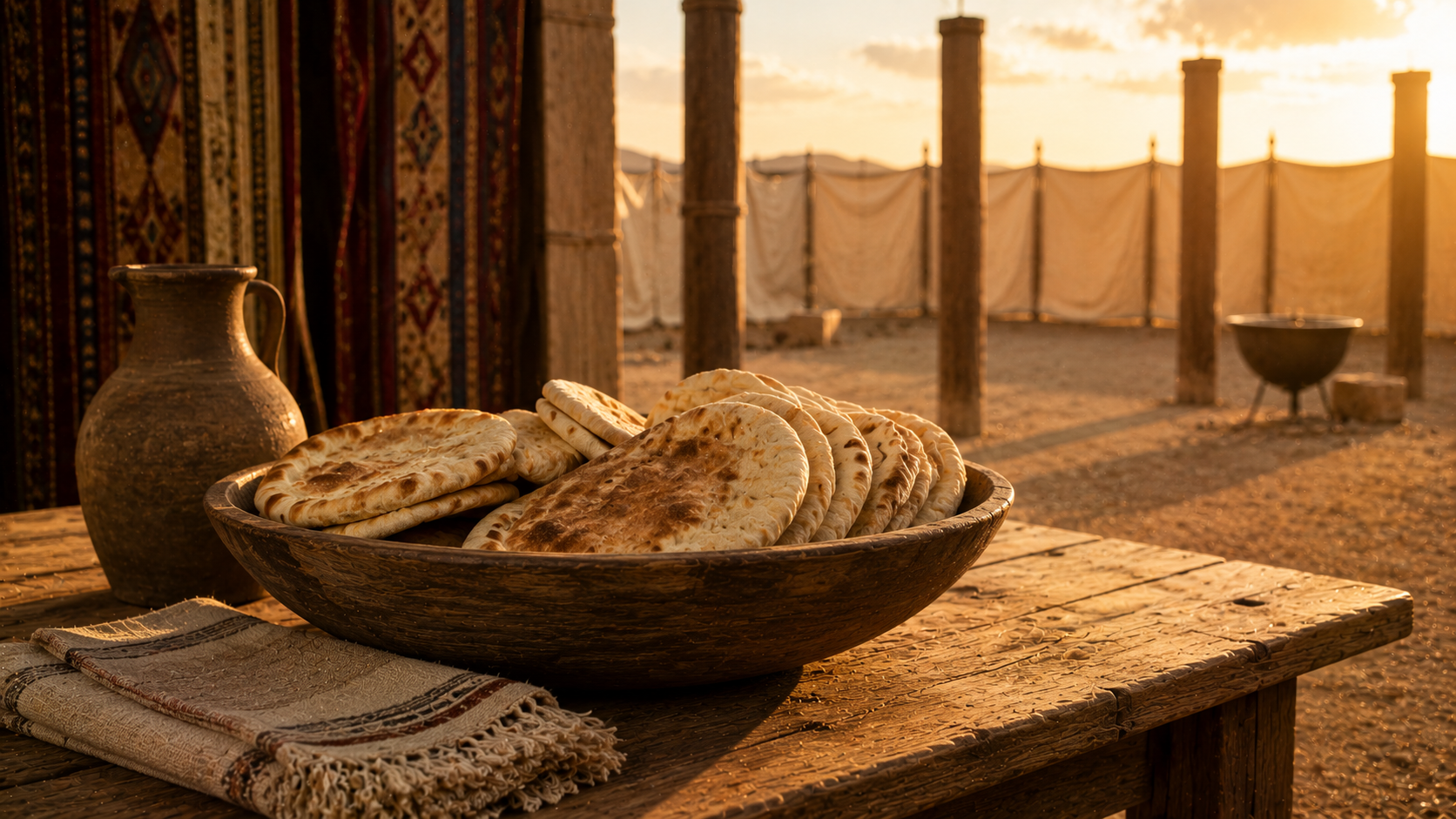
- He shall eat the bread of his God, both of the most holy, and of the holy (v. 22). The chapter’s most important single verse for modern readers struggling with the passage. The disabled priest is not excluded from the priesthood. He still eats the holy food. He still belongs to the priestly community. He still has his consecrated status. The chapter is restricting only one specific function — approaching the altar to offer sacrifice — while preserving every other dimension of his priestly identity. This is theologically significant: the chapter is not declaring the disabled priest unworthy or outside the community. It is naming a specific liturgical restriction within a wider context of full belonging.
- He shall not come near to the veil, nor come near to the altar, because he has a defect; that he may not profane my sanctuaries (v. 23). The chapter’s reasoning is consistent with the whole-and-unblemished logic of the sacrificial system. The chapter is not claiming the disabled priest lacks holiness; it is preserving a specific liturgical pattern of wholeness-at-the-altar. The whole later book of Hebrews will frame Christ as the priest who is whole in every possible sense — body, life, perfection — and whose entry into the heavenly sanctuary fulfills what this chapter could only partially gesture at (Heb 4:14-5:10; 7:26-28).
- I am Yahweh who sanctifies them (v. 23). The chapter closes its hardest provision with the same gentle theological grounding that has run through the whole Holiness Code. YHWH sanctifies. The priests do not sanctify themselves. The disabled priest is sanctified alongside his able-bodied brothers; the chapter’s altar-restriction does not change his sanctification status.
Where this lands: The disabled priest who still eats the bread
Verse 22 is the chapter’s most pastorally important single verse for modern readers. The disabled priest still eats the bread of his God, both of the most holy and of the holy. He is not cast out. He is not stripped of his priestly identity. He is not made a second-class member of the priestly community. The chapter restricts one specific function — approaching the altar to offer sacrifice — while preserving everything else.
Modern readers who encounter the chapter’s restriction often read it as the Hebrew Bible declaring the disabled unworthy or less in some fundamental way. The chapter refuses that reading. The disabled priest eats with his brothers. He receives the same provisions. He belongs to the same family. He has the same name. The chapter is preserving a specific liturgical gradient of altar-access while maintaining the disabled priest’s full standing in every other respect.
The application matters because modern communities frequently do not preserve this distinction. A church or a workplace or a family encounters someone whose body or mind functions differently, and the response is full exclusion — from the community, the table, the conversation, the affection, the role-recognition. The chapter is not asking modern communities to bar disabled people from the altar (the altar itself is now Christ, and Christ welcomes the blind and the lame into the kingdom; cf. 2 Sam 5:6-8, the lame and the blind cannot come into the house; Mt 21:14, the blind and the lame came to him in the temple, and he healed them). The chapter is asking: are you preserving the full standing of the people whose bodies do not fit your community’s standard? Are they still at the table? Are they still receiving the most holy and the holy? Are they still your family?
If your community has effectively cast out people whose bodies or minds do not conform — even while not naming it as exclusion — the chapter’s verse 22 is the correction. He shall eat the bread of his God, both of the most holy and of the holy. The disabled priest is still a priest. The chapter does not abolish his belonging.
Influence callout: Nancy Eiesland (The Disabled God; the chapter as the seed of the disability theology Christ fulfills)
Eiesland’s The Disabled God: Toward a Liberatory Theology of Disability (Abingdon, 1994) reshaped the modern Christian conversation about Scripture and disability. Eiesland’s pastoral payoff begins by taking Leviticus 21 seriously as a difficulty and as a chapter that does not say what it is sometimes assumed to say. The disabled priest retains his priestly identity in the chapter; he is barred from altar approach but not from priestly community, family, food, or status. Eiesland’s larger theological move: the chapter’s restriction is fulfilled and reversed in Christ. The risen Christ appears to the disciples still bearing the wounds of crucifixion (Lk 24:39; Jn 20:24-28). The Christ who is the heavenly high priest is the disabled-and-glorified body. The chapter’s restriction (whole bodies at the altar) is read by Eiesland as the type of which Christ’s wounded resurrection body is the anti-type. The disabled Christian, in Eiesland’s reading, is not less an image of God; the disabled Christian images the risen Christ in a way the able-bodied Christian cannot. Eiesland’s work, which she developed while living with significant disability herself, has shaped a generation of Christian disability theology (John Swinton, Amos Yong, Brian Brock, Hans Reinders, Stanley Hauerwas). The whole later New Testament theology of the body of Christ whose members each have their different gift and place (1 Cor 12:14-26, where the seemingly weaker members are indispensable) reads forward from this chapter’s logic in a transformed key. The chapter is the foreshadow of a fuller belonging the New Testament will name.
Reflection prompts
- The chapter restricts altar approach for priests with physical defects, but preserves their full priestly identity and their access to the holy food. Where in your own community has the altar-restriction been mistaken for full exclusion, and what would v. 22 (he shall eat the bread of his God) ask you to recover?
- The chapter places the priest’s office before the priest’s family in the high priest’s case (vv. 11-12). The high priest cannot leave the sanctuary even for his parents’ funeral. Where in your own life is the office you bear (in family, work, or ministry) currently in tension with the personal obligations it would otherwise pull you toward? How does the chapter’s pattern speak to that tension?
- The chapter consistently grounds the priests’ holiness in I am YHWH who sanctifies them. The priesthood is not self-made. Where in your own work or ministry have you been operating as if you must make yourself worthy of the calling, when the chapter’s pattern is that the calling makes the worthiness?
Frameworks at play in this chapter: the clean and unclean, the kipper / atonement framework, the tabernacle as cosmic temple, Paul Within Judaism.