
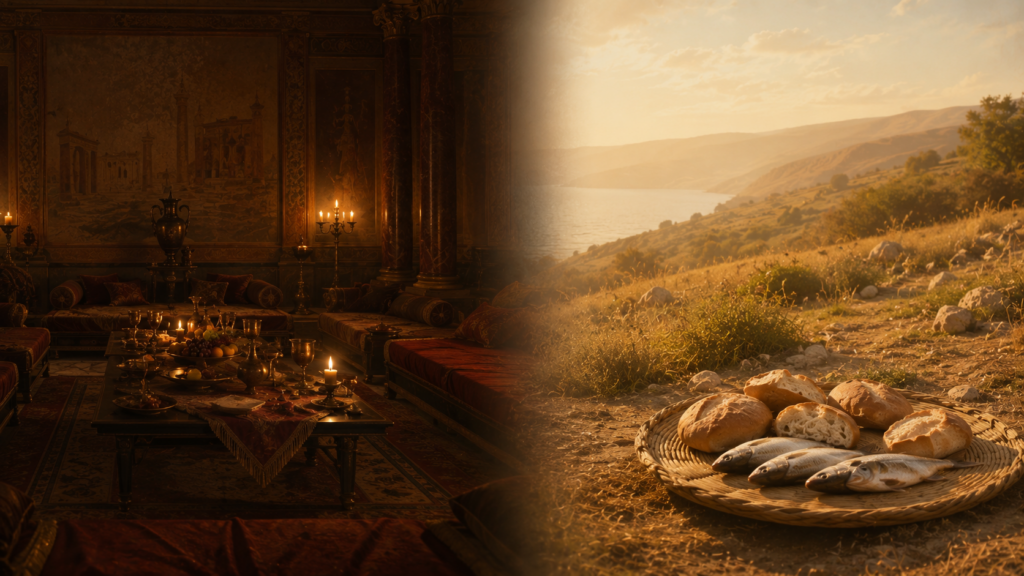
Matthew 14 is one of the gospel’s most carefully constructed contrast-chapters. It opens with a flashback to Herod’s birthday banquet, where John the Baptist is beheaded as a party-favor for a stepdaughter’s dance, and immediately pivots to Jesus’s response: he withdraws to a deserted place, and the crowds follow him, and he feeds them. The two banquets sit side by side (Herod’s ending in a severed head on a platter, Jesus’s ending in twelve baskets of leftovers), and the chapter is recording, with characteristic narrative restraint, the kingdom’s deepest single contrast with empire. The chapter then closes with Jesus walking on the sea, Peter walking on the water and sinking, and a brief summary of healings at Gennesaret.
The chapter has three movements. The first (verses 1 to 12) is the Herod-and-John flashback: the Tetrarch’s birthday party, the dance, the rash oath, the beheading, the disciples’ burial of John, the report to Jesus. The second (verses 13 to 21) is the feeding of the five thousand: Jesus’s withdrawal, the crowds following on foot, the disciples’ suggestion to send them away, Jesus’s you give them something to eat, the five loaves and two fish, the twelve baskets of leftovers. The third (verses 22 to 36) is the storm-and-water section: the disciples crossing the lake at night, Jesus walking on the water, Peter’s brief walk and sinking, the worship in the boat, and the healings at Gennesaret.
Beneath the chapter’s surface flow is the gospel’s most explicit single staging of the kingdom-versus-empire contrast. The two banquets are deliberately paired. The two kinds of authority over creation (Herod over a courtroom, Jesus over a sea) are deliberately contrasted. The chapter is teaching, in narrative form, what kind of king the gospel is announcing.
A · Matthew 14:1–12 · Herod’s banquet and the death of John
¹ At that time, Herod the tetrarch heard the report concerning Jesus, ² and said to his servants, “This is John the Baptizer. He is risen from the dead. That is why these powers work in him.” ³ For Herod had laid hold of John, and bound him, and put him in prison for the sake of Herodias, his brother Philip’s wife. ⁴ For John said to him, “It is not lawful for you to have her.” ⁵ When he would have put him to death, he feared the multitude, because they counted him as a prophet. ⁶ But when Herod’s birthday came, the daughter of Herodias danced among them and pleased Herod. ⁷ Whereupon he promised with an oath to give her whatever she should ask. ⁸ She, being prompted by her mother, said, “Give me here on a platter the head of John the Baptizer.” ⁹ The king was grieved, but for the sake of his oaths, and of those who sat at the table with him, he commanded it to be given, ¹⁰ and he sent and beheaded John in the prison. ¹¹ His head was brought on a platter, and given to the young lady; and she brought it to her mother. ¹² His disciples came, and took the body, and buried it; and they went and told Jesus. (Matthew 14:1–12, World English Bible)
- Herod the tetrarch heard the report concerning Jesus, and said to his servants, “This is John the Baptizer. He is risen from the dead. That is why these powers work in him” (verses 1 to 2). The Greek Herodes ho tetrarches, “Herod the tetrarch,” names Herod Antipas, son of Herod the Great (the Herod of chapter 2), ruler of Galilee and Perea from 4 BCE to 39 CE. The chapter is recording, with characteristic narrative care, Herod’s haunted self-explanation for what he is hearing about Jesus. The man he beheaded is somehow operating again. The flashback that follows answers the natural question: how did John end up dead?
- Herod had laid hold of John, and bound him, and put him in prison for the sake of Herodias, his brother Philip’s wife. For John said to him, “It is not lawful for you to have her” (verses 3 to 4). The Greek ouk exestin soi echein auten, “it is not lawful for you to have her,” names the prophetic confrontation. Herod Antipas had taken his half-brother Philip’s wife (Herodias was also Antipas’s niece; the family is tangled). John, in classic Hebrew prophet-fashion, had spoken truth to power and had been imprisoned for it. The chapter is recording, with characteristic narrative honesty, the actual political situation: a prophet in prison for telling a king his marriage was unlawful.
- When Herod’s birthday came, the daughter of Herodias danced among them and pleased Herod (verse 6). The Greek genesiois de genomenois tou Herodou, “and the birthday-celebrations of Herod having come,” names the imperial-style birthday banquet. First-century Roman client-kings followed Roman custom, and Roman birthday banquets were lavish public-political events. Josephus describes Herod Antipas’s birthday banquets as held at the fortress of Machaerus, the same fortress where John was imprisoned. The chapter is recording, with characteristic cultural-historical specificity, that John is being killed inside the fortress whose courtyard is hosting the king’s party.
Influence callout: Marty Solomon (Bema, Herod’s banquet as counter-imperial foil)
Solomon’s reading of the Herod-and-Jesus banquet pairing in this chapter names it as the gospel’s most deliberate single juxtaposition of empire-banquet and kingdom-banquet. Verses 1 to 12 record Herod’s birthday party: a self-celebrating royal-imperial event held at a remote fortress, featuring entertainment for the king, oaths sworn for the king’s pleasure, a violent killing performed for the king’s amusement, and a severed head delivered on a platter as the meal’s final dish. Verses 13 to 21 record Jesus’s banquet: a king who withdraws when he hears the news of John’s death, who is followed by a crowd of the very people Herod’s regime had marginalized, who looks at the crowd and is moved with compassion (the same splanchnizomai of 9:36), who feeds them with five loaves and two fish, and who has twelve baskets of leftovers when the meal is done. Solomon argues that Matthew is teaching, in the deliberate side-by-side framing, what kind of king the gospel is announcing. Herod’s banquet ends with a man’s head; Jesus’s banquet ends with twelve baskets of bread that did not exist when the meal began. The chapter is recording, in two banquets, the entire gospel’s counter-imperial argument: there are two kinds of kingship in the world, and the disciple is being asked to recognize which one is rightfully called king. The kingdom of heaven is structurally not the kingdom of Herod, and the chapter has just shown the difference in the cost of admission.
- He promised with an oath to give her whatever she should ask (verse 7). The Greek meta horkou, “with an oath,” names the chapter’s most theologically-pointed irony. The Sermon on the Mount (5:33-37) had specifically taught against oaths: let your yes be yes and your no be no. Herod’s rash oath, sworn for the entertainment of party-guests, becomes the mechanism by which a prophet is killed. The chapter is recording, with characteristic narrative-theological irony, that the religious-ethical teaching the king should have heard had been delivered ten chapters earlier and would have prevented the murder.
- His disciples came, and took the body, and buried it; and they went and told Jesus (verse 12). The chapter ends the flashback with the disciples of John burying their teacher and bringing the news to Jesus. The chapter is recording, with characteristic narrative care, the human relational network through which the news travels. John’s disciples, presumably the same ones who had come from John in chapter 11 with the prison-cell question, are now bringing a different report. The forerunner has been killed.
B · Matthew 14:13–21 · The feeding of the five thousand
¹³ Now when Jesus heard this, he withdrew from there in a boat, to a deserted place apart. When the multitudes heard it, they followed him on foot from the cities. ¹⁴ Jesus went out, and he saw a great multitude. He had compassion on them, and healed their sick. ¹⁵ When evening had come, his disciples came to him, saying, “This place is deserted, and the hour is already late. Send the multitudes away, that they may go into the villages, and buy themselves food.” ¹⁶ But Jesus said to them, “They don’t need to go away. You give them something to eat.” ¹⁷ They told him, “We only have here five loaves and two fish.” ¹⁸ He said, “Bring them here to me.” ¹⁹ He commanded the multitudes to sit down on the grass; and he took the five loaves and the two fish, and looking up to heaven, he blessed, broke and gave the loaves to the disciples, and the disciples gave to the multitudes. ²⁰ They all ate, and were filled. They took up twelve baskets full of that which remained left over from the broken pieces. ²¹ Those who ate were about five thousand men, in addition to women and children. (Matthew 14:13–21, World English Bible)
- Now when Jesus heard this, he withdrew from there in a boat, to a deserted place apart (verse 13). The Greek eis eremon topon kat’ idian, “into a deserted place by himself,” names the kind of geographic pivot the gospel uses for theologically loaded moments. Eremos (wilderness, deserted place) is the same word the gospel used at 4:1 (the wilderness temptation) and that the Septuagint uses for Israel’s wilderness. The chapter is recording, with characteristic Hebrew Bible echo, that the feeding-miracle scene is being staged in the geographic register of the original exodus.
- When the multitudes heard it, they followed him on foot from the cities (verse 13b). The Greek pezei, “on foot,” names the crowd’s effort. They walked around the lakeshore (the water route is shorter; the foot route around the lake’s northern end is several miles). The chapter is recording, with characteristic narrative restraint, the depth of need: they came on foot to find the rabbi who would not turn them away.
- He had compassion on them, and healed their sick (verse 14). The Greek esplanchnisthe, “he was moved with compassion,” uses the same gut-level verb the gospel used at 9:36 (the harassed sheep without a shepherd). The chapter is recording, with characteristic verbal continuity, the same disposition that produced the miracle block of chapters 8-9 producing the feeding-miracle here. Compassion is the kingdom’s standing posture toward the crowd.
- You give them something to eat (verse 16). The Greek dote autois hymeis phagein, “you yourselves give them to eat,” is the chapter’s most pastorally-loaded single line. The disciples have proposed a sensible solution: send the crowd away to find their own food. Jesus refuses the sensible solution. The chapter is recording, with characteristic narrative directness, the kingdom’s refusal of the that’s not our problem response. The crowd is hungry; the disciples have what they have; Jesus is asking them to bring what they have.
- We only have here five loaves and two fish (verse 17). The Greek pente artous kai duo ichthyas, “five loaves and two fishes,” names the absurd inadequacy of the supply. Five flatbreads and two small fish would feed perhaps a single small family. The chapter is recording, with characteristic narrative care, that the kingdom’s economy starts with what is in hand, even when what is in hand is impossible.
Influence callout: Tim Mackie (the feeding as new manna and Mosaic typology)
Mackie’s reading of the feeding-of-the-five-thousand names it as the gospel’s clearest single Mosaic-typology miracle. The setting is the wilderness (verse 13, eremos). The crowd is a multitude reminiscent of the Exodus generation (Numbers 11:21 names Israel’s wilderness population as six hundred thousand men. Matthew’s five thousand men plus women and children is operating in the same numerical register, though smaller). The provision is bread in the wilderness (Exodus 16’s manna). The leader-figure looks up to heaven, gives thanks, breaks the bread, and distributes it through intermediaries (the way Moses received the manna from heaven and distributed it through the people’s elders). The leftover-baskets count is twelve (the twelve tribes). Mackie argues that the chapter is recording, in deliberate Mosaic-typological detail, the kingdom’s announcement: here is the new Moses doing what Moses did, but more. The Sermon on the Mount staged the new-Sinai-Torah; the feeding stages the new wilderness manna. The whole gospel is keeping the Mosaic typology going (chapter 17’s transfiguration will reach its climax). The chapter is recording, in one narrative scene, that the kingdom’s provision is the same provision the wilderness generation received, now offered through the same kind of mediating figure to the crowd that has gathered in another wilderness.
- He commanded the multitudes to sit down on the grass; and he took the five loaves and the two fish, and looking up to heaven, he blessed, broke and gave the loaves to the disciples, and the disciples gave to the multitudes (verse 19). The Greek verbs labon, eulogesen, klasas, edoken, “having taken, blessed, broken, given,” are the same four-verb sequence that will recur at the Last Supper (26:26). The chapter is recording, with characteristic verbal-prefiguring care, that the feeding miracle is rehearsing the eucharistic pattern that will be definitively named at the Passover meal. The kingdom’s table is being staged here in advance.
- They all ate, and were filled. They took up twelve baskets full of that which remained left over from the broken pieces (verse 20). The Greek echortasthesan, “they were satisfied,” uses the verb for the satisfaction of livestock at full feeding. Five thousand men plus women and children ate to satisfaction. Twelve baskets (Greek dodeka kophinous) of leftovers remained: one for each disciple, or one for each tribe of restored Israel, or both. The chapter is recording, with characteristic narrative-symbolic care, the kingdom’s abundance: more bread at the end of the meal than at the beginning.
C · Matthew 14:22–36 · Walking on the water and the healings at Gennesaret
²² Immediately Jesus made the disciples get into the boat, and to go ahead of him to the other side, while he sent the multitudes away. ²³ After he had sent the multitudes away, he went up into the mountain by himself to pray. When evening had come, he was there alone. ²⁴ But the boat was now in the middle of the sea, distressed by the waves, for the wind was contrary. ²⁵ In the fourth watch of the night, Jesus came to them, walking on the sea. ²⁶ When the disciples saw him walking on the sea, they were troubled, saying, “It’s a ghost!” and they cried out for fear. ²⁷ But immediately Jesus spoke to them, saying, “Cheer up! It is I! Don’t be afraid.” ²⁸ Peter answered him and said, “Lord, if it is you, command me to come to you on the waters.” ²⁹ He said, “Come!” Peter stepped down from the boat, and walked on the waters to come to Jesus. ³⁰ But when he saw that the wind was strong, he was afraid, and beginning to sink, he cried out, saying, “Lord, save me!” ³¹ Immediately Jesus stretched out his hand, took hold of him, and said to him, “You of little faith, why did you doubt?” ³² When they got up into the boat, the wind ceased. ³³ Those who were in the boat came and worshiped him, saying, “You are truly the Son of God!” ³⁴ When they had crossed over, they came to the land of Gennesaret. ³⁵ When the people of that place recognized him, they sent into all that surrounding region, and brought to him all who were sick, ³⁶ and they begged him that they might just touch the fringe of his garment. As many as touched it were made whole. (Matthew 14:22–36, World English Bible)
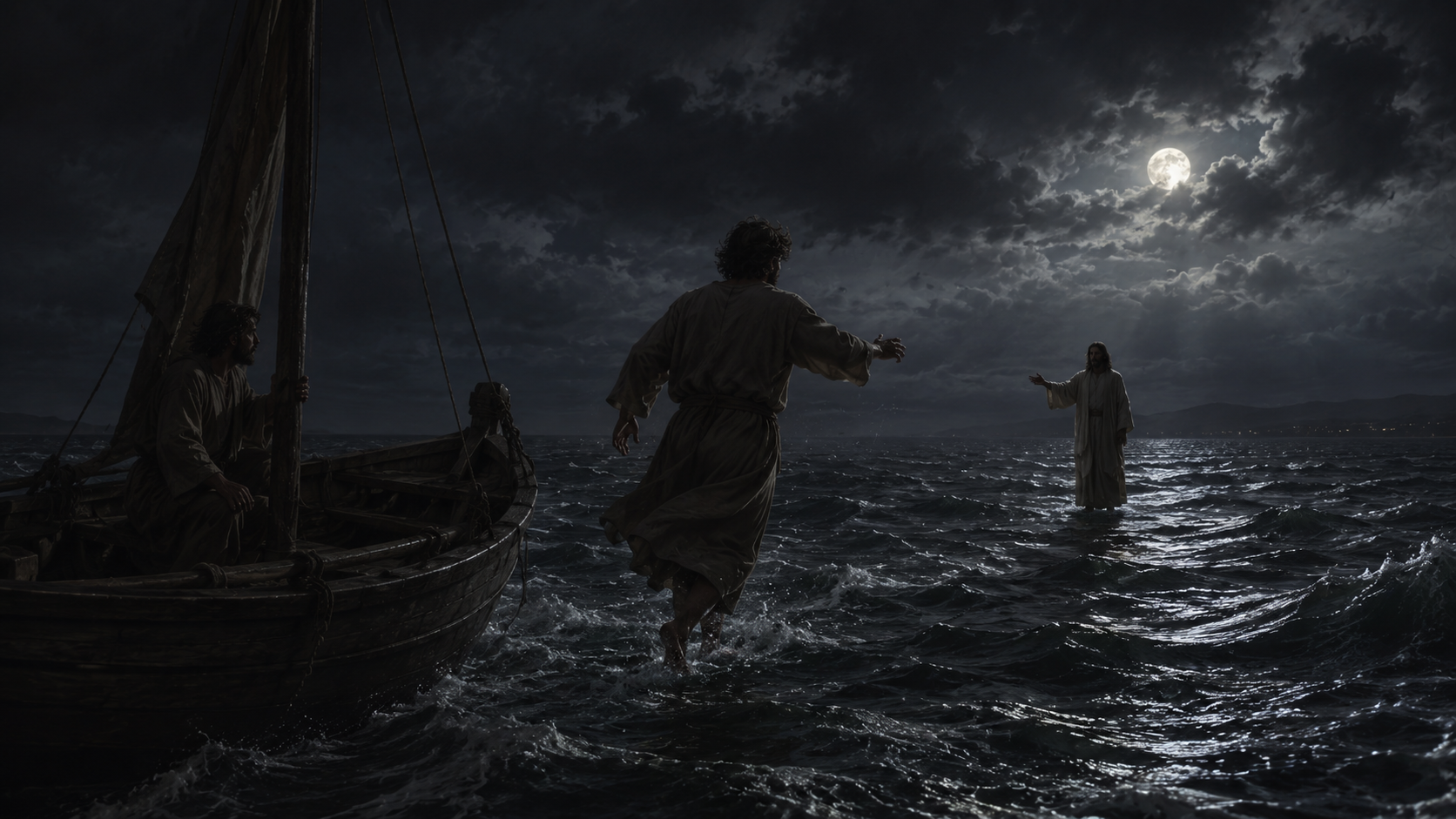
- He went up into the mountain by himself to pray (verse 23). The Greek eis to oros kat’ idian proseuxasthai, “into the mountain by himself to pray,” names a recurring gospel pattern: Jesus withdraws to solitary mountain-prayer at theologically loaded moments (Mark 1:35, 6:46; Luke 6:12; Matthew 26:36). The chapter is recording, with characteristic narrative care, that the king who has just refused Herod’s banquet’s pattern by feeding the crowd does not stay among the crowd; he withdraws into prayer. The kingdom’s leadership-pattern requires sustained solitude.
- In the fourth watch of the night, Jesus came to them, walking on the sea (verse 25). The Greek tetarte phylake tes nyktos, “the fourth watch of the night” (roughly 3 to 6 AM in Roman timekeeping), names the darkest stretch before dawn. The chapter is recording, with characteristic narrative care, that the disciples have been struggling against the storm for hours by the time Jesus arrives. The lateness is part of the chapter’s pastoral teaching about the kingdom’s timing.
Word study: ego eimi (ἐγώ εἰμι), “I am” / “It is I”
The Greek phrase Jesus speaks in verse 27, translated it is I in the WEB, is ego eimi, literally I am. The phrase is the Septuagint’s standard rendering of the divine self-identification at the burning bush (Exodus 3:14, ehyeh asher ehyeh, “I am who I am”) and throughout Isaiah 40-55 (Isaiah 41:4; 43:10-11, 25; 45:18; 46:4; 48:12, where Yahweh repeatedly identifies himself with ani hu, the Hebrew underlying the LXX ego eimi). The chapter is recording, with characteristic Hebrew Bible literacy, that Jesus’s reassurance to the storm-tossed disciples uses the divine self-identification vocabulary. The walking-on-the-sea miracle is itself, in Hebrew Bible imagination, divine action (Job 9:8, who alone stretched out the heavens, and treads on the waves of the sea; Psalm 77:19, your way was through the sea, your path through the great waters, yet your footprints were unseen). The chapter is teaching, in one Greek phrase and one walking-on-water act, the gospel’s most explicit pre-resurrection identification of Jesus with the God of Israel. The boat’s response, you are truly the Son of God (verse 33), is the disciples’ first explicit confession of this identification.
- Lord, if it is you, command me to come to you on the waters (verse 28). The Greek ei sy ei, keleuson me elthein pros se, “if it is you, command me to come to you,” names Peter’s request. The chapter is recording, with characteristic narrative honesty, the disciple’s mixed posture: he asks for confirmation (if it is you) and at the same time wants to do what the rabbi is doing (command me to come). Peter’s ei sy ei is faith and uncertainty in the same breath.
- Beginning to sink, he cried out, saying, “Lord, save me!” (verse 30). The Greek kyrie, soson me, “Lord, save me,” is the chapter’s most concise prayer. Three words, two of them imperative. The chapter is recording, with characteristic narrative restraint, the disciple’s prayer in the actual moment of going under: not theological, not eloquent, just the cry. The kingdom’s prayer-life is, on the chapter’s reading, sufficient when reduced to Lord, save me.
- Immediately Jesus stretched out his hand, took hold of him, and said to him, “You of little faith, why did you doubt?” (verse 31). The Greek oligopiste, “of little faith,” is the same address Jesus has used at 6:30 (do not be anxious) and 8:26 (the storm). The chapter is recording, with characteristic narrative care, that little faith is the disciple’s recurring condition: not faithlessness, not strong faith, but a faith that begins and falters. The hand stretched out is what the kingdom does with it.
- Those who were in the boat came and worshiped him, saying, “You are truly the Son of God!” (verse 33). The Greek theou huios ei, “you are God’s son,” is the gospel’s first disciple-confession of Jesus as Son of God in this title-form (Peter’s later confession at 16:16 will use the same language). The boat’s response to the walking-on-water and the storm-calming is worship and confession. The chapter is recording, with characteristic narrative care, the disciples’ Christological awareness deepening.
- They begged him that they might just touch the fringe of his garment. As many as touched it were made whole (verse 36). The Greek tou kraspedou tou himatiou autou, “the fringe of his garment,” is the same vocabulary the gospel used at 9:20 (the bleeding woman). The chapter is recording, with characteristic verbal continuity, that the same touching-the-tzitzit pattern that worked once before is now working at scale. The kingdom’s healing-ministry is becoming popularly accessible: people know to touch the fringe.
Reflection prompts
- The chapter opens with two banquets side by side. Herod’s birthday party ends with a severed head on a platter. Jesus’s wilderness banquet ends with twelve baskets of leftover bread. Same evening, two kingdoms, two kinds of king. Where in your life are you currently being formed by the wrong banquet’s pattern (its values, its appetites, its violence-against-truth-tellers), and what would it mean to recognize which banquet you have actually been attending?
- You give them something to eat. The disciples propose the sensible solution; the rabbi refuses it. The kingdom’s economy starts with what is in hand, even when what is in hand is impossibly inadequate. Where in your life are you currently looking at an inadequate supply and assuming the send them away answer is the right one, and what would it mean to bring what you have to Jesus and ask him to bless it?
- Peter walks on the water for a few steps, looks at the wind, sinks, and prays a three-word prayer: Lord, save me. The chapter does not call him a failure; the chapter records that Jesus immediately stretched out his hand. Where in your life are you currently sinking in something you started in faith, and what would it mean to reduce your prayer to the chapter’s three words and trust the hand that is already reaching?