

Matthew 13 is the third of Matthew’s five teaching discourses, the parables discourse. The chapter holds eight kingdom-of-heaven parables in tightly arranged succession, with two extended explanations and one fulfillment citation, and ends with a brief narrative scene at Nazareth. The chapter is the gospel’s most concentrated single-chapter use of the parable form, and it is also one of the gospel’s most theologically dense single chapters. Behind the surface flow of the kingdom of heaven is like… sayings is a sustained argument about how the kingdom is currently breaking into the world: hidden, mixed with what is not yet kingdom, small at the start, separable at the end, costly enough to require everything from the disciple who recognizes it.
The chapter has three movements. The first (verses 1 to 23) opens with the parable of the sower (the four soils on which the kingdom-seed falls), the disciples’ question about why Jesus speaks in parables, and Jesus’s interpretation of the sower. The second (verses 24 to 43) records three parables (the wheat and the weeds, the mustard seed, the leaven), a fulfillment citation from Psalm 78:2, and Jesus’s interpretation of the wheat-and-weeds parable. The third (verses 44 to 58) records four shorter parables (the hidden treasure, the pearl, the dragnet, the householder) and closes with the rejection at Nazareth.
Beneath the chapter’s parable-by-parable structure is the gospel’s claim that the kingdom does not look the way most people expected the kingdom to look. The kingdom is hidden, like a seed in the soil. The kingdom is mixed in with what opposes it, like wheat with weeds. The kingdom is small at the start, like a mustard seed. The kingdom is worth everything, like a treasure or pearl. The kingdom will eventually be separated, like a dragnet’s catch. The chapter is teaching, in narrative-parabolic form, the kingdom’s actual shape, and the closing rejection at Nazareth is the chapter’s most unsettling commentary on its own teaching: even the people who knew Jesus as a child cannot see what the chapter has just been describing.
A · Matthew 13:1–23 · The parable of the sower and the question of why parables
¹ On that day Jesus went out of the house, and sat by the seaside. ² Great multitudes gathered to him, so that he entered into a boat, and sat, and all the multitude stood on the beach. ³ He spoke to them many things in parables, saying, “Behold, a farmer went out to sow. ⁴ As he sowed, some seeds fell by the roadside, and the birds came and devoured them. ⁵ Others fell on rocky ground, where they didn’t have much soil, and immediately they sprang up, because they had no depth of earth. ⁶ When the sun had risen, they were scorched. Because they had no root, they withered away. ⁷ Others fell among thorns. The thorns grew up and choked them. ⁸ Others fell on good soil, and yielded fruit: some one hundred times as much, some sixty, and some thirty. ⁹ He who has ears to hear, let him hear.” ¹⁰ The disciples came, and said to him, “Why do you speak to them in parables?” ¹¹ He answered them, “To you it is given to know the mysteries of the Kingdom of Heaven, but it is not given to them. ¹² For whoever has, to him will be given, and he will have abundance, but whoever doesn’t have, from him will be taken away even that which he has. ¹³ Therefore I speak to them in parables, because seeing they don’t see, and hearing, they don’t hear, neither do they understand. ¹⁴ In them the prophecy of Isaiah is fulfilled, which says, ‘By hearing you will hear, and will in no way understand; Seeing you will see, and will in no way perceive: ¹⁵ for this people’s heart has grown callous, their ears are dull of hearing, they have closed their eyes; or else perhaps they might perceive with their eyes, hear with their ears, understand with their heart, and should turn again; and I would heal them.’ ¹⁶ But blessed are your eyes, for they see; and your ears, for they hear. ¹⁷ For most certainly I tell you that many prophets and righteous men desired to see the things which you see, and didn’t see them; and to hear the things which you hear, and didn’t hear them. ¹⁸ “Hear, then, the parable of the farmer. ¹⁹ When anyone hears the word of the Kingdom, and doesn’t understand it, the evil one comes, and snatches away that which has been sown in his heart. This is what was sown by the roadside. ²⁰ What was sown on the rocky places, this is he who hears the word, and immediately with joy receives it; ²¹ yet he has no root in himself, but endures for a while. When oppression or persecution arises because of the word, immediately he stumbles. ²² What was sown among the thorns, this is he who hears the word, but the cares of this age and the deceitfulness of riches choke the word, and he becomes unfruitful. ²³ What was sown on the good ground, this is he who hears the word and understands it, who most certainly bears fruit and produces, some one hundred times as much, some sixty, and some thirty.” (Matthew 13:1–23, World English Bible)
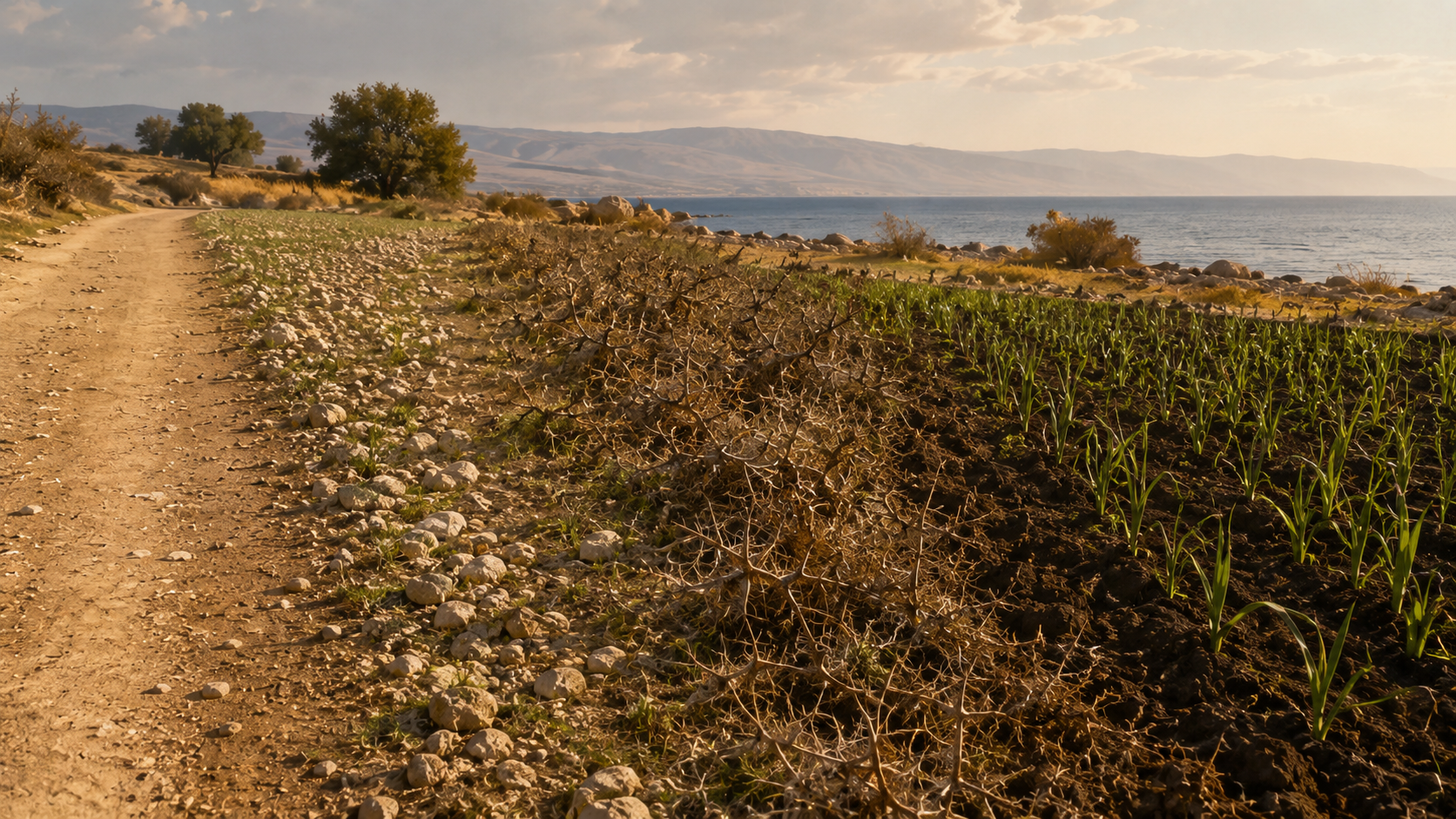
- On that day Jesus went out of the house, and sat by the seaside (verse 1). The Greek en te hemera ekeine, “on that day,” loosely connects to chapter 12. The setting moves to the lakeshore (the same Sea of Galilee that has been the gospel’s geographic center since chapter 4). The chapter is recording, with characteristic narrative care, that Jesus is teaching from a boat with the crowd standing on the beach. The acoustic setting, where the gentle slope of the Galilean shoreline at certain spots actually amplifies sound, allows a teacher in a boat to be heard by a large crowd ashore.
- He spoke to them many things in parables (verse 3). The Greek en parabolais, “in parables,” is the chapter’s structural keyword. Parabole (parable) translates the Hebrew mashal, the wide range of comparative and metaphorical speech the Hebrew Bible uses (Proverbs is the Mishlei, the parables). The chapter is recording, with characteristic Hebrew Bible literacy, that Jesus is doing what the Hebrew wisdom and prophetic traditions had always done: using comparison, image, and indirection to teach a truth that direct statement could not carry as deeply.
Word study: parabole / mashal (παραβολή / מָשָׁל), “comparison, similitude, riddle, wisdom-saying”
The Greek parabole translates the Hebrew mashal. The Hebrew word covers a wider range than the English parable: it includes proverbs (Proverbs 1:1, the proverbs of Solomon), riddles (Numbers 12:8, I speak with him face to face… not in dark sayings, where the LXX uses parabolais), allegorical images (Ezekiel 17:2, son of man, propose a riddle, and tell a parable), short comparative sayings (1 Samuel 24:13, as the proverb of the ancients says), and longer narrative-comparisons of the kind Jesus uses in this chapter. The form does not have a single fixed meaning; it has a function: to teach the reader to think analogically, to find the truth not in the surface statement but in the relationship between the image and the thing imaged. Jesus’s parables are firmly inside this Hebrew tradition. They are not flat illustrations of abstract truths; they are wisdom-comparisons that invite the disciple to think along with them. The chapter is recording, with characteristic narrative-pedagogical care, that the kingdom is being taught in the form Hebrew wisdom has always been taught.
- Why do you speak to them in parables? (verse 10). The Greek dia ti en parabolais laleis autois, “why do you speak to them in parables?” is the disciples’ first explicit question about the teaching method. The chapter is recording, with characteristic narrative honesty, that the parables are not transparent; they require interpretation. The disciples themselves had to ask.
- To you it is given to know the mysteries of the Kingdom of Heaven, but it is not given to them (verse 11). The Greek hymin dedotai gnonai ta mysteria tes basileias ton ouranon, “to you it has been given to know the mysteries of the kingdom,” uses mysteria (mysteries), the standard first-century Greek word for the secret-teachings of mystery religions and philosophical schools. Paul will later use the same word for the gospel itself (Ephesians 3:3-9; Colossians 1:26-27; 1 Corinthians 2:7). The chapter is recording, with characteristic theological precision, that the parables are functioning as a kind of disclosure-and-veiling at the same time: revealing the kingdom to those positioned to hear, veiling it from those who have closed their hearts to hearing.
Influence callout: Marty Solomon (the parables as kingdom-pedagogy)
Solomon’s reading of Jesus’s parable-method names it as the gospel’s most distinctive Hebrew-pedagogical move. First-century rabbinic teaching depended heavily on the mashal form: comparative-narrative teaching that invited the student into thinking-with the rabbi rather than receiving fixed propositions. Solomon argues that Jesus’s parables are not simplifications of theological truths for an unsophisticated audience; they are the opposite. They are intensifications of theological complexity into images that require the disciple to wrestle. The good soil produces fruit in the disciple who hears, returns to the parable, asks what it means, returns again. The roadside, rocky-ground, and thorny-soil disciples are the ones who hear once, do not return, and do not let the parable do its work. Solomon names the chapter’s deepest pedagogical claim: the kingdom is taught in a form that does not give itself away on the first hearing. The disciple is being formed through the wrestling. The chapter is the gospel’s most explicit single chapter on how Jesus actually taught: by mashal, the form that asks the disciple to come back.
- In them the prophecy of Isaiah is fulfilled (verse 14). The citation is Isaiah 6:9-10, the prophet’s commissioning vision in the temple, where Isaiah was told to preach to a people whose hearts had grown callous. The chapter is recording, with characteristic Hebrew Bible literacy, that the parables are functioning as Isaiah’s prophetic-veil-and-disclosure has functioned throughout the prophetic tradition. The form is the prophet’s form. The same indirection that Isaiah encountered seven centuries earlier is operating now in Galilee.
- When anyone hears the word of the Kingdom, and doesn’t understand it, the evil one comes, and snatches away that which has been sown in his heart (verse 19). The chapter’s interpretation of the sower names four kinds of hearer: the roadside (no understanding, immediate snatching), the rocky ground (joy without root, falls away under pressure), the thorny soil (cares and riches choke the word), the good ground (understanding, fruit at varying yields). The chapter is recording, with characteristic narrative honesty, that not every hearer becomes a fruitful disciple. The word is sown widely; the soils receive it differently.
B · Matthew 13:24–43 · The wheat and the weeds, the mustard seed, the leaven, the explanation
²⁴ He set another parable before them, saying, “The Kingdom of Heaven is like a man who sowed good seed in his field, ²⁵ but while people slept, his enemy came and sowed darnel weeds also among the wheat, and went away. ²⁶ But when the blade sprang up and produced fruit, then the darnel weeds appeared also. ²⁷ The servants of the householder came and said to him, ‘Sir, didn’t you sow good seed in your field? Where did these darnel weeds come from?’ ²⁸ “He said to them, ‘An enemy has done this.’ “The servants asked him, ‘Do you want us to go and gather them up?’ ²⁹ “But he said, ‘No, lest perhaps while you gather up the darnel weeds, you root up the wheat with them. ³⁰ Let both grow together until the harvest, and in the harvest time I will tell the reapers, “First, gather up the darnel weeds, and bind them in bundles to burn them; but gather the wheat into my barn.”‘” ³¹ He set another parable before them, saying, “The Kingdom of Heaven is like a grain of mustard seed, which a man took, and sowed in his field; ³² which indeed is smaller than all seeds. But when it is grown, it is greater than the herbs, and becomes a tree, so that the birds of the air come and lodge in its branches.” ³³ He spoke another parable to them. “The Kingdom of Heaven is like yeast, which a woman took, and hid in three measures of meal, until it was all leavened.” ³⁴ Jesus spoke all these things in parables to the multitudes; and without a parable, he didn’t speak to them, ³⁵ that it might be fulfilled which was spoken through the prophet, saying, “I will open my mouth in parables; I will utter things hidden from the foundation of the world.” ³⁶ Then Jesus sent the multitudes away, and went into the house. His disciples came to him, saying, “Explain to us the parable of the darnel weeds of the field.” ³⁷ He answered them, “He who sows the good seed is the Son of Man, ³⁸ the field is the world; and the good seed, these are the children of the Kingdom; and the darnel weeds are the children of the evil one. ³⁹ The enemy who sowed them is the devil. The harvest is the end of the age, and the reapers are angels. ⁴⁰ As therefore the darnel weeds are gathered up and burned with fire; so will it be at the end of this age. ⁴¹ The Son of Man will send out his angels, and they will gather out of his Kingdom all things that cause stumbling, and those who do iniquity, ⁴² and will cast them into the furnace of fire. There will be the weeping and the gnashing of teeth. ⁴³ Then the righteous will shine like the sun in the Kingdom of their Father. He who has ears to hear, let him hear.” (Matthew 13:24–43, World English Bible)
- The Kingdom of Heaven is like a man who sowed good seed in his field, but while people slept, his enemy came and sowed darnel weeds also among the wheat (verses 24 to 25). The Greek zizania, “darnel,” names a specific weed (Lolium temulentum) that looks nearly identical to wheat in its early growth and only becomes distinguishable as the heads form. First-century Galilean farmers knew the plant as bastard wheat; it was a common pest, sometimes deliberately sown by an enemy to ruin a competitor’s crop (Roman law specifically prohibited the practice, suggesting it happened). The chapter is recording, with characteristic narrative-cultural specificity, a parable that uses real first-century agricultural sabotage as its central image.
- Let both grow together until the harvest (verse 30). The Greek aphete synauxanesthai, “let them grow together,” is the parable’s central instruction. The householder refuses the servants’ request to pull up the weeds early. The reasons given are twofold: the weeds and wheat have grown into each other (pulling up the weeds would damage the wheat), and the separation is the harvest’s job, not the servants’. The chapter is recording, with characteristic narrative restraint, the kingdom’s not yet shape: the church is not the post-harvest community; the church is the in-the-mixed-field community.
- The Kingdom of Heaven is like a grain of mustard seed (verse 31). The Greek mikroteron men estin panton ton spermaton, “indeed smaller than all the seeds,” names the mustard seed’s proverbial smallness in the first-century Galilean context. The mustard plant grows in the Galilee as a large bush, sometimes tree-like (up to ten feet tall in optimal conditions), enough to provide shade and bird-perches. The chapter is recording the kingdom’s beginnings-vs.-ends paradox: the kingdom starts small and ends great. The crucifixion-resurrection that closes the gospel will be the most dramatic instance of this pattern.
- The Kingdom of Heaven is like yeast, which a woman took, and hid in three measures of meal, until it was all leavened (verse 33). The Greek enekrypsen, “hid,” is the parable’s most theologically loaded verb. The woman hides the yeast in the dough, a small action with cumulative, transformative consequences across the whole batch. Three measures of meal is roughly fifty pounds of flour, the amount Sarah used to bake bread for Yahweh’s three visitors at Mamre (Genesis 18:6). The chapter is recording, with characteristic Hebrew Bible echo, that the kingdom’s leavening-work is on the scale of the original Abrahamic-hospitality moment.
- I will open my mouth in parables; I will utter things hidden from the foundation of the world (verse 35). The citation is Psalm 78:2. Psalm 78 is one of Israel’s great rehearsal-of-history psalms, recounting Yahweh’s faithfulness across Israel’s repeated unfaithfulness. The chapter is recording, with characteristic fulfillment-formula precision, that Jesus’s parables are the form Asaph had named centuries earlier: the prophet-teacher opening his mouth to disclose the things hidden from the foundation of the world.
Influence callout: Origen of Alexandria (Commentary on Matthew, on the parables, c. 246 to 248 AD)
Origen’s Commentary on Matthew is the earliest surviving sustained patristic treatment of the parables. He devotes substantial space to chapter 13, working through each parable with careful attention to its inner logic. Origen’s central interpretive move is allegorical: each element of the parable is read as standing for a larger spiritual reality (the field is the world, the seed is the word, the enemy is the devil, the harvest is the end of the age. Origen is following Jesus’s own interpretation in 13:37-39 here). Origen extends the same method to parables Jesus does not interpret: the mustard seed is the word of the kingdom, the leaven is the gospel hidden in the world, the treasure is Christ himself hidden in scripture, the pearl is the merchant’s discovery of the gospel that costs everything. The site does not adopt every move of Origen’s allegorical method (later patristic and medieval interpretation sometimes pushed the allegorical too far, finding hidden references where the parable was making a simpler point); the modern recovery has been to read the parables as wisdom-comparisons making one or two main points rather than coded ciphers requiring a key. But Origen’s instinct that the parables are dense with meaning, that they reward sustained attention, and that they often point beyond their surface to Christological depth has shaped Christian reading of the parables for eighteen centuries. Every later commentary on Matthew 13 has worked in conversation with Origen, even when correcting him. The chapter is the early church’s first sustained meditation on what the kingdom looks like, and Origen’s commentary is the church’s first sustained meditation on the chapter.
- He who sows the good seed is the Son of Man, the field is the world (verses 37 to 38). Jesus’s interpretation of the wheat-and-weeds parable identifies the field as the world, not the church. This is one of the chapter’s most often misread interpretive moves. The parable is not, on Jesus’s own reading, primarily about church discipline or the mixed condition of the visible church; it is about the kingdom’s situation in the wider world during the in-between time before the harvest. The chapter is recording, with characteristic narrative care, the kingdom’s actual stage: the world, not just the church, is the field where the kingdom is now growing alongside opposition.
- Then the righteous will shine like the sun in the Kingdom of their Father (verse 43). The Greek hos ho helios, “as the sun,” echoes Daniel 12:3 (those who are wise shall shine like the brightness of the sky), the apocalyptic resurrection-vindication promise. The chapter is recording, with characteristic Hebrew Bible literacy, the kingdom’s eschatological completion: the people who have grown alongside opposition will be vindicated and visibly glorified at the harvest.
C · Matthew 13:44–58 · Treasure, pearl, dragnet, householder, and the rejection at Nazareth
⁴⁴ “Again, the Kingdom of Heaven is like a treasure hidden in the field, which a man found, and hid. In his joy, he goes and sells all that he has, and buys that field. ⁴⁵ “Again, the Kingdom of Heaven is like a man who is a merchant seeking fine pearls, ⁴⁶ who having found one pearl of great price, he went and sold all that he had, and bought it. ⁴⁷ “Again, the Kingdom of Heaven is like a dragnet, that was cast into the sea, and gathered some fish of every kind, ⁴⁸ which, when it was filled, they drew up on the beach. They sat down, and gathered the good into containers, but the bad they threw away. ⁴⁹ So will it be in the end of the world. The angels will come and separate the wicked from among the righteous, ⁵⁰ and will cast them into the furnace of fire. There will be the weeping and the gnashing of teeth.” ⁵¹ Jesus said to them, “Have you understood all these things?” They answered him, “Yes, Lord.” ⁵² He said to them, “Therefore every scribe who has been made a disciple in the Kingdom of Heaven is like a man who is a householder, who brings out of his treasure new and old things.” ⁵³ When Jesus had finished these parables, he departed from there. ⁵⁴ Coming into his own country, he taught them in their synagogue, so that they were astonished, and said, “Where did this man get this wisdom, and these mighty works? ⁵⁵ Isn’t this the carpenter’s son? Isn’t his mother called Mary, and his brothers, James, Joses, Simon, and Judas? ⁵⁶ Aren’t all of his sisters with us? Where then did this man get all of these things?” ⁵⁷ They were offended by him. But Jesus said to them, “A prophet is not without honor, except in his own country, and in his own house.” ⁵⁸ He didn’t do many mighty works there because of their unbelief. (Matthew 13:44–58, World English Bible)
- The Kingdom of Heaven is like a treasure hidden in the field, which a man found, and hid. In his joy, he goes and sells all that he has, and buys that field (verse 44). The Greek apo tes charas, “from his joy,” names the parable’s controlling emotion. The man who has found the treasure does not part with everything reluctantly; he does it joyfully. The chapter is recording, with characteristic narrative precision, that the kingdom’s all-cost is also the kingdom’s deep-joy. The two are not in tension; they are the same disposition viewed from two angles.
- The Kingdom of Heaven is like a man who is a merchant seeking fine pearls, who having found one pearl of great price, he went and sold all that he had, and bought it (verses 45 to 46). The Greek pairs the pearl parable with the treasure parable, but with a different opening posture. The treasure-finder stumbled on the kingdom (he was working a field, not looking for treasure). The pearl-merchant has been searching for it (he is a buyer of pearls professionally, looking for the right one). The chapter is recording, with characteristic narrative care, that the kingdom comes to people in different ways: some find it without looking; others find it after long searching. The all-cost response is the same. There is a second reading worth noting that some interpreters press, especially in light of the surrounding parables of this chapter. In every other parable in chapter 13 where the comparison is to a person taking action (the sower, the householder, the man sowing good seed, the woman with the leaven), the active figure is God or the Son of Man. If the same pattern holds for the treasure and pearl parables, the active figure (the treasure-finder, the pearl-merchant) is also God or the Son of Man, and the treasure and pearl are the people God has come to find. Ezekiel 16 stages exactly this kind of image of God toward Israel: God passes by an abandoned newborn cast out in a field, takes the child in, raises her up, and decks her with jewels until she has reached the age for fine ornaments (Ezekiel 16:7-13). On this reading, the parables are not principally about how much we sacrifice for the kingdom but about how much God has been willing to sacrifice for his people: the pursuing God who sells everything (the cross) to acquire the treasure he had been searching for. The chapter is generous enough to hold both readings; the all-cost response runs in either direction. What is unmistakable in either case is the parable’s joy. The exchange is not made under duress; it is made with the surrender of someone who has just found what he had been looking for.
- The Kingdom of Heaven is like a dragnet, that was cast into the sea, and gathered some fish of every kind (verse 47). The Greek sagene, “dragnet,” names the large fishing net used in commercial Galilean fishing. A dragnet pulls in everything in its path: some fish of every kind. The chapter is recording, with characteristic narrative-cultural specificity, the kingdom’s wide-gathering scope. The kingdom does not pre-sort the catch; the kingdom catches widely and sorts at the end.
- Therefore every scribe who has been made a disciple in the Kingdom of Heaven is like a man who is a householder, who brings out of his treasure new and old things (verse 52). The Greek ekballei ek tou thesaurou autou kaina kai palaia, “brings out of his treasury new and old,” names the chapter’s most quoted single line about how disciples are formed. The scribe-disciple has both the old (the Hebrew Bible, the prophetic tradition, Israel’s covenant memory) and the new (the kingdom-teaching Jesus has just delivered) in a single treasury. The chapter is recording, with characteristic narrative-pedagogical care, that the disciple is not asked to choose between continuity and innovation. The disciple is asked to hold both.
- Coming into his own country, he taught them in their synagogue, so that they were astonished (verse 54). The Greek eis ten patrida autou, “into his own homeland,” refers to Nazareth, where Jesus had grown up. The chapter pivots from the parables to a brief narrative scene that comments on the parables’ own teaching. The Nazareth synagogue is the most natural place for Jesus to be received, and it is the place that does not receive him.
- Isn’t this the carpenter’s son? Isn’t his mother called Mary, and his brothers, James, Joses, Simon, and Judas? (verses 55 to 56). The Greek ho tou tektonos huios, “the son of the carpenter,” names Joseph’s trade (tekton covered woodworking, stonecutting, and general construction-trade). The chapter is recording, with characteristic narrative honesty, the Nazareth villagers’ problem: they know Jesus’s family. They know him as a child grown up. They cannot reconcile the wisdom and mighty works with the boy they remember. The familiarity is the obstacle.
- A prophet is not without honor, except in his own country, and in his own house (verse 57). The Greek atimon, “without honor,” names the inverse principle. The chapter is recording, with characteristic narrative directness, that prophetic recognition often happens easier at distance than at home. The chapter is closing the parables discourse with an unintended demonstration of the soils-parable: the seed has fallen on home soil, and the home soil has not received it. The chapter’s own theological teaching is being illustrated by its closing scene. Luke’s parallel account of the Nazareth visit (Luke 4:16-30) fills in what specifically scandalized the home crowd. There Jesus reads from Isaiah 61 (the Spirit of the Lord is upon me to proclaim good news to the poor), then reminds the synagogue that in Israel’s history, when the prophet Elijah was sent to a widow during a famine, he was sent not to one of the many Israelite widows but to the Gentile widow at Zarephath in Sidon; and when there were many lepers in Israel during Elisha’s ministry, only Naaman the Syrian was cleansed. The mention of Gentile recipients of God’s prophetic ministry produces the rage that drives the synagogue crowd to attempt to throw Jesus off a cliff. Matthew’s account is more compressed and does not include the Elijah-Elisha references, but the pattern is the same: the home crowd is offended by the kingdom’s wide reach. The chapter is recording, with characteristic narrative restraint, that the kingdom’s expansive grace is in fact the very thing the most religious-credentialed audiences struggle to receive.
- He didn’t do many mighty works there because of their unbelief (verse 58). The Greek ouk epoiesen ekei dynameis pollas dia ten apistian auton, “he did not do many miracles there because of their unbelief,” names the chapter’s most disquieting closing note. The chapter is recording, with characteristic narrative restraint, that the kingdom’s power is somehow correlated to the receiving-soil. The same Jesus who healed crowds in Gennesaret (14:34-36) does not many mighty works in Nazareth. The chapter is closing on the disciples’ formation: this is what closed-soil response looks like.
Reflection prompts
- The four soils in the parable of the sower are not just first-century types of hearer; they are the four kinds of reception any disciple-life cycles through. There are seasons when the word is snatched away by distraction, seasons when shallow joy gives way under pressure, seasons when the cares of the age choke the word, and seasons when the word is heard, understood, and produces fruit. Where in your life is the word currently being received, and what soil-condition is the receiving in?
- The wheat and the weeds are growing together until the harvest. The kingdom is mixed in with what opposes it for the entire span of the present age, and the householder explicitly forbids the early sorting. Where in your life or in your community are you currently tempted to do the early sorting (separating the wheat from the weeds before the time), and what would it mean to let both grow together as the parable instructs?
- The chapter closes with Jesus unable to do many mighty works in his hometown because of their unbelief. The kingdom’s power is correlated, somehow, to the receiving-soil. Where in your life is closed-soil unbelief currently shaping what the kingdom is able to do, and what would it mean to be the kind of soil that receives the seed and lets it root deeply enough to bear?