
Matthew 12 is the chapter where the conflict that has been building between Jesus and the religious establishment moves from quiet objection (chapters 9 and 11) into open opposition. The chapter has four movements. The first (verses 1 to 21) records two Sabbath controversies (the disciples picking grain in the fields, the man with the withered hand healed in the synagogue) and closes with a long fulfillment-citation from Isaiah 42 announcing Jesus as the chosen servant of the Lord. The second (verses 22 to 37) is the Beelzebul controversy: a healing of a blind-and-mute demoniac provokes the Pharisees to charge that Jesus casts out demons by the prince of demons, and Jesus responds with the binding-the-strong-man teaching and the warning about the unforgivable sin against the Holy Spirit. The third (verses 38 to 45) records the Pharisees’ demand for a sign and Jesus’s response (the sign of Jonah), followed by the unsettling parable of the unclean spirit returning to the swept house. The fourth (verses 46 to 50) closes with Jesus’s mother and brothers arriving and the redefining of family: whoever does the will of my Father in heaven is my brother and sister and mother.
Beneath the controversy-by-controversy progression is the chapter’s announcement that the kingdom is not just expanding into towns; the kingdom is engaging the cosmic conflict that the Hebrew Bible’s divine-council literature has been preparing the reader for. The Beelzebul scene names what is actually happening: a binding of the strong man whose house has been holding the world. The sign of Jonah, on the surface a refusal to perform on demand, becomes the gospel’s first explicit prediction of the resurrection. The chapter is recording the kingdom’s deepening engagement with the powers it has come to dethrone.
A · Matthew 12:1–21 · The Sabbath conflicts and the chosen servant
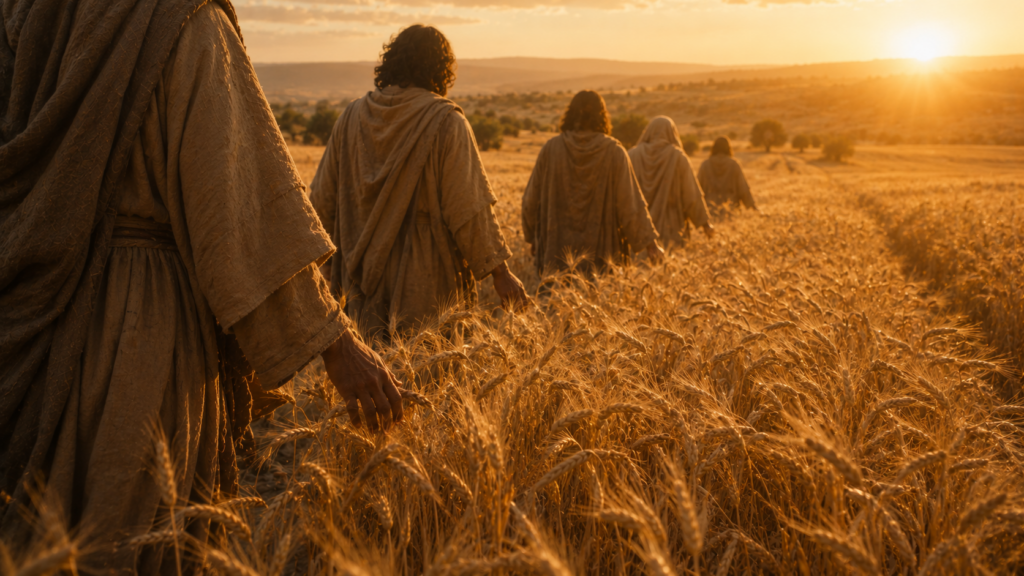
¹ At that time, Jesus went on the Sabbath day through the grain fields. His disciples were hungry and began to pluck heads of grain and to eat. ² But the Pharisees, when they saw it, said to him, “Behold, your disciples do what is not lawful to do on the Sabbath.” ³ But he said to them, “Haven’t you read what David did when he was hungry, and those who were with him; ⁴ how he entered into the house of God, and ate the show bread, which was not lawful for him to eat, neither for those who were with him, but only for the priests? ⁵ Or have you not read in the law, that on the Sabbath day, the priests in the temple profane the Sabbath, and are guiltless? ⁶ But I tell you that one greater than the temple is here. ⁷ But if you had known what this means, ‘I desire mercy, and not sacrifice,’ you wouldn’t have condemned the guiltless. ⁸ For the Son of Man is Lord of the Sabbath.” ⁹ He departed there, and went into their synagogue. ¹⁰ And behold there was a man with a withered hand. They asked him, “Is it lawful to heal on the Sabbath day?” that they might accuse him. ¹¹ He said to them, “What man is there among you, who has one sheep, and if this one falls into a pit on the Sabbath day, won’t he grab on to it, and lift it out? ¹² Of how much more value then is a man than a sheep! Therefore it is lawful to do good on the Sabbath day.” ¹³ Then he told the man, “Stretch out your hand.” He stretched it out; and it was restored whole, just like the other. ¹⁴ But the Pharisees went out, and conspired against him, how they might destroy him. ¹⁵ Jesus, perceiving that, withdrew from there. Great multitudes followed him; and he healed them all, ¹⁶ and commanded them that they should not make him known: ¹⁷ that it might be fulfilled which was spoken through Isaiah the prophet, saying, ¹⁸ “Behold, my servant whom I have chosen; my beloved in whom my soul is well pleased: I will put my Spirit on him. He will proclaim justice to the nations. ¹⁹ He will not strive, nor shout; neither will anyone hear his voice in the streets. ²⁰ He won’t break a bruised reed. He won’t quench a smoking flax, until he leads justice to victory. ²¹ In his name, the nations will hope.” (Matthew 12:1–21, World English Bible)
- At that time, Jesus went on the Sabbath day through the grain fields. His disciples were hungry and began to pluck heads of grain and to eat (verse 1). The Greek en ekeino to kairo, “at that time,” loosely connects to chapter 11. The disciples’ grain-plucking on the Sabbath is, by Mosaic-legal standards, technically permitted (Deuteronomy 23:25 explicitly allows the hungry traveler to pluck a neighbor’s grain by hand) but Pharisaically problematic (the Pharisaic oral tradition had categorized plucking-and-rubbing-grain as a form of reaping and threshing, both of which were among the thirty-nine melachot, the categories of work prohibited on the Sabbath).
- Haven’t you read what David did when he was hungry, and those who were with him (verse 3). The Greek ouk anegnote ti epoiesen David, “have you not read what David did,” is Jesus’s standard rabbinic-debate formula for citing precedent. The David-and-the-showbread incident (1 Samuel 21) is a Hebrew Bible case in which the law’s letter was set aside for human need. The chapter is recording, with characteristic rabbinic-style argumentation, that Jesus is not abolishing Sabbath; he is interpreting it from within the Hebrew Bible’s own prior precedent.
- I tell you that one greater than the temple is here (verse 6). The Greek meizon tou hierou estin hode, “something greater than the temple is here,” is the chapter’s first explicit Christological intensification. The temple, in first-century Jewish theology, was the most sacred space on earth. For Jesus to claim that something greater than the temple has arrived is, on first-century Jewish ears, a startling claim. The chapter is recording, with characteristic theological care, that the kingdom Jesus is bringing is making a claim larger than the institutions the religious establishment is built around.
- I desire mercy, and not sacrifice (verse 7). The Greek cites Hosea 6:6 again (the chapter’s second use of this verse, after 9:13). The chapter is recording, with characteristic verbal continuity, that Jesus keeps returning to the same prophetic correction whenever the Pharisaic religious system prioritizes ritual purity over human flourishing. Mercy, not sacrifice is becoming the gospel’s running interpretive principle for how to read Torah at its prophetic depth.
- For the Son of Man is Lord of the Sabbath (verse 8). The Greek kyrios gar estin tou sabbatou ho huios tou anthropou, “lord of the Sabbath is the Son of Man,” is the chapter’s most explicit Sabbath-related Christological claim. The Son of Man (Daniel 7’s eschatological figure who receives the everlasting kingdom) has lordship over the institution that the Hebrew Bible itself names as a sign of God’s covenant with Israel (Exodus 31:13 to 17; Ezekiel 20:12). The chapter is recording, in one Greek phrase, the gospel’s most thoroughgoing claim to date: the same authority that gave the Sabbath through Moses is now standing in the grain field.
Influence callout: Marty Solomon (the lord of the Sabbath as kingdom-rest)
Solomon’s reading of the Sabbath conflicts in 12:1 to 14 names them as the gospel’s most explicit recovery of what Sabbath was always for. The Hebrew Shabbat was given as the seventh-day inauguration of cosmic temple in Genesis 2 and reissued at Sinai as the covenantal sign of Israel’s identity (Exodus 20:8 to 11; 31:13 to 17; Deuteronomy 5:12 to 15). Solomon argues that the Pharisaic system, with its thirty-nine categories of forbidden work and its endless legal-defining of edge cases, had inverted Sabbath: it had become a day people had to survive rather than a day they were given. Jesus’s response in this chapter does not abolish Sabbath; it reclaims its original purpose. The Sabbath was made for man, not man for the Sabbath (Mark’s parallel, Mark 2:27, makes this explicit). Solomon names the deeper move: when Jesus claims to be lord of the Sabbath, he is not claiming the right to ignore the Sabbath; he is claiming the authority to restore it to its kingdom-shape. The healing of the man with the withered hand in verse 13 is itself a Sabbath-restoration: the man is brought into the rest he was originally made for. The kingdom’s whole economy (the Sermon on the Mount’s seek first the kingdom, the Lord’s Prayer’s let your kingdom come on earth as it is in heaven) is staged as a return to Sabbath-shaped life. The chapter is recording, in two Sabbath conflicts, the gospel’s claim that the rest the Hebrew Bible promised is the rest the kingdom is now making available, and the religious establishment’s protection of the Sabbath has been the very thing keeping people from receiving it.
- He won’t break a bruised reed. He won’t quench a smoking flax (verse 20). The Greek cites Isaiah 42:3, the first servant song. The chapter is recording, with characteristic Hebrew Bible literacy, the kingdom’s pastoral shape: the Messiah is not the kind of king who finishes off the wounded (the bruised reed is a person already nearly broken; the smoking flax is a person whose inner light is barely flickering). The kingdom’s representative does not crush the people the world has already crushed. He restores them.
B · Matthew 12:22–37 · The Beelzebul controversy and the unforgivable sin
²² Then one possessed by a demon, blind and mute, was brought to him; and he healed him, so that the blind and mute man both spoke and saw. ²³ All the multitudes were amazed, and said, “Can this be the son of David?” ²⁴ But when the Pharisees heard it, they said, “This man does not cast out demons, except by Beelzebul, the prince of the demons.” ²⁵ Knowing their thoughts, Jesus said to them, “Every kingdom divided against itself is brought to desolation, and every city or house divided against itself will not stand. ²⁶ If Satan casts out Satan, he is divided against himself. How then will his kingdom stand? ²⁷ If I by Beelzebul cast out demons, by whom do your children cast them out? Therefore they will be your judges. ²⁸ But if I by the Spirit of God cast out demons, then the Kingdom of God has come upon you. ²⁹ Or how can one enter into the house of the strong man, and plunder his goods, unless he first bind the strong man? Then he will plunder his house. ³⁰ “He who is not with me is against me, and he who doesn’t gather with me, scatters. ³¹ Therefore I tell you, every sin and blasphemy will be forgiven men, but the blasphemy against the Spirit will not be forgiven men. ³² Whoever speaks a word against the Son of Man, it will be forgiven him; but whoever speaks against the Holy Spirit, it will not be forgiven him, neither in this age, nor in that which is to come. ³³ “Either make the tree good, and its fruit good, or make the tree corrupt, and its fruit corrupt; for the tree is known by its fruit. […] ³⁶ I tell you that every idle word that men speak, they will give account of it in the day of judgment. ³⁷ For by your words you will be justified, and by your words you will be condemned.” (Matthew 12:22–37, World English Bible, abridged)
- Then one possessed by a demon, blind and mute, was brought to him; and he healed him (verse 22). The Greek records a triple-condition deliverance: blindness, muteness, and demonic possession all addressed in one healing. The crowd’s response (verse 23) is to ask the chapter’s most explicit messianic question: can this be the son of David? The miracle’s scale is provoking the Christological recognition.
- This man does not cast out demons, except by Beelzebul, the prince of the demons (verse 24). The Greek en to Beelzeboul archonti ton daimonion, “by Beelzebul the ruler of the demons,” names the religious establishment’s counter-explanation. Beelzebul (originally a Canaanite deity-name, Baal-Zebul, “Lord of the High Place,” polemically distorted in 2 Kings 1:2 to Baal-Zebub, “Lord of the Flies”) was a name first-century Jews used for the chief of demonic powers. The chapter is recording, with characteristic narrative honesty, the Pharisees’ decision to attribute the kingdom’s most demonstrable acts of liberation to satanic power.
- Every kingdom divided against itself is brought to desolation (verse 25). The Greek pasa basileia merisitheisa kath’ heautes eremoutai, “every kingdom divided against itself is laid waste,” exposes the logical incoherence of the Pharisees’ charge. Satan would not work against himself; the demonic realm has its own internal logic of self-preservation. The chapter is recording, with characteristic argumentative care, that Jesus is willing to do basic logic in public against a charge that does not survive it.
- But if I by the Spirit of God cast out demons, then the Kingdom of God has come upon you (verse 28). The Greek ephthasen eph’ hymas he basileia tou theou, “the kingdom of God has come upon you,” is a key kingdom-vocabulary verse. Ephthasen (from phthano, “to arrive, to overtake”) names a kingdom that is not just near but has come upon the hearers. The kingdom is no longer just announced; it is in the room.
- Or how can one enter into the house of the strong man, and plunder his goods, unless he first bind the strong man? Then he will plunder his house (verse 29). The Greek desai ton ischyron, “to bind the strong one,” names the chapter’s most cosmologically-loaded teaching. Jesus is reading his exorcism ministry as a binding-the-strong-man operation: the demonic powers have been holding the world’s house (humanity) as their possessions; Jesus’s deliverance ministry is the binding of the strong man so the goods can be released.
Influence callout: Michael Heiser (the binding of the strong man as cosmic conflict)
Heiser’s reading of the binding-the-strong-man teaching names it as the chapter’s clearest staging of the cosmic-conflict framework that the divine-council literature of the Hebrew Bible has been developing. In Heiser’s reading (the Unseen Realm framework), the Hebrew Bible’s storyline is shaped by three key rebellions of supernatural beings against God’s reign: the rebellion in Eden (Genesis 3), the rebellion of the sons of God (Genesis 6), and the rebellion at Babel that resulted in the gods of the nations taking over the seventy peoples while Yahweh kept Israel as his portion (Deuteronomy 32:8 to 9). The cosmic powers that have been holding humanity in spiritual captivity since these rebellions are the strong man of Matthew 12:29, and Jesus’s exorcism ministry is the kingdom’s offensive operation against them. Heiser argues that the chapter is recording, in this image, the gospel’s deepest cosmological claim: the kingdom is not just teaching ethics or healing diseases; the kingdom is engaging the powers that have held humanity in captivity since Eden. The exorcism scenes throughout the gospel (8:28 to 34, 9:32 to 34, 12:22, 17:14 to 21) are the field operations of a war whose decisive battle will happen at the cross. The cross will look, on the surface, like the strong man winning. The resurrection will reveal that the strong man was bound at the moment he thought he was prevailing. The chapter is laying down, in the strong-man saying, the gospel’s whole binding-and-plundering logic.
- Every sin and blasphemy will be forgiven men, but the blasphemy against the Spirit will not be forgiven men (verse 31). The Greek he tou pneumatos blasphemia ouk aphethesetai, “the blasphemy of the Spirit will not be forgiven,” names the chapter’s most disquieting saying, the so-called unforgivable sin. Reading this verse in its actual context (verses 22 to 32) clarifies what is being warned about: the Pharisees have just witnessed an unmistakable kingdom-deliverance and have publicly attributed it to satanic power. The blasphemy against the Spirit is the deliberate, eyes-open rejection of the Spirit’s clearly-visible work, calling good evil and the Spirit’s deliverance the work of demons. The verse is a serious warning to those engaging in this specific posture; it has frightened countless tender consciences who were never in danger of it. (The standard pastoral reassurance: anyone worried about having committed the unforgivable sin almost certainly has not. The Pharisees in this scene are not worried.)
C · Matthew 12:38–50 · The sign of Jonah and the kingdom’s true family
³⁸ Then certain of the scribes and Pharisees answered, “Teacher, we want to see a sign from you.” ³⁹ But he answered them, “An evil and adulterous generation seeks after a sign, but no sign will be given to it but the sign of Jonah the prophet. ⁴⁰ For as Jonah was three days and three nights in the belly of the great fish, so will the Son of Man be three days and three nights in the heart of the earth. ⁴¹ The men of Nineveh will stand up in the judgment with this generation, and will condemn it, for they repented at the preaching of Jonah; and behold, someone greater than Jonah is here. ⁴² The Queen of the South will rise up in the judgment with this generation, and will condemn it, for she came from the ends of the earth to hear the wisdom of Solomon; and behold, someone greater than Solomon is here. ⁴³ “When an unclean spirit has gone out of a man, he passes through waterless places seeking rest, and doesn’t find it. ⁴⁴ Then he says, ‘I will return into my house from which I came;’ and when he has come back, he finds it empty, swept, and put in order. ⁴⁵ Then he goes, and takes with himself seven other spirits more evil than he is, and they enter in and dwell there. The last state of that man becomes worse than the first. So it will be also to this evil generation.” ⁴⁶ While he was yet speaking to the multitudes, behold, his mother and his brothers stood outside, seeking to speak to him. ⁴⁷ One said to him, “Behold, your mother and your brothers stand outside, seeking to speak to you.” ⁴⁸ But he answered him who spoke to him, “Who is my mother? Who are my brothers?” ⁴⁹ He stretched out his hand toward his disciples, and said, “Behold, my mother and my brothers! ⁵⁰ For whoever does the will of my Father who is in heaven, he is my brother, and sister, and mother.” (Matthew 12:38–50, World English Bible)
- Teacher, we want to see a sign from you (verse 38). The Greek thelomen apo sou semeion idein, “we wish to see a sign from you,” is the religious establishment’s demand for a performance-on-demand. The chapter is recording, with characteristic narrative honesty, the irony of the demand: the Pharisees have just attributed the most extraordinary kingdom-power they have ever seen to satanic agency, and now they ask for another sign. The demand is not a request for evidence; it is a refusal of the evidence already given.
- No sign will be given to it but the sign of Jonah the prophet (verse 39). The Greek to semeion Iona tou prophetou, “the sign of Jonah the prophet,” is the chapter’s most enigmatic prediction. Jonah’s three-days-and-three-nights in the great fish (Jonah 1:17) is being explicitly typological: as Jonah was buried in the sea-creature and then released, so will the Son of Man be three days and three nights in the heart of the earth (verse 40). The chapter is recording, with characteristic theological care, the gospel’s first explicit resurrection prediction.
- The men of Nineveh will stand up in the judgment with this generation, and will condemn it (verse 41). The Greek records the chapter’s most pointed cross-Gentile comparison after the Tyre-Sidon and Sodom comparisons of chapter 11. The Ninevites (a brutal, enemy, pagan people from the Hebrew Bible’s prophetic tradition) repented at Jonah’s preaching. The current generation has something greater than Jonah in the room and has not.
- The Queen of the South will rise up in the judgment with this generation (verse 42). The Greek extends the chapter’s cross-Gentile pattern. The Queen of Sheba (1 Kings 10:1 to 13) traveled enormous distance to hear Solomon’s wisdom. The current generation has something greater than Solomon in the room and has not even traveled across the synagogue. The chapter is recording, with characteristic narrative directness, the comparative-judgment principle: receptiveness to revelation is what matters at the judgment, not access to it.
- When an unclean spirit has gone out of a man, he passes through waterless places seeking rest (verses 43 to 45). The Greek records the unsettling parable of the swept-and-empty house. A spirit cast out, finding no resting place, returns to its original house and finds it empty, swept, and put in order. The deliverance has not been filled with anything new. The spirit returns with seven worse spirits. The last state is worse than the first. The chapter is recording, with characteristic narrative warning, the kingdom’s principle: deliverance without filling is dangerous. A house that has merely been cleaned (without the kingdom’s positive presence taking up residence) is more vulnerable than the unswept original.
- Behold, my mother and my brothers (verse 49). The Greek idou he meter mou kai hoi adelphoi mou, “behold my mother and my brothers,” is the chapter’s most family-redefining moment. Jesus’s biological family is standing outside; he names his disciples as his real family. The chapter is recording, with characteristic narrative directness, the kingdom’s family-restructuring (which 10:34 to 37 has already prepared the reader for). The kingdom is making a family that is not bounded by biological descent; the criterion is doing the will of my Father in heaven. To feel how startling this scene was to its first hearers, it helps to know that the first-century Mediterranean world was what sociologists call a strong-group society. In the modern West, identity tends to run through the individual outward (who am I, and how do I relate to my family); in Jesus’s world, identity ran through the group inward (the group has priority over the individual member, as Bruce Malina puts it, and the individual is embedded in the group). The strongest social bond in this kind of society was not marriage and not romantic love but blood-sibling loyalty. Herod the Great put his wife to death because blood loyalty to his sister outranked the marriage bond. Octavia chose her brother Octavian over her husband Mark Antony. Caesar Augustus pardoned the rioters who had revolted against Archelaus, except those who were the king’s blood relatives, who got the death penalty for the deeper crime of family disloyalty. To stand publicly in front of one’s mother and brothers and call other people my mother and my brothers was, in this world, not just a teaching about kingdom-priority; it was a near-blasphemous reordering of what had been the deepest social bond known. The chapter is recording, in one short scene, the kingdom’s reconstruction of the most basic unit of identity. The kingdom is not asking the disciple to abandon biological family; it is asking the disciple to recognize that the family of those who do the Father’s will is at least as deep, and in cases of conflict it is the deeper bond. The early church will live this out (Acts 2:42-47, the church holding all things in common like an extended household) and will be persecuted for it precisely because it was perceived as the kind of bond that should only exist among blood kin.
- For whoever does the will of my Father who is in heaven, he is my brother, and sister, and mother (verse 50). The Greek hostis gar an poiese to thelema tou patros mou, “for whoever does the will of my Father,” uses the same vocabulary as the Lord’s Prayer (let your will be done) and as the Sermon on the Mount’s closing test (not everyone who says to me Lord, Lord, but he who does the will of my Father, 7:21). The chapter is closing on the gospel’s running criterion. The kingdom-family is the family of those who actually do the kingdom’s will, in whatever cultural-biological-religious category they happen to come from.
Reflection prompts
- The Sabbath was given as the seventh-day inauguration of cosmic-temple rest, the covenantal sign of Israel’s identity. The Pharisaic system had inverted it into a day people had to survive. Jesus’s claim to be lord of the Sabbath is the kingdom’s restoration of Sabbath to its original gift-shape. Where in your life is a religious practice that was meant to be gift currently functioning as burden, and what does it mean to consider that the kingdom’s representative is lord even of that practice and is offering its restoration?
- The Pharisees in this chapter watch a blind-and-mute demoniac be delivered and conclude that Jesus is working by satanic power. The chapter’s warning about the unforgivable sin sits in this context: the deliberate, eyes-open rejection of the Spirit’s clearly-visible work, calling good evil. Where in your life are you currently in danger of categorizing something the Spirit is doing as something else (because you do not like the people through whom it is happening, or because it does not fit your prior expectations), and what would the chapter’s warning have you do instead?
- The chapter ends with Jesus’s biological family standing outside while he names his disciples as his real family. The kingdom-family is the family of those who do the will of my Father, in whatever cultural-biological-religious category they happen to come from. Where in your life have you been organizing your sense of belonging primarily by biological or institutional family, and what would it mean to recognize that the kingdom’s family includes the disciples sitting at your feet and excludes nothing about your given relations except their primacy?