
Matthew 15 is the chapter where the kingdom’s outsider-agenda reaches its sharpest pre-passion moment. The chapter opens with a delegation of Pharisees and scribes from Jerusalem confronting Jesus over disciples who eat without ritual hand-washing, and Jesus uses the confrontation to expose a much deeper tradition-and-Torah problem: a particular Pharisaic legal device (korban) was being used to evade the Torah’s command to honor parents. Jesus then teaches the crowd directly: it is not what enters a person from outside that defiles, but what comes out of the heart. The chapter pivots into a stunning encounter with a Canaanite woman in Tyre and Sidon territory, whose faith Jesus publicly names as great and whose daughter is healed. The chapter closes with healings on a mountain and a second feeding miracle, this time of four thousand, in (probably) Gentile territory.
The chapter has three movements. The first (verses 1 to 20) is the Pharisees-and-tradition controversy: their question about hand-washing, Jesus’s counter-question about korban and parental honor, the citation of Isaiah 29:13, and the teaching to the crowd about what actually defiles a person. The second (verses 21 to 28) is the Canaanite woman in the region of Tyre and Sidon: her cry, the disciples’ urging Jesus to send her away, the not from the children’s bread to the dogs exchange, her famous reply, and the immediate healing of her daughter. The third (verses 29 to 39) is the second-feeding sequence: Jesus on a mountainside in (likely Gentile) Decapolis, the crowds bringing the lame and blind, the healings, and the feeding of the four thousand from seven loaves and a few small fish.
Beneath the chapter’s surface flow is the gospel’s continuing argument about who is in and who is out of the kingdom. The Pharisaic religious-establishment insiders are using legal devices to dodge the Torah’s most basic commands. A Canaanite woman, by every first-century cultural marker an outsider, is publicly named as having great faith. The kingdom’s demographics are not what the religious establishment expected; the chapter is making the case again, in narrative form.
A · Matthew 15:1–20 · The Pharisees, the korban problem, and what actually defiles
¹ Then Pharisees and scribes came to Jesus from Jerusalem, saying, ² “Why do your disciples disobey the tradition of the elders? For they don’t wash their hands when they eat bread.” ³ He answered them, “Why do you also disobey the commandment of God because of your tradition? ⁴ For God commanded, ‘Honor your father and your mother,’ and, ‘He who speaks evil of father or mother, let him be put to death.’ ⁵ But you say, ‘Whoever may tell his father or his mother, “Whatever help you might otherwise have gotten from me is a gift devoted to God,” ⁶ he shall not honor his father or mother.’ You have made the commandment of God void because of your tradition. ⁷ You hypocrites! Well did Isaiah prophesy of you, saying, ⁸ ‘These people draw near to me with their mouth, and honor me with their lips; but their heart is far from me. ⁹ And in vain do they worship me, teaching as doctrine rules made by men.’” ¹⁰ He summoned the multitude, and said to them, “Hear, and understand. ¹¹ That which enters into the mouth doesn’t defile the man; but that which proceeds out of the mouth, this defiles the man.” ¹² Then the disciples came, and said to him, “Do you know that the Pharisees were offended, when they heard this saying?” ¹³ But he answered, “Every plant which my heavenly Father didn’t plant will be uprooted. ¹⁴ Leave them alone. They are blind guides of the blind. If the blind guide the blind, both will fall into a pit.” ¹⁵ Peter answered him, “Explain the parable to us.” ¹⁶ So Jesus said, “Do you also still not understand? ¹⁷ Don’t you understand that whatever goes into the mouth passes into the belly, and then out of the body? ¹⁸ But the things which proceed out of the mouth come out of the heart, and they defile the man. ¹⁹ For out of the heart come evil thoughts, murders, adulteries, sexual sins, thefts, false testimony, and blasphemies. ²⁰ These are the things which defile the man; but to eat with unwashed hands doesn’t defile the man.” (Matthew 15:1–20, World English Bible)
- Pharisees and scribes came to Jesus from Jerusalem (verse 1). The Greek apo Hierosolymon, “from Jerusalem,” names a delegation rather than a chance encounter. The Jerusalem religious establishment is now sending official representatives to investigate the Galilean rabbi. The chapter is recording, with characteristic narrative-political care, that the conflict has escalated. Jerusalem is taking notice.
- Why do your disciples disobey the tradition of the elders? For they don’t wash their hands when they eat bread (verse 2). The Greek paradosin ton presbyteron, “the tradition of the elders,” names the Pharisaic oral tradition (later codified as the Mishnah). The hand-washing requirement before meals was not a Mosaic-Torah command; it was a Pharisaic extension built around the Levitical purity code. The chapter is recording, with characteristic narrative honesty, the genre of the dispute: the Pharisees are objecting that Jesus’s disciples are violating tradition, not Torah.
- Why do you also disobey the commandment of God because of your tradition? (verse 3). The Greek dia ten paradosin hymon, “because of your tradition,” names Jesus’s counter-charge. He is escalating the dispute: the Pharisees have charged the disciples with violating tradition; Jesus charges the Pharisees themselves with violating Torah through their tradition. The chapter is recording, with characteristic narrative directness, that the conflict is not Torah-versus-Torah but Torah-versus-Pharisaic-extension-of-Torah. Jesus is on the Torah side.
- Whoever may tell his father or his mother, “Whatever help you might otherwise have gotten from me is a gift devoted to God,” he shall not honor his father or mother (verses 5 to 6). The Greek references the korban device. Korban (Hebrew, qorban; Greek doron, gift) was a Pharisaic legal mechanism by which a person could declare a portion of their property devoted to God and thereby exempt it from other obligations (including, in the practice Jesus is criticizing, the obligation to support aging parents). Mark 7:11 makes the korban identification explicit; Matthew assumes the reader knows it. The chapter is recording, with characteristic religious-cultural specificity, that the Pharisaic tradition was being used to legally evade one of the Decalogue’s most direct commands.
Influence callout: Scot McKnight (the heart-defilement reading and Hosea 6:6 extended)
McKnight’s reading of Jesus’s what enters does not defile, what proceeds defiles teaching names it as the chapter’s most thoroughgoing extension of the I desire mercy not sacrifice principle the gospel has already deployed at 9:13 and 12:7. The Pharisaic system was built around a careful boundary-keeping between clean and unclean, with elaborate ritual procedures for managing the boundary. Jesus’s counter-teaching does not abolish the boundary in principle; it relocates the boundary. The real defilement-source is not external contact (food, persons, places) but internal disposition (the heart’s actual orientation, expressed in speech and action). McKnight argues that this teaching is the gospel’s deepest critique of religious-purity-as-system: a system that polices external boundaries can produce people whose internal lives are entirely uncovenanted with God’s actual concern for justice and mercy. The teaching is the seed Paul will later develop in Acts 10-15 (the Gentile mission’s expansion through the redefinition of clean/unclean) and Galatians (the table-fellowship controversy). The chapter is recording, with characteristic narrative-theological precision, the kingdom’s moral-religious correction: God’s concern is the heart, not the hand-washing. The whole prophetic tradition had been making this argument for centuries (Isaiah 1:11-17; Amos 5:21-24; Micah 6:6-8; Hosea 6:6); Jesus is restating it as the kingdom’s foundational moral-religious orientation. The teaching is also a gift to the disciple-community: the kingdom does not run on perpetual anxiety about the boundary’s contamination. It runs on the heart that has actually been re-oriented to love.
- Hear, and understand. That which enters into the mouth doesn’t defile the man; but that which proceeds out of the mouth, this defiles the man (verses 10 to 11). The Greek to eisporeuomenon eis to stoma ou koinoi ton anthropon, “the entering-into-the-mouth does not defile the person,” uses koinoo (to make common / unclean), the Septuagint’s word for ritual defilement. The chapter is recording, with characteristic theological-vocabulary precision, that Jesus is using the precise technical language the Pharisaic system uses, and reversing its valence.
- They are blind guides of the blind. If the blind guide the blind, both will fall into a pit (verse 14). The Greek typhloi eisin hodegoi typhlon, “they are blind guides of blind people,” is the chapter’s most pointed Pharisaic-rebuke. The image is of a guide attempting to lead someone through difficult terrain while neither can see. The chapter is recording, with characteristic narrative directness, that the religious teachers Jerusalem has sent are themselves not seeing, and the people following them are also not seeing.
- Out of the heart come evil thoughts, murders, adulteries, sexual sins, thefts, false testimony, and blasphemies (verse 19). The Greek lists seven specific moral failures that proceed from the heart. The list maps roughly onto the second table of the Decalogue (commandments six through nine). The chapter is recording, with characteristic Decalogue-echo, that the moral content of the Torah has not been abolished; the source of the failures has been correctly located in the heart rather than in external boundary-violations.
B · Matthew 15:21–28 · The Canaanite woman’s faith
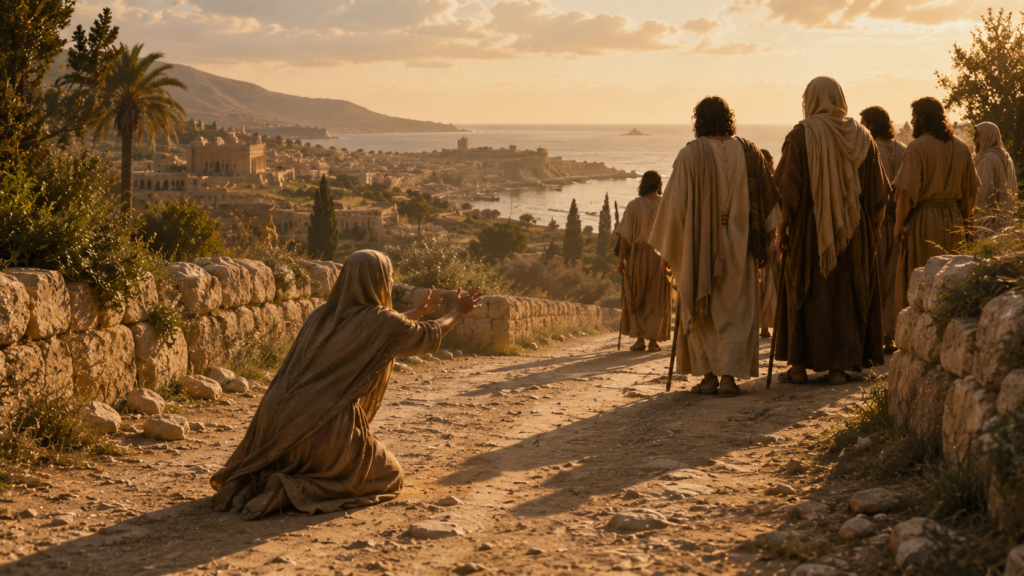
²¹ Jesus went out from there and withdrew into the region of Tyre and Sidon. ²² Behold, a Canaanite woman came out from those borders, and cried, saying, “Have mercy on me, Lord, you son of David! My daughter is severely possessed by a demon!” ²³ But he answered her not a word. His disciples came and begged him, saying, “Send her away; for she cries after us.” ²⁴ But he answered, “I wasn’t sent to anyone but the lost sheep of the house of Israel.” ²⁵ But she came and worshiped him, saying, “Lord, help me.” ²⁶ But he answered, “It is not appropriate to take the children’s bread and throw it to the dogs.” ²⁷ But she said, “Yes, Lord, but even the dogs eat the crumbs which fall from their masters’ table.” ²⁸ Then Jesus answered her, “Woman, great is your faith! Be it done to you even as you desire.” And her daughter was healed from that hour. (Matthew 15:21–28, World English Bible)
- Jesus went out from there and withdrew into the region of Tyre and Sidon (verse 21). The Greek eis ta mere Tyrou kai Sidonos, “into the regions of Tyre and Sidon,” names the most extreme geographic move in the gospel so far. Tyre and Sidon are Phoenician coastal cities in modern southern Lebanon, well outside the borders of Galilee, in unambiguously Gentile territory. The chapter is recording, with characteristic geographic-theological precision, that the Galilean rabbi has crossed into pagan territory.
- A Canaanite woman came out from those borders, and cried, saying, “Have mercy on me, Lord, you son of David!” (verse 22). The Greek gyne Chananaia, “a Canaanite woman,” is Matthew’s deliberate Hebrew Bible vocabulary choice. Mark 7:26 names the same woman as Syrophoenician (Hellenistic-cultural identification); Matthew calls her Canaanite, the Hebrew Bible’s term for the people Israel was supposed to drive out of the land. The chapter is recording, with characteristic Hebrew Bible literacy, the identification that would land most provocatively on a Jewish ear: this is a Canaanite, the most paradigmatically outside category the Hebrew Bible has. Her address to Jesus as son of David, the messianic title, is theologically loaded: a Canaanite is using the Davidic-messianic vocabulary correctly.
Influence callout: Marty Solomon (the mumzer reading continues, Canaanite-woman edition)
Solomon’s reading of the Canaanite-woman scene names it as the gospel’s most striking single staging of the mumzer agenda since chapter 1’s genealogy. The four women in Jesus’s genealogy (Tamar the Canaanite, Rahab the Canaanite, Ruth the Moabite, Bathsheba the Hittite-husband’s-wife) were all foreign-blooded women whom the messianic family had run through. The Canaanite woman in Matthew 15 is, structurally, the genealogy’s pattern walking up to its fulfillment. She is everything the Pharisaic religious establishment of chapter 15:1-9 would dismiss: a foreign woman, a Canaanite by cultural memory, a Gentile by birth, in pagan territory, with a demon-possessed daughter. And she does not flinch. She uses the son of David messianic title; she takes Jesus’s dogs metaphor and turns it back on him with theological wit (even the dogs eat the crumbs which fall from their masters’ table); she gets her daughter healed. Solomon argues that the chapter is recording, in the dialogue, the kingdom’s deepest single in-this-world demonstration of the genealogy’s outsider-agenda: the Canaanite woman was always going to be inside the family. The genealogy’s pattern was not a one-time historical accident; it is the kingdom’s continuing shape. Solomon also names what the dialogue is doing to the disciples (and to the reader): Jesus’s initial silence and his apparent rebuff (I was not sent except to the lost sheep of Israel) function pedagogically. The disciples would have heard the apparent rebuff with relief: finally, the rabbi is reinforcing the boundary. The woman’s reply, and Jesus’s public commendation of her great faith, is the chapter pulling the rug out. The lost sheep of Israel mission, on which Jesus had sent the twelve in chapter 10, has not been abolished; it has been re-revealed to include the people the disciples did not expect Israel to include. The chapter is teaching, in a single unforgettable scene, that the kingdom’s family-borders have always been larger than the religious establishment’s borders. The genealogy’s Canaanite-Tamar is the chapter’s Canaanite-mother is the church’s Gentile-mission.
- I wasn’t sent to anyone but the lost sheep of the house of Israel (verse 24). The Greek ouk apestalen ei me eis ta probata ta apololota oikou Israel, “I was not sent except to the lost sheep of the house of Israel,” names Jesus’s ministry’s stated geographic-ethnic priority (continuous with 10:5-6’s instruction to the twelve). The chapter is recording, with characteristic theological care, the genuine priority of the Jewish-first ministry, without erasing the chapter’s coming demonstration that the priority is not the ceiling.
- It is not appropriate to take the children’s bread and throw it to the dogs (verse 26). The Greek kynariois, “little dogs,” uses the diminutive (the household-pet word, not the wild-stray word). The chapter is recording, with characteristic narrative care, that Jesus’s metaphor is dialogue-opening, not dismissive. The diminutive softens the edge. The Canaanite woman picks up the dialogue at exactly that point.
- Yes, Lord, but even the dogs eat the crumbs which fall from their masters’ table (verse 27). The Greek kai gar ta kynaria esthiei apo ton psichion ton piptonton apo tes trapezes ton kyrion auton, “for indeed the little dogs eat from the crumbs falling from the table of their masters,” is one of the most theologically agile single replies in the gospel. The woman accepts the metaphor, and turns it: even the dogs get crumbs from the master’s table. The chapter is recording, with characteristic narrative honesty, the woman’s wit. She has out-rabbi’d the rabbi.
- Woman, great is your faith! Be it done to you even as you desire (verse 28). The Greek o gynai, megale sou he pistis, “O woman, great is your faith,” is the chapter’s pivot. Jesus publicly names her faith as great, the same adjective the gospel reserved for the centurion’s faith at 8:10 (not even in Israel have I found such faith). The chapter is recording, with characteristic narrative care, that the kingdom’s great faith has now been named twice: once in a Roman centurion, once in a Canaanite mother. Both Gentiles. Both outsiders. Both the kind of faith Jesus could not find in the religious establishment.
C · Matthew 15:29–39 · Healings and the feeding of the four thousand
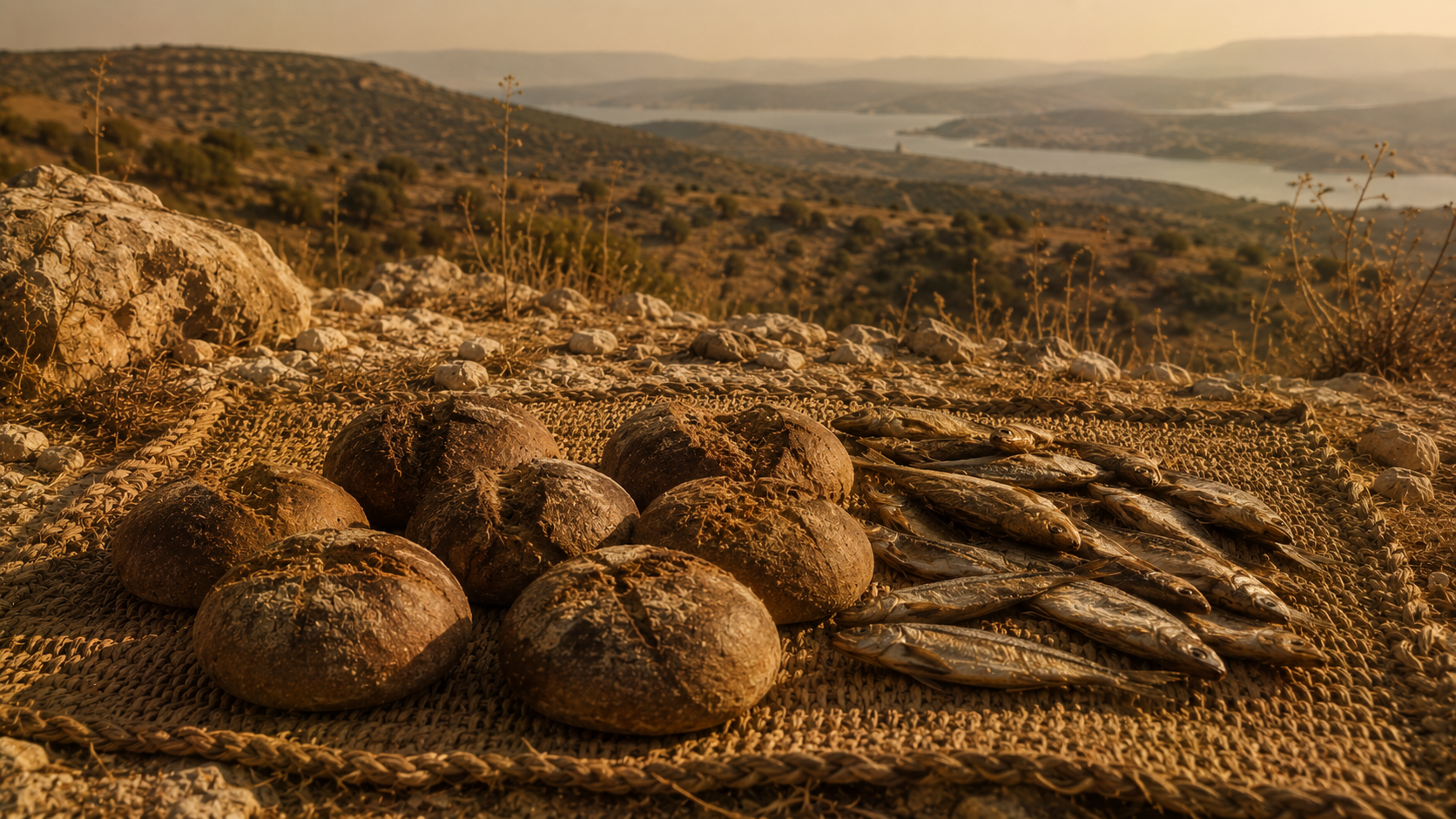
²⁹ Jesus departed from there, and came near to the sea of Galilee; and he went up into the mountain, and sat there. ³⁰ Great multitudes came to him, having with them the lame, blind, mute, maimed, and many others, and they put them down at his feet. He healed them, ³¹ so that the multitude wondered when they saw the mute speaking, the injured healed, the lame walking, and the blind seeing, and they glorified the God of Israel. ³² Jesus summoned his disciples and said, “I have compassion on the multitude, because they continue with me now three days and have nothing to eat. I don’t want to send them away fasting, or they might faint on the way.” ³³ The disciples said to him, “Where could we get so many loaves in a deserted place to satisfy so great a multitude?” ³⁴ Jesus said to them, “How many loaves do you have?” They said, “Seven, and a few small fish.” ³⁵ He commanded the multitude to sit down on the ground; ³⁶ and he took the seven loaves and the fish. He gave thanks and broke them, and gave to the disciples, and the disciples to the multitudes. ³⁷ They all ate, and were filled. They took up seven baskets full of the broken pieces that were left over. ³⁸ Those who ate were four thousand men, in addition to women and children. ³⁹ Then he sent away the multitudes, got into the boat, and came into the borders of Magdala. (Matthew 15:29–39, World English Bible)
- Jesus departed from there, and came near to the sea of Galilee; and he went up into the mountain, and sat there (verse 29). The Greek eis to oros… ekathezeto ekei, “into the mountain… he sat there,” uses the Sinai-vocabulary the Sermon on the Mount used (5:1, anebe eis to oros, kathisantos). The chapter is recording, with characteristic narrative-Mosaic echo, that the second-feeding scene is being staged in the same Sinai-pattern register as the first. The location is probably the eastern shore of the Sea of Galilee in the Decapolis (Mark’s parallel at 7:31 makes the location explicit), which would mean the scene is happening in predominantly Gentile territory.
- They glorified the God of Israel (verse 31). The Greek edoxasan ton theon Israel, “they glorified the God of Israel,” is a striking phrase. The natural way for a Jewish crowd to praise God would be simply they glorified God. The specification the God of Israel signals that the crowd here is not exclusively Jewish; they are recognizing the God of Israel in distinction from their own pagan deities. The chapter is recording, with characteristic narrative-cultural precision, that the crowd is in part Gentile, and the crowd is identifying Yahweh as the God whose power they have just witnessed.
- I have compassion on the multitude, because they continue with me now three days and have nothing to eat (verse 32). The Greek splanchnizomai, “I have compassion,” uses the same gut-level verb as 9:36, 14:14. The chapter is recording, with characteristic verbal continuity, that the same kingdom-disposition that fed the five thousand is now feeding a different crowd. The compassion is not partial to Jewish crowds; the chapter is the second time the gut-level moving-of-compassion has produced bread.
- Seven, and a few small fish (verse 34). The Greek hepta arteous, “seven loaves,” names the supply for this second feeding. The number is significant: seven is the Hebrew number of completion-and-fullness. Compare the first feeding’s five loaves and two fish (Mosaic-five-books, twelve-tribes basket-count). The second feeding’s seven loaves… seven baskets (verse 37) operates in a different numerical register. The chapter may be recording, with characteristic numerical-symbolic care, the kingdom’s expansion from the twelve-tribe Israel-numerical-pattern to the seven-completion-of-the-nations pattern. (The reading is debated; the numerical asymmetry is real.)
- They all ate, and were filled. They took up seven baskets full of the broken pieces that were left over (verse 37). The Greek spyridas, “baskets,” is a different word from the kophinous of 14:20. The first-feeding kophinos is a smaller wicker basket commonly carried by Jews; the second-feeding spyris is a larger basket-or-hamper used in Gentile contexts (the same word names the basket Paul was lowered down the wall in at Damascus, Acts 9:25). The chapter is recording, with characteristic vocabulary precision, that even the basket-types fit the second feeding’s likely Gentile setting.
- Those who ate were four thousand men, in addition to women and children (verse 38). The Greek hos tetrakischilioi, “about four thousand,” names a smaller-than-the-first-feeding crowd. The chapter is recording, with characteristic narrative restraint, the second feeding without claiming it is a bigger or better miracle. Both feedings are testimonies; the chapter does not need to compete them against each other.
- He sent away the multitudes, got into the boat, and came into the borders of Magdala (verse 39). The Greek closes the chapter with Jesus crossing back to the western (Jewish) shore of the Sea of Galilee. The chapter is recording, with characteristic narrative-geographic care, that the Gentile-territory excursion is over and the ministry is back at the Jewish-Galilean base. The next chapter will continue from there.
Reflection prompts
- The Pharisees use the korban tradition to legally evade the Decalogue’s command to honor parents. Jesus’s response is unsparing: you have made the commandment of God void because of your tradition. Where in your life is a religious-cultural tradition you have inherited (a custom, a practice, a piece of conventional wisdom) currently functioning to evade a clearer biblical command, and what would it mean to recognize the tradition for what it is and let the clearer command stand?
- A Canaanite woman in pagan territory uses the Davidic-messianic title correctly, refuses to be dismissed, takes Jesus’s metaphor and out-rabbis him with it, and gets her daughter healed. Jesus publicly names her faith as great. Where in your life are you currently expecting great faith to come from inside the religious community’s official channels, and what does it mean to consider that the kingdom’s great faith keeps showing up in the people the official channels have written off?
- What enters the mouth does not defile the person; what proceeds out of the mouth does. The kingdom’s moral concern is not external boundary-policing but internal heart-orientation. Where in your life are you currently working hard to manage external boundaries while leaving the heart-source unaddressed, and what would it mean to hear Jesus’s relocation: the source is the heart?