
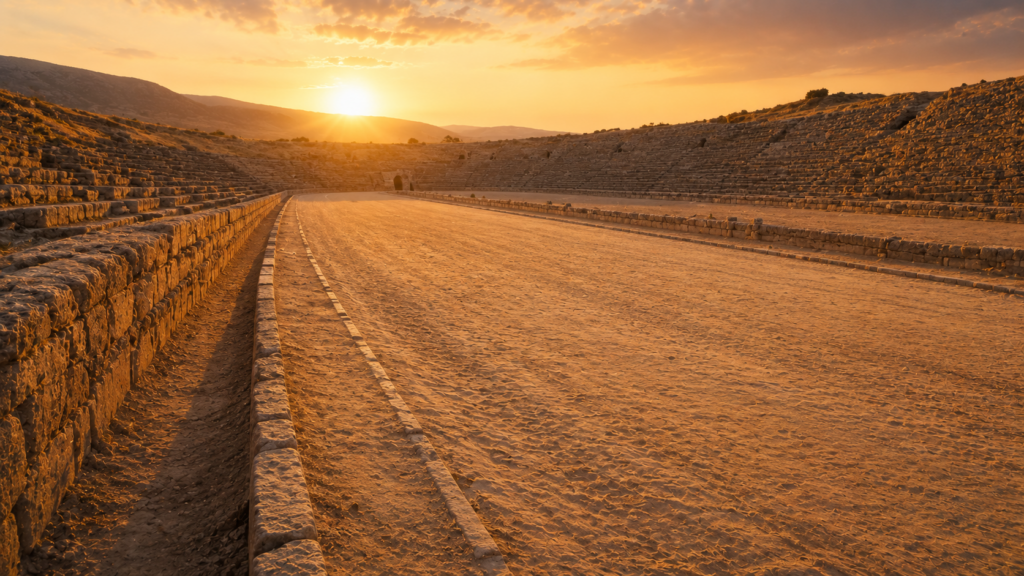
Hebrews 12 brings the book’s argument home. The chapter opens with the most concentrated image in the book: we are surrounded by a great cloud of witnesses; let us run the race set before us, looking to Jesus, the author and perfecter of our pistis. The metaphor of the race controls the chapter. The audience is running; the witnesses are watching; Jesus is the goal; endurance is the discipline. The chapter then develops three sustained pastoral movements: the discipline of the Lord (vv. 4-13), the Mount Sinai vs. Mount Zion contrast (vv. 18-24), and the fifth and final warning passage (vv. 25-29). The book’s central argument was Christological; the chapter’s central concern is how the audience runs the race.
The chapter must be read carefully on the discipline passage (vv. 4-13). The standard pastoral misuse takes the chapter as authorization for God causes your suffering for your good. The chapter’s actual claim is more careful. The Greek paideia (training, discipline) names the formative process by which a child is brought to maturity. The verses are not saying that all suffering is divine punishment; they are saying that the struggles the audience is enduring (10:32-34’s reproaches, oppressions, plundering of possessions) are the kind of formation that mature children undergo. The pastoral move is to reframe the struggle as formation, not to create new struggle as discipline.
The chapter’s Mount Sinai vs. Mount Zion contrast (vv. 18-24) is often misread as a contrast between terror (Sinai) and welcome (Zion), with Sinai dismissed as the old covenant’s fearfulness and Zion celebrated as the new covenant’s tenderness. The chapter does not dismiss Sinai. Sinai’s terror is what covenant inauguration looked like under Mosaic mediation: a real divine encounter, with real divine glory, in a covenant moment that had to be received with the fear appropriate to the encounter. Zion’s welcome is what covenant participation looks like under Christ’s mediation: a real divine encounter, in a covenant moment opened by Christ’s blood that speaks better than the blood of Abel (v. 24). The two mountains are not opposites; they are two modes of covenantal encounter. The chapter is not anti-Sinai; the chapter is naming what changes in the mode of encounter, without dismissing the substance of either.
A · Hebrews 12:1-3 · The race set before us
¹ Therefore let’s also, seeing we are surrounded by so great a cloud of witnesses, lay aside every weight and the sin which so easily entangles us, and let’s run with perseverance the race that is set before us, ² looking to Jesus, the author and perfecter of faith, who for the joy that was set before him endured the cross, despising its shame, and has sat down at the right hand of the throne of God. ³ For consider him who has endured such contradiction of sinners against himself, that you don’t grow weary, fainting in your souls.
- Therefore let’s also, seeing we are surrounded by so great a cloud of witnesses (v. 1). The chapter opens with the therefore that gathers chapter 11. The audience is surrounded (Greek perikeimenon, being encircled, being wrapped around) by so great a cloud of witnesses (Greek tosouton nephos martyrōn). The image is precise: the patriarchs, prophets, judges, and martyrs of chapter 11 are not behind the audience or ahead of the audience but around the audience, encircling the racetrack, watching the race in progress.
- Lay aside every weight and the sin which so easily entangles us (v. 1). The chapter names two distinct things to set aside: every weight (Greek onkon panta, every encumbrance) and the sin (Greek tēn euperistaton hamartian, the sin that closely surrounds). Weight is not the same as sin: weights are things that are not in themselves sinful but that slow the runner down. Sin is the thing that entangles. Both must be set aside for the race.
- Let’s run with perseverance the race that is set before us (v. 1). The Greek di’ hypomonēs (through endurance) is the chapter’s key endurance vocabulary. The race is not a sprint; it is the long-distance discipline the chapter will develop. The verb trechōmen (let us run) is present subjunctive, naming a continuing activity.
- Looking to Jesus, the author and perfecter of faith (v. 2). The chapter names Jesus as the runner’s gaze-point. The Greek aphorōntes eis ton tēs pisteōs archēgon kai teleiōtēn Iēsoun (looking away to Jesus, the author and perfecter of pistis). The verb aphorōntes (looking away from) names the deliberate redirection of attention: away from the cloud of witnesses (who are encouraging but not the goal), away from one’s own running (which is the activity but not the focus), toward Jesus. Jesus is the author (Greek archēgon, the same word from 2:10, pioneer) and perfecter (Greek teleiōtēn, the one who brings to completion) of pistis. Jesus is both the one who started the audience’s pistis and the one who completes it.
- Who for the joy that was set before him endured the cross, despising its shame (v. 2). The chapter’s most theologically loaded single phrase. Jesus endured the cross (Greek hypemeinen stauron) for the joy set before him (Greek anti tēs prokeimenēs autō charas). The preposition anti can mean either for the sake of (Jesus endured the cross because of the joy he saw ahead) or in exchange for (Jesus exchanged the joy he could have had for the cross). Either reading is theologically rich. The verse honors Jesus’s deliberate choice of the cross, with the joy fully in view.
- Has sat down at the right hand of the throne of God (v. 2). The chapter cites the enthronement of Christ (Ps 110:1 again). The Greek ekathisen (he sat down) is the same verb from 1:3, 8:1, 10:12. Christ’s seated position names the completed work. The audience is running toward the one who has already arrived.
- Consider him who has endured such contradiction of sinners against himself, that you don’t grow weary, fainting in your souls (v. 3). The chapter’s pastoral application. The audience must consider Jesus’s contradiction (Greek antilogian, the contradicting opposition) from sinners. The Greek hina mē kamēte tais psychais hymōn ekluomenoi (so that you do not grow weary, fainting in your souls) names the real risk: spiritual exhaustion. The cure is the deliberate fixation on Jesus’s own enduring example.
B · Hebrews 12:4-13 · The discipline of the Lord
⁴ You have not yet resisted to blood, striving against sin; ⁵ and you have forgotten the exhortation which reasons with you as with children, “My son, don’t take lightly the chastening of the Lord, nor faint when you are reproved by him; ⁶ for whom the Lord loves, he chastens, and scourges every son whom he receives.” ⁷ It is for discipline that you endure. God deals with you as with children, for what son is there whom his father doesn’t discipline? ⁸ But if you are without discipline, of which all have been made partakers, then you are illegitimate, and not children. ⁹ Furthermore, we had the fathers of our flesh to chasten us, and we paid them respect. Shall we not much rather be in subjection to the Father of spirits, and live? ¹⁰ For they indeed, for a few days, punished us as seemed good to them; but he for our profit, that we may be partakers of his holiness. ¹¹ All chastening seems for the present to be not joyous but grievous; yet afterward it yields the peaceful fruit of righteousness to those who have been trained by it. ¹² Therefore lift up the hands that hang down and the feeble knees, ¹³ and make straight paths for your feet, so that which is lame may not be dislocated, but rather be healed.
- You have not yet resisted to blood, striving against sin (v. 4). The chapter’s opening pastoral assessment. The audience has struggled against sin but has not yet resisted to the point of blood (Greek mechris haimatos). The verse is not trivializing the audience’s previous suffering (chapter 10:32-34 honored their previous endurance); it is naming that the struggle continues and may intensify.
- You have forgotten the exhortation which reasons with you as with children (v. 5). The chapter introduces the paideia (discipline, training) framework. The Greek paraklēseōs hētis hymin hōs huiois dialegetai (the exhortation that reasons with you as with sons). The chapter is teaching that the audience is being treated as children (a position of honor and family belonging), not as outsiders.
- My son, don’t take lightly the chastening of the Lord, nor faint when you are reproved by him; for whom the Lord loves, he chastens (vv. 5-6, citing Prov 3:11-12). The chapter cites Proverbs 3:11-12. The Septuagint reads whom the Lord loves, he disciplines (Greek paideuei). The Hebrew Bible’s wisdom tradition names discipline as the form parental love takes. The chapter applies this to YHWH’s relationship with the audience.
- It is for discipline that you endure. God deals with you as with children (v. 7). The chapter’s central pastoral reframe. The Greek eis paideian hypomenete (you endure with reference to discipline). The audience’s current suffering is being interpreted as paideia, not as punishment for specific sins or as random misfortune. The reframe is not claiming that God causes the suffering; it is claiming that the suffering, in YHWH’s hand, is being formed into paideia.
- For what son is there whom his father doesn’t discipline? But if you are without discipline … then you are illegitimate, and not children (vv. 7-8). The chapter’s theological argument. Real children are disciplined; illegitimate offspring (Greek nothoi, bastards) are not. The verse is not implying that suffering proves sonship in the abstract; it is naming that YHWH’s formative attention is what children receive and outsiders do not. The audience’s struggle is evidence of family belonging, not evidence of divine rejection.
- We had the fathers of our flesh to chasten us, and we paid them respect. Shall we not much rather be in subjection to the Father of spirits, and live? (v. 9). The chapter’s a fortiori (how much more) argument. The Greek tō patri tōn pneumatōn (the Father of spirits) names YHWH in the most cosmic terms. If we respected earthly fathers’ discipline, how much more the discipline of the Father of spirits.
- They indeed, for a few days, punished us as seemed good to them; but he for our profit, that we may be partakers of his holiness (v. 10). The chapter’s careful theological qualifier. Earthly fathers punished (Greek epaideuon, disciplined) imperfectly: for a few days, as seemed good to them. YHWH disciplines for our profit, that we may share in his holiness (Greek eis to metalabein tēs hagiotētos autou). The pastoral move is precise: YHWH’s discipline has a specific purpose (holiness-sharing) and is not arbitrary.
- All chastening seems for the present to be not joyous but grievous; yet afterward it yields the peaceful fruit of righteousness to those who have been trained by it (v. 11). The chapter’s pastoral honesty. The Greek pros men to paron ou dokei charas einai alla lypēs (for the present it does not seem to be of joy but of grief). The chapter is not pretending that discipline feels good in the moment. Afterward (Greek hysteron de) it yields the peaceful fruit of righteousness to those who have been trained by it (Greek tois di’ autēs gegymnasmenois, those exercised by it). The verse is the New Testament’s clearest single statement that discipline’s payoff is delayed.
- Therefore lift up the hands that hang down and the feeble knees, and make straight paths for your feet (vv. 12-13, citing Isa 35:3 and Prov 4:26). The chapter’s pastoral exhortation. The audience is to lift up (Greek anorthōsate, set upright) the hands hanging down and feeble knees. The verbs are pastoral: the audience is not abandoned in their struggle; they are called to stand up again and make straight paths so that the lame (the weaker members of the community) may not be dislocated but healed. The whole community’s pace is set by the care of the weakest.

C · Hebrews 12:14-29 · Mount Zion and the final warning
¹⁴ Follow after peace with all men, and the sanctification without which no man will see the Lord, ¹⁵ looking carefully lest there be any man who falls short of the grace of God; lest any root of bitterness springing up trouble you, and many be defiled by it; ¹⁶ lest there be any sexually immoral person, or profane person, like Esau, who sold his birthright for one meal. ¹⁷ For you know that even when he afterward desired to inherit the blessing, he was rejected, for he found no place for a change of mind though he sought it diligently with tears. ¹⁸ For you have not come to a mountain that might be touched, and that burned with fire, and to blackness, darkness, storm, ¹⁹ the sound of a trumpet, and the voice of words; which those who heard it begged that not one more word should be spoken to them, ²⁰ for they could not stand that which was commanded, “If even an animal touches the mountain, it shall be stoned”; ²¹ and so fearful was the appearance, that Moses said, “I am terrified and trembling.” ²² But you have come to Mount Zion, and to the city of the living God, the heavenly Jerusalem, and to innumerable multitudes of angels, ²³ to the festal gathering and assembly of the firstborn who are enrolled in heaven, to God the Judge of all, to the spirits of just men made perfect, ²⁴ to Jesus, the mediator of a new covenant, and to the blood of sprinkling that speaks better than that of Abel. ²⁵ See that you don’t refuse him who speaks. For if they didn’t escape when they refused him who warned on the earth, how much more will we not escape who turn away from him who warns from heaven, ²⁶ whose voice shook the earth then, but now he has promised, saying, “Yet once more I will shake not only the earth, but also the heavens.” ²⁷ This phrase, “Yet once more,” signifies the removing of those things that are shaken, as of things that have been made, that those things which are not shaken may remain. ²⁸ Therefore, receiving a Kingdom that can’t be shaken, let’s have grace, by which we may offer service well pleasing to God, with reverence and awe, ²⁹ for our God is a consuming fire.
- Follow after peace with all men, and the sanctification without which no man will see the Lord (v. 14). The chapter’s opening exhortation in this section. The audience is to pursue (Greek diōkete, the verb of pursuit, the same verb used of pursuit in athletic competition) peace and holiness. The phrase without which no man will see the Lord is the chapter’s most pastorally severe note: sanctification is required for the vision of God. The whole later Christian theology of sanctification as preparation for the beatific vision reads forward from this verse.
- Lest there be any sexually immoral person, or profane person, like Esau, who sold his birthright for one meal (v. 16). The chapter’s specific warning. Esau (Gen 25:29-34; 27:30-40) is named as the negative example. Esau sold his birthright (Greek prōtotokia) for a single meal. The chapter is reading Esau’s act as a failure of pistis: he traded the long-term covenantal inheritance for short-term gratification. The audience is warned against the same pattern.
- He found no place for a change of mind though he sought it diligently with tears (v. 17). The chapter’s note on Esau’s failed recovery. The Greek metanoias gar topon ouch heuren kaiper meta dakryōn ekzētēsas autēn (he found no place for repentance, though he sought it with tears). The verse is not saying that Esau wanted to repent and YHWH refused him; it is saying that the consequences of Esau’s choice could not be reversed even when he later regretted them. The verse is a pastoral warning about the irrevocability of certain choices.
- For you have not come to a mountain that might be touched, and that burned with fire, and to blackness, darkness, storm (v. 18). The chapter pivots to the Mount Sinai image. The Greek ou gar proselēlythate psēlaphōmenō kai kekaumenō pyri kai gnophō kai zophō kai thyellē (for you have not come to a [mountain] that can be touched and [that has been] burning with fire, and to blackness, darkness, storm). The chapter is not dismissing Sinai; it is naming what Sinai’s mode of covenantal encounter was: terror, fire, darkness, storm, trumpet, voice that drove people to beg for silence. The verse honors the real gravity of the Sinai encounter.
- And so fearful was the appearance, that Moses said, “I am terrified and trembling” (v. 21). The chapter notes that even Moses was terrified and trembling at Sinai. The verse cites a tradition not directly found in the Exodus narrative but consistent with the Septuagint of Deut 9:19. Moses himself found the mountain terrifying. The chapter is honoring the severity of the Sinai encounter without dismissing it.
- But you have come to Mount Zion, and to the city of the living God, the heavenly Jerusalem (v. 22). The chapter’s central pivot. The audience has come (Greek proselēlythate, perfect tense, have come and remain) to Mount Zion. The Greek Siōn orei names Jerusalem’s temple mount, the place of YHWH’s enthroned presence. The audience is not outside the encounter; they are at Zion. The verse is the chapter’s most theologically generous note: the audience is already at the heavenly Jerusalem, in worshipping relation with God.
- And to innumerable multitudes of angels, to the festal gathering and assembly of the firstborn who are enrolled in heaven, to God the Judge of all, to the spirits of just men made perfect (vv. 22-23). The chapter expands the Zion image. The audience has come to a gathered assembly: angels, the firstborn enrolled in heaven (likely the Christian community), God the Judge of all, and the spirits of just men made perfect (the Hebrew Bible’s cloud of witnesses, now perfected). The whole gathering is one cosmic worshipping community. The audience joins the worship that is already in progress at Zion.
- To Jesus, the mediator of a new covenant, and to the blood of sprinkling that speaks better than that of Abel (v. 24). The chapter’s most theologically dense single phrase about Christ. Jesus is the mediator of a new covenant (Greek diathēkēs neas mesitē, using neas “new in time” rather than kainēs “new in quality”; the contrast may be subtle). The blood of sprinkling that speaks better than that of Abel: Abel’s blood, shed by Cain, cried out for vengeance from the ground (Gen 4:10); Christ’s blood speaks something better, namely forgiveness and redemption. The verse is the chapter’s deepest pastoral consolation: the blood that speaks now is for the audience, not against them.
- See that you don’t refuse him who speaks (v. 25). The chapter’s fifth warning passage opens. The Greek blepete mē paraitēsēsthe ton lalounta (see that you do not refuse the one who speaks). The verb paraiteomai (refuse, decline, beg off from) names active refusal, not careless drift. The chapter is teaching that the speaking continues: God spoke at Sinai; God speaks now from heaven; the audience must not refuse.
- Yet once more I will shake not only the earth, but also the heavens (v. 26, citing Hag 2:6). The chapter cites Haggai’s prophetic vision. YHWH will shake the heavens and the earth one more time. The shaking is eschatological: it precedes the new order. The verse is the New Testament’s reference to the eschatological cosmic shaking (cf. Mt 24:29; 2 Pet 3:10-13).
- That those things which are not shaken may remain (v. 27). The chapter’s eschatological logic. The shaking will remove what can be shaken so that what cannot be shaken remains. The Kingdom (v. 28) is unshakable; the audience is receiving that Kingdom. The contrast is not between Sinai and Zion (both are real divine encounters); the contrast is between all created things (which can be shaken) and the Kingdom that endures.
- Therefore, receiving a Kingdom that can’t be shaken, let’s have grace, by which we may offer service well pleasing to God, with reverence and awe (v. 28). The chapter’s response. The audience receives an unshakable Kingdom. The response is gratitude that takes the form of acceptable worship. The Greek meta eulabeias kai deous (with reverence and awe) names the fitting posture before the encountered God.
- For our God is a consuming fire (v. 29). The chapter’s closing phrase. The Greek kai gar ho theos hēmōn pyr katanaliskon (for our God is a consuming fire). The verse cites Deut 4:24 (and 9:3). The phrase is not contradicting the chapter’s earlier celebration of Zion’s welcome; it is naming the same God whose welcome is real and whose holiness is also real. The fire is the same fire that burned the bush at Horeb, descended on Sinai, consumed the altar at Lev 9:24, fell from heaven at Pentecost. Welcome and holiness are not in tension; they are the same God’s character.
Word study: paideia (παιδεία), “training, discipline, formative education”
The Greek noun paideia names the formative process by which a child is brought to maturity. The word’s range covers education, training, formative discipline, the deliberate shaping of a child by a parent or teacher. The classical Greek context is the paideia of the citizen: the long, deliberate process of training a child to become a virtuous adult. The Septuagint uses paideia to translate the Hebrew musar (instruction, discipline). Hebrews 12 is the New Testament’s most extended treatment of the word. The chapter is not using paideia in its modern sense of punishment; it is using it in its classical sense of formative training. YHWH’s paideia is the deliberate, formative shaping by which children are brought to maturity. The chapter is not arguing that all suffering is divine discipline; it is arguing that the suffering the audience is enduring, in YHWH’s hands, is being formed into paideia. The pastoral move is to reframe the audience’s struggle as formation, not to create new struggle as discipline. The whole later Christian tradition of spiritual formation, the dark night of the soul (John of the Cross), the formation through suffering (Bonhoeffer’s Cost of Discipleship), reads forward from this chapter.
Influence callout: Marty Solomon (Bema podcast; Mount Sinai and Mount Zion as complementary, not opposed)
Solomon’s reading of Hebrews 12:18-24 in the Bema podcast Hebrews series develops the two mountains contrast carefully. The standard evangelical reading takes the contrast as bad old Sinai (the terrifying old covenant) vs. good new Zion (the welcoming new covenant). Solomon’s reading rejects this. Both mountains are real divine encounters. Sinai’s terror was the appropriate response to the covenantal moment of inauguration: a real divine presence requires real fear. Zion’s welcome is the appropriate experience of the same God by people whose access has been opened by Christ’s mediation. The mountains are not opposed; they are two modes of encounter with the same God. Solomon’s pastoral payoff: the chapter is not anti-Sinai. The chapter is teaching the audience that the same holy God whom Israel met at Sinai is the God they now meet at Zion. The closing verse of the chapter (v. 29, our God is a consuming fire, citing Deut 4:24) makes this explicit: the God of Zion is the God of Sinai. The welcome and the fire are one God’s character. Solomon’s reading is consistent with the Paul Within Judaism lane the site reads from: the chapter is not setting up a contrast between the bad old religion and the good new religion. It is naming what changes in the mode of covenantal encounter (Christ’s blood, the unshakable Kingdom) without dismissing the substance of either mountain’s reality.
Reflection prompts
- The chapter calls the audience to lay aside every weight and the sin which so easily entangles (v. 1). Weights are not themselves sinful, but they slow the runner. Where in your own life is there a weight (not a sin, but a thing that slows you down) that needs to be set aside for the race?
- The discipline passage (vv. 4-13) is not saying that God causes your suffering; it is saying that the struggles you are enduring are being formed, in YHWH’s hand, into paideia. Where in your own current suffering has the suffering been reframed as formation, and where has it remained as bare hardship that needs reframing?
- The chapter pairs Mount Sinai’s terror and Mount Zion’s welcome as two modes of encounter with the same God. Where in your own theology have you separated the welcoming God from the holy God, as if they were two different deities, when the chapter is teaching that they are one God’s character?
Frameworks at play in this chapter: gospel allegiance, the new covenant, the cruciform hermeneutic, Paul within Judaism, the kipper / atonement framework, the divine council.