
Hebrews
A better covenant.
All 13 chapters drafted.
How to read it
Themes: Christ as the superior revealer (1-2) · Christ as the high priest after the order of Melchizedek (5-7) · the new covenant fulfilled in Christ (8-10) · the Sabbath rest that remains for the people of God (3-4) · the cloud of witnesses and the endurance of faith (11-12) · the practical exhortations of the closing community life (13) · Christ at the right hand of the Father, interceding (the book’s central image) Literary design: a sermon (Hebrew 13:22, word of exhortation) rather than a letter; alternating exposition and exhortation through five major movements; five “warning passages” embedded inside the argument; an extended quotation of Jeremiah 31:31-34 at the structural center (Heb 8:8-12); the highest-register Greek in the New Testament Frameworks at play: the new covenant · the Melchizedek priesthood · Sabbath rest · the kipper / atonement framework · the five offerings · the tabernacle as cosmic temple · Paul within Judaism · gospel allegiance · exile and return · the cruciform hermeneutic · the festival calendar
Hebrews is the New Testament book most often read against its own grain. Modern Christian readers, especially in the evangelical-Reformed traditions, have frequently treated Hebrews as the book that retires the Old Testament, that argues Judaism was an inferior first attempt and Christianity is the upgrade. This commentary reads the book otherwise. Hebrews is not bashing the Torah. It is not declaring Judaism obsolete. It is not setting up a supersessionist victory of church over Israel. It is the most sustained New Testament argument that Christ is the climactic fulfillment of categories the Hebrew Bible itself preserves. Every “better than” comparison in Hebrews is a Christological superlative inside the Hebrew Bible’s own grammar; it is not a Jewish-people supersessionism. The book honors Torah, honors the priesthood, honors the sacrificial system, and reads Christ as the eschatological completion of what those institutions were always reaching toward.
The site reads Hebrews in the Paul Within Judaism lane, with Marty Solomon (Bema podcast) and David Moffitt (Rethinking the Atonement) as primary modern voices. Solomon’s careful Hebrew-context reading prevents the supersessionist drift; Moffitt’s recovery of atonement at the ascension (the kipper-making in Hebrews is located at Christ’s heavenly entry, not at the cross alone) reframes the central atonement argument. Amy Peeler‘s 2024 commentary in the Commentaries for Christian Formation series provides the formal scholarly anchor; N.T. Wright‘s Hebrews for Everyone provides the lay-level bridge; Tim Mackie‘s BibleProject classroom on Hebrews provides the Hebrew-literary-design lens.
This page is a “how to read it” overview, meant to be read alongside the chapter commentaries (linked at the bottom). If you want the verse-by-verse work, follow a chapter link. If you want the lay of the land before you walk it, you’re in the right place.
The book is a sermon, not a letter
The first thing modern readers need to know about Hebrews is that it is not a letter. The book has no opening salutation, no “Paul to the church at…” formula, no list of greetings, no author’s identification. The book’s own self-description at 13:22 is decisive: I appeal to you, brothers, bear with my word of exhortation, for I have written to you briefly (Greek logos tēs paraklēseōs, the technical name for a synagogue sermon). The same phrase is used at Acts 13:15 for the sermon Paul preaches at Pisidian Antioch. Hebrews is a homily, not correspondence. It was preached (or perhaps circulated to be preached) before being sent as text. The few epistolary features at the close (13:18-25) appear to be a brief covering note attached when the sermon was sent to a specific community.
This matters interpretively. Sermons have different structural conventions than letters: they alternate exposition and exhortation; they double back to the same point from different angles; they use amplification (saying the same thing repeatedly with intensifying rhetorical force) as a method of persuasion; they assume a gathered audience whose response shapes the address. Hebrews reads exactly this way. The book is not bad letter-writing; it is excellent preaching transcribed.
The author is anonymous. Early Christian tradition variously attributed the book to Paul (the dominant ancient view, though most modern scholars reject Pauline authorship on grounds of style, vocabulary, and structure), Apollos (Luther’s guess, based on Acts 18:24-28’s description of Apollos as a learned Alexandrian Jew skilled in the Scriptures), Barnabas (Tertullian’s view), Priscilla (a modern guess of Adolf von Harnack, though the participle forms in 11:32 suggest a male author or at least a male preaching voice), or Luke (a minority ancient view, based on stylistic similarities with Acts). The book itself does not name its author, and Christian tradition’s earliest practice was to receive the book without insisting on identifying who wrote it. This commentary follows that practice.
The audience is harder to identify than the author. The book’s title (Pros Hebraious, “To the Hebrews”) is a later editorial addition. Internal evidence suggests Jewish believers in Messiah facing pressure to return to pre-messianic Jewish practice, possibly because of persecution from Roman authorities, possibly because of social pressure from non-messianic Jewish family and community. The author’s repeated argument that Christ is the inheritor of the messianic categories (priesthood, sacrifice, atonement, covenant) is exactly the argument one would give to people considering whether to abandon their commitment to Yeshua and reintegrate with mainstream Judaism. The community is not being told to abandon Judaism or the Torah; they are being told not to leave Yeshua.
The date is most likely before 70 CE (the destruction of the second temple). The book’s repeated use of the present tense for temple worship (every priest stands daily at his service, offering repeatedly the same sacrifices, Heb 10:11) suggests the temple system is still operative as the author writes. Had the temple already been destroyed, the argument that Christ has rendered the sacrifices obsolete would have had an obvious historical confirmation the author never invokes. The book is therefore probably written sometime between the mid-60s CE.
The storyline
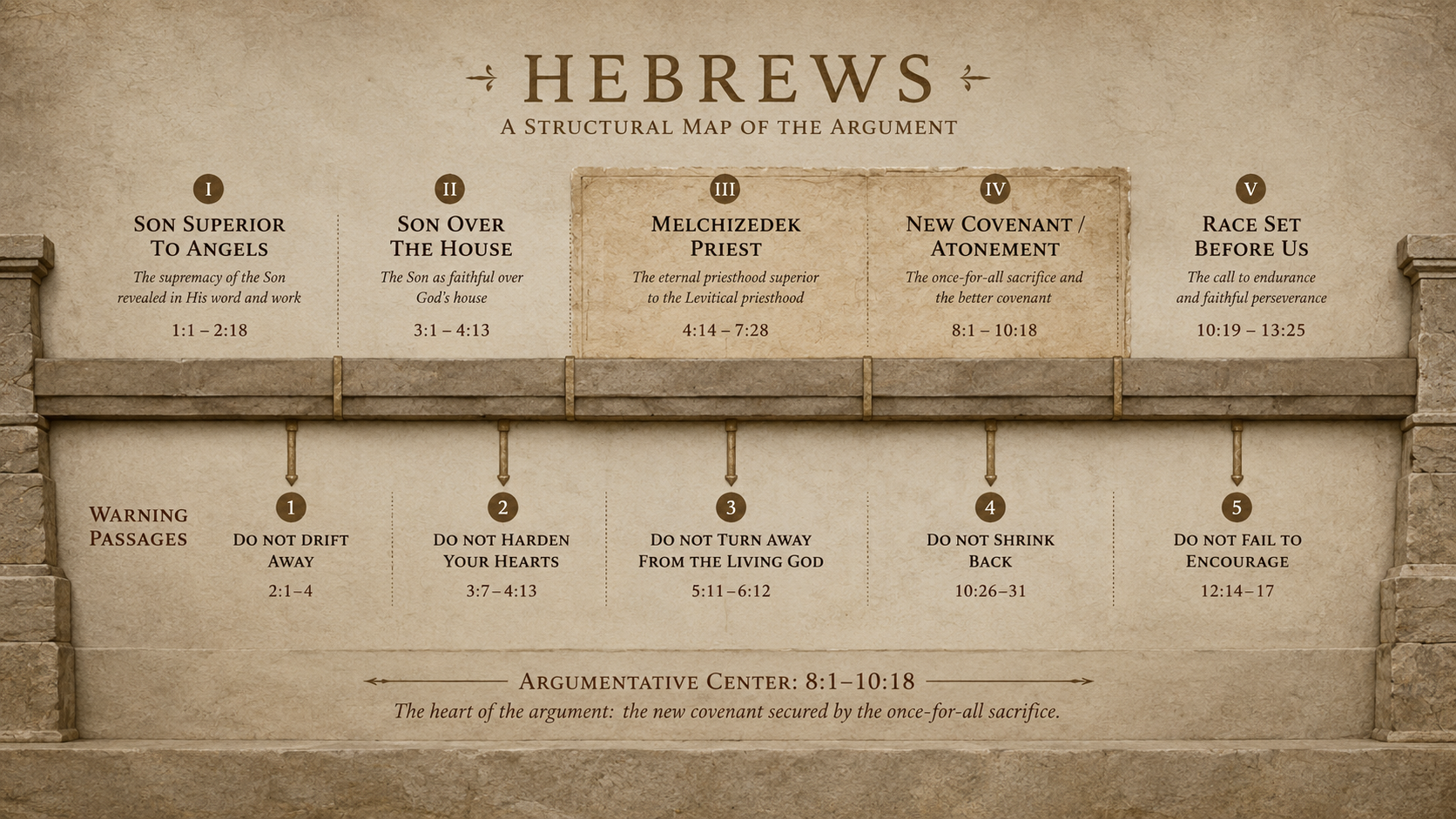
Hebrews has very little narrative plot. The book is argument, not story. But the argument has a clear shape, organized around five major expository movements interrupted by five major exhortation movements (“warning passages”). The structure is not a linear theological treatise; it is a sermon that repeatedly pauses to plead with the hearer to not turn back.
Chapters 1-2 establish Christ as the superior revealer. The opening (1:1-4) is one of the most theologically dense sentences in the New Testament: God spoke in many parts and many ways through the prophets; in these last days, he has spoken in a Son. Christ is identified as the radiance of the divine glory and the exact imprint of God’s being. Hebrews 1 then catalogues seven Old Testament texts that show Christ’s superiority to the angels, the Hebrew Bible texts cited (Ps 2:7, 2 Sam 7:14, Deut 32:43 LXX, Ps 104:4, Ps 45:6-7, Ps 102:25-27, Ps 110:1) are not arbitrary proof-texts; each names a Christological dimension the author will develop later. Chapter 2 turns to Christ’s solidarity with humanity: he partook of flesh and blood (2:14), suffered as brothers and sisters (2:11-12), and is now able to help those who are being tempted (2:18). The first warning passage (2:1-4) is embedded in this movement: we must pay closer attention to what we have heard, lest we drift away.
Chapters 3-4 turn to Christ as superior to Moses and develop the Sabbath rest argument. Moses is a faithful servant in God’s house; Jesus is a faithful Son over God’s house (3:5-6). The chapter then quotes Psalm 95 at length, applying the wilderness generation’s failure to enter the land’s rest as a warning to the present audience. Hebrews 4 develops the argument: the rest YHWH promised was not fully entered in Joshua’s conquest; there remains a Sabbath rest (sabbatismos) for the people of God (4:9). The author’s exhortation: strive to enter that rest (4:11). The second warning passage (3:7-4:13) is the longest of the warnings in the book.
Chapters 5-7 are the Melchizedek priesthood section. The author argues that Christ is a high priest after the order of Melchizedek (Ps 110:4) rather than the order of Aaron, a priesthood older, higher, and outside the Levitical succession. Chapter 5 introduces the comparison; chapter 6 contains the third warning passage (the famously hard 6:4-8 verses on “impossible to renew them to repentance”) and culminates in the anchor of the soul image (6:19-20); chapter 7 develops the Melchizedek argument in full. The chapter is unintelligible without the Melchizedek priesthood framework.
Chapters 8-10 are the book’s atonement center. Chapter 8 announces that Christ is the mediator of a better covenant, enacted on better promises, and quotes Jeremiah 31:31-34 in full, the longest single Hebrew Bible quotation in the New Testament. Chapter 9 develops the heavenly sanctuary / earthly tabernacle contrast and the Day of Atonement argument: Christ entered the true tabernacle (the heavenly one) with his own blood, not goats and bulls (9:11-12, 23-28). Chapter 10 develops the once for all sufficiency of Christ’s offering and contains the fourth warning passage (10:26-31, the “willful sin” passage, the most theologically loaded warning in the book) followed by an appeal to endurance and the assembling of yourselves together (10:32-39). This whole section reads forward from the kipper / atonement framework and especially Moffitt’s recovery of atonement at the ascension, the kipper-making is not the cross alone but Christ’s heavenly entry as the risen high priest.
Chapter 11 is the famous cloud of witnesses chapter. The author walks through the Hebrew Bible’s narrative tradition (Abel, Enoch, Noah, Abraham, Sarah, Isaac, Jacob, Joseph, Moses, Rahab, the judges, the prophets, the martyrs) and demonstrates pistis, faithful allegiance, as the canonical pattern. The chapter is the largest single demonstration of gospel allegiance anywhere in Scripture. Every name in the chapter acted on YHWH’s word before seeing what was promised. And all these, though commended through their pistis, did not receive what was promised, since God had provided something better for us, that apart from us they should not be made perfect (11:39-40).
Chapter 12 brings the argument home. The metaphor of the race set before us (12:1-3) frames Christian discipleship as endurance running; the discipline of the Lord (12:4-13) reframes hardship as fatherly correction; the Mount Sinai vs. Mount Zion contrast (12:18-24) names the new covenant’s grounded reality. The fifth warning passage (12:14-29) closes the chapter: see that you do not refuse him who speaks.
Chapter 13 is the book’s closing pastoral coda. Practical exhortations on hospitality, marriage, money, the worship of the community, and the imitation of leaders. The book’s most distinctive single closing image: let us go to him outside the camp, bearing the reproach he endured (13:13). Christ’s death outside the gate (echoing Lev 16:27, the Day of Atonement’s bull burned outside the camp) is the place the community is called to inhabit. The book closes with a brief epistolary section (13:18-25) that may have been the covering note when the sermon was sent.
Why the book matters
Hebrews is the New Testament’s most sustained engagement with Levitical theology. The book reads all of Leviticus into the meaning of the cross-resurrection-ascension. Christ as the better priest (Heb 4:14-5:10; 7:1-28). Christ as the better sacrifice (Heb 9:11-14; 10:11-14). Christ as the better tabernacle (Heb 9:11; 10:19-22). Christ as the once-for-all atonement (Heb 9:25-28). The book assumes a reader who knows Leviticus 16 (the Day of Atonement) in detail; it does not waste time explaining the framework before reading Christ into it. To read the New Testament’s theology of the cross without Hebrews is to read the New Testament with one wing clipped.
The book also matters for what it teaches about the new covenant. Jeremiah 31:31-34 is the longest single Hebrew Bible quotation in the entire New Testament, and Hebrews 8:8-12 is where it appears. The whole later Christian theology of the new covenant in Christ’s blood (Lk 22:20; 1 Cor 11:25) finds its most extended development here. The author’s careful refusal of supersessionism is structural: the new covenant is with the house of Israel and the house of Judah (Heb 8:8, quoting Jer 31:31), not with a new people who have replaced Israel. The Gentile believers receiving this sermon are grafted in, not substitutes for, the covenant family the prophets named (cf. Paul Within Judaism).
The book also matters for what it teaches about conscience. The Greek word syneidēsis (conscience) appears five times in Hebrews, more than in any other New Testament book except 1 Corinthians and 1 Timothy. The author repeatedly names the cleansing of the conscience as the new covenant’s deepest interior work (Heb 9:9, 14; 10:2, 22; 13:18). This is the Jeremianic Torah written on the heart enacted: the new covenant’s interior dimension is not vague feeling but the moral organ being cleaned and reactivated. The whole later Christian tradition’s theology of the conscience formed by the Spirit through the Word reads forward from this Hebrews material.
And the book matters for what it teaches about endurance. Hebrews is one of the most pastorally direct books in the New Testament. The author repeatedly warns: do not turn back, do not drift, do not refuse the one who speaks, do not throw away your confidence. The community to which Hebrews is addressed is tempted to abandon their commitment. The book’s argument is not abstract theology; it is theology in service of pastoral perseverance. The whole later Christian tradition’s vocabulary of endurance, perseverance, the cloud of witnesses, finishing the race takes its texture from Hebrews 11-12.
Literary architecture
Hebrews is not a flat treatise. The book has been carefully crafted with a discernible chiastic shape and five major movements punctuated by five warning passages. The expositions and exhortations alternate; the author keeps interrupting the theological argument to make sure the hearer has not drifted.
The chiastic structure is approximate but real:
- A. The Son superior to angels (chs. 1-2)
- B. Christ as faithful Son over God’s house; the Sabbath rest (chs. 3-4)
- C. Christ as high priest after Melchizedek (chs. 5-7)
- D. The new covenant; the heavenly sanctuary; the once-for-all sacrifice (chs. 8-10)
- C’. Pistis through the cloud of witnesses (ch. 11)
- B’. The race set before us; Mount Sinai vs. Mount Zion (ch. 12)
- A’. Closing exhortations and benediction (ch. 13)
The center of the structure (chs. 8-10) is the book’s argumentative heart: Christ as the mediator of the new covenant who enters the heavenly sanctuary with his own life and accomplishes the once-for-all kipper. This is the book’s longest sustained theological argument and the place where the new-covenant framework, the kipper-atonement framework, and the tabernacle-cosmic-temple framework all converge.
The five warning passages punctuate the argument:
- Heb 2:1-4, we must pay closer attention, lest we drift
- Heb 3:7-4:13, do not harden your hearts as in the rebellion; today, if you hear his voice
- Heb 5:11-6:12, it is impossible to restore again to repentance those who have once been enlightened and then fallen away
- Heb 10:26-31, if we go on sinning deliberately after receiving the knowledge of the truth, there no longer remains a sacrifice for sins
- Heb 12:14-29, see that you do not refuse him who is speaking … our God is a consuming fire
The warnings are theologically among the hardest passages in the New Testament. They have generated centuries of debate over the security of the believer, the possibility of apostasy, and the relationship between pistis and perseverance. The site’s commentary engages each warning passage carefully on its own terms; the commentary refuses to read the warnings as either empty pastoral rhetoric (no real possibility of falling away) or as theological contradictions of grace. The author of Hebrews means what he says.
The frameworks at play
Hebrews extends and consummates multiple frameworks the site has built across Genesis, Exodus, and Leviticus.
The new covenant framework is the book’s structural lens. Hebrews 8:8-12 quotes Jeremiah 31:31-34 in full. Every “better than” comparison in the book is set inside the new covenant’s interpretive frame. The framework explicitly resists the supersessionist read: the new covenant is with Israel, fulfilled in Christ, and grafts Gentile believers in.
The Melchizedek priesthood framework is the structural backbone of chapters 5-7. Without it, the book’s argument that Christ is priest forever after the order of Melchizedek is opaque. The framework draws on Gen 14, Ps 110, the Qumran Melchizedek Scroll (11Q13), and the patristic tradition.
The Sabbath rest framework is the structural lens for Hebrews 3-4. The sabbatismos of Heb 4:9 ties Genesis 2’s seventh-day rest, the wilderness generation’s failed entry, the land’s rest, and the eschatological rest into a single theological category.
The kipper / atonement framework is the structural lens for Hebrews 8-10. Moffitt’s recovery of atonement at the ascension (the kipper-making in Hebrews is located at Christ’s heavenly entry, not at the cross alone) is the framework’s contemporary peak; the framework page already incorporates this insight.
The tabernacle as cosmic temple framework is the lens for understanding Hebrews’s heavenly sanctuary language. The book is not Platonizing the tabernacle; it is reading the earthly tabernacle as a true and faithful copy of a real heavenly pattern (Heb 8:5, citing Ex 25:40).
The five offerings framework provides the Leviticus 1-7 vocabulary the book repeatedly assumes. Hebrews’s Christ as the better sacrifice makes sense only inside Leviticus’s specific sacrificial taxonomy.
The gospel allegiance framework is the lens for Hebrews 11. The pistis enacted across the cloud of witnesses is faithful allegiance, not mental assent.
The exile and return framework is the broader macro-narrative the book operates inside. Hebrews’s audience is between the resurrection-ascension and the Parousia; the book’s call to endure is a call to live well in the not-yet of the exile’s resolution.
The cruciform hermeneutic framework anchors the book’s outside-the-camp image at Hebrews 13:13. Christ’s death outside the gate is the cruciform pattern the community is called to inhabit.
The Paul within Judaism framework, though Paul is not the author of Hebrews, sets the lane in which the book’s “better than” comparisons are read. Hebrews’s superlatives are Christological (Christ is the better high priest), not anti-Jewish (the church has replaced Israel).
What this site does with Hebrews
The site reads Hebrews carefully inside its actual lane, resisting the dominant evangelical-Reformed misreading that turns the book into a supersessionist polemic. Specifically:
- The book honors Torah. Every “better than” comparison is a comparison within the Hebrew Bible’s own categories, not a rejection of them. Christ is a better priest because the Hebrew Bible itself preserves a priesthood (Melchizedek’s) older than and superior to the Levitical one. Christ is a better sacrifice because the Hebrew Bible itself names a life-for-life logic the Levitical sacrifices were always pointing toward (Lev 17:11). Christ is a better mediator because Jeremiah 31 itself promised a new covenant that would deepen the Sinai relationship rather than abolish it.
- The book honors Israel. Hebrews never argues that the church has replaced Israel. The new covenant in Hebrews 8 is, in Jeremiah’s own grammar, with the house of Israel and the house of Judah (Jer 31:31; quoted at Heb 8:8). The Gentile believers receiving this sermon are grafted in, not substitutes for, the covenant family the prophets named.
- The book’s “better than” rhetoric is honor-amplification, not contempt. The author of Hebrews is not saying that Aaron’s priesthood was wrong; he is saying that Christ’s priesthood, located in a different and older order, is permanent in ways the Aaronic could not be. The author is not saying that the Day of Atonement was meaningless; he is saying that Christ’s heavenly entry is the eschatological consummation of what the Day of Atonement was always reaching toward.
- The site reads with Moffitt’s recovery of atonement at the ascension. The standard modern Christian assumption locates Christian atonement at the cross: Jesus dies, and at that moment atonement is accomplished. Moffitt argues this is not what Hebrews actually says when read inside its Levitical framework. Leviticus 16’s kipper (atonement-making) is not the slaughter of the goat at the outer altar; it is the high priest bringing the blood inside the Most Holy Place. Hebrews follows this structure precisely: the cross corresponds to the slaughter; the kipper-making itself happens when Christ, as the risen high priest, enters the heavenly Most Holy Place and presents his life before the Father. The full Christian atonement is cross-resurrection-ascension as one movement, with the kipper at the ascension. (See the Moffitt callout in the kipper / atonement framework.)
- The site engages the conscience-theology of Hebrews seriously. The author repeatedly names the cleansing of the conscience as the new covenant’s deepest interior work. This is the Jeremianic Torah written on the heart enacted: not vague spiritual feeling, but the moral organ being cleaned and reactivated. Modern American Christianity often spiritualizes the conscience into private emotion; Hebrews is teaching that conscience is the site of new-covenant formation and the place where Torah’s substance becomes interior.
- The site takes the warning passages with theological seriousness. Hebrews’s five warnings (2:1-4; 3:7-4:13; 5:11-6:12; 10:26-31; 12:14-29) are not empty rhetoric and are not contradictions of grace. The site’s commentary engages each on its own terms, names the historic interpretive options, and avoids the modern temptation to neutralize them.
- The site marks Marty Solomon and David Moffitt as the most consistent lane-keepers for this reading. Where the standard evangelical commentary tradition has drifted toward supersessionism, the Bema podcast and Rethinking the Atonement keep returning the book to its actual Jewish context.
Approaching the hard chapters
Hebrews has several passages that have generated centuries of theological debate.
Hebrews 6:4-8 (the impossibility of renewal): it is impossible to restore again to repentance those who have once been enlightened … and then have fallen away. The verse is the most contested in the book’s history. The major options: (a) the passage describes apostates whose hearts have hardened to the point of inability to repent; (b) the passage is hypothetical, naming what would be impossible if the work of Christ could be undone, which it cannot; (c) the passage names a category of Hebrew Christians considering returning to non-messianic Judaism, whose return would be a structural rejection of Christ. The commentary surveys the options without forcing closure.
Hebrews 7:18-19 (the former commandment is set aside because of its weakness and uselessness). The standard read takes this as “the Torah was weak and useless.” The Solomon-lane read: the commandment set aside is specifically the Levitical priestly succession requirement (since Christ comes from Judah, not Levi); the broader Torah is not what is being called weak. The commentary develops this reading carefully.
Hebrews 8:13 (what is becoming obsolete and growing old is ready to vanish away). Easily misread as “Old Testament religion is obsolete.” The careful read: the first covenant’s sacrificial-priestly system is what is aging out, not the Torah’s moral substance, not the covenant relationship itself.
Hebrews 9-10 (the contrast of earthly tabernacle and true tabernacle). The Platonic two-tier metaphysics misread (earthly = inferior, heavenly = real) is the standard misreading. The careful read: the earthly tabernacle was a true copy of a real heavenly pattern (Ex 25:40, quoted at Heb 8:5). Both are real; the heavenly is more permanent, not more real.
Hebrews 10:26-31 (the willful sin warning): if we go on sinning deliberately … there no longer remains a sacrifice for sins. The most pastorally severe verse in Hebrews. The commentary treats this verse with the gravity the author intends, refusing to neutralize it.
Hebrews 12:18-24 (Mount Sinai vs. Mount Zion). Easily read as a contrast between terror (Sinai) and welcome (Zion). The careful read: both mountains are real divine encounters; Sinai’s terror is what covenant inauguration looked like under the Mosaic mediation, and Zion’s welcome is what the new covenant looks like under Christ’s mediation. The chapter is not anti-Sinai; it is naming a different mode of covenantal encounter.
Chapters
- Hebrews 1 · The opening Christological hymn and the seven Hebrew Bible texts that show the Son superior to the angels
- Hebrews 2 · The first warning, the human vocation crowned with glory and honor, and the high priest made like his brothers
- Hebrews 3 · Christ as Son over the house, Moses as faithful servant in the house, and the Psalm 95 warning against hardening the heart
- Hebrews 4 · The Sabbath rest that remains for the people of God, and the great high priest who has passed through the heavens
- Hebrews 5 · The qualifications of the high priest, Christ's calling, and the audience's immaturity
- Hebrews 6 · The third warning passage, God's oath to Abraham, and the hope that anchors the soul within the veil
- Hebrews 7 · The Melchizedek priesthood developed in full: Genesis 14, Psalm 110:4, and the eternal high priest
- Hebrews 8 · Christ's heavenly ministry, the better covenant, and Jeremiah 31 quoted in full
- Hebrews 9 · The earthly tabernacle, Christ entering the heavenly sanctuary with his own blood, and the new covenant inaugurated
- Hebrews 10 · The once-for-all sacrifice, the new and living way, and the fourth warning passage
- Hebrews 11 · The cloud of witnesses: faithful allegiance enacted across the Hebrew Bible's whole story
- Hebrews 12 · The race set before us, the discipline of the Lord, Mount Zion, and the fifth warning passage
- Hebrews 13 · The closing pastoral coda: outside the camp, the unchanging Christ, and the great benediction