
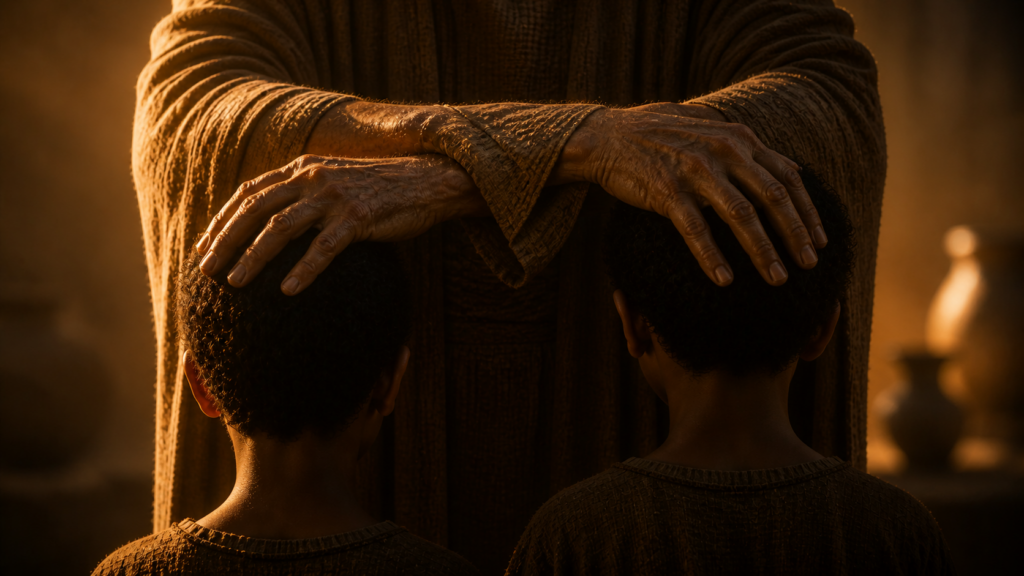
Genesis 48 is the chapter of the crossed hands. Joseph, hearing that his father is failing, brings his two Egyptian-born sons, Manasseh and Ephraim, to Jacob’s bedside. The patriarch sits up on the bed and does two extraordinary things. First, he adopts Joseph’s sons into the patriarchal line, ranking them with Reuben and Simeon as full tribal heads. Second, he crosses his hands at the moment of blessing: his right hand on Ephraim (the younger) and his left on Manasseh (the elder), inverting Joseph’s careful placement. Joseph protests; Jacob refuses to switch them. I know, my son, I know.
The chapter is, in narrative form, the patriarchal cycle’s deepest commentary on the inversion of primogeniture. The Hebrew Bible has been doing this from the beginning. Abel over Cain, Isaac over Ishmael, Jacob over Esau, Judah/Joseph over Reuben, Perez over Zerah, and now Ephraim over Manasseh. The pattern is consistent: the younger is preferred. The chapter records the patriarch (himself the second-born who took the blessing) executing the same pattern he himself once received, this time deliberately and openly rather than by deception.
The chapter is also the patriarchal cycle’s most striking theological self-disclosure on Jacob’s part. He names God three ways in his blessing: the God before whom my fathers Abraham and Isaac walked; the God who has been my shepherd all my life to this day; the angel who has redeemed me from all evil. The patriarch, looking back over a hundred and forty-seven years, names what God has been to him in three distinct theological registers. The chapter is one of the cycle’s deepest old-man theology speeches.
A · Genesis 48:1–7 · Joseph called to the bedside; Ephraim and Manasseh adopted
¹ After these things, someone said to Joseph, “Behold, your father is sick.” He took with him his two sons, Manasseh and Ephraim. ² Someone told Jacob, and said, “Behold, your son Joseph comes to you,” and Israel strengthened himself, and sat on the bed. ³ Jacob said to Joseph, “God Almighty appeared to me at Luz in the land of Canaan, and blessed me, ⁴ and said to me, ‘Behold, I will make you fruitful, and multiply you, and I will make of you a company of peoples, and will give this land to your offspring after you for an everlasting possession.’ ⁵ Now your two sons, who were born to you in the land of Egypt before I came to you into Egypt, are mine; Ephraim and Manasseh, even as Reuben and Simeon, will be mine. ⁶ Your offspring, whom you become the father of after them, will be yours. They will be called after the name of their brothers in their inheritance. ⁷ As for me, when I came from Paddan, Rachel died beside me in the land of Canaan on the way, when there was still some distance to come to Ephrath, and I buried her there on the way to Ephrath (also called Bethlehem).” (Genesis 48:1–7, World English Bible)
- The chapter opens with Joseph called to the bedside. Behold, your father is sick. The Hebrew hineh avikha choleh, “behold, your father is ill,” is the patriarchal-deathbed vocabulary. Joseph takes both sons. The chapter is recording, with characteristic narrative economy, that Joseph has anticipated what is coming. He brings the children because he wants the patriarchal blessing for them.
- Israel strengthened himself, and sat on the bed (verse 2). The Hebrew vayitchazzeq Yisrael, “and Israel strengthened himself,” uses the verb chazaq (to be strong, to summon strength). The patriarch is mustering for one more act. The chapter is recording, with characteristic restraint, the physical effort the dying patriarch makes to receive his son. He is not strong; he gathers what strength he has left.
- God Almighty appeared to me at Luz in the land of Canaan (verse 3). The patriarch begins the speech with theology. El Shaddai (God Almighty) is the patriarchal name for God in the Genesis 17, 28, and 35 traditions. Luz is the older name for Bethel, where Jacob saw the ladder in chapter 28 and where God renamed him in chapter 35. The chapter is recording the patriarch’s deliberate framing: what is about to happen at the bedside is grounded in the theophanies of the past.
Influence callout: Walter Brueggemann
Brueggemann’s reading of the patriarchal speech here names it as the cycle’s clearest pattern of blessing-from-memory. Jacob is not blessing on his own authority. He is rooting the present blessing in the divine speech he received decades ago at Luz. The Hebrew Bible’s blessing tradition is consistently this shape: the blessing carries forward what God has already promised, the elder reaches back into the divine word and extends it to the younger. Brueggemann argues that the chapter is teaching, in narrative form, what the Hebrew Bible understands blessing to be. It is not magic; it is not autonomous patriarchal authority; it is the elder reaching back into the divine word and applying it to the younger.
- Now your two sons, who were born to you in the land of Egypt before I came to you into Egypt, are mine (verse 5). The Hebrew li-hem, “they are mine,” is direct adoption language. Ephraim and Manasseh, even as Reuben and Simeon, will be mine. The chapter is recording the formal patriarchal adoption of Joseph’s two sons into the same rank as the firstborn and the second-born of Jacob’s own sons. The pair will count as full tribal heads.
Influence callout: Marty Solomon
Solomon’s reading of the adoption names it as the patriarchal narrative’s quiet structural inversion of Joseph’s missing tribal share. The Hebrew Bible’s tribes will be twelve, but the list will not include a tribe of Joseph and the list will not always include the same twelve. The Levites will be set apart and not counted in the land allotment. Joseph’s portion will be filled by Ephraim and Manasseh as separate tribes. Solomon argues that the chapter is doing the structural arithmetic in advance. By adopting Ephraim and Manasseh as full tribes, Jacob is making Joseph the only son of Jacob who effectively gets a double portion. The firstborn’s share, denied to Reuben for the Bilhah incident (Genesis 35:22; 49:3-4), is being given to Joseph through the adoption of his two sons.
- Your offspring, whom you become the father of after them, will be yours. They will be called after the name of their brothers in their inheritance (verse 6). The clause clarifies the scope. Only Manasseh and Ephraim are adopted; any future sons of Joseph will inherit through the two adopted sons. The Hebrew Bible records no future sons of Joseph, but the legal structure is laid down.
- As for me, when I came from Paddan, Rachel died beside me in the land of Canaan on the way (verse 7). The patriarch’s mention of Rachel’s death at this moment is one of the chapter’s most touching details. He is adopting her two grandsons (Manasseh and Ephraim are her son Joseph’s sons) into the patriarchal line. The grief of her death (recorded in Genesis 35:16-19) is, for the patriarch, still close. The chapter is recording, with characteristic narrative honesty, that the patriarch’s adoption of the grandsons is partly a way of giving Rachel a tribal share she did not live to receive.
Influence callout: Tim Mackie
Mackie’s reading of the Rachel-mention names it as the cycle’s quiet pastoral honesty. Jacob, adopting Joseph’s sons, mentions the death of their grandmother in the same breath. He is, in this small detail, naming what the adoption means to him personally. The chapter is recording, in the patriarchal vocabulary, what every grieving grandparent knows: the grandchildren are part of the long extension of the lost beloved. Mackie argues that the Hebrew Bible is consistently honest about the personal grief that runs through theological-juridical actions. Jacob’s adoption is a legal act, and it is also an act of love for a wife he buried decades earlier.
B · Genesis 48:8–16 · The crossed hands and the threefold naming of God
⁸ Israel saw Joseph’s sons, and said, “Who are these?” ⁹ Joseph said to his father, “They are my sons, whom God has given me here.” He said, “Please bring them to me, and I will bless them.” ¹⁰ Now the eyes of Israel were dim for age, so that he couldn’t see well. Joseph brought them near to him; and he kissed them, and embraced them. ¹¹ Israel said to Joseph, “I didn’t think I would see your face, and behold, God has let me see your offspring also.” ¹² Joseph brought them out from between his knees, and he bowed himself with his face to the earth. ¹³ Joseph took them both, Ephraim in his right hand toward Israel’s left hand, and Manasseh in his left hand toward Israel’s right hand, and brought them near to him. ¹⁴ Israel stretched out his right hand, and laid it on Ephraim’s head, who was the younger, and his left hand on Manasseh’s head, guiding his hands knowingly, for Manasseh was the firstborn. ¹⁵ He blessed Joseph, and said, “The God before whom my fathers Abraham and Isaac walked, the God who has fed me all my life long to this day, ¹⁶ the angel who has redeemed me from all evil, bless the lads, and let my name be named on them, and the name of my fathers Abraham and Isaac. Let them grow into a multitude in the middle of the earth.” (Genesis 48:8–16, World English Bible)
- Israel saw Joseph’s sons, and said, “Who are these?” (verse 8). The Hebrew vayar Yisrael et-bnei Yosef vayomer mi-eleh, “and Israel saw the sons of Joseph and said, who are these?”, is poignant. The patriarch’s eyes are dim. He knows his son but cannot quite see the boys. The question is the patriarch asking for confirmation: is this who I think it is?
- Now the eyes of Israel were dim for age, so that he couldn’t see well (verse 10). The chapter is recording, with characteristic narrative honesty, the patriarch’s diminishment. The detail is also a deliberate verbal echo of Genesis 27:1, where Isaac’s eyes were dim from old age and Jacob deceived him to take Esau’s blessing. The chapter is signaling, by the verbal echo, that the patriarch who once exploited a blind father’s blindness is himself now the blind patriarch giving the blessing. This time, the blindness will be honest. He sees by knowledge, not by eye.
Influence callout: Marty Solomon
Solomon’s reading of the dim-eyes detail names it as one of the chapter’s most theologically pointed echoes. Genesis 27 had a deceiving Jacob standing before a dim-eyed Isaac, taking the blessing meant for Esau. Genesis 48 has a dim-eyed Jacob receiving Joseph’s sons, knowingly inverting the order of the blessing. Solomon argues that the Hebrew Bible is doing structural theology in the parallel. The patriarch who deceived a blind father is himself the blind patriarch who refuses to be deceived. The chapter is recording that Jacob, at the end of his life, is the steward of the same divine pattern that once worked through deception against him. He is, this time, doing it with eyes-of-knowledge open.
- Israel said to Joseph, “I didn’t think I would see your face, and behold, God has let me see your offspring also” (verse 11). The Hebrew re’oh paneicha lo filalti, “I had not expected to see your face,” is the patriarch naming what his expectation had been. He had grieved Joseph as dead. He has now not only seen his son’s face; he is seeing his son’s sons. The chapter is recording, with characteristic restraint, the abundance of the patriarch’s late-life mercies.
- Verse 13 records Joseph’s careful placement. Joseph took them both, Ephraim in his right hand toward Israel’s left hand, and Manasseh in his left hand toward Israel’s right hand. Joseph is being precise. The right hand is the hand of greater blessing in the Hebrew Bible. He places the elder son (Manasseh) where the right hand will fall and the younger son (Ephraim) where the left hand will fall.
- Israel stretched out his right hand, and laid it on Ephraim’s head, who was the younger, and his left hand on Manasseh’s head, guiding his hands knowingly, for Manasseh was the firstborn (verse 14). The Hebrew sikkel et-yadav, “he crossed his hands,” is the chapter’s central physical action. The verb sakal in the Piel form here can mean to cross or to do something deliberately with skill. Either reading names the patriarch’s deliberate inversion. He is not making a mistake. He is choosing.
Word study: sakal (שָׂכַל) in the Piel, “to act with insight, to cross deliberately”
The Hebrew verb in 48:14 (sikkel et-yadav). The Piel form carries the sense of acting with deliberate insight or skill, sometimes glossed as crossing (the older translation) but more accurately acting knowingly, with insight. The chapter is recording, with one verb, that Jacob’s hand-crossing is not a mistake but a deliberate act of patriarchal insight. The same root will be used in the wisdom literature for the wise person who acts with discernment (maskil). The patriarch’s blindness has not removed his insight; the insight is what makes the blessing work.
- The blessing itself (verses 15 to 16) is one of the chapter’s most theologically dense passages. The patriarch names God three ways: – The God before whom my fathers Abraham and Isaac walked. – The God who has fed me all my life long to this day. – The angel who has redeemed me from all evil.
- The first naming is genealogical: God is the God of the patriarchal line. The Hebrew Elohim asher hithallechu avotai lefanav, “the God before whom my fathers walked,” is the same construction the patriarchal narrative has used for the covenant God. This is the inherited name.
- The second naming is autobiographical: the God who has fed me all my life long to this day. The Hebrew ha-ro’eh oti me’odi, “the one shepherding me from my youth,” uses the Hebrew word for shepherd (ro’eh). The chapter is recording, with characteristic Hebrew Bible care, the first explicit appearance of the divine shepherd vocabulary. The patriarch is naming God as the one who has herded him through one hundred and forty-seven years. The image will run forward through the Psalter (the LORD is my shepherd, Psalm 23) and into the Gospel of John (I am the good shepherd).
Influence callout: Brian Zahnd
Zahnd’s reading of the God who has shepherded me all my life names it as one of the chapter’s most quietly important contributions to biblical theology. The patriarchal narrative has been describing a God who guides, who promises, who appears in dreams, who wrestles. Jacob’s deathbed naming consolidates all of those into one image: the shepherd. Zahnd argues that the chapter is recording, in the patriarchal vocabulary, the seed of the entire Hebrew Bible’s pastoral imagination. The God who walks ahead of the flock, finds water, drives off predators, carries the lambs. The patriarch is the first speaker in the Hebrew Bible to name God this way. The image will be picked up by every shepherd-prophet that follows.
- The third naming is most striking: the angel who has redeemed me from all evil. The Hebrew ha-malach ha-go’el oti mikkol-ra, “the angel who is redeeming me from all evil,” uses two theologically loaded words. Malach (angel, messenger) is the patriarchal-narrative term for divine appearances that are sometimes God’s own presence and sometimes a distinct messenger. Go’el (redeemer) is the Hebrew Bible’s kinship-redemption vocabulary: the family member with the right and the obligation to buy back the lost.
Word study: go’el (גֹּאֵל), “redeemer, kinsman who has the right to buy back”
The Hebrew word for the family member in ancient Israel who had the legal right and obligation to buy back land that had been lost, to free a relative who had become enslaved, or to avenge a kinsman’s murder. The chapter is recording, in 48:16, the first patriarchal use of this term in connection with God. Jacob is naming God as a go’el: the one who has bought back what was lost across his life. The category will run forward through the book of Ruth (where Boaz acts as Naomi’s go’el), into Job’s deepest cry (I know that my redeemer lives, Job 19:25), into the prophetic vocabulary (Isaiah’s redeemer of Israel), and into the New Testament’s Christology. The first use of go’el applied to God in the Hebrew Bible is in this chapter.
Influence callout: N.T. Wright
Wright’s reading of the angel who has redeemed me from all evil names it as one of the patriarchal narrative’s most theologically loaded phrases. The patriarch is using the kinship-redemption vocabulary for God. The God who has bought him back from his various entrapments (the deception of Laban, the threat of Esau, the Shechem catastrophe, the Joseph grief) has acted, in the patriarch’s mind, as the family member with the right to redeem. Wright argues that the chapter is laying the foundation for the Hebrew Bible’s most distinctive theological category: God as the one who pays the price to bring his people back. The Christology of the New Testament will pick up this category and read it forward through the cross. The first patriarch to call God a redeemer is Jacob, on his deathbed, with crossed hands, blessing his grandsons.
C · Genesis 48:17–22 · The protest and the doubled portion
¹⁷ When Joseph saw that his father laid his right hand on the head of Ephraim, it displeased him. He held up his father’s hand, to remove it from Ephraim’s head to Manasseh’s head. ¹⁸ Joseph said to his father, “Not so, my father, for this is the firstborn. Put your right hand on his head.” ¹⁹ His father refused, and said, “I know, my son, I know. He also will become a people, and he also will be great. However, his younger brother will be greater than he, and his offspring will become a multitude of nations.” ²⁰ He blessed them that day, saying, “Israel will bless in you, saying, ‘God make you as Ephraim and as Manasseh,’” and he set Ephraim before Manasseh. ²¹ Israel said to Joseph, “Behold, I am dying, but God will be with you, and bring you again to the land of your fathers. ²² Moreover I have given to you one portion above your brothers, which I took out of the hand of the Amorite with my sword and with my bow.” (Genesis 48:17–22, World English Bible)
- When Joseph saw that his father laid his right hand on the head of Ephraim, it displeased him (verse 17). The Hebrew vayera be’einav, “and it was evil in his eyes,” is direct. Joseph is not just confused; he is upset. He had positioned the boys carefully. He thought his father had made a mistake.
- Not so, my father, for this is the firstborn. Put your right hand on his head (verse 18). The Hebrew lo-khen avi, “not so, my father,” is one of the chapter’s most touching protests. Joseph is correcting his father with the deference due a dying patriarch but with the directness of a son who thinks his father has gotten it wrong.
- His father refused, and said, “I know, my son, I know” (verse 19). The Hebrew yadati v’ni yadati, “I know, my son, I know,” is the chapter’s most heartbreaking line. The patriarch is not confused. He is not blind to which boy is which. He has known the whole time. The doubled yadati is the patriarch’s gentle assertion of his own knowledge against his son’s protest.
Influence callout: Walter Brueggemann
Brueggemann’s reading of I know, my son, I know names it as one of the patriarchal narrative’s most pastorally weighty sentences. The patriarch, who himself was the second-born and took the blessing meant for the firstborn, is now the giver of the same kind of blessing. He knows what he is doing. He is not deceiving anyone. He is recognizing the same divine pattern he himself once received and refusing to switch the hands. Brueggemann argues that the chapter is teaching, in narrative form, the Hebrew Bible’s deepest teaching about divine election. The pattern is consistent. The younger over the elder. God’s choice is not domesticated to primogeniture. The patriarch, who once benefited from this pattern, has lived long enough to be its conscious steward.
- He also will become a people, and he also will be great. However, his younger brother will be greater than he, and his offspring will become a multitude of nations. The patriarch is generous. Manasseh will not be cursed; Manasseh will be great. Ephraim will be greater. The chapter is recording, with characteristic Hebrew Bible care, that the inversion of primogeniture does not erase the elder; it just refuses to make seniority decisive.
Pushback note
Some readings have read the inversion of Manasseh and Ephraim as a kind of cosmic favoritism that flattens the elder into nothing. The Hebrew is more careful. Manasseh will be a people; Manasseh will be great. The chapter is recording that the Hebrew Bible’s pattern of younger-over-elder does not erase the elder; it refuses to let seniority be the decisive thing. Both will be tribes; both will inherit; the younger will be larger. The Hebrew Bible has been making this point in narrative form throughout Genesis.
- Israel will bless in you, saying, “God make you as Ephraim and as Manasseh” (verse 20). The Hebrew bekha yevarech Yisrael lemor, “by you Israel will bless, saying,” names the formula the chapter is laying down for future Israelite practice. The two boys will become the proverbial blessing-formula for sons. To this day in observant Jewish homes on Friday nights, the blessing of the sons uses this formula: May God make you like Ephraim and Manasseh. The chapter is recording the origin of one of Judaism’s longest-running family rituals.
Influence callout: Marty Solomon
Solomon’s reading of Israel will bless in you names it as the chapter’s quiet legacy. The two boys, born in Egypt, half-Egyptian by their mother, adopted into the patriarchal line on the deathbed, become the formula by which Israelite fathers bless their sons forever. Solomon argues that the chapter is recording, in narrative form, what the Hebrew Bible understands the family blessing to be. It is not magic; it is not generic; it is rooted in a specific patriarchal scene where two specific boys received the inheritance. Every Friday night blessing in the Jewish tradition reaches back into Genesis 48 and re-enacts the patriarchal hands.
- Behold, I am dying, but God will be with you, and bring you again to the land of your fathers (verse 21). The Hebrew hineh anokhi met, “behold, I am dying,” is the patriarchal-deathbed self-naming. The patriarch knows he is dying. The promise (God will be with you, and bring you again to the land of your fathers) is the deathbed echo of the Beer-sheba theophany of Genesis 46:4. The chapter is recording the patriarch passing the descent-and-return promise on to the next generation. The exodus theology is being seeded in the patriarchal blessing.
- Moreover I have given to you one portion above your brothers, which I took out of the hand of the Amorite with my sword and with my bow (verse 22). The Hebrew shechem achad al-acheicha, “one shoulder/portion above your brothers,” puns on the place name Shechem, the city associated with the Genesis 34 violence. The patriarch is granting Joseph the city or region of Shechem as an additional inheritance. The reference to the Amorite and my sword and my bow is one of the patriarchal narrative’s most cryptic notes. Genesis 34 records the violence committed by Simeon and Levi (which Jacob later disowns in Genesis 49:5-7); no other Genesis passage describes Jacob taking territory by his own sword. The note may refer to a tradition not preserved in the canonical Genesis text. The Hebrew Bible does not always tell us everything.
Influence callout: Ray Vander Laan
Vander Laan’s reading of the Shechem-portion verse names it as the patriarchal narrative’s quiet preparation for Joshua 24, where the bones of Joseph will be buried at Shechem, in the portion of ground which Jacob bought from the sons of Hamor (Joshua 24:32). Vander Laan argues that the chapter is laying down, in cryptic patriarchal language, the seed of one of the Pentateuch’s most theologically loaded geographic markers. Shechem is the place where Israel will renew the covenant under Joshua, where Joseph’s bones will be buried, where the kingdom will eventually split. The patriarch is, in this verse, signaling a place that will carry the family’s story forward through the conquest, the judges, the divided monarchy, and the prophets. The chapter is reaching, in its closing verse, into all of biblical history.
Reflection prompts
- Jacob, with his eyes dim from age, crosses his hands at the moment of blessing. Joseph protests; the patriarch refuses. I know, my son, I know. Where in your life are you currently being asked to carry forward a divine pattern that does not match the cultural assumption about who deserves what, and what does it mean to act with the patriarch’s I know rather than with apologetic hesitation?
- Jacob names God three ways: the God of his fathers, the shepherd of his life, the angel who has redeemed him from all evil. The three names cover genealogy, autobiography, and rescue. Where in your life are you currently able to name God in each of these three registers, and which of them is most absent or most full at the moment?
- The two boys born in Egypt to a half-Egyptian mother are adopted into the patriarchal line and become the formula by which Israel will bless its sons forever. The most outsider-located children become the model of inheritance. Where in your life is the supposed-outsider proving to be the heir, and what does it mean to read your family’s lineage by who has been adopted in rather than only by who was born in?