
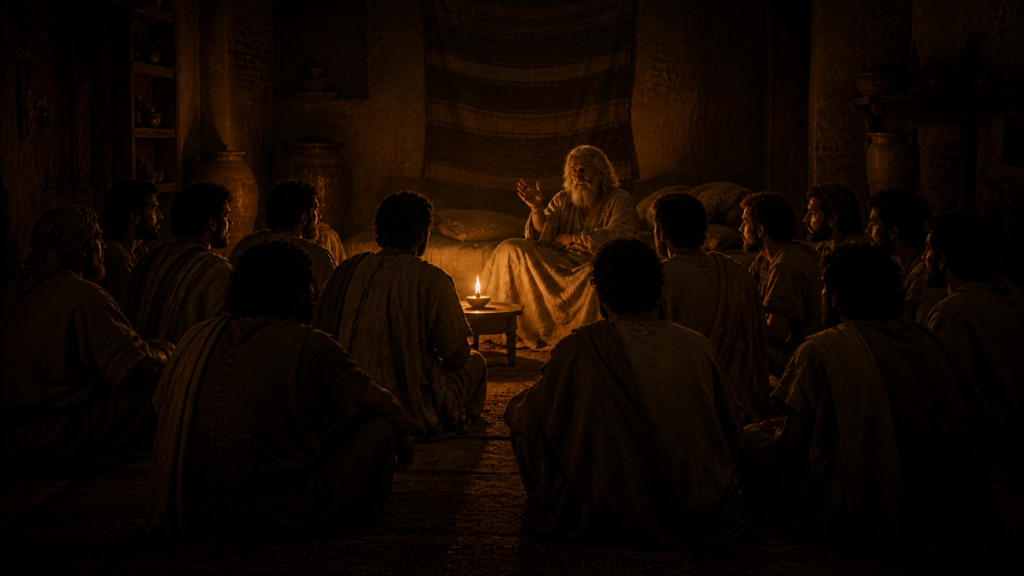
Genesis 49 is the patriarchal poem. After the prose adoption of Manasseh and Ephraim in chapter 48, Jacob calls all twelve of his sons to the bedside and pronounces a poetic blessing-and-prophecy over each. The chapter shifts genre. The Joseph cycle has been narrative for thirteen chapters; the patriarch’s final speech is poetry. The Hebrew is dense, ancient, sometimes obscure, and is among the oldest poetic material in the Hebrew Bible.
The poem is structured by birth order, with deliberate adjustments. Reuben (the firstborn) is named first but disqualified for the Bilhah incident of Genesis 35:22. Simeon and Levi (the next two) are paired and condemned for the violence at Shechem in Genesis 34. Judah, the fourth-born, is the first to receive a positive blessing; he is given the lion, the scepter, and one of the Hebrew Bible’s most messianically loaded oracles (until Shiloh comes). Joseph receives the longest individual blessing, structured around the fruitful bough by the spring and the threefold naming of God (the Mighty One of Jacob, the Shepherd, the Stone of Israel, the Almighty). Benjamin closes the poem as a ravenous wolf. The other tribes (Zebulun, Issachar, Dan, Gad, Asher, Naphtali) receive shorter, often gnomic, blessings.
The chapter then closes the patriarchal narrative. Jacob commands his sons to bury him in the cave of Machpelah with Abraham, Sarah, Isaac, Rebekah, and Leah. He draws his feet up into the bed and is gathered to his people. The Hebrew Bible’s first patriarchal generation is closing. The chapter is the formal end of the patriarchal era and the seeding of every tribe that will appear in the Pentateuchal and historical books.
A · Genesis 49:1–12 · The opening, Reuben’s disqualification, Simeon and Levi cursed, Judah blessed
¹ Jacob called to his sons, and said: “Gather yourselves together, that I may tell you that which will happen to you in the days to come. ² Assemble yourselves, and hear, you sons of Jacob. Listen to Israel, your father. ³ Reuben, you are my firstborn, my might, and the beginning of my strength, excelling in dignity, and excelling in power. ⁴ Boiling over like water, you shall not excel; because you went up to your father’s bed, then defiled it. He went up to my couch. ⁵ Simeon and Levi are brothers. Their swords are weapons of violence. ⁶ My soul, don’t come into their council. My glory, don’t be united to their assembly; for in their anger they killed men. In their self-will they hamstrung cattle. ⁷ Cursed be their anger, for it was fierce; and their wrath, for it was cruel. I will divide them in Jacob, and scatter them in Israel. ⁸ Judah, your brothers will praise you. Your hand will be on the neck of your enemies. Your father’s sons will bow down before you. ⁹ Judah is a lion’s cub. From the prey, my son, you have gone up. He stooped down, he crouched as a lion, as a lioness. Who will rouse him up? ¹⁰ The scepter will not depart from Judah, nor the ruler’s staff from between his feet, until he comes to whom it belongs. To him will the obedience of the peoples be. ¹¹ Binding his foal to the vine, his donkey’s colt to the choice vine; he has washed his garments in wine, his robes in the blood of grapes. ¹² His eyes will be red with wine, his teeth white with milk.” (Genesis 49:1–12, World English Bible)

- Gather yourselves together, that I may tell you that which will happen to you in the days to come (verse 1). The Hebrew be’acharit ha-yamim, “in the latter days” or “in the days to come,” is the chapter’s prophetic-horizon vocabulary. The phrase will become foundational in the Hebrew Bible for the eschatological future. The patriarch is naming his speech as oracle, not as autobiography.
Influence callout: Walter Brueggemann
Brueggemann’s reading of be’acharit ha-yamim names it as the chapter’s deliberate prophetic framing. The patriarch is not just reading character; he is announcing what the tribes will become. Brueggemann argues that the chapter is one of the Hebrew Bible’s earliest prophetic-poetry pieces, working in the same genre that will later be picked up by Balaam in Numbers 24, by Moses in Deuteronomy 33, and by the writing prophets. The chapter is the first major use of latter days vocabulary in the Hebrew Bible. The category that will eventually cover Daniel’s visions, the Hebrew Bible’s eschatology, and the New Testament’s reading of the messianic age is being introduced here on a deathbed.
- Reuben, you are my firstborn, my might, and the beginning of my strength (verse 3). The patriarch begins with the firstborn. The Hebrew bekhori atah, kochi vereshit oni, “you are my firstborn, my strength and the firstfruits of my vigor,” names the proper status of the firstborn. The expectation has been set up: Reuben should receive the firstborn’s double portion.
- Boiling over like water, you shall not excel; because you went up to your father’s bed, then defiled it (verse 4). The Hebrew pachaz ka-mayim al-totar, “unstable as water, you shall not excel,” disqualifies him. The reference is to Genesis 35:22 (Reuben went and lay with Bilhah his father’s concubine). The chapter is recording the patriarch’s long-delayed verdict on that incident. The double portion will not go to Reuben; it has gone, through chapter 48, to Joseph.
Influence callout: Marty Solomon
Solomon’s reading of Reuben’s disqualification names it as one of the chapter’s most theologically pointed moments. The Bilhah incident in Genesis 35:22 was reported in the narrative without comment. Jacob said nothing at the time. The Hebrew Bible let the incident stand unresolved through fourteen chapters of the Joseph cycle. Now, on the deathbed, the patriarch finally speaks. Solomon argues that the chapter is teaching the Hebrew Bible’s distinctive pattern of delayed moral reckoning. The patriarch did not erupt at the time; he did not pretend the incident did not matter; he held the verdict until the deathbed and then delivered it. The cycle is recording, in narrative form, the kind of long, slow, considered moral assessment that the Hebrew Bible consistently models.
- Simeon and Levi are brothers. Their swords are weapons of violence (verse 5). The two are paired; they receive joint condemnation. The Hebrew kelei chamas mekheroteihem, “instruments of violence are their swords/wares,” echoes the Genesis 34 narrative where Simeon and Levi slaughtered the men of Shechem after the rape of Dinah.
- Cursed be their anger, for it was fierce; and their wrath, for it was cruel. I will divide them in Jacob, and scatter them in Israel (verse 7). The chapter is recording, with characteristic narrative honesty, that Simeon and Levi will not inherit a contiguous tribal territory. The Hebrew achaleqem be-Yaakov, “I will divide them in Jacob,” predicts what later geography will bear out: the tribe of Simeon will be absorbed into Judah’s territory; the tribe of Levi will be scattered as priests through all the tribes without an inheritance of their own. The chapter is doing predictive geography in poetic form.
Pushback note
Some readings have softened the Levi-curse by noting that Levi’s later priestly role looks like an honor. The Hebrew is not soft. The verdict on Levi here is unambiguously negative: scattering is a curse in this poem. The later development, where Levi’s zeal at Sinai (Exodus 32) and Phinehas’s zeal at Baal-peor (Numbers 25) result in priestly election, is the Hebrew Bible’s surprising reversal. The Levi who is cursed here ends up as the priestly tribe. The chapter is honest about the starting point: the curse is real. The reversal is the gift, not the original verdict.
- Judah, your brothers will praise you. Your hand will be on the neck of your enemies. Your father’s sons will bow down before you (verse 8). The chapter pivots. The first three sons have been disqualified. The fourth-born receives the firstborn’s preeminence in everything except the double portion (which has gone to Joseph). Judah will be the leader.
Influence callout: N.T. Wright
Wright’s reading of the Judah blessing names it as the most theologically loaded passage in the chapter. The Hebrew Bible’s entire Davidic and messianic theology is rooted here. Judah will receive the scepter, the lion, and the oracle. Every later passage about the rule of David, the messianic prophecies of the prophets, the New Testament’s identification of Jesus as the lion of the tribe of Judah (Revelation 5:5), reaches back into this passage. Wright argues that the chapter is the seed of biblical Christology in patriarchal poetry. The cycle has been preparing this through Judah’s role in Genesis 38, his speech in Genesis 44, and his leadership in Genesis 46. The deathbed blessing makes the trajectory explicit.
- Judah is a lion’s cub. The Hebrew gur aryeh Yehudah, “a lion’s whelp is Judah,” is the chapter’s most famous image. The lion will become Judah’s tribal symbol; David will be associated with Judah’s lion; the New Testament will read Christ as the lion. The chapter is laying down the iconography in three Hebrew words.
- The scepter will not depart from Judah, nor the ruler’s staff from between his feet, until he comes to whom it belongs. To him will the obedience of the peoples be (verse 10). The Hebrew is one of the most debated verses in the Hebrew Bible. The phrase ad ki-yavo Shilo, “until Shiloh comes,” has been read as a place name (Shiloh, the early Israelite shrine), as a personal name (Shiloh, a messianic figure), or as a phrase meaning until that which belongs to him comes. Most modern translations follow the third reading. The Septuagint and Targums read it messianically.
Influence callout: Tim Mackie
Mackie’s reading of the Shiloh phrase names it as one of the chapter’s most theologically loaded ambiguities. The Hebrew is genuinely uncertain; the messianic reading is supported by the Septuagint and the Targumic tradition; the New Testament reads the verse messianically (Hebrews 7:14, Revelation 5:5). Mackie argues that the Hebrew Bible itself is laying the seed of a coming-king tradition that will be picked up by the prophets (Isaiah 9, 11; Micah 5; Zechariah 9) and that will eventually shape the messianic expectations of Second Temple Judaism. The chapter is doing theology in deliberate poetic ambiguity. The patriarch is naming a kingship that is coming and is not yet here.
- Binding his foal to the vine, his donkey’s colt to the choice vine; he has washed his garments in wine, his robes in the blood of grapes (verse 11). The Hebrew imagery is messianic-pastoral. So much wine is produced in Judah’s territory that the donkey can be tied to a vine without anyone caring; the garments are washed in wine because there is so much of it. The chapter is recording, in idyllic pastoral imagery, the abundance of Judah’s territorial future. The image of the blood of grapes will be picked up by the New Testament’s eucharistic vocabulary.
B · Genesis 49:13–21 · The middle tribes (Zebulun, Issachar, Dan, Gad, Asher, Naphtali)
¹³ “Zebulun will dwell at the haven of the sea. He will be for a haven of ships. His border will be on Sidon. ¹⁴ Issachar is a strong donkey, lying down between the saddlebags. ¹⁵ He saw a resting place, that it was good, the land, that it was pleasant. He bows his shoulder to the burden, and becomes a servant doing forced labor. ¹⁶ Dan will judge his people, as one of the tribes of Israel. ¹⁷ Dan will be a serpent on the trail, an adder in the path, that bites the horse’s heels, so that his rider falls backward. ¹⁸ I have waited for your salvation, LORD. ¹⁹ A troop will press on Gad, but he will press on their heel. ²⁰ Asher’s food will be rich. He will produce royal dainties. ²¹ Naphtali is a doe set free, who bears beautiful fawns.” (Genesis 49:13–21, World English Bible)
- Zebulun will dwell at the haven of the sea. He will be for a haven of ships (verse 13). The Hebrew Zevulun le-chof yamim yishkon, “Zebulun will dwell at the shore of seas,” is geographic. Zebulun’s tribal territory will run toward the coast. The chapter is doing predictive tribal geography.
- Issachar is a strong donkey, lying down between the saddlebags (verse 14). The Hebrew Yissaschar chamor garem, “Issachar is a strong-boned donkey,” is character description. The image is of an agriculturally productive tribe that will trade independence for security: He saw a resting place, that it was good … He bows his shoulder to the burden, and becomes a servant doing forced labor. The chapter is recording, with characteristic Hebrew Bible realism, the political price Issachar’s territorial fertility will cost.
- Dan will judge his people (verse 16). The Hebrew Dan yadin amo, “Dan will judge his people,” puns on Dan’s name (which means judge). The tribe will produce judges, including, in the Hebrew Bible’s later record, Samson. The serpent imagery in verse 17 is more cryptic. The tribe will use stealth and asymmetric tactics rather than open battle.
- I have waited for your salvation, LORD (verse 18). This single line interrupts the tribal blessings with a personal prayer. The Hebrew li-shu’atekha qiviti YHWH, “for your salvation I have waited, YHWH,” is the patriarch’s deathbed cry. The chapter is recording, in one short line, the aged patriarch’s personal posture as he speaks the oracles. He is waiting for God’s salvation. Whatever the tribes will become, the salvation is what he is hoping for.
Influence callout: Brian Zahnd
Zahnd’s reading of I have waited for your salvation, LORD names it as one of the chapter’s most quietly important verses. The patriarch, in the middle of pronouncing predictions about his sons, breaks frame and prays. The interruption is not random. Zahnd argues that the chapter is recording, in a single Hebrew sentence, the patriarchal hope that runs underneath the entire blessing. The tribes will be what they will be; the salvation the patriarch is waiting for is something larger. The line will be picked up later in the Hebrew Bible’s hope tradition: I waited patiently for the LORD (Psalm 40:1), waiting for the consolation of Israel (Luke 2:25). The patriarch on his deathbed is the first speaker in this lineage.
- The middle tribes (Gad, Asher, Naphtali) receive shorter blessings. Gad’s name puns on the Hebrew word for troop (gedud); the line predicts military pressure but final victory. Asher’s blessing names agricultural prosperity. Naphtali’s doe set free names tribal speed and freedom. The chapter is doing rapid character description in tribal terms.
C · Genesis 49:22–33 · Joseph blessed, Benjamin named, the burial command, the patriarch’s death
²² “Joseph is a fruitful vine, a fruitful vine by a spring. His branches run over the wall. ²³ The archers have severely grieved him, shot at him, and persecuted him: ²⁴ But his bow remained strong. The arms of his hands were made strong, by the hands of the Mighty One of Jacob, (from there is the shepherd, the stone of Israel), ²⁵ even by the God of your father, who will help you, by the Almighty, who will bless you, with blessings of heaven above, blessings of the deep that lies below, blessings of the breasts, and of the womb. ²⁶ The blessings of your father have prevailed above the blessings of your ancestors, above the boundaries of the ancient hills. They will be on the head of Joseph, on the crown of the head of him who is separated from his brothers. ²⁷ Benjamin is a ravenous wolf. In the morning he will devour the prey. At evening he will divide the plunder.” ²⁸ All these are the twelve tribes of Israel, and this is what their father spoke to them, and blessed them. He blessed everyone according to his own blessing. ²⁹ He instructed them, and said to them, “I am to be gathered to my people. Bury me with my fathers in the cave that is in the field of Ephron the Hittite, ³⁰ in the cave that is in the field of Machpelah, which is before Mamre, in the land of Canaan, which Abraham bought with the field from Ephron the Hittite as a burial place. ³¹ There they buried Abraham and Sarah, his wife. There they buried Isaac and Rebekah, his wife, and there I buried Leah: ³² the field and the cave that is in it, which was purchased from the children of Heth.” ³³ When Jacob finished charging his sons, he gathered up his feet into the bed, breathed his last breath, and was gathered to his people. (Genesis 49:22–33, World English Bible)
- Joseph’s blessing (verses 22 to 26) is the longest in the chapter. Joseph is a fruitful vine (Hebrew ben porat Yosef, with a debated translation that could mean fruitful son or young bull). The image is agricultural abundance: branches running over the wall, fruitfulness extending beyond ordinary limits.
- The archers have severely grieved him, shot at him, and persecuted him: But his bow remained strong (verses 23 to 24). The chapter is recording, in retrospective poetic compression, what the Joseph cycle has been narrating for fourteen chapters. The brothers attacked him; Potiphar’s wife attacked him; the prison years attacked him. His bow remained strong. The patriarch is naming Joseph’s resilience under sustained adversity.
- The threefold naming of God in verses 24 to 25 is the chapter’s most theologically loaded passage: – The Mighty One of Jacob (Hebrew avir Yaakov). – The Shepherd, the Stone of Israel (Hebrew ro’eh even Yisrael). – The God of your father, who will help you; the Almighty, who will bless you (Hebrew El avikha … ve’et Shaddai).
Word study: avir Yaakov (אֲבִיר יַעֲקֹב), “the Mighty One of Jacob”
The Hebrew title avir names strength, sometimes connected to a strong bull or warrior. The phrase avir Yaakov (the Mighty One of Jacob) is a divine title that occurs in this verse, in Isaiah 49:26, in Psalm 132:2, and in a few other places. The chapter is laying down a divine title that the prophets will pick up. The patriarchal narrative is the seedbed for the Hebrew Bible’s divine vocabulary, including the titles by which God will be invoked through the Psalter and the prophets.
Word study: ro’eh even Yisrael (רֹעֵה אֶבֶן יִשְׂרָאֵל), “the Shepherd, the Stone of Israel”
The compound divine title in 49:24, “the Shepherd, the Stone of Israel” (or, with a different syntactic reading, “the Shepherd, from there the Stone of Israel”). The Hebrew is dense and the translation debated. Either reading combines two divine images: God as shepherd (echoing Jacob’s deathbed naming in Genesis 48:15) and God as stone or rock (the foundational metaphor that will run through the Psalms: the LORD is my rock, Psalm 18:2). The chapter is consolidating, in one verse, two of the Hebrew Bible’s most foundational divine images.
Influence callout: Tim Mackie
Mackie’s reading of the threefold naming of God in Joseph’s blessing names it as the chapter’s deepest theological summation. The patriarch is ascribing Joseph’s resilience to the Mighty One of Jacob, the Shepherd-Stone of Israel, and the Almighty. Mackie argues that the chapter is teaching, in poetic vocabulary, the Hebrew Bible’s distinctive theological compactness. God is not one name; God is named differently in different registers. The Mighty One is the strength image; the Shepherd is the relational image; the Stone is the foundational image; the Almighty is the patriarchal-theophany image. The chapter is recording, in three short Hebrew lines, the full theological vocabulary that the Hebrew Bible will continue to develop.
- The blessings of your father have prevailed above the blessings of your ancestors (verse 26). The Hebrew birkhot avikha gavru al-birkhot horai, “the blessings of your father have surpassed the blessings of my ancestors,” is a striking patriarchal statement. The patriarch is claiming that the blessings he is bestowing on Joseph exceed what was given to him by his own ancestors. The chapter is recording, with characteristic Hebrew Bible amplification, that the blessing trajectory is increasing across the generations.
- He who is separated from his brothers (verse 26b). The Hebrew nezir echav, “the consecrated one of his brothers” or “the separated one of his brothers,” is one of the chapter’s most theologically loaded titles for Joseph. The root nzr will become the basis of the Nazirite vow in Numbers 6. Joseph is being named as the consecrated one, the separated one, set apart from his brothers in his uniqueness. The chapter is laying down vocabulary that will reverberate through Samson, Samuel, and beyond.
- Benjamin is a ravenous wolf (verse 27). The youngest son receives the shortest blessing, an image of predatory aggression. The Hebrew Binyamin ze’ev yitraf, “Benjamin, a wolf will tear,” is unromantic. The tribe of Benjamin will be small but militarily fierce. The judges-era story of the Benjamite war (Judges 19-21) and the rise of Saul (the Benjamite king) and the apostle Paul (a Benjamite) will all draw on the militancy this verse predicts.
Pushback note
Some readings have softened Benjamin’s wolf-blessing into a heroic warrior image. The Hebrew is direct: a ravenous wolf, devouring the prey, dividing the plunder. The verse is not a compliment in the moralistic sense. It is a prediction of tribal character. The Hebrew Bible is honest about all twelve tribes, including the ones whose character will produce both heroes and atrocities. Benjamin’s history will include both Saul’s leadership and the horrific Gibeah events of Judges 19. The chapter does not pretend the wolf will only do good things.
- Verse 28 is the chapter’s structural closure: All these are the twelve tribes of Israel, and this is what their father spoke to them, and blessed them. The Hebrew is direct. The poem has been pronounced. All twelve sons have been named. The patriarchal blessing is complete.
- Verses 29 to 32 record the burial command in detail. The Hebrew enumerates the burial site: the cave that is in the field of Ephron the Hittite … the cave that is in the field of Machpelah, which is before Mamre, in the land of Canaan, which Abraham bought with the field from Ephron the Hittite as a burial place. The chapter is recording, with characteristic Hebrew Bible legal precision, the title to the burial place. The cave at Machpelah, purchased in Genesis 23 for four hundred shekels of silver, is the patriarchal burial site. The full chain of title is laid out so that no one can dispute the burial location.
- There they buried Abraham and Sarah, his wife. There they buried Isaac and Rebekah, his wife, and there I buried Leah (verse 31). The patriarch names the existing occupants. Abraham, Sarah, Isaac, Rebekah, Leah. He will join them. Rachel, who died in childbirth on the road and was buried near Bethlehem (Genesis 35:19), is not in the cave. The chapter is recording, with characteristic Hebrew Bible honesty, that the family burial place includes some patriarchs and matriarchs and not others.
Influence callout: Walter Brueggemann
Brueggemann’s reading of the burial command names it as the chapter’s quiet theological gravity. The patriarch, dying in Egypt, dictates the legal address of the cave at Machpelah. He names every previous occupant. He names the title-holder (Abraham), the seller (Ephron the Hittite), the location (Mamre), and the price (implied: from Genesis 23). Brueggemann argues that the chapter is recording, with the precision of a property deed, the patriarchal commitment to the land. The bones go back to a specific deeded location. The Hebrew Bible is teaching, in narrative form, that the covenant with the land is not abstract; it is a specific cave with a specific title, where specific named ancestors are buried. The exodus and conquest will run on this anchor.
- When Jacob finished charging his sons, he gathered up his feet into the bed, breathed his last breath, and was gathered to his people (verse 33). The Hebrew vaye’esof raglav el-ha-mittah, “and he gathered his feet into the bed,” is the patriarchal-death gesture. The chapter records the patriarch’s quiet death surrounded by his sons. Was gathered to his people. The Hebrew vaye’asef el-amav uses the same verb (asaf, to gather) twice in the verse, deliberately. He gathers his feet; he is gathered to his people. The chapter is recording, in one verse, the closing of the patriarchal era.
Influence callout: Brian Zahnd
Zahnd’s reading of was gathered to his people names it as the Hebrew Bible’s quiet introduction of an afterlife vocabulary that does not require systematic theology. The patriarch is gathered to his people. The Hebrew Bible is not telling us, in this verse, what gathering means; it is naming, in the small phrase, that the dead patriarch is now with the patriarchs who came before him. Zahnd argues that the chapter is teaching, by what it does not say, the Hebrew Bible’s posture toward death. The phrase is patriarchal hope in compact form: the dead are not lost. They are gathered.
Reflection prompts
- Jacob’s deathbed blessings on Reuben, Simeon, and Levi are honest about what those sons did wrong. The patriarch did not erupt at the time of the offenses; he held the verdict for years; he delivered it on the deathbed. Where in your life are you currently holding a verdict that has not been the right time to deliver, and what does it mean to take seriously the patriarchal pattern of long, slow, considered moral assessment?
- The patriarch interrupts his oracles with a single line of personal prayer: I have waited for your salvation, LORD. The line breaks frame. He is waiting, in his last hours, for something larger than what he is naming about the tribes. Where in your life is your deepest waiting located, and what does it mean to let that waiting interrupt the practical work you are doing as you finish your days?
- Jacob dictates the chain of title to the cave at Machpelah with the precision of a property deed. The patriarchal commitment to the land is specific, deeded, geographic. Where in your life is your deepest commitment a specific named location rather than an abstract idea, and what does it mean to be precise about the address of your hopes?