
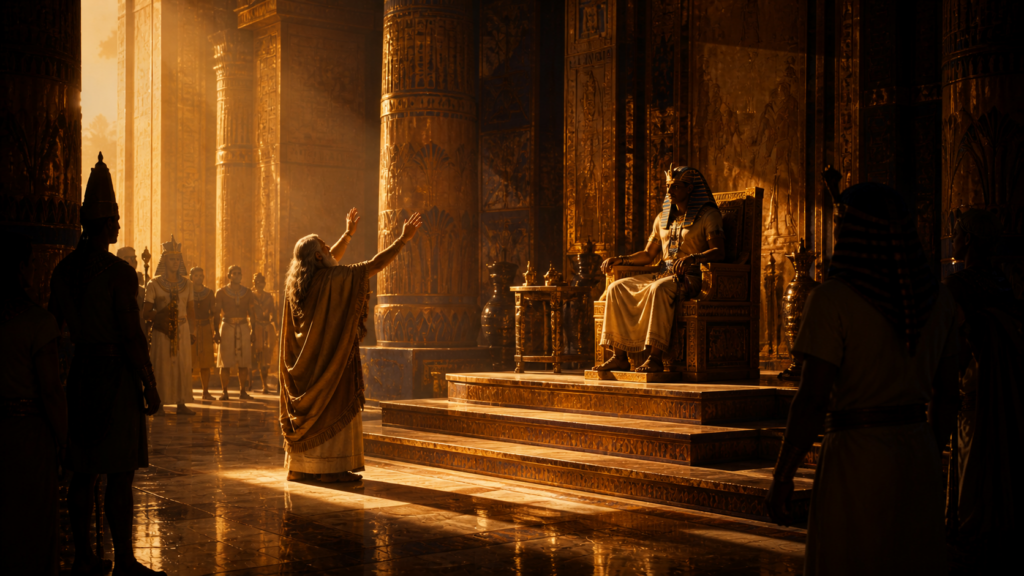
Genesis 47 is the chapter of settlement and the chapter of policy. The family arrives in Goshen; Joseph presents them to Pharaoh; Pharaoh grants them the best of the land. Jacob meets Pharaoh, blesses him, and answers his question about age in one of the patriarchal narrative’s most striking self-assessments. Then the chapter pivots to Joseph’s economic administration of the famine. The famine deepens. Egyptians sell their livestock for grain, then their land, then themselves. Joseph reorganizes Egyptian society around centralized grain distribution and a one-fifth tax to Pharaoh. The chapter is honest about what it means to be the second-in-command of an imperial economy. Joseph saves lives and consolidates state power at the same time.
The chapter closes with the patriarch’s first instructions about his burial. Jacob, sensing that his death is approaching, calls Joseph and asks him to swear that he will not be buried in Egypt. Bury me with my fathers. Joseph swears. The cycle is laying the seed of what chapter 50 will record: the funeral procession back to the cave of Machpelah, the patriarchs’ burial place. Even in Egypt, even with the family settled in Goshen, even with seventeen years of comfort between the descent and the death, Jacob will not be buried in Egypt. The land of promise is, in his bones, where he belongs.
The chapter is among the cycle’s most theologically complicated. Joseph saves Egypt from starvation. Joseph also organizes the consolidation of Egyptian land into Pharaoh’s hands. The chapter does not flatten the tension. The cycle is honest that the agent of preservation is also the agent of state-building. The Hebrew Bible will read this tension forward; the Pharaoh of Exodus 1, who did not know Joseph, will inherit the centralized state that Joseph built.
A · Genesis 47:1–12 · Pharaoh receives the family and Jacob blesses Pharaoh
¹ Then Joseph went in and told Pharaoh, and said, “My father and my brothers, with their flocks, their herds, and all that they own, have come out of the land of Canaan; and behold, they are in the land of Goshen.” ² From among his brothers he took five men, and presented them to Pharaoh. ³ Pharaoh said to his brothers, “What is your occupation?” They said to Pharaoh, “Your servants are shepherds, both we, and our fathers.” ⁴ They also said to Pharaoh, “We have come to live as foreigners in the land, for there is no pasture for your servants’ flocks. For the famine is severe in the land of Canaan. Now therefore, please let your servants dwell in the land of Goshen.” ⁵ Pharaoh spoke to Joseph, saying, “Your father and your brothers have come to you. ⁶ The land of Egypt is before you. Make your father and your brothers dwell in the best of the land. Let them dwell in the land of Goshen. If you know any able men among them, then put them in charge of my livestock.” ⁷ Joseph brought in Jacob, his father, and set him before Pharaoh; and Jacob blessed Pharaoh. ⁸ Pharaoh said to Jacob, “How old are you?” ⁹ Jacob said to Pharaoh, “The days of the years of my pilgrimage are one hundred thirty years. The days of the years of my life have been few and evil. They have not attained to the days of the years of the life of my fathers in the days of their pilgrimage.” ¹⁰ Jacob blessed Pharaoh, and went out from the presence of Pharaoh. ¹¹ Joseph placed his father and his brothers, and gave them a possession in the land of Egypt, in the best of the land, in the land of Rameses, as Pharaoh had commanded. ¹² Joseph provided his father, his brothers, and all of his father’s household with bread, according to their families. (Genesis 47:1–12, World English Bible)
- The chapter opens with Joseph following protocol. He goes in, reports the family’s arrival, and presents five of his brothers to Pharaoh. The number five is a courtly choice: enough to represent the family without overwhelming the audience. The Hebrew u-mi-ktzeh echav laqach chamishah anashim, “and from the edge of his brothers he took five men,” uses the same construction the Hebrew Bible elsewhere uses for selecting representatives.
- Pharaoh’s question (verse 3) is the one Joseph anticipated in 46:33. What is your occupation? The brothers answer exactly as Joseph instructed: Your servants are shepherds, both we and our fathers. The chapter is recording, with characteristic narrative economy, the family executing Joseph’s plan. The pasture in Goshen is what they need; the shepherd identity is what gets them there.
- Pharaoh’s response (verses 5 to 6) is generous beyond the request. The land of Egypt is before you. Make your father and your brothers dwell in the best of the land. The Hebrew eretz Mitzraim lefaneicha hi, “the land of Egypt is before you,” is the imperial idiom of access. Pharaoh is not granting permission to settle; he is granting access to the whole country and naming Goshen as the specific allotment. The chapter is recording, with characteristic narrative restraint, the formal Egyptian-state welcome.
- Pharaoh’s additional offer (verse 6) is striking: If you know any able men among them, then put them in charge of my livestock. The Hebrew anshei chayil, “men of valor” or “able men,” is the same construction Pharaoh will later use of professional Egyptian officials. The chapter is recording that the Egyptian state is offering the brothers honored positions in royal animal husbandry. The cycle is honest about the texture of the family’s new life: they are settled outsiders, but they are also offered access to imperial roles.
- Verse 7 is one of the chapter’s most theologically loaded sentences. Joseph brought in Jacob, his father, and set him before Pharaoh; and Jacob blessed Pharaoh. The Hebrew vayivarech Yaakov et-Paro, “and Jacob blessed Pharaoh,” is direct. The patriarch, the carrier of the Abrahamic covenant, blesses the imperial sovereign. The chapter is doing structural theology in one sentence. The Genesis 12:3 promise (in you all the families of the earth shall be blessed) is being enacted in court.
Influence callout: N.T. Wright
Wright’s reading of Jacob blessed Pharaoh names it as the cycle’s most explicit fulfillment of the Abrahamic blessing-the-nations promise. The Hebrew is unambiguous about the direction of the blessing. The patriarch (the older man, the carrier of the covenant, the lesser in worldly power) blesses the imperial sovereign (the younger man in this exchange, the holder of worldly power). The chapter is recording that the covenant always blesses outward toward the nations, and that the direction of blessing in the Hebrew Bible is consistently the opposite of the direction of worldly power. Wright argues that this scene is the patriarchal narrative’s deepest political theology in narrative form.
- How old are you? (verse 8). Pharaoh’s question is courtly: ancient Near Eastern monarchs noted longevity as a sign of divine favor. The chapter is recording Pharaoh’s diplomatic interest. Jacob’s answer (verse 9) is the patriarch’s most striking self-assessment.
- The days of the years of my pilgrimage are one hundred thirty years. The days of the years of my life have been few and evil. They have not attained to the days of the years of the life of my fathers in the days of their pilgrimage. The Hebrew yemei shenei megurai shloshim u-me’at shanah, “the days of the years of my sojournings are one hundred thirty years,” uses the noun megurim (sojournings) not chayim (life). The patriarch is naming his life as a sojourning, an unsettled wandering, not a settled existence. The chapter is recording, with characteristic theological precision, how the patriarch reads his own life. He has not had a settled home. He has been a guest his whole life. He is, in this final stretch, a guest in Egypt as he has been a guest everywhere.
Word study: megurim (מְגוּרִים), “sojournings, the time of being a resident alien”
The Hebrew word from the verb gur, to sojourn, to live as a resident alien. Megurim names the patriarchal experience of living in a land that is promised but not yet possessed. Abraham was a ger (resident alien) in Hebron (23:4). Isaac sojourned in Gerar. Jacob sojourned with Laban in Paddan-aram, and now sojourns in Goshen. The chapter is naming the patriarch’s whole life as megurim. The category will run forward into Israel’s self-understanding: we were sojourners in the land of Egypt (Exodus 22:21; 23:9; Leviticus 19:34). The patriarchal sojourning becomes the people’s identity.
- Few and evil have been the days. The Hebrew me’at vera’im, “few and evil,” is unsparing. The patriarch is honest about his life. The deception of Esau, the twenty years with Laban, the wrestling at Peniel, the Dinah and Shechem catastrophe, the Joseph cycle: these are not nostalgic memories. The patriarch reads his own life as marked by trouble. The chapter is recording, with characteristic Hebrew Bible honesty, that the patriarchal life was not easy. The covenant carrier does not pretend it was.
Influence callout: Walter Brueggemann
Brueggemann’s reading of few and evil names it as one of the patriarchal narrative’s most pastorally important sentences. The patriarch is not in despair; he is in court, in the presence of Pharaoh, blessing him. He is also, in the same speech, naming his life as few and evil. Brueggemann argues that the Hebrew Bible holds these together routinely. The patriarchal life is real life: full of loss, full of moral complication, full of trouble, also marked by divine promise and divine blessing. The chapter is recording, in one short Hebrew speech, the kind of honest old-man theology that has marked the Hebrew Bible from the beginning.
- The chapter closes the audience with a second blessing (verse 10): Jacob blessed Pharaoh, and went out from the presence of Pharaoh. The bracketed structure (entry blessing, age conversation, exit blessing) is a formal court courtesy. The patriarch leaves having performed his role.
- Verses 11 to 12 record the practical settlement. Joseph placed his father and his brothers, and gave them a possession in the land of Egypt, in the best of the land, in the land of Rameses. The Hebrew eretz Ra’meses is geographic shorthand for the eastern Nile Delta. The naming of the region is anachronistic (the city of Rameses will be named for Pharaoh Rameses II, centuries later) and is one of the Pentateuch’s small editorial markers indicating later compilation.
B · Genesis 47:13–26 · The famine deepens and Joseph’s grain-and-land policy
¹³ There was no bread in all the land; for the famine was very severe, so that the land of Egypt and the land of Canaan fainted by reason of the famine. ¹⁴ Joseph gathered up all the money that was found in the land of Egypt, and in the land of Canaan, for the grain which they bought; and Joseph brought the money into Pharaoh’s house. ¹⁵ When the money was all spent in the land of Egypt, and in the land of Canaan, all the Egyptians came to Joseph, and said, “Give us bread, for why should we die in your presence? For our money fails.” ¹⁶ Joseph said, “Give me your livestock; and I will give you food for your livestock, if your money is gone.” ¹⁷ They brought their livestock to Joseph, and Joseph gave them bread in exchange for the horses, and for the flocks, and for the herds, and for the donkeys: and he fed them with bread in exchange for all their livestock for that year. ¹⁸ When that year was ended, they came to him the second year, and said to him, “We will not hide from my lord how our money is all spent, and the herds of livestock are my lord’s. There is nothing left in the sight of my lord, but our bodies, and our lands. ¹⁹ Why should we die before your eyes, both we and our land? Buy us and our land for bread, and we and our land will be servants to Pharaoh. Give us seed, that we may live, and not die, and that the land won’t be desolate.” ²⁰ So Joseph bought all the land of Egypt for Pharaoh, for every man of the Egyptians sold his field, because the famine was severe on them, and the land became Pharaoh’s. ²¹ As for the people, he moved them to the cities from one end of the border of Egypt even to the other end of it. ²² Only he didn’t buy the land of the priests, for the priests had a portion from Pharaoh, and ate their portion which Pharaoh gave them. That is why they didn’t sell their land. ²³ Then Joseph said to the people, “Behold, I have bought you and your land today for Pharaoh. Behold, here is seed for you, and you shall sow the land. ²⁴ It will happen at the harvests, that you shall give a fifth to Pharaoh, and four parts will be your own, for seed of the field, for your food, for them of your households, and for food for your little ones.” ²⁵ They said, “You have saved our lives! Let us find favor in the sight of my lord, and we will be Pharaoh’s servants.” ²⁶ Joseph made it a statute concerning the land of Egypt to this day, that Pharaoh should have the fifth. Only the land of the priests alone didn’t become Pharaoh’s. (Genesis 47:13–26, World English Bible)
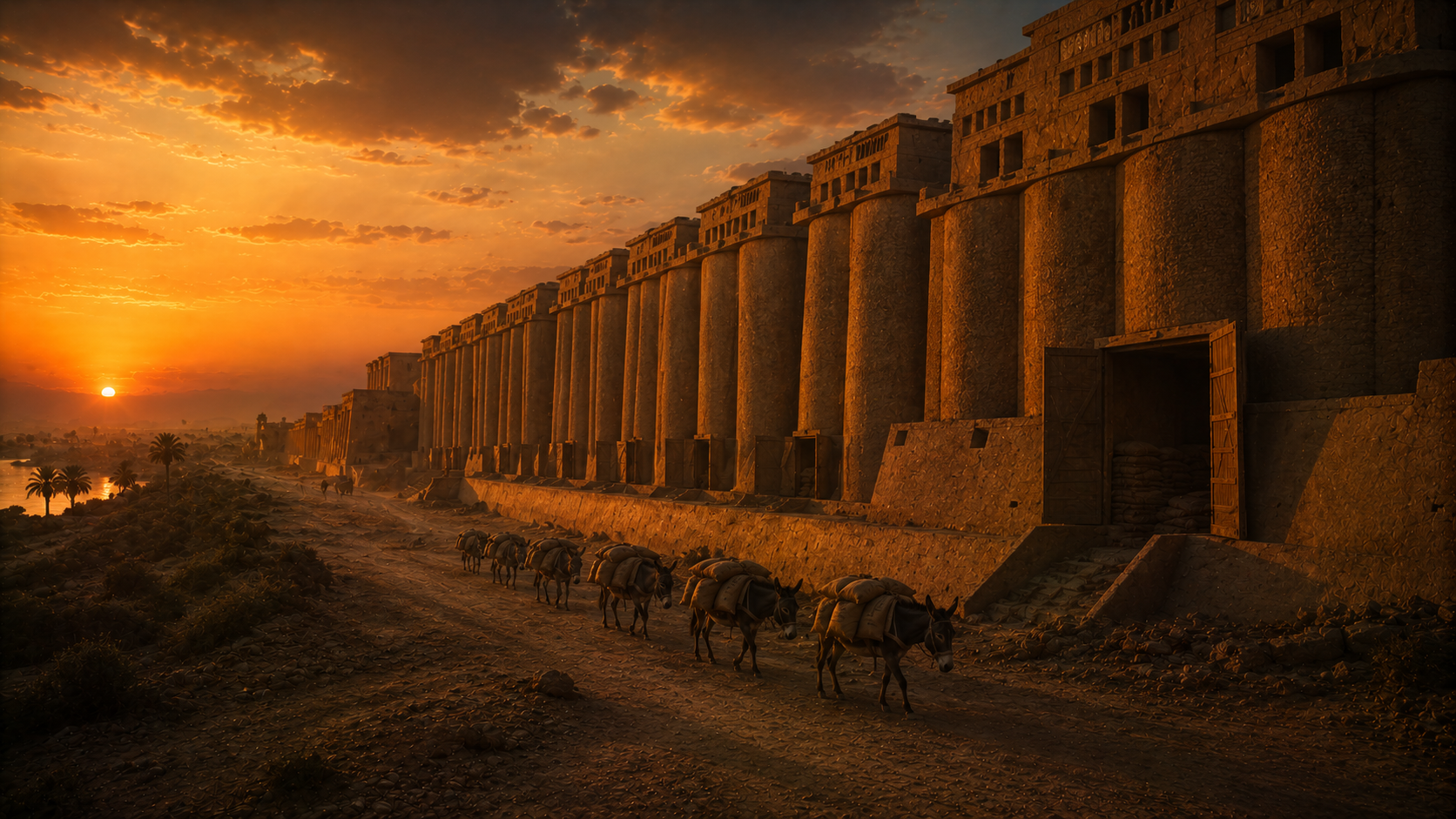
- The chapter pivots in verse 13. The famine intensifies; Egyptian and Canaanite economies collapse. The Hebrew valehem ein b’khol-ha’aretz, “and there was no bread in all the land,” names the scale of the crisis. The whole region is in famine.
- Joseph’s first move (verses 14 to 15) is to gather all the money. The Hebrew vayelaqqet Yosef et-kol-ha-kesef, “and Joseph gathered up all the silver,” is precise. The cash economy is consolidated into Pharaoh’s house. When the money runs out, the people come back: give us bread, for why should we die in your presence? For our money fails.
- The second move (verses 16 to 17) is livestock for grain. Joseph trades food for the people’s animals. The Hebrew lists the animals deliberately: horses, sheep, cattle, donkeys. By the end of the year, the people’s animal capital has been transferred to Pharaoh’s holdings.
- The third move (verses 18 to 21) is land and labor for grain. The Egyptians return the second year and offer themselves: buy us and our land for bread, and we and our land will be servants to Pharaoh. Joseph buys the land. The verse-21 detail is striking: as for the people, he moved them to the cities from one end of the border of Egypt even to the other end of it. The Septuagint and Samaritan Pentateuch read this as he made them slaves rather than he moved them to cities; the Hebrew text is debated. Either reading names a major social reorganization.
Influence callout: Walter Brueggemann
Brueggemann’s reading of the grain-and-land policy is among his most theologically pointed. He argues that the chapter is honest about what Joseph is doing. Joseph is preserving life, and Joseph is also building the centralized imperial state that will, in Exodus 1, oppress his own descendants. Brueggemann reads the chapter as the Hebrew Bible’s earliest critique of the totalizing state. The famine is real; the preservation is real; the cost of the preservation is the consolidation of all economic power in Pharaoh’s house. The Hebrew Bible does not erase the moral complication. The same Joseph who saves lives in chapter 41 builds the system that will enslave his own family by Exodus 1. The chapter is teaching, in narrative form, what Brueggemann calls the royal consciousness: the centralized power that always justifies itself by emergency and never disassembles itself when the emergency passes.
- Only he didn’t buy the land of the priests (verse 22). The Hebrew is explicit: the priestly class kept their land because they received a state stipend. The chapter is recording, with characteristic political realism, that the Egyptian priesthood was protected from the centralization. Religion, in the imperial center, is exempted from the leveling. The cycle is being honest about how priestly classes typically fare under centralizing administrations.
Influence callout: Marty Solomon
Solomon’s reading of the priests-exempted detail names it as one of the chapter’s most quietly significant notes. The Egyptian priesthood is protected; the rest of the population is reorganized. Solomon argues that the Hebrew Bible is recording, with characteristic eastern context awareness, that imperial systems consistently protect the religious elite while reorganizing everyone else. The Pentateuch will later prohibit the Levites from owning land in Israel (Numbers 18:20: I am your portion and your inheritance), as a deliberate counter-move to the Egyptian priesthood model. The Levites of Israel will be precisely not the Egyptian priests; the Israelite religious class will not be the protected landed elite.
- They said, “You have saved our lives!” (verse 25). The Hebrew hechiyitanu, “you have kept us alive,” is the Egyptians’ verdict on Joseph’s policy. The chapter is honest. From the people’s perspective, Joseph has saved their lives. From the perspective of the longer Pentateuchal arc, Joseph has consolidated the system that will be turned against the family. Both are true.
Pushback note
Some readings have flattened Joseph’s policy into either pure heroism (he saved Egypt) or pure villainy (he enslaved a free people). The Hebrew is more honest than either reading. Joseph saved lives; Joseph also reorganized the economy of an empire into the hands of the imperial center; the people themselves named both as true (you have saved our lives; we will be Pharaoh’s servants). The chapter is recording, with characteristic narrative restraint, the moral complication of being the second-in-command of an empire during a crisis. The cycle is asking the reader to hold the tension, not to flatten it.
- Joseph made it a statute concerning the land of Egypt to this day, that Pharaoh should have the fifth (verse 26). The Hebrew chuqq (statute) is the legal vocabulary the Pentateuch will use for Israel’s covenant law. Joseph is, in this sentence, named as the architect of an Egyptian chuqq: a one-fifth tax to the imperial center as a permanent feature of Egyptian land tenure. The chapter is recording the patriarchal hero as the founder of an Egyptian fiscal regime. The Hebrew Bible does not separate these.
C · Genesis 47:27–31 · Settlement and the burial oath
²⁷ Israel lived in the land of Egypt, in the land of Goshen; and they got themselves possessions therein, and were fruitful, and multiplied exceedingly. ²⁸ Jacob lived in the land of Egypt seventeen years. So the days of Jacob, the years of his life, were one hundred forty-seven years. ²⁹ The time came near that Israel must die, and he called his son Joseph, and said to him, “If now I have found favor in your sight, please put your hand under my thigh, and deal kindly and truly with me. Please don’t bury me in Egypt, ³⁰ but when I sleep with my fathers, you shall carry me out of Egypt, and bury me in their burying place.” Joseph said, “I will do as you have said.” ³¹ He said, “Swear to me,” and he swore to him. Then Israel bowed himself on the bed’s head. (Genesis 47:27–31, World English Bible)
- Israel lived in the land of Egypt, in the land of Goshen; and they got themselves possessions therein, and were fruitful, and multiplied exceedingly (verse 27). The Hebrew vayifru vayirbu me’od, “and they were fruitful and multiplied exceedingly,” is the chapter’s most theologically loaded sentence. The vocabulary is the Genesis 1:28 creation mandate (be fruitful and multiply) that has run through the patriarchal narrative as the divine promise. In Egypt, in the land of Goshen, the family is fulfilling the creation mandate.
Influence callout: Tim Mackie
Mackie’s reading of they were fruitful and multiplied exceedingly names it as the cycle’s quiet structural fulfillment of the original blessing. The Hebrew is the Genesis 1:28 vocabulary applied to the family in Egypt. The patriarchal narrative has been tracing the slow, threatened, contested progress of the creation mandate through five hundred years of barren women, family conflicts, and threats to the line. In Goshen, the family is finally multiplying as the original blessing intended. Mackie argues that the chapter is teaching, by the deliberate vocabulary echo, that the descent into Egypt is paradoxically the place where the creation mandate is finally being fulfilled. The Hebrew Bible is full of these reversals.
- Jacob lived in the land of Egypt seventeen years (verse 28). The number is structural. Joseph was seventeen when the cycle began (37:2). The chapter is recording, with characteristic narrative symmetry, that Jacob and Joseph have now had a second seventeen years together. The seventeen-year-old who was lost has come back; the patriarch has been given seventeen more years with him before death.
- So the days of Jacob, the years of his life, were one hundred forty-seven years. The patriarchal lifespans are decreasing across the cycle: Abraham 175, Isaac 180, Jacob 147. The chapter is recording, in the numbers, the pattern the Hebrew Bible will eventually formalize in Genesis 6 and Psalm 90: human lifespans contract across the generations.
- The time came near that Israel must die, and he called his son Joseph. The Hebrew vayikrevu yemei-Yisrael lamut, “the days of Israel drew near to die,” is the patriarchal death-vocabulary. The patriarch is preparing for death; he is making arrangements; he calls his most-trusted son.
- Please put your hand under my thigh, and deal kindly and truly with me. Please don’t bury me in Egypt, but when I sleep with my fathers, you shall carry me out of Egypt, and bury me in their burying place (verses 29 to 30). The Hebrew sim-na yadekha tachat yereki, “place your hand under my thigh,” is the same oath-formula Abraham used with his servant in Genesis 24:2 to send him to find a wife for Isaac. The patriarchal oath is sworn by the most intimate physical contact, signaling the gravest possible commitment.
Influence callout: Marty Solomon
Solomon’s reading of the burial oath names it as one of the cycle’s most theologically pointed scenes. Jacob has lived in Egypt for seventeen years. He has been welcomed by Pharaoh; he has been provided for; he has watched his family multiply in Goshen. He could be buried in Egypt with full Egyptian honors. He refuses. The Hebrew al-na tiqberini b’Mitzraim, “please do not bury me in Egypt,” is unambiguous. Solomon argues that the chapter is recording the patriarch’s deepest theological commitment in the smallest action. The land of promise is where his bones belong. Egypt is not home; Egypt has never been home; Egypt has been a sojourning. The bones go back. Solomon reads this as the cycle’s foundation for the exodus theology that will run through the rest of the Pentateuch. The bodies of the patriarchs being in Canaan is the seed of the people’s eventual return.
Word study: chesed ve-emet (חֶסֶד וֶאֱמֶת), “kindness and truth, faithful loyalty”
The Hebrew phrase Jacob uses in 47:29: deal kindly and truly with me. Chesed is covenant loyalty, the steady commitment that does not fail. Emet is faithfulness, reliability, truth. Together, they name the deepest covenantal posture in the Hebrew Bible. Jacob is not asking Joseph for a favor; he is asking Joseph to enact, in his death-care, the deepest covenantal virtue. The phrase will become foundational in the Hebrew Bible’s vocabulary about God: the LORD, the LORD, a God merciful and gracious, slow to anger, and abounding in steadfast love and faithfulness (Exodus 34:6). The patriarch is asking his son to be, in the matter of the bones, a small image of God’s own covenantal character.
- Joseph said, “I will do as you have said.” He said, “Swear to me,” and he swore to him (verses 30 to 31). The chapter is recording, with characteristic narrative restraint, the formal oath. Joseph’s verbal assent is not enough; the patriarch requires the oath. The chapter is being precise about how serious the burial commitment is. Even the trusted son must be bound by the patriarchal-thigh oath.
- Then Israel bowed himself on the bed’s head (verse 31). The Hebrew vayishtachu Yisrael al-rosh ha-mittah, “and Israel bowed on the head of the bed,” is the chapter’s closing image. The bowing is patriarchal worship, an acknowledgment that the oath has been received and that God has heard. Hebrews 11:21 will later reference this scene with the Septuagint reading (on the head of his staff), but the Hebrew has bed. Either reading names the patriarch in worship at the moment the burial promise is sworn.
Influence callout: Walter Brueggemann
Brueggemann’s reading of Israel bowed himself on the bed’s head names it as the chapter’s quiet theological closure. The patriarch, having secured the promise that his bones will be carried home, worships. The chapter is recording that the covenantal commitment to burial in the land of promise is, for Jacob, an act that calls for worship. Brueggemann argues that the Hebrew Bible is teaching, by this small detail, that the patriarchal hope for the land is grounded in worship. The bones going back is worship-shaped before it is geographically practical. The chapter ends with the patriarch bowing.
Reflection prompts
- Jacob, called by Pharaoh to the imperial court, blesses the imperial sovereign. The covenant carrier blesses the ruler of the empire that will eventually oppress his descendants. Where in your life are you currently being asked to bless someone whose power is greater than yours, and what does it mean to read the Genesis 12:3 promise (in you all the families of the earth shall be blessed) as a vocation that runs in this direction?
- Joseph’s grain-and-land policy preserves Egypt and consolidates the imperial state at the same time. The chapter does not flatten this; it names both as true. Where in your life are you currently making a decision that is preserving something good and also building a system whose long-term shape you cannot fully see, and what does it mean to be honest about the moral complication of that?
- Jacob refuses to be buried in Egypt. After seventeen years of comfort, after Pharaoh’s welcome, after the family’s flourishing in Goshen, his bones go back to the land of promise. Where in your life is your deepest commitment located somewhere other than the place you are currently living, and what does it mean to mark that commitment in the way you arrange your endings?