

Genesis 46 is the chapter of the descent. Jacob, his spirit revived at the end of chapter 45 by the sight of Pharaoh’s wagons, gathers everything he has and starts south. The journey is not casual. Going down to Egypt is the theological inversion of every promise the patriarchs have received. Abraham went up to the land; Isaac was forbidden to leave it; Jacob himself returned to it from Paddan-aram. Now the family is leaving. The chapter records the theological weight of that leaving, and the divine promise that frames it.
The chapter opens at Beer-sheba, the southernmost edge of the land of promise. Jacob stops to offer sacrifices to the God of his father Isaac. The phrase is precise: not the God of Abraham (the journey-up God), but the God of Isaac (the don’t-leave-the-land God). In the night, God speaks in vision. Jacob, Jacob. The patriarch answers in the old vocabulary: Here I am. God speaks the chapter’s pivotal promise: Do not be afraid to go down to Egypt; for I will make of you a great nation there. I myself will go down with you to Egypt, and I will also bring you up again. The descent is sanctioned. The God of the promise is the God who goes with them into the land that is not theirs and the God who will bring them back.
The chapter then records the genealogy of the family, seventy souls in all, by mother and by son. The list is structural, not casual. The number seventy is the number of the nations in the table of nations in chapter 10. The chapter is laying the seed of a theological category: this small family going down to Egypt is, in microcosm, the world. They will multiply there. They will become a nation. Eventually, in the prophetic vision of Isaiah and the apostolic vision of Paul, they will become a blessing to the nations.
The chapter closes with the meeting in Goshen. Joseph harnesses his chariot and rides up to meet his father. He falls on his neck and weeps for a long time. Jacob’s response is the chapter’s emotional resolution: Now let me die, since I have seen your face, that you are still alive. The descent is complete. The family is in Egypt. The Genesis cycle has crossed the threshold.
A · Genesis 46:1–7 · The theophany at Beer-sheba
¹ Israel traveled with all that he had, and came to Beersheba, and offered sacrifices to the God of his father, Isaac. ² God spoke to Israel in the visions of the night, and said, “Jacob, Jacob!” He said, “Here I am.” ³ He said, “I am God, the God of your father. Don’t be afraid to go down into Egypt, for there I will make of you a great nation. ⁴ I will go down with you into Egypt. I will also surely bring you up again. Joseph will close your eyes.” ⁵ Jacob rose up from Beersheba, and the sons of Israel carried Jacob, their father, their little ones, and their wives, in the wagons which Pharaoh had sent to carry him. ⁶ They took their livestock, and their goods, which they had gotten in the land of Canaan, and came into Egypt: Jacob, and all his offspring with him, ⁷ his sons, and his sons’ sons with him, his daughters, and his sons’ daughters, and he brought all his offspring with him into Egypt. (Genesis 46:1–7, World English Bible)
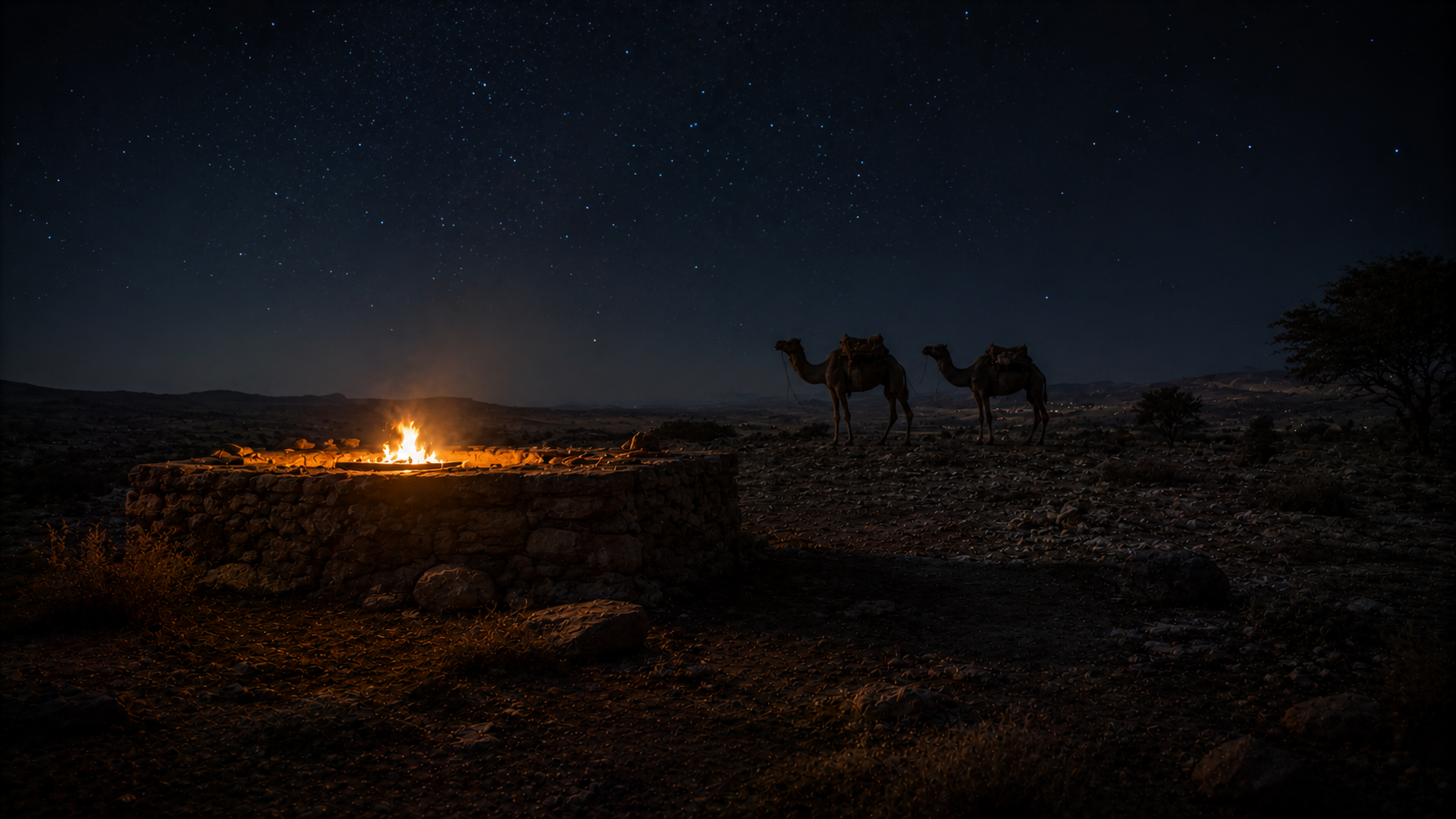
- Israel traveled with all that he had, and came to Beersheba. The Hebrew vayisa Yisrael ve’khol-asher-lo, “and Israel set out with all that he had,” uses the patriarchal travel verb nasa (to pull up stakes, to set out), the same verb that has marked every patriarchal migration since Abraham. The chapter is recording, with characteristic precision, that this is not a small move. The whole household, the livestock, every possession, the entire family company is in motion.
- Beer-sheba is the southernmost city in the land of promise, the place where Abraham planted the tamarisk tree (21:33) and where Isaac dug the well and built the altar (26:23-25). The chapter is recording, with characteristic theological awareness, that the patriarch is stopping at the boundary marker of the promise before crossing it.
Influence callout: Marty Solomon
Solomon’s reading of the Beer-sheba stop names it as the chapter’s deepest theological gesture. Jacob is leaving the land of promise. Going to Egypt is the inversion of Abraham’s call (go from your country to a land I will show you). The patriarch knows what this looks like. He stops at the southern boundary, builds an altar, and asks God whether the descent is sanctioned. Solomon argues that the chapter is recording the patriarchal habit of seeking divine confirmation at the boundaries of decision. Jacob does not assume the descent is right because Joseph is in Egypt; he asks. The theophany at Beer-sheba is the answer.
- Offered sacrifices to the God of his father, Isaac. The Hebrew vayizbach zevachim l’Elohei aviv Yitzchaq, “and offered sacrifices to the God of his father Isaac,” is precise. Not the God of Abraham; not the God of his fathers in the plural; the God of Isaac specifically. Isaac is the patriarch who was forbidden to leave the land (26:2: do not go down to Egypt). The chapter is recording, with deliberate vocabulary, that Jacob is bringing the question to the right God. The God who told Isaac to stay is the God whose permission is required to leave.
- God spoke to Israel in the visions of the night, and said, “Jacob, Jacob!” He said, “Here I am.” The Hebrew vayomer Yaakov, Yaakov, “and he said, Jacob, Jacob,” uses the doubled-name address that the Hebrew Bible reserves for moments of personal call: Abraham, Abraham (22:11), Moses, Moses (Exodus 3:4), Samuel, Samuel (1 Samuel 3:10). The chapter is signaling, by the name pattern, that this is a vocational theophany. Jacob is being called.
- Here I am. The Hebrew hineni, the patriarchal availability vocabulary that Abraham used in Genesis 22 (here I am, my son) and that Moses will use in Exodus 3, is Jacob’s response. The patriarch is making himself available to whatever God is about to say. The chapter is recording that the descent is going to happen on the basis of an explicit divine commission, not on Jacob’s own initiative.
Word study: hineni (הִנֵּנִי), “here I am”
The Hebrew vocational availability word. Used by Abraham at the binding of Isaac (here I am, my son, 22:7; here I am, 22:11), by Jacob at Beer-sheba (46:2), by Moses at the burning bush (Exodus 3:4), by Samuel in the temple (1 Samuel 3:4). The word is more than presence. It is the verbal posture of being available for whatever God is about to ask. The chapter places Jacob in this lineage: he is, at the boundary of the land, available for the divine commission.
- The promise (verses 3 to 4) is structured. Four clauses: – I am God, the God of your father. – Do not be afraid to go down into Egypt. – For there I will make of you a great nation. – I will go down with you into Egypt; I will also surely bring you up again.
Influence callout: N.T. Wright
Wright’s reading of the Beer-sheba theophany names it as the foundation for the exodus narrative. The promise I will go down with you into Egypt; I will also surely bring you up again is the theological seed for everything that will happen in Exodus. The God who goes down with the family will also bring them up. The descent is not abandonment of the promise; the descent is preparation for the exodus that will fulfill the promise on a national scale. Wright argues that the chapter is laying down, in patriarchal vocabulary, the architecture of the entire Pentateuch’s central event. The exodus is not a new theme; it was promised at the entry to Egypt.
- Joseph will close your eyes (verse 4). The Hebrew v’Yosef yashit yado al-eineicha, “and Joseph will lay his hand on your eyes,” is the ancient Near Eastern image of a son closing the dead parent’s eyes at the moment of burial. The chapter is recording, with characteristic gentleness, that the promise to Jacob includes the dignity of a proper death surrounded by family. The patriarch will not die alone. Joseph will be there.
Influence callout: Walter Brueggemann
Brueggemann’s reading of Joseph will close your eyes names it as the chapter’s most pastoral promise. The patriarch has lived through twenty-two years of believing his son was dead. The promise of the closing of the eyes is the theological reversal of the bloody coat. Joseph, who Jacob believed was torn by a wild beast, will lay his hand on the patriarch’s face at his burial. Brueggemann argues that the chapter is recording, with characteristic Hebrew Bible honesty, that the promise of God includes not just nation-building but the small mercies of family death-care. The God of the promise notices the small things.
- Verses 5 to 7 record the actual departure. Jacob rose up from Beersheba, and the sons of Israel carried Jacob, their father, their little ones, and their wives, in the wagons which Pharaoh had sent to carry him. The chapter is recording, with characteristic narrative restraint, that the wagons are doing exactly the work Pharaoh sent them for. The patriarchal household, with all its livestock and goods, crosses the southern boundary of the land of promise.
B · Genesis 46:8–27 · The seventy souls
⁸ These are the names of the children of Israel, who came into Egypt, Jacob and his sons: Reuben, Jacob’s firstborn. ⁹ The sons of Reuben: Hanoch, Pallu, Hezron, and Carmi. ¹⁰ The sons of Simeon: Jemuel, Jamin, Ohad, Jachin, Zohar, and Shaul the son of a Canaanite woman. ¹¹ The sons of Levi: Gershon, Kohath, and Merari. ¹² The sons of Judah: Er, Onan, Shelah, Perez, and Zerah; but Er and Onan died in the land of Canaan. The sons of Perez were Hezron and Hamul. ¹³ The sons of Issachar: Tola, Puvah, Iob, and Shimron. ¹⁴ The sons of Zebulun: Sered, Elon, and Jahleel. ¹⁵ These are the sons of Leah, whom she bore to Jacob in Paddan Aram, with his daughter Dinah. All the souls of his sons and his daughters were thirty-three. […] ²⁶ All the souls who came with Jacob into Egypt, who were his direct offspring, in addition to Jacob’s sons’ wives, all the souls were sixty-six. ²⁷ The sons of Joseph, who were born to him in Egypt, were two souls. All the souls of the house of Jacob, who came into Egypt, were seventy. (Genesis 46:8–27, World English Bible, abridged)
- The genealogy of seventy souls is one of the chapter’s most theologically loaded passages. The list is organized by mother (Leah’s children, Zilpah’s children, Rachel’s children, Bilhah’s children) and counted in groups. The chapter is recording, with characteristic patriarchal precision, the family that crosses the boundary into Egypt.
- The number seventy is structural, not random. Seventy is the number of the nations in the table of nations in Genesis 10. The chapter is laying down, in microcosm, the same number. The covenant family entering Egypt is the seed of the world. The Hebrew Bible will pick up this counting again in Exodus 1:5 (the descendants of Jacob were seventy persons) and in Deuteronomy 32:8 (when the Most High apportioned the nations, when he divided humankind, he fixed the boundaries of the peoples according to the number of the gods of God, the verse Heiser reads as referring to the seventy nations).
Influence callout: Michael S. Heiser
Heiser’s reading of the seventy-souls count names it as the deliberate echo of the seventy nations of Genesis 10 and the seventy bene Elohim of Deuteronomy 32. The chapter is signaling, in numerical structure, that the covenant family is a kind of microcosm of the human world. As the nations were divided into seventy at Babel, so the covenant family is constituted as seventy at the descent. The two seventies stand in covenantal relationship: the one family will bless the seventy nations. Heiser argues that the chapter is doing structural theology in arithmetic.
Word study: nefesh (נֶפֶשׁ), “soul, person, life”
The Hebrew word translated as “soul” throughout the genealogy. Nefesh is not the disembodied soul of later Greek philosophy; it is the whole living person. The chapter’s repeated counting of nefashot (souls) is naming people in their full embodied existence: men, women, children, the whole household. The seventy nefashot who go down to Egypt are seventy whole human lives, not seventy abstractions. The Hebrew Bible’s vocabulary is consistently embodied.
- The list includes some structural details worth noting. Er and Onan died in the land of Canaan (verse 12), preserving the Genesis 38 narrative inside the genealogy. Shaul the son of a Canaanite woman (verse 10) is the only named non-Israelite mother, possibly because the integration of Canaanite descent into the line of Simeon was significant enough to mark. Dinah is named (verse 15) but no descendants are listed; her presence is part of the family count. The genealogy is honest about who is in the family, including the complications.
Influence callout: Marty Solomon
Solomon’s reading of the seventy-souls list names it as one of the chapter’s quiet theological hinges. The covenant family that goes down to Egypt is small (seventy souls, plus wives) but theologically loaded (the seventy of Genesis 10). Solomon argues that the cycle is preparing for the exodus by establishing exactly who the people of God are at the moment they enter the foreign land. The Pentateuch’s later concern with who is in Israel (the mixed multitude in Exodus 12, the law about resident aliens, the genealogies in Numbers) is rooted in this seventy-souls list. The cycle is laying the seed of an entire theological tradition.
- The sons of Joseph, who were born to him in Egypt, were two souls (verse 27). Manasseh and Ephraim, born to Joseph in Egypt, are counted in the family total. The chapter is recording, with characteristic generosity, that Joseph’s Egyptian-born sons are full members of the covenant family. The next chapter and the chapter after will pick this up: Manasseh and Ephraim will be brought into the patriarchal blessing as if they were sons of Jacob.
C · Genesis 46:28–34 · The meeting in Goshen and the shepherd warning
²⁸ Jacob sent Judah before him to Joseph, to show the way before him to Goshen, and they came into the land of Goshen. ²⁹ Joseph prepared his chariot, and went up to meet Israel, his father, in Goshen. He presented himself to him, and fell on his neck, and wept on his neck a long time. ³⁰ Israel said to Joseph, “Now let me die, since I have seen your face, that you are still alive.” ³¹ Joseph said to his brothers, and to his father’s house, “I will go up, and speak with Pharaoh, and will tell him, ‘My brothers, and my father’s house, who were in the land of Canaan, have come to me. ³² These men are shepherds, for they have been keepers of livestock, and they have brought their flocks, and their herds, and all that they have.’ ³³ It will happen, when Pharaoh summons you, and will say, ‘What is your occupation?’ ³⁴ that you shall say, ‘Your servants have been keepers of livestock from our youth even until now, both we, and our fathers,’ that you may dwell in the land of Goshen; for every shepherd is an abomination to the Egyptians.” (Genesis 46:28–34, World English Bible)
- Jacob sent Judah before him to Joseph, to show the way before him to Goshen (verse 28). Judah, the brother whose speech in chapter 44 brought the cycle to its reveal, is now the brother sent ahead. The chapter is recording, with characteristic narrative restraint, the elevation of Judah within the family hierarchy. Reuben (the eldest, disqualified by Genesis 35:22) and Simeon and Levi (disqualified by Genesis 34) are not chosen. Judah goes ahead. The line of Judah is being prepared for what chapter 49 will name openly: the scepter.
- Joseph prepared his chariot, and went up to meet Israel, his father, in Goshen (verse 29). The Hebrew vaye’esor Yosef merkavto, “and Joseph harnessed his chariot,” is one of the cycle’s most touching details. The vizier of Egypt, who has not seen his father in twenty-two years, is hitching up his own chariot. The chapter is recording, with characteristic narrative care, the personal urgency of the meeting. Joseph could have sent a delegation; he goes himself.
- He presented himself to him, and fell on his neck, and wept on his neck a long time. The Hebrew vayipol al-tzav’ravav vayevk al-tzav’ravav od, “and fell on his neck and wept on his neck still,” uses the same neck-falling vocabulary the chapter applied to Joseph and Benjamin in 45:14, and the same vocabulary Genesis 33:4 used of Esau and Jacob. The chapter is recording, by deliberate verbal echo, the cycle’s deepest fraternal and paternal embraces in the same Hebrew construction.
- Israel said to Joseph, “Now let me die, since I have seen your face, that you are still alive” (verse 30). The Hebrew amutah ha-pa’am, acharei re’oti et-paneicha, “let me die this once, after I have seen your face,” is the patriarch’s resolution. Twenty-two years of grief are now closed. The patriarch has seen his son’s face; the rest is detail. The chapter is recording, with characteristic Hebrew Bible directness, the patriarch’s readiness for death as the natural completion of his life. He has lived long enough.
Influence callout: Brian Zahnd
Zahnd’s reading of now let me die, since I have seen your face names it as the chapter’s deepest pastoral move. The patriarch has been carrying grief that organized his entire emotional life since chapter 37. The grief has now been answered. The seeing of the face is not just visual; it is the physical confirmation of the lost being found. Zahnd argues that the chapter is recording what spiritual writers have known throughout the Christian tradition: the seeing of the face of the lost beloved is its own kind of resurrection. Jacob’s now let me die is not despair; it is completion. The chapter is teaching, in the patriarchal vocabulary, that some griefs only release at the seeing of the face.
- Verses 31 to 34 record Joseph’s strategic instructions about the shepherd identity. The chapter has Joseph telling the brothers exactly what to say when Pharaoh asks their occupation: Your servants have been keepers of livestock from our youth even until now, both we, and our fathers. The Hebrew is straightforward: tell Pharaoh you are shepherds.
- That you may dwell in the land of Goshen; for every shepherd is an abomination to the Egyptians (verse 34). The Hebrew ki-to’avat Mitzraim kol-ro’eh tzon, “for every shepherd of flocks is an abomination to Egyptians,” is one of the cycle’s most culturally specific notes. The Egyptian preference for cattle and grain over sheep, and the social ranking of shepherds below settled farmers, would have placed the family at the cultural margin of Egyptian society. The chapter is recording, with characteristic cultural precision, that Joseph’s strategy is to leverage the Egyptian preference: by being shepherds, the family will be allowed to settle in Goshen rather than be absorbed into Egyptian urban life.
Influence callout: Ray Vander Laan
Vander Laan’s reading of the shepherd-as-abomination note names it as the chapter’s most theologically loaded cultural detail. The covenant family is being preserved by being kept at the cultural margin of the imperial center. They will not be absorbed into Egyptian religion, Egyptian intermarriage, Egyptian land-tenure, or Egyptian urban life. They will live in Goshen, on the eastern Delta, doing the work that Egyptians find distasteful. Vander Laan argues that the chapter is recording, in cultural-strategic terms, the same theological logic that runs through the Pentateuch: God preserves the people by keeping them at the edge. The marginal position is the protected position. The family that the imperial center ranks below is the family the imperial center cannot absorb.
Pushback note
Some readings have softened the shepherd-abomination note into a casual cultural observation. The Hebrew to’evah (abomination) is not casual. The word is the same the Hebrew Bible will use for forbidden practices in Leviticus and Deuteronomy. The chapter is honest about the cultural distance. Joseph is not pretending Egypt loves shepherds; he is using Egypt’s distaste for shepherds to secure the family’s separation. The cycle is recording, with characteristic political realism, that the descent into Egypt is not a fusion. The family will live in the empire as outsiders, by design.
Reflection prompts
- Jacob stops at Beer-sheba, the southern boundary of the land of promise, and asks God whether the descent into Egypt is sanctioned. He does not assume that because Joseph is in Egypt, going to Egypt is right. Where in your life are you currently being asked to make a move that crosses a threshold, and what would it mean to stop at the boundary and ask before you cross?
- The promise I will go down with you into Egypt; I will also surely bring you up again names the descent as a journey God will make alongside the family. The going-down is sanctioned because the bringing-up is promised. Where in your life are you currently in some kind of going-down that feels like leaving the land of promise, and what does it mean to read the descent inside the frame of a God who goes with and brings up?
- Joseph harnesses his own chariot to ride up and meet his father. The vizier of Egypt does the small task of hitching the horses himself. Where in your life is there a meeting that requires you to do the small physical work of preparation rather than delegating it, and what does it mean to consider that the harnessing is part of the meeting?