

Genesis 36 is a catalogue chapter. It records, in detail, the descendants of Esau, the establishment of the Edomite people in the land of Seir, the chiefs of the Edomite clans, and a list of the early Edomite kings. The chapter has no narrative action. There are no characters in the foreground. There is no dialogue. There is no theophany. The chapter is, by every conventional measure, a list.
That is exactly what the chapter is doing, and the doing matters. Genesis is, throughout, a book of toledot (generations), and the patriarchal narrative’s pattern is to give the non-chosen line its full accounting before continuing with the chosen line. Cain’s line was traced fully (Genesis 4) before Seth’s line continued. Ishmael’s toledot was given (Genesis 25:12-18) before Isaac’s toledot continued. Now Esau’s toledot is given, in this longest patriarchal-cycle catalogue, before the Joseph cycle (Genesis 37 to 50) begins.
The chapter is also doing strategic biblical work. The Edomites will recur throughout the rest of the Hebrew Bible. Israel’s relationship with Edom will be one of the canon’s most fraught (Numbers 20, Obadiah, Malachi 1, and the recurring prophetic oracles against Edom). Genesis 36 lays the foundation for who the Edomites are, where they came from, and how they came to occupy the land of Seir south of the Dead Sea. The chapter is the seed of a long canonical thread.
For the modern reader, the chapter is hard to read straight through. The names are unfamiliar; the genealogical layers are dense; the chiefs and kings come in lists that resist memorization. We will not try to comment on every name. The chapter’s interest is the structural function of the catalogue, not the individual identification of every figure listed. We will trace the chapter’s main movements, name what the catalogue is doing theologically, and let the lists themselves stand without exhausting them.
A · Genesis 36:1–14 · Esau’s wives, sons, and the move to Seir
¹ Now this is the history of the generations of Esau (that is, Edom). ² Esau took his wives from the daughters of Canaan: Adah the daughter of Elon, the Hittite; and Oholibamah the daughter of Anah, the daughter of Zibeon, the Hivite; ³ and Basemath, Ishmael’s daughter, sister of Nebaioth. ⁴ Adah bore to Esau Eliphaz. Basemath bore Reuel. ⁵ Oholibamah bore Jeush, Jalam, and Korah. These are the sons of Esau, who were born to him in the land of Canaan. ⁶ Esau took his wives, his sons, his daughters, and all the members of his household, with his livestock, all his animals, and all his possessions, which he had gathered in the land of Canaan, and went into a land away from his brother Jacob. ⁷ For their substance was too great for them to dwell together, and the land of their travels couldn’t bear them because of their livestock. ⁸ Esau lived in the hill country of Seir. Esau is Edom. ⁹ This is the history of the generations of Esau the father of the Edomites in the hill country of Seir: ¹⁰ these are the names of Esau’s sons: Eliphaz the son of Adah the wife of Esau, and Reuel the son of Basemath the wife of Esau. ¹¹ The sons of Eliphaz were Teman, Omar, Zepho, and Gatam, and Kenaz. ¹² Timna was concubine to Eliphaz, Esau’s son; and she bore to Eliphaz Amalek. These are the descendants of Adah, Esau’s wife. ¹³ These are the sons of Reuel: Nahath, Zerah, Shammah, and Mizzah. These were the descendants of Basemath, Esau’s wife. ¹⁴ These were the sons of Oholibamah, the daughter of Anah, the daughter of Zibeon, Esau’s wife: she bore to Esau Jeush, Jalam, and Korah. (Genesis 36:1–14, World English Bible)
- The chapter opens with the toledot formula. Now this is the history of the generations of Esau (that is, Edom). The Hebrew eleh toldot Esav, hu Edom ties Esau and Edom in the very first verse. Esau and Edom are the same person and the same nation. The patriarch and the people he founded share an identity in the chapter’s grammar.
Word study: toledot (תּוֹלְדוֹת), “generations”
The recurring structural marker of Genesis. The Hebrew word means “generations, descendants, family history.” It appears ten times in Genesis (2:4, 5:1, 6:9, 10:1, 11:10, 11:27, 25:12, 25:19, 36:1, 37:2) and divides the book into ten sections. Each toledot narrows the focus toward the line that will carry the next generation of the covenant. Genesis 36 is the second-to-last toledot in the book, marking the boundary between the patriarchal narrative (Abraham, Isaac, Jacob) and the Joseph cycle (Genesis 37 to 50). The catalogue chapters (10, 25:12-18, 36) all use the toledot formula to give the non-chosen line its full accounting before the chosen line continues.
- Esau’s three wives (verses 2 to 3) are listed in detail. The names are slightly different from the names given in Genesis 26:34 and 28:9 for Esau’s wives. The discrepancy has been variously explained: scribal error, multiple wife-names (women in this period sometimes had several), or different sources working from different family records. The catalogue is honest about the family’s complications. The wives are Adah (daughter of Elon the Hittite), Oholibamah (daughter of Anah, granddaughter of Zibeon the Hivite), and Basemath (Ishmael’s daughter, sister of Nebaioth).
- Verses 6 to 8 record the geographic move. Esau takes his entire household, his wives, his sons, his daughters, his livestock, his accumulated wealth, and goes into a land away from his brother Jacob. The reasoning is given in verse 7: for their substance was too great for them to dwell together. The Hebrew construction echoes Genesis 13:6, where Abraham and Lot had to separate because the land could not support both their flocks. The pattern is repeating in the next generation. The chapter is not saying Esau and Jacob have fallen out again; it is saying they have grown too prosperous to stay in the same neighborhood.
Influence callout: Tim Mackie
Mackie’s reading of this small geographic note names it as one of the patriarchal narrative’s quiet structural moves. The chapter is letting Esau settle in his own land, with his own wealth, with the dignity of being the head of his own people. The catalogue that follows then traces what becomes of him. Mackie reads this as the patriarchal narrative’s refusal to erase the parallel line. Esau is not banished; he is not defeated; he is allowed to settle in his own territory and become his own people. The covenant family’s narrowing toward Jacob is not the chapter’s only concern. The chapter is also recording, with full dignity, the founding of Edom.
- Esau lived in the hill country of Seir. Esau is Edom (verse 8). The Hebrew Esav hu Edom repeats the chapter’s opening identification. Esau, the Edomites, the land of Seir, the adom (red) thread that has run through Esau’s narrative since chapter 25 (where he was named for being red and traded his birthright for the red stew), all converge in the toponym Edom. The chapter is sealing the identification. The man who has been adom throughout his story founds the people called Edom in the land they will hold for centuries.
- Verses 9 to 14 list Esau’s grandsons and their tribal groupings. The names include Eliphaz (whose son will be Amalek, the eponymous ancestor of the Amalekite people, who will become Israel’s enduring enemy from Exodus 17 through 1 Samuel 15) and Reuel (sometimes identified with the father-in-law of Moses in some traditions). The catalogue is locating, in the Esau lineage, the seeds of nations Israel will encounter throughout its later history.
Influence callout: Walter Brueggemann
Brueggemann’s reading of the catalogue chapters foregrounds their function in the canon’s larger geography. By the time the reader of the Pentateuch reaches Numbers and Deuteronomy, the surrounding peoples (Edomites, Amalekites, Moabites, Ammonites, etc.) will be repeatedly named, both as enemies and as kin. The patriarchal toledot chapters give the genealogy that explains where these peoples came from. Brueggemann argues that the chapter is doing patient theological work: every people Israel will encounter has a place in Genesis’s family tree. The covenant family is narrowing, but the family more broadly is being recorded in full. Genesis 36 is one of the chapter’s most extensive examples of this recording.
B · Genesis 36:15–30 · The chiefs of Edom and the sons of Seir
¹⁵ These are the chiefs of the sons of Esau: the sons of Eliphaz the firstborn of Esau: chief Teman, chief Omar, chief Zepho, chief Kenaz, ¹⁶ chief Korah, chief Gatam, chief Amalek: these are the chiefs who came of Eliphaz in the land of Edom; these are the sons of Adah. ¹⁷ These are the sons of Reuel, Esau’s son: chief Nahath, chief Zerah, chief Shammah, chief Mizzah: these are the chiefs who came of Reuel in the land of Edom; these are the sons of Basemath, Esau’s wife. ¹⁸ These are the sons of Oholibamah, Esau’s wife: chief Jeush, chief Jalam, chief Korah: these are the chiefs who came of Oholibamah the daughter of Anah, Esau’s wife. ¹⁹ These are the sons of Esau (that is, Edom), and these are their chiefs. ²⁰ These are the sons of Seir the Horite, the inhabitants of the land: Lotan, Shobal, Zibeon, Anah, ²¹ Dishon, Ezer, and Dishan. These are the chiefs who came of the Horites, the children of Seir in the land of Edom. ²² The children of Lotan were Hori and Heman. Lotan’s sister was Timna. ²³ These are the children of Shobal: Alvan, Manahath, Ebal, Shepho, and Onam. ²⁴ These are the children of Zibeon: Aiah and Anah. This is Anah who found the hot springs in the wilderness, as he fed the donkeys of Zibeon his father. ²⁵ These are the children of Anah: Dishon and Oholibamah, the daughter of Anah. ²⁶ These are the children of Dishon: Hemdan, Eshban, Ithran, and Cheran. ²⁷ These are the children of Ezer: Bilhan, Zaavan, and Akan. ²⁸ These are the children of Dishan: Uz and Aran. ²⁹ These are the chiefs who came of the Horites: chief Lotan, chief Shobal, chief Zibeon, chief Anah, ³⁰ chief Dishon, chief Ezer, and chief Dishan. These are the chiefs who came of the Horites, according to their chiefs in the land of Seir. (Genesis 36:15–30, World English Bible)
- Verses 15 to 19 list the chiefs (Hebrew alufim) descended from Esau. The Hebrew word aluf means “tribal head, clan chief, leader of a thousand” and is the Edomite term for what would be called a nasi or zaqen in Israelite tribal organization. The chapter is recording, with full ANE-tribal precision, the political structure of the early Edomite people: thirteen named chiefs across the three lines of Esau’s wives.
- Verses 20 to 30 then catalogue the sons of Seir the Horite. The Horites were the indigenous population of the land of Seir before the Edomites arrived. The chapter is recording the population the Edomites encountered (and eventually displaced) when they settled in the region. Deuteronomy 2:12 will note this displacement explicitly: the Horites also lived in Seir before, but the children of Esau succeeded them. Genesis 36 is laying the demographic groundwork.
- Verse 24 contains a small narrative interruption that has caught readers’ attention for centuries: this is Anah who found the hot springs in the wilderness, as he fed the donkeys of Zibeon his father. The Hebrew word translated “hot springs” (yemim) is a hapax legomenon, occurring only here in the Hebrew Bible. Some translations render it “hot springs,” others “mules,” still others as a place-name. The exact translation is debated. What is clear is that the chapter is pausing, in the middle of an otherwise dry catalogue, to mark a particular grandson’s discovery. The narrator is capable of human notice even inside the lists.
Pushback note
The catalogue chapters of Genesis (10, 25:12-18, 36) are often skipped by modern readers. The chapters resist easy reading. They feel like the boring parts. We have argued elsewhere on this site (in the Genesis book overview and in chapters 5 and 10) that the genealogies and catalogues are doing real theological work, not filler work. Genesis 36 is making three structural arguments simultaneously: (1) the patriarchal narrative is honest about who the surrounding peoples are and where they came from; (2) the covenant family’s narrowing toward Jacob does not erase the wider family of Abraham; (3) the canonical record is meant to be navigable for later readers who need to know who, for instance, the Amalekites are or where the kings of Edom listed in verses 31 to 39 came from. Skipping the chapter is reading without the canonical map the chapter is providing.
C · Genesis 36:31–43 · The kings of Edom and the closing list of chiefs
³¹ These are the kings who reigned in the land of Edom, before any king reigned over the children of Israel. ³² Bela, the son of Beor, reigned in Edom. The name of his city was Dinhabah. ³³ Bela died, and Jobab, the son of Zerah of Bozrah, reigned in his place. ³⁴ Jobab died, and Husham of the land of the Temanites reigned in his place. ³⁵ Husham died, and Hadad, the son of Bedad, who struck Midian in the field of Moab, reigned in his place. The name of his city was Avith. ³⁶ Hadad died, and Samlah of Masrekah reigned in his place. ³⁷ Samlah died, and Shaul of Rehoboth by the river, reigned in his place. ³⁸ Shaul died, and Baal Hanan the son of Achbor reigned in his place. ³⁹ Baal Hanan the son of Achbor died, and Hadar reigned in his place. The name of his city was Pau. His wife’s name was Mehetabel, the daughter of Matred, the daughter of Mezahab. ⁴⁰ These are the names of the chiefs who came from Esau, according to their families, after their places, and by their names: chief Timna, chief Alvah, chief Jetheth, ⁴¹ chief Oholibamah, chief Elah, chief Pinon, ⁴² chief Kenaz, chief Teman, chief Mibzar, ⁴³ chief Magdiel, and chief Iram. These are the chiefs of Edom, according to their habitations in the land of their possession. This is Esau, the father of the Edomites. (Genesis 36:31–43, World English Bible)
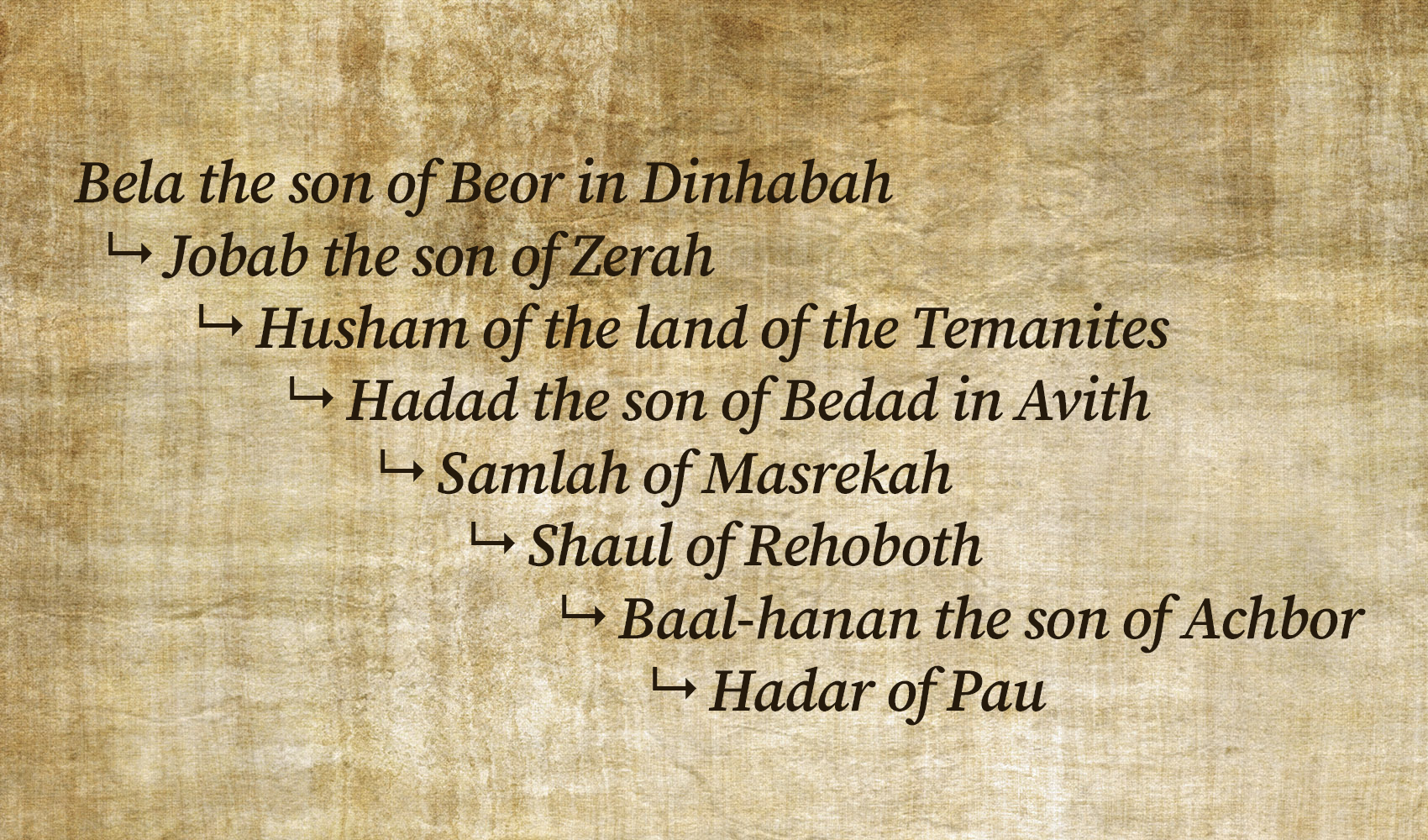
- Verse 31 contains one of the chapter’s most quietly significant phrases: these are the kings who reigned in the land of Edom, before any king reigned over the children of Israel. The Hebrew construction lifnei meloch melech li-bnei Yisrael, “before the reigning of a king to the children of Israel,” is doing chronological work that has occupied readers for centuries. The phrase suggests the chapter, or at least this verse, was composed (or finalized) at a time when there was a king reigning over Israel, that is, in the monarchic period (after roughly 1000 BCE). Some traditional readings have argued the phrase is a prophetic anticipation written by Moses; modern critical readings see it as a later editorial note inserted by a scribe working in or after the monarchy. Either way, the phrase is telling: by the time this catalogue was being compiled, Israel had its own kings, and the Edomite kings could be measured against that timeline.
- The list of seven Edomite kings (verses 32 to 39) is a kind of mini-king-list, structurally similar to the Sumerian King List and other ANE royal records. None of the seven is described as the son of his predecessor; the line is non-dynastic. Each king has a city or place named with him; each comes from a different family. The chapter is recording an early Edomite political organization that was selective rather than hereditary. Hadar (the seventh and final king) is given a wife and a maternal lineage, suggesting his family was the closing of the era and the beginning of the next phase (where the chiefs in verses 40 to 43 take over).
Influence callout: John Walton
Walton’s ANE work is helpful here. The Edomite king-list, with its non-dynastic structure, parallels the early Sumerian and pre-dynastic Egyptian records, where kingship was sometimes more elective or rotational rather than strictly hereditary. The patriarchal narrative is giving us, in seven verses, an early ANE political record. Walton argues that the chapter is doing what the rest of the Pentateuch will later do for Israel: locating the people in the surrounding political world. The Israelites will eventually have kings; the Edomites had them earlier. The chapter is recording that fact without commentary.
- The closing list of chiefs (verses 40 to 43) names eleven alufim by name and place. The names are mostly geographic (Timna, Magdiel, Iram, etc., are also place-names in Edomite territory). The chapter is closing the catalogue with a final summary of the chiefs according to their habitations in the land of their possession. The repetition of land of their possession (Hebrew eretz achuzzatam) echoes Abraham’s achuzzah (possession, landed property) at Machpelah in Genesis 23. The chapter is recording that the Edomites have, in their own way, secured their achuzzah in Seir.
- This is Esau, the father of the Edomites (verse 43). The chapter’s closing line returns to the chapter’s opening identification. Esau is Edom; the Edomites are his descendants; the people Israel will encounter, contend with, and (in the prophets) be repeatedly warned about, all begin here.
Influence callout: N.T. Wright
Wright’s broader reading of the parallel-line catalogues in Genesis names them as the Hebrew Bible’s quiet refusal of triumphalism. The covenant family is being narrowed; the line of promise is moving through Jacob; the next chapter will begin the Joseph cycle that will carry the family to Egypt. But the chapter pauses, before any of that happens, to give Esau’s full accounting. The non-chosen brother is not erased. He becomes a people; he becomes a king-list; he becomes the chiefs of a settled land. Wright argues that the patriarchal narrative is teaching, in these catalogue chapters, a posture the Hebrew Bible will keep modeling: God’s choice of one family for a particular vocation does not entail God’s abandonment of the rest. The world is bigger than the covenant line, and the canon is honest about that. Genesis 36 is one of the most extended examples.
- The chapter ends without theological commentary. There is no altar built. There is no theophany. There is no divine speech. The chapter is the calm before the storm. The next chapter will begin the Joseph cycle with the line Joseph, being seventeen years old, was feeding the flock with his brothers. The chapter that follows the toledot of Esau is the toledot of Jacob, but the toledot of Jacob will turn out to be primarily about Joseph. The patriarchal narrative is moving into its final long arc.
Reflection prompts
- The chapter is a catalogue. There are no characters in the foreground, no dialogue, no narrative action. And yet the chapter is doing real theological work: it is refusing to erase Esau’s line. Where in your life have you been tempted to skip the parts of someone’s story that did not involve you, and what does it mean to honor the canonical record by reading the lists?
- The Edomite king-list is non-dynastic. Each king came from a different family. The political organization the chapter records is rotational rather than hereditary. Where in your life or your community is leadership organized by inheritance when it could be organized differently? What might the Edomite model suggest about an alternative pattern?
- Esau settles in Seir because the land could not support both his and Jacob’s flocks. The separation is honest, practical, and amicable. The chapter does not record a final reconciliation between the brothers; it records that they parted amicably and prospered in their own territories. Where in your life is the right relational outcome more likely to be amicable separation than ongoing partnership? What does it cost to recognize that as the right ending?