
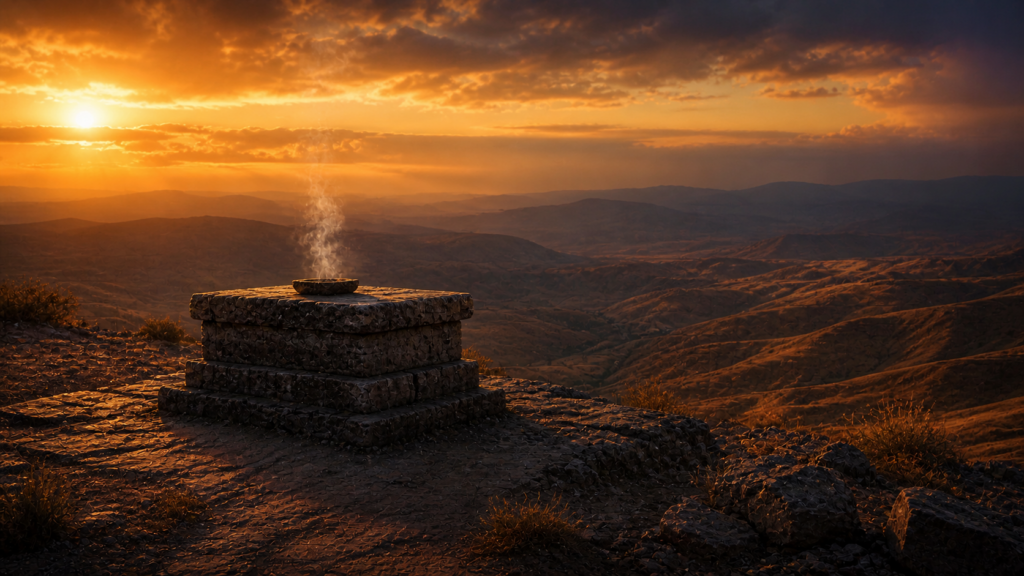
Genesis 35 closes most of the open arcs of the Jacob cycle. The household, after the violence at Shechem in chapter 34, is told by God to go up to Bethel. Jacob purges the household of foreign gods (including, presumably, the teraphim Rachel stole from Laban in chapter 31), buries them under the oak at Shechem, and travels to the place of his original theophany. He builds an altar; God appears again; the renaming to Israel is confirmed; the patriarchal blessing is repeated. Then the chapter records two deaths and one birth in quick succession: Deborah, Rebekah’s nurse, dies at Bethel; Rachel dies in childbirth giving birth to Benjamin, near Bethlehem; and finally, at the chapter’s end, Isaac dies at Hebron at one hundred eighty years old, and Esau and Jacob bury him at Machpelah together.
The chapter is structurally a closing. The Jacob cycle that began with the patriarch’s flight from Beersheba in chapter 28 ends with his return to Bethel in chapter 35, with Yahweh’s renewed blessing, with the household purged of foreign gods, with the twelfth and final son born, and with the patriarchal generation’s last patriarch (Isaac) buried. The chapter is doing for Jacob what chapter 25 did for Abraham: closing the arc with a death-and-burial scene that locates the patriarch in the geographic and theological lineage he has joined.
The chapter is also honest about loss. Two of the three deaths are women’s deaths (Deborah and Rachel). Rachel’s death in childbirth is one of the patriarchal narrative’s most painful scenes. The chapter does not soften it. The matriarch who in chapter 30 said give me children, or else I will die dies giving birth to her second son.
A · Genesis 35:1–8 · The purge and the return to Bethel
¹ God said to Jacob, “Arise, go up to Bethel, and live there. Make there an altar to God, who appeared to you when you fled from the face of Esau your brother.” ² Then Jacob said to his household, and to all who were with him, “Put away the foreign gods that are among you, purify yourselves, change your garments. ³ Let us arise, and go up to Bethel. I will make there an altar to God, who answered me in the day of my distress, and was with me on the way which I went.” ⁴ They gave to Jacob all the foreign gods which were in their hands, and the rings which were in their ears; and Jacob hid them under the oak which was by Shechem. ⁵ They traveled, and a terror of God was on the cities that were around them, and they didn’t pursue the sons of Jacob. ⁶ So Jacob came to Luz (that is, Bethel), which is in the land of Canaan, he and all the people who were with him. ⁷ He built an altar there, and called the place El Beth El; because there God was revealed to him, when he fled from the face of his brother. ⁸ Deborah, Rebekah’s nurse, died, and she was buried below Bethel under the oak; and its name was called Allon Bacuth. (Genesis 35:1–8, World English Bible)
- The chapter opens with Yahweh’s instruction. Arise, go up to Bethel, and live there. The Hebrew construction qum aleh, “arise, go up,” is the standard call to action in the Hebrew Bible. Yahweh is sending Jacob back to the place of his original theophany. The instruction is also a quiet reminder: the patriarch has been at Shechem (the place of the violence in chapter 34) and needs to move. The chapter does not say so explicitly, but the geography is making the argument. The household cannot stay at the site of the violence.
- Jacob’s response (verses 2 to 3) is one of the patriarchal narrative’s most careful purification scenes. Put away the foreign gods that are among you, purify yourselves, change your garments. Three commands. The Hebrew word for “foreign gods” (elohei ha-nekhar) is the standard term for the deities of surrounding peoples. The household has accumulated, over twenty-plus years of life among the Arameans and Hivites, a collection of foreign religious objects.
Pushback note
The Hebrew Bible has often been read as if the patriarchal household practiced an unmixed monotheism from Abraham forward. Genesis 35:2 makes clear the picture is messier. The household had foreign gods. Rachel’s theft of the teraphim from Laban (31:19) is the explicit textual case; verse 4 of this chapter (“they gave to Jacob all the foreign gods which were in their hands”) suggests the teraphim were not the only ones. The chapter is honest that the patriarchal family lived alongside, and partially within, the religious world of the surrounding peoples. The purge here is the patriarchal grandson’s first act of religious housecleaning. It will not be the last; the rest of the Hebrew Bible will keep returning to this kind of purification under the prophets and the kings.
- And the rings which were in their ears (verse 4). The Hebrew detail is unusual. Some readings see the rings as religious amulets associated with the foreign gods (the same word nezem will be used for the gold rings melted down to make the golden calf in Exodus 32:2-4). Others see them as ordinary jewelry being given up as part of the purification. Either way, the household is divesting of items associated with their old life. Jacob buries them all under the oak which was by Shechem. The same oak under which Abraham first received the land promise (Genesis 12:6) is now the burial site of the household’s foreign gods. The chapter is doing geographic theology again.
Influence callout: Walter Brueggemann
Brueggemann’s reading of the purge under the oak names it as one of the patriarchal narrative’s quiet structural moves. The household is divesting of accumulated religious clutter at the same site where the original land promise was given. Brueggemann argues that the chapter is teaching, in narrative form, what later prophets will articulate explicitly: covenant identity requires periodic purification. The covenant family does not stay clean; it accumulates. The patriarchal grandson, on the way to Bethel, leads the household in setting down what should not have been carried this far. The chapter is recording the kind of pause-and-purge that the rest of the Hebrew Bible will keep returning to.
- Verse 5 records a small protective providence. A terror of God was on the cities that were around them, and they didn’t pursue the sons of Jacob. The Hebrew word chittat Elohim, “terror of God,” is unusual. After the violence at Shechem, the surrounding peoples had every reason to retaliate. The chapter records that Yahweh placed a divine restraint on them. The household, traveling vulnerable from Shechem to Bethel, is protected by something not their own doing.
- Verse 7 records the altar’s name. El-Beth-El, “God of the house of God.” The patriarchal grandson is naming the altar by the same divine name compound the chapter has been working with: God of the place where the staircase touched. The altar’s name is the chapter’s quiet vindication of Jacob’s earlier vow at Bethel (28:20-22). He had said: if God will be with me… and I come again to my father’s house in peace, then the LORD will be my God. The conditions have been met. The altar is built. The vow is being collected.
- Verse 8 records a brief, tender death. Deborah, Rebekah’s nurse, died, and she was buried below Bethel under the oak; and its name was called Allon Bacuth. The Hebrew name Allon Bachut, “oak of weeping,” names the burial site by the household’s grief. Deborah is mentioned only twice in Genesis (24:59, where she traveled with Rebekah from Haran to marry Isaac, and here at her death). The narrator gives this old woman, who has been with the family across two generations and across the long journey from Aram-Naharaim, a single named burial. Rebekah herself is not given this in Genesis. Her nurse is. The chapter is doing quiet honoring work.
Influence callout: Nijay Gupta
The kind of attentive reading on women in biblical narrative that Gupta and others have done finds a small significant act of remembering here. Deborah is otherwise an entirely background figure in Genesis. The chapter pauses to record her death, her burial, and the place-name that commemorates the household’s grief over her. Rebekah, whose own death is not narrated in Genesis at all, is honored vicariously through the marking of her nurse’s grave. The chapter is, in its quiet pause, doing one of the patriarchal narrative’s smaller moves of female honoring. The household is grieved. The oak is named for the weeping. The detail is small and the honoring is real.
B · Genesis 35:9–15 · The renaming confirmed and the covenant repeated
⁹ God appeared to Jacob again, when he came from Paddan Aram, and blessed him. ¹⁰ God said to him, “Your name is Jacob. Your name shall not be Jacob any more, but your name will be Israel.” He named him Israel. ¹¹ God said to him, “I am God Almighty. Be fruitful and multiply. A nation and a company of nations will be from you, and kings will come out of your body. ¹² The land which I gave to Abraham and Isaac, I will give it to you, and to your offspring after you I will give the land.” ¹³ God went up from him in the place where he spoke with him. ¹⁴ Jacob set up a pillar in the place where he spoke with him, a pillar of stone. He poured out a drink offering on it, and poured oil on it. ¹⁵ Jacob called the name of the place where God spoke with him, Bethel. (Genesis 35:9–15, World English Bible)
- The renaming is confirmed. Your name is Jacob. Your name shall not be Jacob any more, but your name will be Israel. The construction echoes Genesis 32:28 at the Jabbok, but with a difference. At Jabbok, the divine being said your name shall no longer be called Jacob, but Israel, for you have struggled with God and with men, and have prevailed. Here, in Genesis 35:10, the renaming is given without the etymological reason. The chapter is, in effect, confirming what was given at Jabbok in a more formal, more public, more covenantal setting. The renaming is being received twice. Once in the night by the river. Once in the daylight at Bethel.
Influence callout: Tim Mackie
Mackie’s reading of the doubled renaming names it as the patriarchal narrative’s deliberate structural move. The renaming at Jabbok was personal, in the dark, in the wrestling, with the wound. The renaming at Bethel is public, in the daylight, at the altar, with the household watching. Mackie reads this as the chapter’s quiet pastoral teaching: the new name given in private encounter is confirmed in public covenant. The patriarchal grandson’s transformation does not stay between him and the divine wrestler; it gets sealed into the family’s geography and the family’s altar at Bethel. The renaming is now part of the covenant record.
- The covenant promises (verses 11 to 12) repeat the patriarchal language. I am God Almighty (El Shaddai) is the same name used to Abram in Genesis 17:1 and to Isaac in Genesis 28:3. Be fruitful and multiply echoes Genesis 1:28 and 9:1. A nation and a company of nations will be from you names the multiple-peoples promise; kings will come out of your body anticipates the eventual Israelite monarchy. The land grant is repeated word for word as it was given to Abraham and Isaac. The patriarchal grandson is now formally inheriting the full covenant promise.
- God went up from him in the place where he spoke with him (verse 13). The Hebrew is unusual. The phrase vayaal me’alav, “and he went up from him,” is the same idiom used of Yahweh’s departure from Abraham in Genesis 17:22 and 18:33. The chapter is using consistent vocabulary for divine ascent after a theophany. The visit ends; the patriarch is left at the altar.
- Jacob’s response (verses 14 to 15) is to set up another pillar (matzevah) at Bethel and to pour out a drink offering and oil on it. The same pillar-and-oil action he performed twenty-some years earlier in Genesis 28:18. The chapter is recording the parallel action: at Bethel-as-young-man, he marked the place with a stone pillar; at Bethel-as-old-man, he marks it again. The geography has been repeated; the action has been repeated; the name Bethel is given once more.
C · Genesis 35:16–29 · Rachel’s death, the twelve sons, Isaac’s burial
¹⁶ They traveled from Bethel. There was still some distance to come to Ephrath, and Rachel travailed. She had hard labor. ¹⁷ When she was in hard labor, the midwife said to her, “Don’t be afraid, for now you will have another son.” ¹⁸ As her soul was departing (for she died), she named him Benoni, but his father named him Benjamin. ¹⁹ Rachel died, and was buried on the way to Ephrath (also called Bethlehem). ²⁰ Jacob set up a pillar on her grave. The same is the Pillar of Rachel’s grave to this day. ²¹ Israel traveled, and spread his tent beyond the tower of Eder. ²² While Israel lived in that land, Reuben went and lay with Bilhah, his father’s concubine, and Israel heard of it. Now the sons of Jacob were twelve. ²³ The sons of Leah: Reuben (Jacob’s firstborn), Simeon, Levi, Judah, Issachar, and Zebulun. ²⁴ The sons of Rachel: Joseph and Benjamin. ²⁵ The sons of Bilhah (Rachel’s servant): Dan and Naphtali. ²⁶ The sons of Zilpah (Leah’s servant): Gad and Asher. These are the sons of Jacob, who were born to him in Paddan Aram. ²⁷ Jacob came to Isaac his father, to Mamre, to Kiriath Arba (which is Hebron), where Abraham and Isaac lived as foreigners. ²⁸ The days of Isaac were one hundred eighty years. ²⁹ Isaac gave up the spirit and died, and was gathered to his people, old and full of days. Esau and Jacob, his sons, buried him. (Genesis 35:16–29, World English Bible)
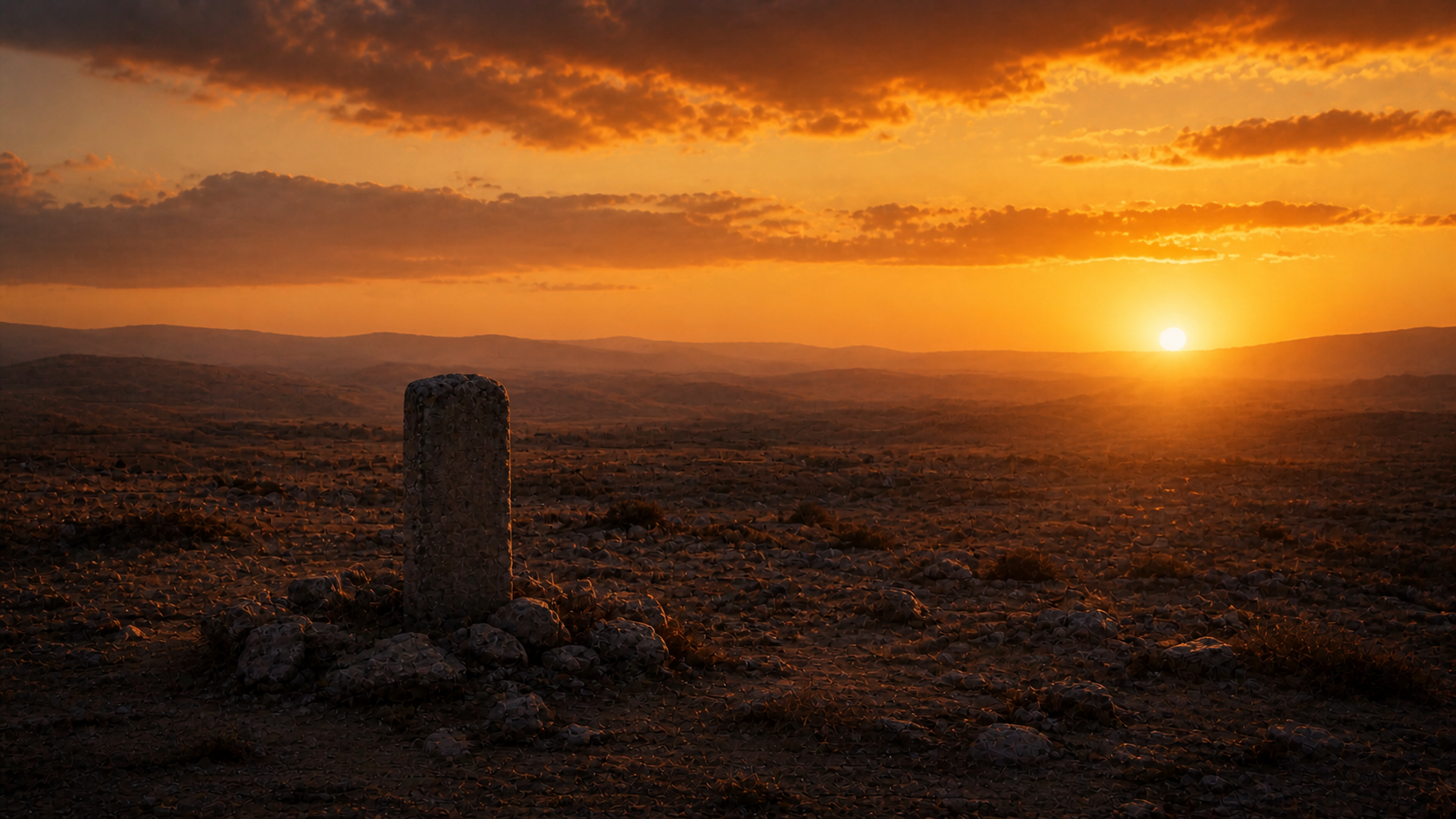
- Rachel’s death (verses 16 to 20) is the chapter’s deepest grief. The household is traveling from Bethel toward Ephrath (later identified with Bethlehem). Rachel goes into labor on the road. The Hebrew word vatekash be-lidtah, “and her labor was hard,” names the difficulty. The midwife tries to comfort her: don’t be afraid, for now you will have another son. The midwife is, by ANE convention, telling Rachel that her hope from chapter 30 is being kept. May the LORD add another son to me, she had named at Joseph’s birth. The added son is here, in this labor. The chapter is keeping the promise.
- Verse 18 is one of the saddest sentences in Genesis. As her soul was departing (for she died), she named him Benoni, but his father named him Benjamin. The Hebrew is vatehi b’tzet nafshah ki metah, “and it was, as her soul was going out, that she died.” Rachel names her last son Ben-Oni, “son of my sorrow” (or “son of my pain”). Jacob renames him Binyamin, “son of the right hand.”
Word study: Benoni (בֶּן־אוֹנִי) and Benjamin (בִּנְיָמִין)
Two names given to one boy in two seconds. Rachel’s name Ben-Oni combines ben (son) with oni (sorrow, pain, vigor in some readings). Jacob’s name Binyamin combines ben (son) with yamin (right hand). The right hand in Hebrew idiom is the place of strength, honor, blessing. Jacob is, in the renaming, doing two things at once: he is honoring the boy his beloved wife just bore, and he is gently overwriting Rachel’s grief-name with a name of blessing. The chapter is recording the gesture without commenting on it. Rachel’s last word names the sorrow of her death; the patriarch’s renaming names the boy as the son of strength.
Influence callout: Walter Brueggemann
Brueggemann’s reading of the renaming notes the chapter’s quiet pastoral honesty. Rachel’s grief-name and Jacob’s blessing-name both stand. The narrator does not erase Rachel’s Ben-Oni; it is recorded forever in this verse. The patriarch’s renaming does not pretend Rachel’s grief did not happen; it gives the boy a different name to walk through life with. Brueggemann argues that the chapter is teaching a small pastoral truth about how grief and blessing can coexist: the grieved name and the blessing name are both real; both are recorded; the canonical text holds them together. The boy is, for the rest of his life, Benjamin, but the canonical record still has Rachel’s Ben-Oni as his first name.
- Rachel is buried on the way to Ephrath (also called Bethlehem) (verse 19). The geographic note is loaded. Rachel’s grave will become a recurring reference point in the Hebrew Bible. Jeremiah 31:15 will use it: a voice is heard in Ramah, lamentation and bitter weeping. Rachel is weeping for her children. She refuses to be comforted for her children, because they are no more. Matthew 2:18 will quote Jeremiah’s verse to describe the slaughter of the innocents at Bethlehem. The matriarch’s grave on the road to Bethlehem becomes, by the rest of the canon’s reading, the place where Israel’s grief over its lost children is permanently located. The chapter is laying down geography that will reach forward by centuries.
Influence callout: Tim Mackie
Mackie’s reading of Rachel’s burial site notes the canonical thread it opens. The matriarch buried near Bethlehem becomes, in Jeremiah and then in Matthew, the figure of a mother weeping for her children. Mackie reads this as one of the Hebrew Bible’s deeper patterns: small details in the patriarchal narrative become, in later books, large theological touchpoints. The chapter is not telling us what Rachel’s grave will mean by the time of Jeremiah. It is just recording where she was buried. The chapter is laying down the seed; the canon will return to it.
- Jacob set up a pillar on her grave (verse 20). The same pillar action he has done at Bethel and elsewhere. The chapter is consistent: where the patriarch encounters the divine and where the matriarch is buried both get marked with stone. The Hebrew matzevah is the patriarch’s recurring gesture of memory.
- Verse 22 records, in one short clause, one of the chapter’s most dropped-in moments. While Israel lived in that land, Reuben went and lay with Bilhah, his father’s concubine, and Israel heard of it. The patriarch’s eldest son, Leah’s firstborn, has done something the rest of Genesis treats as a serious violation. The narrator does not narrate the scene; the narrator just records the act and the patriarch’s hearing. Genesis 49:3-4 will return to this in Jacob’s deathbed pronouncement: Reuben, you are my firstborn… unstable as water, you will not have preeminence, because you went up to your father’s bed. The chapter is, again, planting consequence to be harvested later. Reuben’s first-born status will be effectively forfeit.
Influence callout: N.T. Wright
Wright’s reading of these planted-consequences in the Jacob cycle names them as the patriarchal narrative’s quiet preparation for Genesis 49 (Jacob’s deathbed blessings). Reuben’s loss of firstborn-status will pass the leadership-line through to Judah. Simeon and Levi’s curse from Genesis 34 will produce the diminishment of those tribes. Joseph’s eventual prominence will produce the double portion through Ephraim and Manasseh. Wright argues that the Jacob cycle is doing structural work for the rest of the Bible: the line that will produce David and the kingship runs through Judah, the fourth son, by way of the chapter’s recorded violations of the older brothers. Genesis 35:22 is one of the seeds of that long arc.
- Verses 23 to 26 catalogue the twelve sons by their mothers. The list is now complete: six from Leah, two from Rachel, two from Bilhah, two from Zilpah. The patriarchal household has its full complement of sons. The next chapter will catalogue Esau’s descendants; chapter 37 will begin the Joseph cycle.
- Verses 27 to 29 close the chapter with Isaac’s death. Jacob came to Isaac his father, to Mamre, to Kiriath Arba (which is Hebron), where Abraham and Isaac lived as foreigners. The chapter is bringing Jacob back to his father’s house at last. The reunion, after twenty-plus years, is recorded in one verse. Then the death: the days of Isaac were one hundred eighty years. Isaac gave up the spirit and died, and was gathered to his people, old and full of days.
- The closing verse is the chapter’s quiet structural mirror to chapter 25. Esau and Jacob, his sons, buried him. The same construction Genesis 25:9 used for Abraham’s burial: Isaac and Ishmael, his sons, buried him in the cave of Machpelah. The patriarchal narrative is repeating the burial motif: the brothers who were estranged in life come together at the father’s grave. Jacob and Esau are reunited, briefly, at Machpelah, just as Isaac and Ishmael were reunited there.
Influence callout: Brian Zahnd
Zahnd’s reading of the patriarchal-burial pattern names it as one of the Hebrew Bible’s quietest gestures of reconciliation. The covenant family’s brothers do not always get full restoration. They get a shared grave. Zahnd argues that the chapter is teaching, by its repetition of the burial motif across generations, that reconciliation in real human life often looks like this: brothers who have been separated for decades coming together for one task. The chapter does not record what Jacob and Esau said at Isaac’s grave. It just records that they were both there. That is, the chapter quietly suggests, what reconciliation in this family has come to look like.
Reflection prompts
- Jacob’s purge of the household before the return to Bethel suggests that covenant identity requires periodic divestment. What in your life is the equivalent of the foreign gods buried under the oak at Shechem, things that came home with you from a long season and need to be set down before the next return? Where might the household’s pause-and-purge be calling you?
- Rachel names her son Ben-Oni (son of my sorrow); Jacob renames him Benjamin (son of the right hand). The chapter holds both names without erasing either. Where in your life have you been given a grief-name and a blessing-name for the same thing, and what does it mean to let both stand?
- Esau and Jacob bury their father together. The chapter does not describe what they said or did beyond the burial; it just records that they were both there. Where in your life is reconciliation more likely to look like a shared task than a dramatic restoration? What would it cost you to show up for that shared task?