
Genesis 37 opens the Joseph cycle, the longest and most sustained narrative in Genesis. Fourteen chapters (37 to 50) will follow Joseph from his teenage years in Canaan, through slavery and prison in Egypt, to the height of Egyptian power, to the eventual reunion with the family that betrayed him, and finally to Jacob’s death and Joseph’s own dying instructions. The cycle is a unified literary work, and chapter 37 is its prologue.
The chapter is, on the surface, a family-conflict story. Joseph at seventeen is the favored son; his father gives him an ornamented coat that marks him as the chosen heir; he tells his brothers two dreams in which they bow to him; the brothers hate him more with each provocation. Joseph is sent to check on his brothers near Shechem; he finds them at Dothan; they see him coming and plot to kill him. Reuben intervenes; Judah proposes selling him instead; the brothers sell Joseph to a passing caravan of Ishmaelite-Midianite traders. The coat is dipped in goat’s blood and sent home as evidence that Joseph has been killed by a wild animal. Jacob’s grief is unconsolable. The chapter ends with Joseph in Egypt, sold to Potiphar, an officer of Pharaoh.
Underneath the family-conflict story, the chapter is doing structural work the rest of the cycle will keep activating. The narrator’s pattern is to plant motifs in chapter 37 that will be paid off across chapters 38 to 50. The ornamented coat will return as a stripped garment in chapter 39. The dreams will be answered by Joseph’s interpreting of others’ dreams in chapters 40 and 41. The brothers’ bowing will eventually happen, three times, in chapters 42, 43, and 44. The deception of Jacob with the bloody coat will be answered, twenty-some years later, by the recognition scene in chapter 45. Genesis 37 is the chapter that sets the table for everything that follows.
The chapter is also doing one of the patriarchal narrative’s deepest hyperlinks. The deception of Jacob in this chapter (the brothers showing him the bloody coat and saying check whether or not it is your son’s coat) is the deliberate echo of Jacob’s own deception of Isaac in chapter 27 (the patriarch presenting himself in goat-hair as Esau). The man who deceived his blind father with goat-hair is, in chapter 37, deceived by his own sons with goat-blood. The narrator does not editorialize. The chapter just records the parallel and lets the reader feel it.
A · Genesis 37:1–11 · The favored son and the dreams
¹ Jacob lived in the land of his father’s travels, in the land of Canaan. ² This is the history of the generations of Jacob. Joseph, being seventeen years old, was feeding the flock with his brothers. He was a boy with the sons of Bilhah and Zilpah, his father’s wives. Joseph brought an evil report of them to their father. ³ Now Israel loved Joseph more than all his children, because he was the son of his old age, and he made him a coat of many colors. ⁴ His brothers saw that their father loved him more than all his brothers, and they hated him, and couldn’t speak peaceably to him. ⁵ Joseph dreamed a dream, and he told it to his brothers, and they hated him all the more. ⁶ He said to them, “Please hear this dream which I have dreamed: ⁷ for behold, we were binding sheaves in the field, and behold, my sheaf arose and also stood upright; and behold, your sheaves came around, and bowed down to my sheaf.” ⁸ His brothers asked him, “Will you indeed reign over us? Will you indeed have dominion over us?” They hated him all the more for his dreams and for his words. ⁹ He dreamed yet another dream, and told it to his brothers, and said, “Behold, I have dreamed yet another dream: and behold, the sun and the moon and eleven stars bowed down to me.” ¹⁰ He told it to his father and to his brothers. His father rebuked him, and said to him, “What is this dream that you have dreamed? Will I and your mother and your brothers indeed come to bow ourselves down to you to the earth?” ¹¹ His brothers envied him, but his father kept this saying in mind. (Genesis 37:1–11, World English Bible)
- The chapter opens with the standard toledot formula. This is the history of the generations of Jacob. The chapter’s stated subject is Jacob, but the chapter that follows is dominated by Joseph. The narrator is, in this small framing move, telling us how to read the Joseph cycle. It is Jacob’s generations, but the carrier of those generations going forward is the eleventh son. The chapter’s grammatical center is the patriarch; its narrative center is his son.
- Verse 2 is the chapter’s first character introduction. Joseph, being seventeen years old, was feeding the flock with his brothers. He was a boy with the sons of Bilhah and Zilpah, his father’s wives. Joseph brought an evil report of them to their father. The narrator gives us four pieces of information at once: Joseph is seventeen; he is working with the flocks; he is specifically with the sons of the slave-women (Bilhah’s two and Zilpah’s two); and he is reporting on them to their father. The chapter is setting up what kind of teenager Joseph is, and the picture is not flattering. He is the favored younger son who carries tales home about the brothers he is supposed to be working alongside.
Pushback note
Some readings have softened Joseph in this opening verse, framing him as a young man trying to do the right thing by reporting genuine wrongdoing. The text does not flatter him that strongly. The Hebrew word dibbatam ra’ah, “their evil report,” is the kind of phrase that often denotes slander or unwelcome truth-bearing. Joseph is, in his teenage years, the kind of brother whose presence in a family system produces rivalry. He is not the chapter’s pure hero; the chapter is honest that his role in the family conflict is not zero. The narrator records this without commentary, but the early-chapter portrait is of a boy whose behaviors contribute to the friction even before the dreams arrive.
- Israel loved Joseph more than all his children, because he was the son of his old age (verse 3). The patriarchal grandson is, by his own emotional life, repeating the parental favoritism that broke his own family. His own father loved Esau (because of the venison); his own mother loved him (because she did). He loved Rachel more than Leah, and now he loves Rachel’s son more than the others. The chapter is recording a family pattern across two generations.
Influence callout: Tim Mackie
Mackie’s reading of the Joseph cycle’s opening foregrounds the parental-favoritism pattern. Genesis has been recording, since chapter 25, the slow damage of preferring one child over another. Isaac loved Esau; Rebekah loved Jacob; the family pulled apart. Now Jacob loves Joseph; Leah’s sons hate Joseph. Mackie reads the Joseph cycle as the patriarchal narrative’s most extended treatment of how parental favoritism wounds the next generation. The chapter’s first three verses set up the wound that will produce everything that follows. Joseph’s eventual twenty-year journey into Egypt and back is, in part, the long road of repair from a wound the parents could have refused to inflict.
- He made him a coat of many colors (verse 3). The Hebrew is ketonet passim, the same phrase used only one other place in the entire Hebrew Bible: of Tamar, daughter of David, in 2 Samuel 13:18, where it is described as the garment of the king’s virgin daughters. The phrase has been variously translated: “coat of many colors” (the traditional rendering, going back to the Septuagint), “long-sleeved coat” (some modern translations), “ornamented robe” (the cultural sense). What the phrase clearly does not mean is an ordinary work garment. The ketonet passim is a specific, distinctive piece of clothing that marked the wearer as the favored child or the heir. The chapter is recording a deliberate sartorial signal.
Word study: ketonet passim (כְּתֹנֶת פַּסִּים), “ornamented coat”
A specific Hebrew phrase appearing only in Genesis 37 (of Joseph) and 2 Samuel 13:18 (of Tamar). The Septuagint translated it as chitona poikilon, “varied-colored tunic,” giving English the famous “coat of many colors.” Modern lexicographers debate whether the passim refers to colors, to the long sleeves, or to ornamental details (palm-like patterns, perhaps). What is clear is that the garment was distinctive, expensive, and signaled the wearer’s status as the favored heir or the king’s daughter. The chapter is using a deliberately rare Hebrew phrase to mark the family conflict it is about to produce.
- The brothers’ hatred (verses 4 to 5) is recorded in escalating Hebrew. They hated him (verse 4). They hated him all the more (verse 5). They hated him all the more for his dreams and for his words (verse 8). The narrator is using the same verb (sane, to hate) three times across five verses, intensifying each time. The chapter is being honest about the depth of family animosity.
- The two dreams (verses 5 to 11) follow a deliberate parallelism. The first dream is agricultural: sheaves of grain bowing in the field. The second dream is cosmic: the sun, moon, and eleven stars bowing in the sky. The first dream uses imagery from the brothers’ world (they are shepherds and harvesters). The second dream uses imagery from the family’s broader story (the sun and moon and stars echoing Joseph’s grandmother Rebekah and great-grandmother Sarah, perhaps). The chapter is escalating: the first dream is about the brothers; the second dream includes the parents. By the second dream, even Jacob is uncomfortable.
Pushback note
Some readings of Joseph’s dreams have moralized his telling of them as itself a failure. He should not have told the dreams to his brothers; he was provoking them. The text does not quite go there. The chapter records that Joseph did tell the dreams; the brothers’ reaction is recorded in their words; the chapter does not editorialize about whether Joseph’s telling was wise. What we can say is that the dreams turn out to be true. The brothers do bow to him in chapter 42. The full family does bow eventually. The dreams are real divine communications, and their content is real. Whether seventeen-year-old Joseph’s telling of them was wise is a separate question; the dreams themselves were not Joseph’s projection. The chapter is doing two things at once: showing a teenager whose tact is poor, and showing a divine communication that will be fulfilled.
- Jacob’s response (verse 11) is one of the chapter’s most subtle phrases. His brothers envied him, but his father kept this saying in mind. The Hebrew shamar et-ha-davar, “kept the matter,” uses the same verb (shamar) the patriarchal narrative has used since Eden (for Adam keeping the garden). Jacob is, in this small phrase, doing what the wisdom tradition will later call “treasuring up”: holding the words in mind without acting on them, letting them work. Mary in Luke 2:19 will treasure up the shepherds’ words in the same way. The patriarchal grandson rebukes Joseph publicly but, in private, holds the dreams as something he is not yet ready to dismiss.
B · Genesis 37:12–24 · The brothers, Reuben, the pit
¹² His brothers went to feed their father’s flock in Shechem. ¹³ Israel said to Joseph, “Aren’t your brothers feeding the flock in Shechem? Come, and I will send you to them.” He said to him, “Here I am.” ¹⁴ He said to him, “Go now, see whether it is well with your brothers, and well with the flock; and bring me word again.” So he sent him out of the valley of Hebron, and he came to Shechem. ¹⁵ A certain man found him, and behold, he was wandering in the field. The man asked him, “What are you looking for?” ¹⁶ He said, “I am looking for my brothers. Tell me, please, where they are feeding the flock.” ¹⁷ The man said, “They have left here, for I heard them say, ‘Let us go to Dothan.’” Joseph went after his brothers, and found them in Dothan. ¹⁸ They saw him afar off, and before he came near to them, they conspired against him to kill him. ¹⁹ They said to one another, “Behold, this dreamer comes. ²⁰ Come now therefore, and let’s kill him, and cast him into one of the pits, and we will say, ‘An evil animal has devoured him.’ We will see what will become of his dreams.” ²¹ Reuben heard it, and delivered him out of their hand, and said, “Let’s not take his life.” ²² Reuben said to them, “Shed no blood. Throw him into this pit that is in the wilderness, but lay no hand on him” (that he might deliver him out of their hand, to restore him to his father). ²³ When Joseph came to his brothers, they stripped Joseph of his coat, the coat of many colors that was on him; ²⁴ and they took him, and threw him into the pit. The pit was empty. There was no water in it. (Genesis 37:12–24, World English Bible)
- Verse 12 sends the brothers to Shechem. The geographic detail is loaded. Shechem was the site of the violence in chapter 34. The brothers (especially Simeon and Levi) had killed an entire city there. Returning to feed flocks at Shechem is, by the chapter’s quiet implication, a return to the place where the family had its worst hour. Jacob sending Joseph to check on them at Shechem is the patriarch sending his favored son into the territory of the brothers’ worst memories.
- Joseph’s response to Jacob’s send-off (verse 13) is the single Hebrew word hineni, “here I am.” The same word Abraham said to God at the call (Genesis 22:1, 7, 11) and at the binding (Genesis 22:1). The same word Moses will say at the burning bush. The same word Samuel will say to Eli. Hineni is the disposition of full availability. Joseph, the seventeen-year-old, says it to his father about a journey that will end his life as he knows it. The chapter is using the canonical word of obedient availability for a journey that will become a long suffering.
- The geography of the search (verses 14 to 17) is mapped with care. Joseph leaves the valley of Hebron, where Jacob is camped near Mamre. He travels north to Shechem (a distance of about fifty miles). He cannot find his brothers there. A stranger directs him further north to Dothan (about fifteen miles further). Joseph is, by the time he finds his brothers, deep in the territory the family has been most embedded in.
Influence callout: Ray Vander Laan
Vander Laan’s geographic teaching here is helpful. Dothan sits on a major trade route from Damascus and the eastern caravan paths down toward Egypt. The Ishmaelite-Midianite caravans that will buy Joseph in verses 25 to 28 routinely passed through Dothan on their way south. The chapter is, in its geography, setting up the meeting of trade and family conflict. The brothers’ decision to sell Joseph rather than kill him will be made possible because they happen to be at the place where caravans toward Egypt regularly stop. Vander Laan reads this as one of the chapter’s small structural details: the providence that sends Joseph to Egypt operates partly through the ordinary movements of ANE trade.
- The brothers’ conspiracy (verses 18 to 20) is calculated. They saw him afar off, and before he came near to them, they conspired against him to kill him. The Hebrew vayitnaklu oto la-hamito, “they plotted against him to kill him,” uses the strong verb of deliberate scheming. Behold, this dreamer comes. The brothers’ word for Joseph is ba’al ha-chalomot, “the master/lord of dreams,” used here mockingly. They want to test whether his dreams will save him.
Pushback note
The brothers’ phrase we will see what will become of his dreams (verse 20) has been read by some commentators as the chapter’s clearest moral indictment. The brothers are, in their own words, setting themselves against the divine communication. They are not just killing a brother; they are testing God. The chapter does not editorialize, but the phrase itself is doing the indicting. The brothers’ violence is being framed, in their own mouths, as a contest with the source of the dreams. This is the chapter’s quiet theological move: the brothers’ murderous intent is not just fratricide; it is, in its own self-stated logic, an attempt to disprove what God has been showing them.
- Reuben’s intervention (verses 21 to 22) is the chapter’s first quiet rescue. The eldest brother, who in chapter 35:22 had violated his father’s concubine and forfeited his moral claim on the family, is here trying to save Joseph. The narrator notes the reason: that he might deliver him out of their hand, to restore him to his father. Reuben is trying, in this chapter, to begin recovering what he lost in the previous chapter. The plan is to throw Joseph in a pit and rescue him later. The plan will not work; Reuben will be away when the brothers sell Joseph; he will return to find Joseph gone. But the chapter is recording, with characteristic restraint, that the eldest brother tried.
Influence callout: Walter Brueggemann
Brueggemann’s reading of Reuben’s intervention names it as the patriarchal narrative’s quiet pastoral move. Reuben is not a clean hero; chapter 35:22 is in his record. But chapter 37 records his small attempt to act differently. The chapter is teaching, in the elder brother’s failed-but-genuine effort, that moral repair often looks like this: not full restoration, but small attempts at acting differently when the next opportunity comes. Reuben’s plan does not save Joseph. The chapter records the trying anyway. Brueggemann argues that this is one of the patriarchal narrative’s deeper pastoral notes: the family’s flawed members are still capable, in their flawed ways, of trying to do the next right thing.
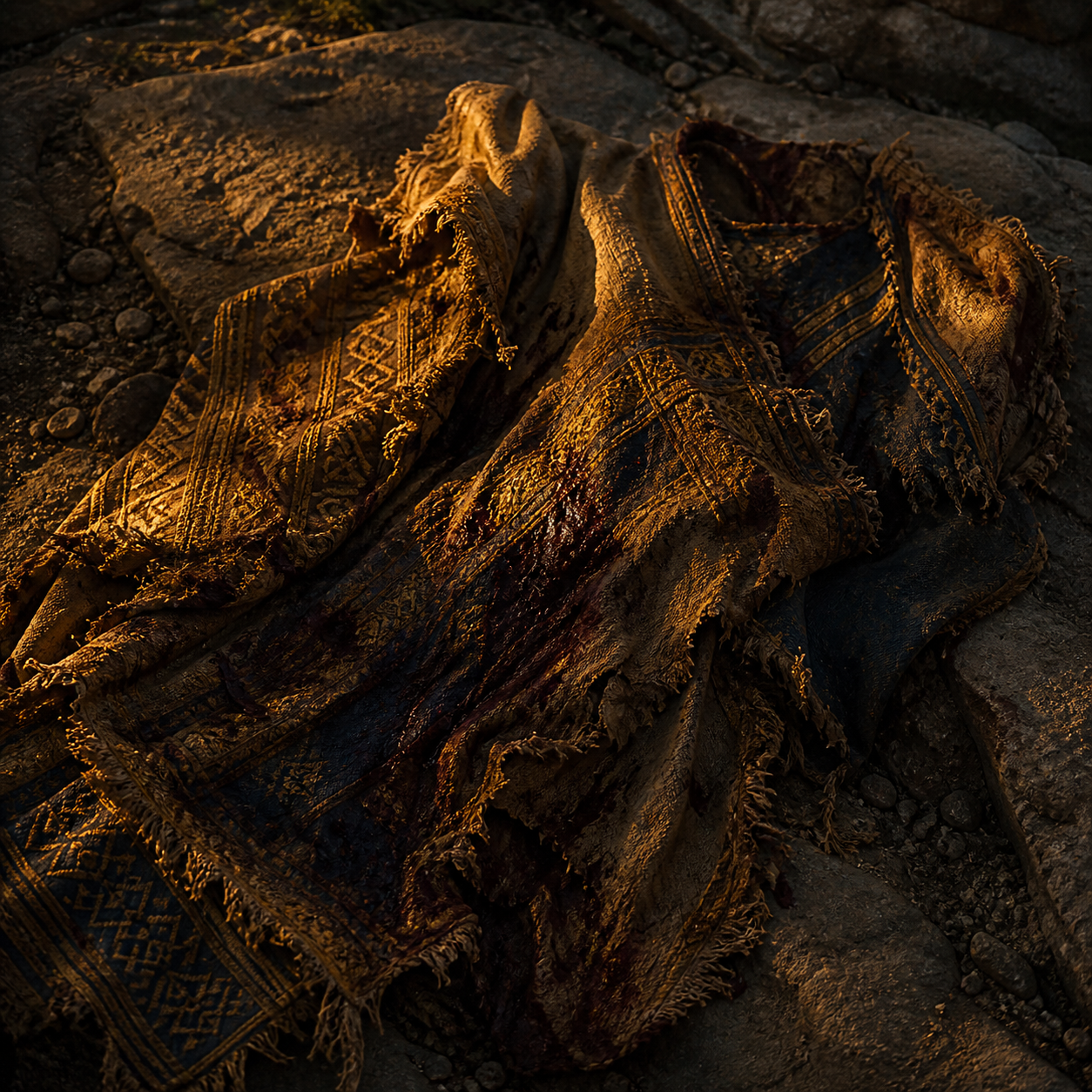
- Verse 23 records the stripping. They stripped Joseph of his coat, the coat of many colors that was on him. The narrator names the coat twice: his coat, the coat of many colors. The garment that marked Joseph as the favored son is being removed, deliberately, by the brothers who hated him for it. The stripping is doing symbolic work the chapter does not need to explain. The coat will return, in the next section, dipped in blood. The coat is the chapter’s central garment, and its life across the chapter (given by Jacob, stripped by the brothers, dipped in blood, presented to Jacob, mourned by Jacob) traces the chapter’s entire arc.
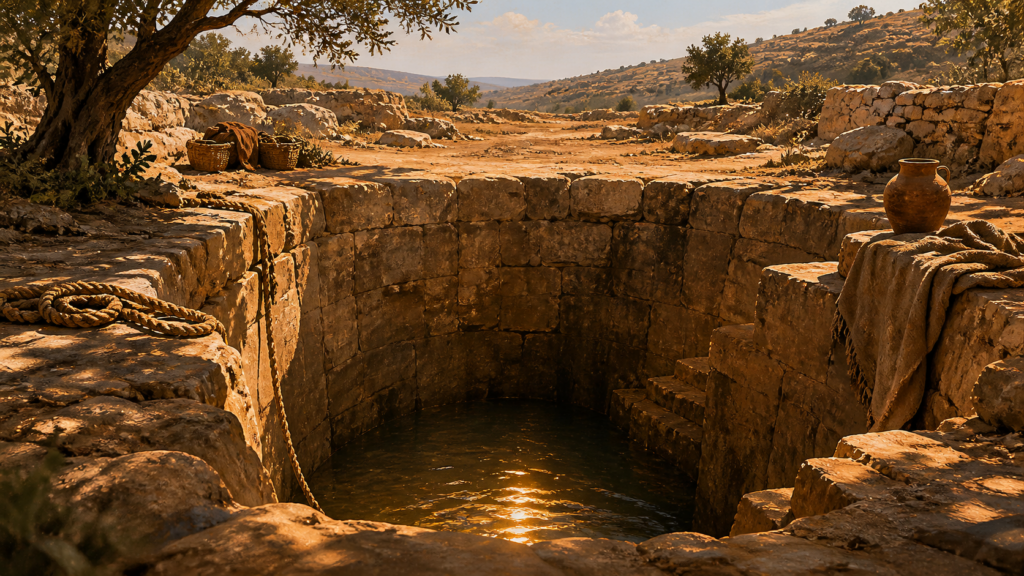
- They took him, and threw him into the pit. The pit was empty. There was no water in it. (verse 24). The Hebrew bor (pit, cistern) is a typical Negev water-storage feature: a deep cylindrical cut in limestone, narrow at the top, wider below. Empty cisterns were common. Joseph could not have escaped on his own. The chapter records the detail without dramatizing it: he is in a hole he cannot climb out of. The geography is the chapter’s quiet setup for what comes next.
C · Genesis 37:25–36 · The sale and the bloody coat
²⁵ They sat down to eat bread, and they lifted up their eyes and looked, and saw a caravan of Ishmaelites was coming from Gilead, with their camels carrying spices and balm and myrrh, going to carry it down to Egypt. ²⁶ Judah said to his brothers, “What profit is it if we kill our brother and conceal his blood? ²⁷ Come, and let’s sell him to the Ishmaelites, and not let our hand be on him; for he is our brother, our flesh.” His brothers listened to him. ²⁸ Midianites who were merchants passed by, and they drew and lifted up Joseph out of the pit, and sold Joseph to the Ishmaelites for twenty pieces of silver. They brought Joseph into Egypt. ²⁹ Reuben returned to the pit, and saw that Joseph wasn’t in the pit; and he tore his clothes. ³⁰ He returned to his brothers, and said, “The child is no more; and I, where will I go?” ³¹ They took Joseph’s coat, and killed a male goat, and dipped the coat in the blood. ³² They took the coat of many colors, and they brought it to their father, and said, “We have found this. Examine it, now, whether it is your son’s coat or not.” ³³ He recognized it, and said, “It is my son’s coat. An evil animal has devoured him. Joseph is without doubt torn in pieces.” ³⁴ Jacob tore his clothes, and put sackcloth on his waist, and mourned for his son many days. ³⁵ All his sons and all his daughters rose up to comfort him, but he refused to be comforted. He said, “For I will go down to Sheol to my son mourning.” His father wept for him. ³⁶ The Midianites sold him into Egypt to Potiphar, an officer of Pharaoh’s, the captain of the guard. (Genesis 37:25–36, World English Bible)
- Verse 25 records the brothers’ meal. They sat down to eat bread. The Hebrew construction is unsparing. The brothers, having just thrown their seventeen-year-old brother into a pit, sit down to eat lunch. The narrator places the meal next to the pit. The chapter is honest about the calmness of the violence. The brothers are not in a frenzy; they are processing what they have just done while having a meal.
- The caravan arrives (verse 25). A caravan of Ishmaelites was coming from Gilead, with their camels carrying spices and balm and myrrh, going to carry it down to Egypt. The Ishmaelites are the descendants of Abraham’s other son (Genesis 16, 21). The trade goods (spices, balm, myrrh) were luxuries for the Egyptian embalming industry. The destination is Egypt. The chapter is pointing the reader, with careful historical and geographic detail, toward where Joseph is about to go.
- Judah’s proposal (verses 26 to 27) is the chapter’s pivotal speech. What profit is it if we kill our brother and conceal his blood? Come, and let’s sell him to the Ishmaelites, and not let our hand be on him; for he is our brother, our flesh. Judah’s speech has two halves. The first is calculating: what profit is it. The second is moral: he is our brother, our flesh. The narrator is recording, with characteristic restraint, that Judah’s intervention is mixed. He is concerned about the moral weight of fratricide; he is also concerned about the financial advantage. The chapter is honest about the mix.
Influence callout: N.T. Wright
Wright’s reading of Judah’s speech in this chapter, paired with Judah’s later prominence in the family (chapters 38, 43, 44, 49), names it as the patriarchal narrative’s quiet preparation of Judah as the brother through whom the kingship will eventually run. Reuben’s moral standing has been compromised by his own actions in chapter 35; Simeon and Levi’s by their violence in chapter 34; Judah is, in chapter 37, the brother whose voice prevents the murder. The voice is mixed; Wright reads this as part of the chapter’s argument. Judah is not a clean hero. He is, in this chapter, a calculating brother whose calculation included a moral floor. The kingship will eventually run through Judah’s tribe; David will descend from him; Christ will descend from David. The chapter is, in its quiet way, locating the seed of that lineage in Judah’s mixed-but-real moral intervention.
- The transaction (verse 28) is recorded with quick economy. Midianites who were merchants passed by, and they drew and lifted up Joseph out of the pit, and sold Joseph to the Ishmaelites for twenty pieces of silver. The Hebrew is briefer than the English. The sale price is twenty shekels of silver, which Leviticus 27:5 will later set as the standard valuation of a male between five and twenty years old. The chapter is recording the transaction at the standard cultural rate. Joseph is being sold for the going price.
Pushback note
The Hebrew text of verse 28 has confused readers for centuries by alternating between “Midianites” and “Ishmaelites” as the merchants. Some scholars read this as evidence of two distinct source traditions stitched together; others read the two terms as broadly interchangeable in the patriarchal period (the Ishmaelites and Midianites were closely related desert-trade peoples, both descended from Abraham). What is clear is that the chapter records two non-Israelite identifiers for the same caravan and that Joseph ends up in Egypt. The textual complexity is real; the narrative result is unambiguous.
- Reuben’s discovery (verses 29 to 30) is the chapter’s most heartbreaking moment of quiet failure. The eldest brother had planned to rescue Joseph. He returns to the pit. Joseph is gone. Reuben tears his clothes. The child is no more; and I, where will I go? The Hebrew va-ani anah ani-va, “and I, where will I go,” is the cry of a man whose plan has failed and who knows the consequence will fall on him. The eldest brother carried responsibility, in ANE convention, for the younger brothers under his care. Reuben is naming, in this verse, that he will be the one accountable.
- The brothers’ deception of Jacob (verses 31 to 33) is one of the chapter’s most loaded moments. They took Joseph’s coat, and killed a male goat, and dipped the coat in the blood. The Hebrew vayishchatu se’ir izzim, “and they slaughtered a male goat,” uses the same Hebrew construction as Genesis 27:9 (Rebekah’s instruction to Jacob: go now to the flock, and get me from there two good young goats). The patriarch who deceived his blind father with goatskins on his arms in chapter 27 is now being deceived by his own sons with goat blood on a coat in chapter 37.
Influence callout: Tim Mackie
Mackie’s reading of this hyperlink names it as one of the patriarchal narrative’s most precise structural ironies. The deceiver is being deceived. The patriarch who used goat to deceive his father is, decades later, being shown a goat-bloodied garment by his own sons. The chapter does not editorialize; the parallel is enough. Mackie reads this as the patriarchal narrative’s quiet theological argument: the family’s deceptive instincts run in the line, and the long arc of consequences eventually returns. The Jacob who fled Beersheba in chapter 28 is the Jacob who weeps over Joseph’s coat in chapter 37, holding the same kind of evidence he himself once produced.
- The brothers’ phrase to Jacob is also precisely chosen: examine it, now, whether it is your son’s coat or not (verse 32). The Hebrew haker-na ha-ketonet binka hi im-lo, “recognize, now, the coat of your son or not.” The verb haker (to recognize) will return in chapter 38 (haker-na, Tamar’s words to Judah, recognize, please, whose these are) and in chapter 42 (va-yaker Yosef, Joseph recognized his brothers). The narrator is using the same verb across the cycle as a marker of recognition-and-deception. The brothers ask Jacob to recognize the coat; Tamar will ask Judah to recognize his pledge; Joseph will recognize his brothers. The chapter is laying down vocabulary that will run for the rest of the cycle.
Word study: haker (הַכֶּר), “recognize”
The Hebrew verb of recognition runs through the Joseph cycle as a structural keyword. It appears in 37:32 (the brothers ask Jacob to recognize Joseph’s coat), 38:25 (Tamar asks Judah to recognize his signet, cord, and staff), 38:26 (Judah recognizes them), 42:7-8 (Joseph recognizes his brothers but they do not recognize him), and elsewhere. The chapter is using the verb as a deliberate tracker. Each time haker appears, the chapter is asking who knows what they are looking at. The verb’s repeated use across the cycle is one of Hebrew narrative’s most careful structural moves.
- Jacob’s response (verses 33 to 35) is the patriarchal narrative’s longest single-character grief scene. He recognized it, and said, “It is my son’s coat. An evil animal has devoured him. Joseph is without doubt torn in pieces.” He tears his clothes. He puts sackcloth on his waist. He mourns for many days. All his sons and all his daughters rose up to comfort him, but he refused to be comforted. The chapter is recording, with painful detail, that the family who deceived him cannot now console him. I will go down to Sheol to my son mourning. The patriarchal grandson’s grief is unconsolable.
Influence callout: Walter Brueggemann
Brueggemann’s reading of Jacob’s grief in this chapter names it as one of the patriarchal narrative’s deepest pastoral moments. The chapter is honest about the consequences of the family system. The patriarch who favored Joseph is now grieving Joseph; the brothers who hated Joseph are now unable to comfort the father whose grief their own actions caused. He refused to be comforted. Brueggemann argues that this is the chapter’s quiet pastoral truth: the wounds of family systems do not always allow the comfort the system itself wants to give. The chapter does not soften this. Jacob mourns. The brothers stand by. The chapter ends with the patriarch in sackcloth, the brothers silent, and the boy in Egypt.
- The chapter closes with one verse (verse 36): the Midianites sold him into Egypt to Potiphar, an officer of Pharaoh’s, the captain of the guard. The transition is abrupt. The chapter has been about Canaan; the next clause moves to Egypt. The narrator does not pause. Joseph is sold; Joseph arrives; Joseph is in Potiphar’s house. The Joseph cycle’s first geographic shift has happened in a single closing verse. The next chapter (38) will surprisingly turn back to Canaan to record the Judah-and-Tamar story. The chapter after that (39) will return to Joseph in Potiphar’s house. The narrator is laying down both threads simultaneously.
Reflection prompts
- The chapter is honest that Jacob’s love for Joseph “more than all his children” is recorded as the seed of the family’s destruction. Where in your life have you seen love-as-favoritism produce more harm than love-as-equity? What does it cost a family system to hold one child as the favored one?
- Reuben tries to save Joseph and fails because he was not present at the right moment. The chapter records the trying anyway. Where in your life have you tried to do the next right thing and not been able to make it stick? What does it mean to keep trying to act differently even when the trying does not produce the result?
- The brothers deceive Jacob with goat blood on a coat. The patriarchal grandson, who once deceived his blind father with goatskins on his arms, is now on the receiving end of the family’s deceptive pattern. Where in your life are you currently on the back-end of a pattern you helped set, and what does it look like to receive that consequence without making it someone else’s fault?