
Exodus 10 is the chapter where two of the most theologically loaded plagues fall, locusts and three days of darkness, and where Pharaoh’s own officials, for the first time, openly beg him to relent. The chapter contains a verse worth the whole book: that you may tell your son and your son’s son what things I have done in Egypt… and that you may know that I am YHWH (10:2). The plagues are not just for Pharaoh; they are for Israel’s children’s children, generations not yet born, whose Passover seders will keep the story alive. The book is teaching, even in the middle of the contest, that the deliverance is being told forward before it has happened.
The ninth plague is the climactic theological strike: three days of darkness so thick people did not move from where they sat (v. 23). Egyptian theology centered on Ra, the sun-god, and Pharaoh as Ra’s son. The plague directly attacks Egypt’s highest deity. For three days, Ra is gone. Pharaoh’s father-god is silenced. The cosmology Egypt built its empire on is publicly humiliated. And then, in Goshen, the Israelites have light. The selective sparing has reached the celestial scale.
By the end of the chapter, Pharaoh’s bargaining has reached its desperate final form (go, only leave your livestock), and the contest is one plague away from its conclusion. The chapter is the breath before the firstborn night.
A · Exodus 10:1-11 · Locusts announced; the officials break ranks
¹ Yahweh said to Moses, “Go in to Pharaoh, for I have hardened his heart, and the heart of his servants, that I may show these my signs in the middle of them, ² and that you may tell in the hearing of your son, and of your son’s son, what things I have done to Egypt, and my signs which I have done among them; that you may know that I am Yahweh.” ³ Moses and Aaron went in to Pharaoh, and said to him, “This is what Yahweh, the God of the Hebrews, says: ‘How long will you refuse to humble yourself before me? Let my people go, that they may serve me. ⁴ Or else, if you refuse to let my people go, behold, tomorrow I will bring locusts into your country, ⁵ and they shall cover the surface of the earth, so that one won’t be able to see the earth. They shall eat the residue of that which has escaped, which remains to you from the hail, and shall eat every tree which grows for you out of the field. ⁶ Your houses shall be filled, and the houses of all your servants, and the houses of all the Egyptians; as neither your fathers nor your fathers’ fathers have seen, since the day that they were on the earth to this day.’” He turned, and went out from Pharaoh. ⁷ Pharaoh’s servants said to him, “How long will this man be a snare to us? Let the men go, that they may serve Yahweh, their God. Don’t you yet know that Egypt is destroyed?” ⁸ Moses and Aaron were brought again to Pharaoh, and he said to them, “Go, serve Yahweh your God; but who are those who will go?” ⁹ Moses said, “We will go with our young and with our old; with our sons and with our daughters, with our flocks and with our herds will we go; for we must hold a feast to Yahweh.” ¹⁰ He said to them, “Yahweh be with you if I let you go with your little ones! See, evil is clearly before your faces. ¹¹ Not so! Go now you who are men, and serve Yahweh; for that is what you desire!” They were driven out from Pharaoh’s presence.
- I have hardened his heart, and the heart of his servants. The Hebrew is ani hikhbadti et-libo ve-et-lev avadav, I have made heavy his heart and the heart of his servants. The verb is kavod (heavy). YHWH is named as the agent for the first time using this particular verb, the kavod heart-language is now also being applied with God as the explicit subject. The chapter is teaching that all three verbs (kavod, qashah, chazaq) are at YHWH’s disposal in the sustained intensification of Pharaoh’s chosen direction. The text is layering the heart-grammar at full strength.
- That I may show these my signs in the middle of them. The Hebrew is ototy be-qirbo, my signs in his midst. The plagues are not punishment first; they are signs: otot: the same word used in Genesis 1:14 for the heavenly bodies (signs and seasons) and in Ex 12:13 for the Passover blood (the blood shall be to you for a sign). The plagues are teaching events. They are doing the work of revelation, marking moments in time, showing who YHWH is.
- That you may tell in the hearing of your son, and of your son’s son. The Hebrew is u-le-ma’an tesaper be-ozney binkha u-ven-binkha, and so that you may recount in the ears of your son and your son’s son. This verse is the chapter’s pastoral heart and one of the most important sentences in Exodus. The deliverance is being structured for intergenerational telling. The plagues are not, in the end, about Pharaoh; they are about the children at the Passover seder for the next three thousand years. The book is teaching that the events of redemption are designed to be told forward. Every Passover seder for the rest of time is being scripted in real time, plague by plague.
- How long will you refuse to humble yourself before me? The Hebrew is ad-matay me’anta le’anot mi-panay, how long will you refuse to humble yourself before my face? The verb anah (humble) shares its root with anavim, the humble ones of the Psalter. Pharaoh is being asked, through the Hebrew vocabulary of the Bible’s piety-language, to do what every Israelite is asked to do: humble yourself before YHWH. The contest is universal. What Pharaoh is being asked to do is not extraordinary; it is the same thing the kingdom of God always asks. Pharaoh’s refusal is the empire-version of every human refusal.
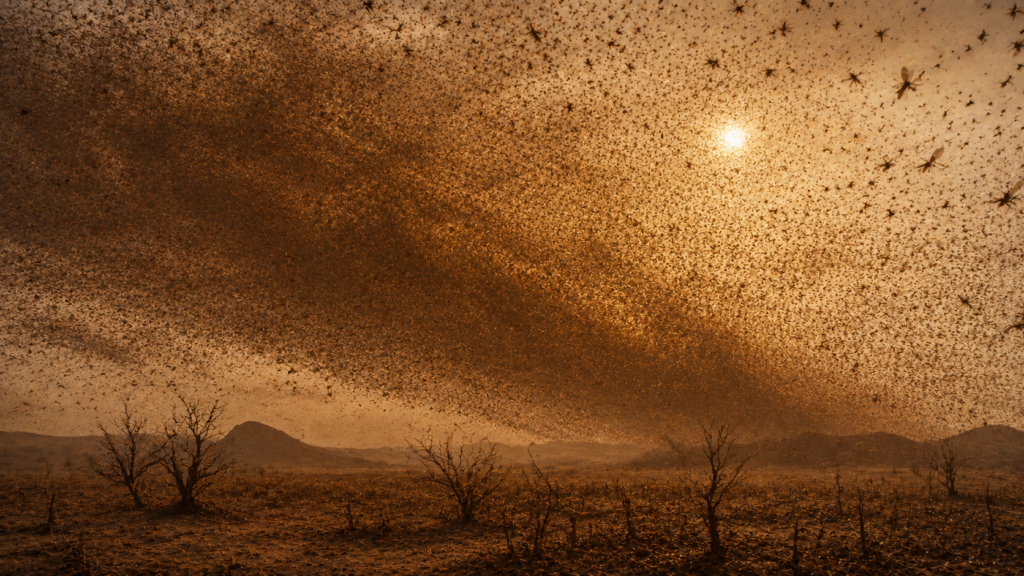
- Locusts. The Hebrew is arbeh, locust swarm. Locust plagues were a known terror in the ancient Near East; entire harvests could be eaten in hours. The plague targets Senehem, the Egyptian deity sometimes called the protector against pests, and (more broadly) the Egyptian agricultural cycle. The hail of chapter 9 broke the trees and ripened crops; the locusts will eat what’s left. The two plagues are sequenced. The seventh and eighth plagues together strip Egypt of its food.
- Pharaoh’s servants said to him, “How long will this man be a snare to us?” The Hebrew is ad-matay yihyeh ze lanu le-moqesh. For the first time, Pharaoh’s own officials break ranks. They speak. They beg him to relent. Don’t you yet know that Egypt is destroyed? The Hebrew is avdah mitsrayim, Egypt has perished / is finished. The verb avad (perish) is grammatically passive-perfect: Egypt has been destroyed, already, past tense. From inside the throne room, the officials see what Pharaoh refuses to: Egypt is over. The empire’s middle management has reached the limit of what it can absorb.
- Moses and Aaron were brought again to Pharaoh. The officials’ insistence forces Pharaoh to recall Moses and reopen the negotiation. Pharaoh has lost ground on the level of palace politics. Even his servants are pressuring him to comply.
- Who are those who will go? Pharaoh’s first new condition. Yes, you can go, but who exactly? He is trying to keep at least some of Israel as collateral.
- We will go with our young and with our old; with our sons and with our daughters, with our flocks and with our herds. Moses’s reply is precise. Everyone. All ages, all genders, all property. The Hebrew specifies: be-ne’areynu u-vi-zekenenu, be-vaneynu u-vi-vnoteynu: with our young and our old, with our sons and our daughters. No one is left behind. The deliverance is comprehensive or it is nothing. Moses will not negotiate the size of the rescue.
- YHWH be with you if I let you go with your little ones! Pharaoh’s response is sarcastic. The Hebrew yehi ken YHWH immakhem, YHWH be so with you, is uttered in mockery. Then evil is clearly before your faces, ki ra’ah neged peneykhem, the Hebrew is ambiguous: either Pharaoh is saying something bad is about to happen to you (a threat) or I see you have evil intent (an accusation). Either way, he is hostile.
- Not so! Go now you who are men, and serve YHWH. Pharaoh’s third concession is reduced. He is now willing to release the adult men to go worship, but no one else. He is offering a minimum compliance. Take the men. Leave the women, the children, the property, as collateral. This is the Hebrew Bible’s archetypal empire-bargaining-move: yes, but on my terms, with my hostages.
- They were driven out from Pharaoh’s presence. The audience ends in violence. Moses and Aaron are forcibly expelled. The Hebrew is vayegaresh otam, and he drove them out. The same verb (garash) will reappear in Ex 12:39 (they were driven out of Egypt). Pharaoh’s garash of Moses and Aaron in chapter 10 is the foreshadowing of his garash of all Israel in chapter 12. He kicks Moses out; soon he will kick all Israel out, on his own initiative.
B · Exodus 10:12-20 · The plague of locusts
¹² Yahweh said to Moses, “Stretch out your hand over the land of Egypt for the locusts, that they may come up on the land of Egypt, and eat every herb of the land, even all that the hail has left.” ¹³ Moses stretched out his rod over the land of Egypt, and Yahweh brought an east wind on the land all that day, and all the night; and when it was morning, the east wind brought the locusts. ¹⁴ The locusts went up over all the land of Egypt, and rested in all the borders of Egypt. They were very grievous. Before them there were no such locusts as they, neither after them shall be such. ¹⁵ For they covered the surface of the whole earth, so that the land was darkened, and they ate every herb of the land, and all the fruit of the trees which the hail had left. There remained nothing green, either tree or herb of the field, through all the land of Egypt. ¹⁶ Then Pharaoh called for Moses and Aaron in haste, and he said, “I have sinned against Yahweh your God, and against you. ¹⁷ Now therefore please forgive my sin again, and pray to Yahweh your God, that he may also take away from me this death.” ¹⁸ Moses went out from Pharaoh, and prayed to Yahweh. ¹⁹ Yahweh turned an exceedingly strong west wind, which took up the locusts, and drove them into the Red Sea. There remained not one locust in all the borders of Egypt. ²⁰ But Yahweh hardened Pharaoh’s heart, and he didn’t let the children of Israel go.
- YHWH brought an east wind on the land all that day, and all the night. The Hebrew is ruach qadim, east wind. The same wind YHWH will use at the Red Sea (Ex 14:21, YHWH drove the sea back by a strong east wind all night). The same wind is at work in two different deliverances. Ruach qadim in Ex 10 brings the locusts; ruach qadim in Ex 14 parts the Sea. The text is layering: the same divine wind that judges Egypt also delivers Israel. The wind is YHWH’s instrument throughout.
- Before them there were no such locusts as they, neither after them shall be such. The plague is hyperbolically severe. The text reaches for superlatives. The locusts cover the surface of the whole earth, Hebrew vaye-khas et eyn kol ha-arets, they covered the eye/face of all the land. The earth itself becomes invisible under the swarm.
- They ate every herb of the land, and all the fruit of the trees which the hail had left. There remained nothing green. The destruction is total. Egypt’s food supply is gone. The wheat and spelt that survived the hail are now eaten. The Hebrew Bible is precise: ein yereq, not a green thing. The cumulative force of seven plagues has now stripped Egypt of its agriculture entirely. The empire that fed the ancient world (Genesis’s grain-storage Egypt) cannot feed itself.
- I have sinned against YHWH your God, and against you. Pharaoh’s second confession (after the chapter-9 confession at the hail). It is shorter, more desperate. The Hebrew is chatati l-YHWH eloheykhem ve-lakhem, I have sinned against YHWH your God and against you. He still says YHWH your God, not my God. He is still keeping a theological distance. But he uses the verb chata (sin) again, and adds ve-lakhem (against you also). He is widening the apology to include Moses and Aaron personally. The pressure is producing tactical contrition.
- Forgive my sin again. The Hebrew is sa-na chatati, please lift my sin. The verb nasa, lift, carry, bear, is the same verb used in the third commandment (lo’ tissa et shem YHWH, Ex 20:7) and in the high priest’s bearing of Israel’s iniquity (Ex 28:38). To “forgive” sin in the Hebrew Bible is to carry it away. Pharaoh is asking for the very forgiveness-grammar he will, by the third commandment, be the empire’s negative example of failing. The text is layering its theology in advance.
- YHWH turned an exceedingly strong west wind, which took up the locusts, and drove them into the Red Sea. The Hebrew is ruach yam chazaq me’od, a very strong sea-wind. Notice: yam chazaq, Chazaq, the same word used for Pharaoh’s heart in v. 20. The wind is chazaq against the locusts. Pharaoh is chazaq-hearted. The text’s wordplay is keeping accounts. Strong wind drives locusts into the sea; strong heart will drive Pharaoh’s chariots into the same sea four chapters later.
- Drove them into the Red Sea. The Hebrew is yamah suf, toward the Sea of Reeds. This is the first mention of the Yam Suf in Exodus, the place that will become Egypt’s grave at chapter 14. The locusts are blown into the same sea Pharaoh’s chariots will eventually drown in. The text is foreshadowing. The Sea is preparing.
- YHWH hardened Pharaoh’s heart, and he didn’t let the children of Israel go. The Hebrew is vayechazeq YHWH et-lev par’oh: YHWH strengthened the heart of Pharaoh. Same pattern as the boils. YHWH is the explicit agent of the chazaq. Pharaoh’s tactical confession evaporates the moment the locusts are gone.
C · Exodus 10:21-29 · Three days of darkness
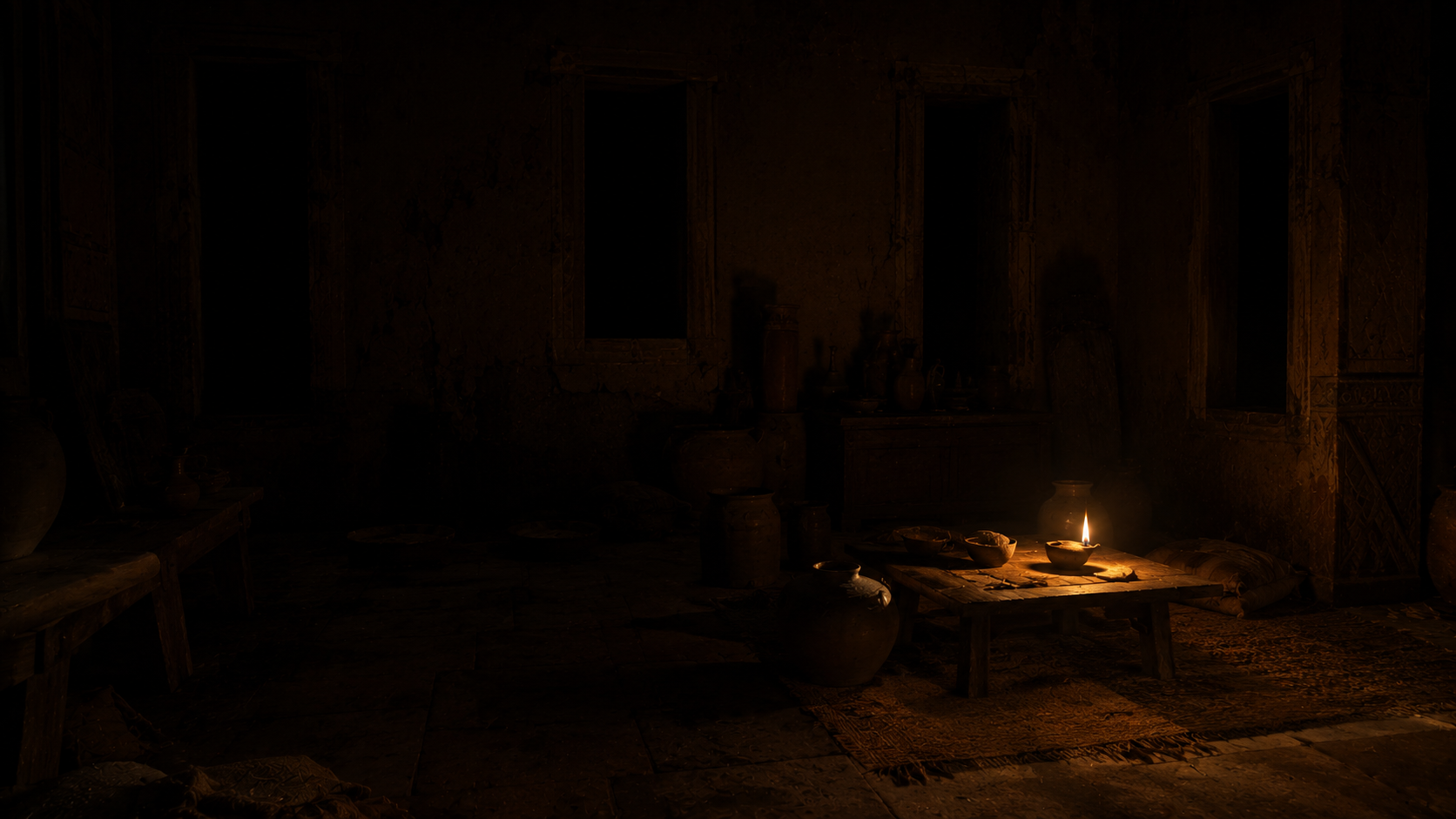
²¹ Yahweh said to Moses, “Stretch out your hand toward the sky, that there may be darkness over the land of Egypt, even darkness which may be felt.” ²² Moses stretched out his hand toward the sky, and there was a thick darkness in all the land of Egypt for three days. ²³ They didn’t see one another, and nobody rose from his place for three days; but all the children of Israel had light in their dwellings. ²⁴ Pharaoh called to Moses, and said, “Go, serve Yahweh. Only let your flocks and your herds stay behind. Let your little ones also go with you.” ²⁵ Moses said, “You must also give into our hand sacrifices and burnt offerings, that we may sacrifice to Yahweh our God. ²⁶ Our livestock also shall go with us. There shall not a hoof be left behind, for of it we must take to serve Yahweh our God; and we don’t know with what we must serve Yahweh, until we come there.” ²⁷ But Yahweh hardened Pharaoh’s heart, and he wouldn’t let them go. ²⁸ Pharaoh said to him, “Get away from me! Be careful to see my face no more; for in the day you see my face you shall die!” ²⁹ Moses said, “You have spoken well. I will see your face again no more.”
- Stretch out your hand toward the sky, that there may be darkness over the land of Egypt. The Hebrew is neteh yadkha al ha-shamaymah, stretch your hand toward the heavens. Moses’s hand against the sky. Where Aaron’s staff produced earlier plagues, Moses’s hand is now the instrument. The deliverer’s gesture is now cosmic, directed at the heavens themselves.
- Even darkness which may be felt. The Hebrew is ve-yamesh choshekh, and let darkness be felt / palpable. The phrase is striking. Darkness so thick it is tactile. This is not just absence of light; it is presence of something dense. Goldingay translates it darkness you can feel. Mackie’s note: the plague’s metaphor is theological, Pharaoh’s kavod heart is the inner condition; the palpable darkness is the outer manifestation. Egypt is now living, sensorially, in the texture of its own king’s heart.
- Three days. The duration is precise. Three days is a Hebrew Bible time-marker that usually signifies a complete divine event (Jonah in the fish, Esther’s fast, the resurrection). The darkness is structured as a complete event with theological weight, not a random meteorological happening.
- The plague targets Ra, the sun-god, Egypt’s highest deity. Ra was the chief of Egypt’s pantheon, the god the Pharaoh claimed direct paternity from. Pharaoh is the son of Ra was the foundation of Egyptian royal theology. To blot out the sun for three days is to blot out the visible presence of Egypt’s chief god, and to expose the son of Ra as a man whose father has gone silent. Mackie’s note: this is the plague that prepares the tenth. The ninth plague kills Egypt’s highest god symbolically; the tenth will strike the king himself by killing the next generation of “the son of Ra.”
- Nobody rose from his place for three days. The Hebrew is ve-lo’ qamu ish mi-tachtav, and no one rose from beneath himself. The phrase is striking. The Egyptians are paralyzed in place. Whatever ordinary Egyptian was doing when the darkness fell, he could not move. The economy stops. The temples stop. The court stops. Egypt is, for three days, a country in suspended animation.
- But all the children of Israel had light in their dwellings. The Hebrew is u-le-khol bney-yisra’el hayah or be-moshvotam, and for all the children of Israel there was light in their dwelling places. The selective sparing of Goshen has now reached the level of light itself. The plague is, on its surface, a meteorological event; but the differential is impossible meteorologically. Egyptian darkness; Israelite light. The same skies; two different experiences. The text is making a theological point that resists naturalistic explanation.
- Go, serve YHWH. Only let your flocks and your herds stay behind. Let your little ones also go with you. Pharaoh’s fourth concession. He has now relented on the children (10:11 had been only the men). He now says take everyone except the livestock. He is still trying to keep collateral. Leave the herds. They are the guarantee that you’ll come back. This is the empire’s last bargaining position before the ten plagues become irreversible.
- Our livestock also shall go with us. There shall not a hoof be left behind. Moses’s response is uncompromising: every hoof goes. The Hebrew is lo’ tisha’er parsah, not a hoof shall remain. Solomon’s note: the deliverance is total. No collateral. No hostages. Nothing of Israel left in Egypt. The reason Moses gives is theological: we don’t know with what we must serve YHWH until we come there. Israelite worship requires animal sacrifice. The exodus is, theologically, the relocation of Israelite worship from Egypt to the wilderness. To leave the livestock would be to leave the worship.
- YHWH hardened Pharaoh’s heart, and he wouldn’t let them go. The Hebrew is vayechazeq YHWH et-lev par’oh, same formula. Pharaoh’s bargaining is now exhausted. Every concession he was willing to offer has been refused; the only thing left is total compliance, and his heart is chazaq against it.
- Get away from me! Be careful to see my face no more; for in the day you see my face you shall die! Pharaoh’s threat. The Hebrew is lekh me-alay, go from over me. He wants Moses out of his sight. In the day you see my face you shall die, the threat ironically forecasts the next chapter: when Pharaoh sees Moses’s face again, it will be in the middle of the night, after the death of every Egyptian firstborn including Pharaoh’s own son.
- You have spoken well. I will see your face again no more. Moses’s response is sharp. Kein dibarta, you have spoken rightly. He agrees. He will not see Pharaoh’s face again. The interview is over. The chapter ends with Moses walking out for the last time. From here, Moses will speak to Pharaoh only at the meeting that the next chapter announces, and that meeting will be at night, with Pharaoh broken and begging.
Influence callout: Marty Solomon (Bema Discipleship, Episode 18) and the kavod-darkness symmetry
Solomon catches the symmetry between the Egyptian Book of the Dead and the ninth plague. In Egyptian afterlife theology, Ra travels through the duat (the underworld) every night. To enter the duat, the deceased had to face darkness, and the worthy soul brought light through the darkness. The plague of three days of darkness puts Egypt in the position the deceased Egyptian was supposed to face, and Egypt fails the test. Pharaoh cannot bring light through the darkness because his heart is too kavod (heavy). The Egyptian theological framework would have Pharaoh’s heart eaten by Ammit at this point in the journey. Meanwhile, the children of Israel had light in their dwellings. Goshen’s light is the right verdict by Egypt’s own theology: the heart that was not heavy passed the test. The ninth plague is the climactic public exposure of what the kavod heart-language has been signaling since plague one. By Egypt’s own afterlife judgment, Pharaoh has been weighed and found wanting.
- The chapter ends with the contest virtually over. Pharaoh has refused every YHWH-demand, expelled Moses, threatened him with death, and watched his country be reduced to ruin. One plague remains. The book is two pages from the firstborn night, and chapter 11 is going to announce it.
Reflection prompts
- That you may tell in the hearing of your son, and of your son’s son. The plagues are not, in the end, about Pharaoh; they are about the children at the seder for the next three thousand years. The deliverance is being told forward before it happens. What in your own life right now is being told forward. What story is being lived in real time that your children’s children will rehearse? What does it mean to live your present knowing it is being scripted as testimony for generations not yet born?
- The Egyptian Book of the Dead required the deceased to bring light through the darkness of the duat. Pharaoh’s kingdom fails. Israel passes, the children of Israel had light in their dwellings. Where, in your own life, are you being asked to carry light through darkness? What does it look like to be the household where the light remains on when the surrounding world has gone dark?
- Pharaoh’s officials, for the first time, ask him to relent: don’t you yet know that Egypt is destroyed? Even inside the imperial court, there are people who see what the king refuses to see. Where, in the systems you are part of, are people quietly asking don’t you see this is over? What would it mean to be one of the voices in the room that says it out loud?
Frameworks at play in this chapter: the divine council, counter-imperial reading.