

Exodus 9 is the chapter where the plague cycle reaches its theological turning point. Three more plagues fall, livestock disease, boils, and hail, and at the sixth plague (boils), the text uses, for the first time, the active phrase YHWH hardened Pharaoh’s heart. Up to this chapter, Pharaoh has been the explicit agent of his own kavod-heart. From the boils forward, God is named as the one strengthening Pharaoh’s resolve. The chapter is the structural threshold the cycle has been moving toward.
It is also the chapter where Pharaoh, at the seventh plague (hail), says for the first time: I have sinned this time. YHWH is righteous. I and my people are wicked. The confession is sincere in the moment, then evaporates as soon as the hail stops. Goldingay’s pastoral note: this is what we always do. The chapter is a study in the human capacity for sincere confession that does not produce sustained change. Pharaoh’s chapter-9 confession is the most theologically articulate statement he ever makes, and it changes nothing. The book is teaching that acknowledging God is righteous is not the same as letting God’s people go. Pharaoh learns the words and still refuses the act.
A · Exodus 9:1-7 · The plague on livestock
¹ Then Yahweh said to Moses, “Go in to Pharaoh, and tell him, ‘This is what Yahweh, the God of the Hebrews, says: “Let my people go, that they may serve me. ² For if you refuse to let them go, and hold them still, ³ behold, Yahweh’s hand is on your livestock which are in the field, on the horses, on the donkeys, on the camels, on the herds, and on the flocks with a very grievous pestilence. ⁴ Yahweh will make a distinction between the livestock of Israel and the livestock of Egypt; and nothing shall die of all that belongs to the children of Israel.”‘” ⁵ Yahweh appointed a set time, saying, “Tomorrow Yahweh shall do this thing in the land.” ⁶ Yahweh did that thing on the next day; and all the livestock of Egypt died, but of the livestock of the children of Israel, not one died. ⁷ Pharaoh sent, and behold, there was not so much as one of the livestock of the Israelites dead. But the heart of Pharaoh was stubborn, and he didn’t let the people go.
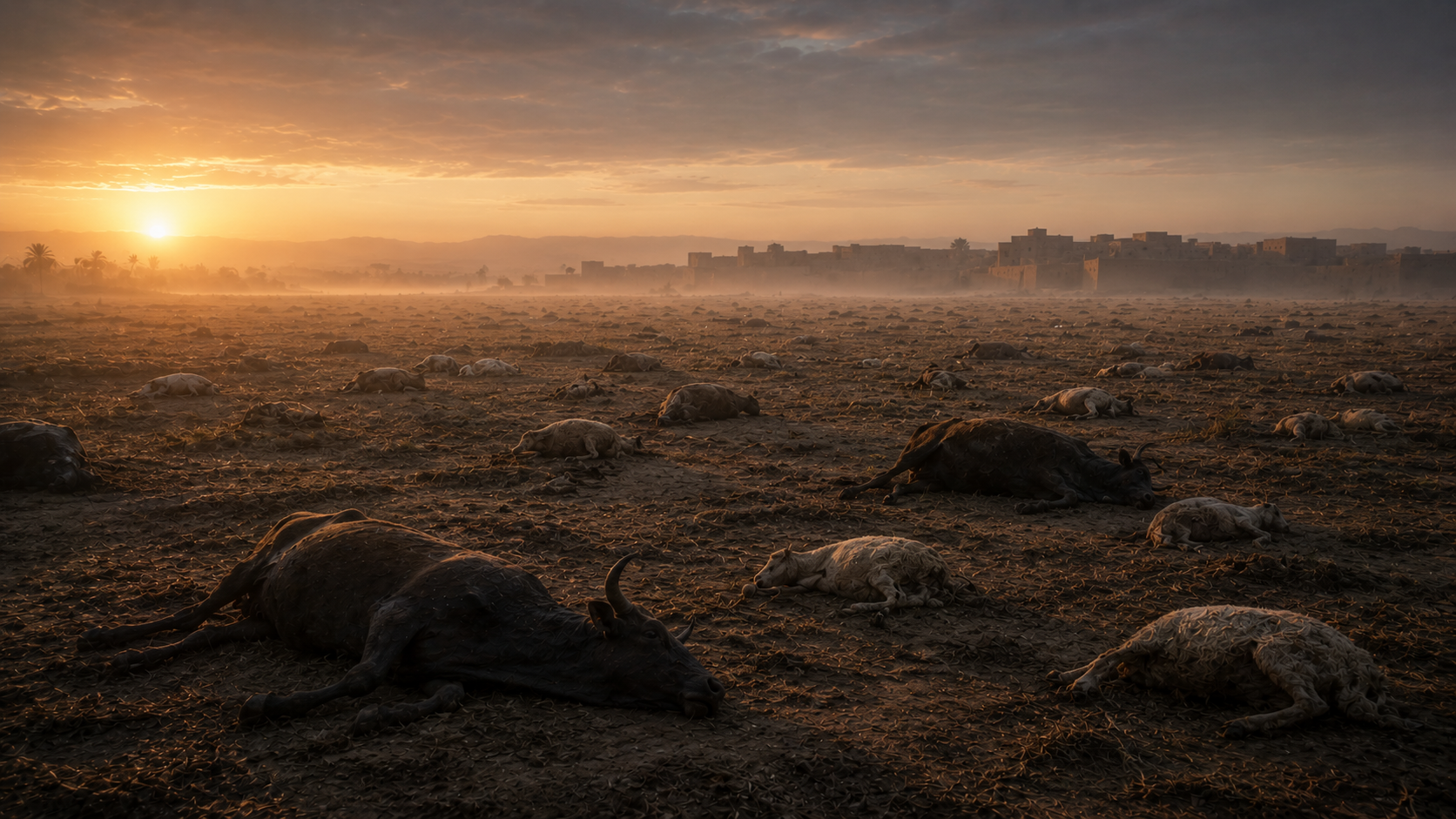
- Yahweh’s hand is on your livestock. The Hebrew is yad YHWH hoyah, YHWH’s hand is going to be. The plague is announced as YHWH’s hand, the same imagery from Ex 6:6 (I will redeem you with an outstretched arm). The contest of yad (hand) is now extending into the livestock fields.
- The plague targets Hathor, Apis, Khnum, the Egyptian deities associated with cattle, bulls, and rams. Apis the bull was perhaps the most prominent Egyptian animal-deity, worshipped at Memphis with elaborate ritual. Hathor, often depicted as a cow, was the goddess of love, motherhood, and music. Khnum, ram-headed, was credited with shaping humans from the clay of the Nile. Mackie’s note: the plague is, again, theologically targeted. The animals embodying Egypt’s pantheon are now dying in the fields. The Hebrew Bible is patient about the pantheon-takedown; each plague picks off another node of Egyptian theology.
- YHWH will make a distinction between the livestock of Israel and the livestock of Egypt. The Hebrew is ve-hifla YHWH, YHWH will distinguish. The same verb (palah) as the Goshen-distinction at the fourth plague (8:22). The selective sparing continues. Israelite livestock are unaffected. The plague’s geography is doing theology: YHWH can pick out the animals of his people from the animals of Egypt without missing one. The precision of the spared/unspared distinction will reach its peak at the tenth plague.
- YHWH appointed a set time. The Hebrew is vayasem YHWH mo’ed, *YHWH set a *mo’ed**. The word mo’ed is loaded: it means appointed time, festival, meeting place. It is the same word used in ohel mo’ed: the tent of meeting (the tabernacle). The plague has a mo’ed: an appointed time: like a religious festival. The text is using the vocabulary of Egyptian (and later Israelite) liturgical calendars. The plague is not chaos; it is a scheduled appointment with judgment.
- Pharaoh sent, and behold, there was not so much as one of the livestock of the Israelites dead. Pharaoh investigates. He sends servants to Goshen to check. They confirm: not one Israelite cow has died. Pharaoh has direct, verified, factual evidence that YHWH is making the distinction. And:
- But the heart of Pharaoh was stubborn. The Hebrew is vayikhbad lev par’oh, Pharaoh’s heart was heavy. The verb is again kavod. The investigative confirmation does not produce change. He has the data and refuses it. The chapter is teaching: evidence does not, by itself, change a heavy heart. Pharaoh has the empirical proof he could have asked for. He goes back to refusal.
B · Exodus 9:8-12 · The plague of boils
⁸ Yahweh said to Moses and to Aaron, “Take to you handfuls of ashes of the furnace, and let Moses sprinkle it toward the sky in the sight of Pharaoh. ⁹ It shall become small dust over all the land of Egypt, and shall be boils and blisters breaking out on man and on animal, throughout all the land of Egypt.” ¹⁰ They took ashes of the furnace, and stood before Pharaoh; and Moses sprinkled it up toward the sky; and it became boils and blisters breaking out on man and on animal. ¹¹ The magicians couldn’t stand before Moses because of the boils; for the boils were on the magicians, and on all the Egyptians. ¹² Yahweh hardened the heart of Pharaoh, and he didn’t listen to them, as Yahweh had spoken to Moses.
- Take to you handfuls of ashes of the furnace. The Hebrew word for furnace is kivshan, the brick-kiln. The very furnace where the Hebrew slaves had been baking bricks for Egyptian storage cities is now the source of the plague. Goldingay’s catch is sharp: the soot of Hebrew slavery is becoming the dust of Egyptian plague. The instruments of oppression are now the instruments of judgment. Middah ke-neged middah (measure for measure) again, the most brutal expression yet.
- Let Moses sprinkle it toward the sky. The Hebrew is yizroq Mosheh ha-shamaymah, Moses shall sprinkle it heavenward. The verb zaraq is the Hebrew word for priestly sprinkling in the sacrificial system (Lev 1:5; 3:2; 17:6). Moses is performing a priestly gesture, but inverted. Where priestly sprinkling brings atonement, Moses’s sprinkling brings plague. The text is using sacrificial vocabulary to describe judicial action. Moses is acting as a prophetic priest of judgment.
- Boils and blisters breaking out on man and on animal. The Hebrew is shechin avabu’ot poreiach, boils, blisters, breaking out. The plague is dermatological, painful, and visible. It targets Sekhmet, the lioness-headed Egyptian goddess of healing and disease, and Imhotep, the deified Egyptian physician. The medical-religious establishment of Egypt is now afflicted with the disease their gods are supposed to prevent.
- The magicians couldn’t stand before Moses because of the boils. This is the chapter’s cruelest detail. The magicians, who had still been physically present at every preceding plague (replicating, then failing), are now incapacitated by the very plague YHWH is producing. They cannot stand in Moses’s presence. The Hebrew is ve-lo’ yakholu… la’amod, they were not able to stand. Their humiliation is complete. The court advisors who once said this is the finger of God now cannot even get up off their boil-covered bodies to attend Pharaoh’s audiences.
- YHWH hardened the heart of Pharaoh. The Hebrew is vayechazeq YHWH et-lev par’oh: YHWH strengthened the heart of Pharaoh. This is the first time in the cycle that the active causation is unambiguously assigned to YHWH. Through plagues 1-5, Pharaoh has been the agent of his own kavod-heart. Beginning at plague 6, YHWH is named as the agent. The verb shifts: it is now chazaq, not kavod. The hardening pattern has crossed the threshold the chapter has been signaling. From this point forward, the text will mostly use chazaq with YHWH as the subject (Ex 9:12; 10:20, 27; 11:10; 14:4, 8, 17), with kavod surfacing only twice more (Ex 9:34; 10:1).
Word study: the threshold from kavod to chazaq
The Hebrew text of Exodus 7-14 is doing precise grammatical theology in its choice of which verb describes Pharaoh’s heart. Through the first five plagues, the active causation is on Pharaoh’s side: Pharaoh hardened his own heart (7:13, 22; 8:15, 19, 32; 9:7). The verb is kavod, heaviness, and Pharaoh is the agent. The first five plagues expose Pharaoh’s heart-condition; they do not create it. He is showing what was already there.
Beginning at the sixth plague (Ex 9:12), the active causation shifts: YHWH strengthened (chazaq) the heart of Pharaoh. The verb changes; the agent changes. From this point, the cycle is no longer Pharaoh hardening his own heart but YHWH intensifying the direction Pharaoh has chosen. Imes’s reading: intensification, not override. Solomon (drawing on Fohrman): divine pursuit and human refusal in tension, God is also still trying to win Pharaoh up to the very last possible moment. The two readings are compatible. What the text refuses is the simple binary of “free will” versus “predestination.” Both are at work, and the text holds them together by changing the verb at exactly the right moment.
The Egyptian kavod / weighing-of-the-heart backdrop (see the kavod word study in Ex 7) deepens the irony: Pharaoh has been making his own heart heavy through five plagues; now YHWH simply confirms what Pharaoh has chosen. By the standard of Egypt’s own afterlife judgment, Pharaoh’s heart has already failed the weighing. YHWH’s chazaq is the ratification of a verdict Pharaoh has, by his own actions, already pronounced on himself.
C · Exodus 9:13-35 · The hail that listened, and the confession that didn’t last
¹³ Yahweh said to Moses, “Rise up early in the morning, and stand before Pharaoh, and tell him, ‘This is what Yahweh, the God of the Hebrews, says: “Let my people go, that they may serve me. ¹⁴ For this time I will send all my plagues against your heart, against your officials, and against your people; that you may know that there is no one like me in all the earth. ¹⁵ For now I would have stretched out my hand, and struck you and your people with pestilence, and you would have been cut off from the earth; ¹⁶ but indeed for this cause I have made you stand: to show you my power, and that my name may be declared throughout all the earth. ¹⁷ As you still exalt yourself against my people, that you won’t let them go, ¹⁸ behold, tomorrow about this time I will cause it to rain a very grievous hail, such as has not been in Egypt since the day it was founded even until now. ¹⁹ Now therefore command that all of your livestock and all that you have in the field be brought into shelter. Every man and animal that is found in the field, and isn’t brought home, the hail shall come down on them, and they shall die.”‘” ²⁰ Those who feared Yahweh’s word among the servants of Pharaoh made their servants and their livestock flee into the houses. ²¹ Whoever didn’t respect Yahweh’s word left his servants and his livestock in the field. ²² Yahweh said to Moses, “Stretch out your hand toward the sky, that there may be hail in all the land of Egypt, on man, and on animal, and on every herb of the field, throughout the land of Egypt.” ²³ Moses stretched out his rod toward the heavens, and Yahweh sent thunder, hail, and lightning flashed down to the earth. Yahweh rained hail on the land of Egypt. ²⁴ So there was very severe hail, and lightning mixed with the hail, such as had not been in all the land of Egypt since it became a nation. ²⁵ The hail struck throughout all the land of Egypt all that was in the field, both man and animal; and the hail struck every herb of the field, and broke every tree of the field. ²⁶ Only in the land of Goshen, where the children of Israel were, there was no hail. ²⁷ Pharaoh sent, and called for Moses and Aaron, and said to them, “I have sinned this time. Yahweh is righteous, and I and my people are wicked. ²⁸ Pray to Yahweh; for there has been enough of mighty thunderings and hail. I will let you go, and you shall stay no longer.” ²⁹ Moses said to him, “As soon as I have gone out of the city, I will spread out my hands to Yahweh. The thunders shall cease, neither shall there be any more hail; that you may know that the earth is Yahweh’s. ³⁰ But as for you and your servants, I know that you don’t yet fear Yahweh God.” ³¹ The flax and the barley were struck, for the barley had ripened, and the flax was in bloom. ³² But the wheat and the spelt were not struck, for they had not grown up. ³³ Moses went out of the city from Pharaoh, and spread out his hands to Yahweh; and the thunders and hail ceased, and the rain was not poured on the earth. ³⁴ When Pharaoh saw that the rain and the hail and the thunders had ceased, he sinned yet more, and hardened his heart, he and his servants. ³⁵ The heart of Pharaoh was hardened, and he didn’t let the children of Israel go, just as Yahweh had spoken through Moses.
- I will send all my plagues against your heart. The Hebrew is shoLeach et kol-magefoty el-libekha, I am sending all my plagues to your heart. The phrase is striking. The plagues’ ultimate target is Pharaoh’s heart. Egypt’s livestock, magicians, ground, sky, all of these are means. The end is Pharaoh’s heart. The chapter is teaching that what God is after is not bodies but the inner posture of empire’s chief.
- I have made you stand: to show you my power, and that my name may be declared throughout all the earth. The Hebrew is be’avur har’otkha et-kohi u-le-ma’an saper shemi be-khol ha-arets: to show you my strength, and to recount my name in all the earth. Paul will quote this verse at Romans 9:17 in his discussion of God’s freedom. The verse is doing layered theological work: Pharaoh has been raised up. Preserved through five plagues he could have died in: for the purpose of the worldwide declaration of YHWH’s name. The plagues are a global advertisement. Egypt is becoming the open book on which YHWH’s name is being inscribed for all the nations to read.
- Tomorrow about this time I will cause it to rain a very grievous hail. The Hebrew is kavod me’od, very heavy. The hail is kavod: heavy: the same word for Pharaoh’s heart. The text’s wordplay is now deliberate: the hail will be kavod on the country whose king has a kavod heart. The judgment matches the heart it is exposing.
- Now therefore command that all of your livestock and all that you have in the field be brought into shelter. This is the chapter’s quietest mercy. YHWH gives Pharaoh advance warning of the seventh plague and an opportunity to protect his people. The plague is announced 24 hours in advance. Anyone who fears YHWH’s word can save his livestock. The chapter is teaching that even in escalating judgment, YHWH leaves a way out for those willing to listen.
- Those who feared YHWH’s word among the servants of Pharaoh made their servants and their livestock flee into the houses. The Hebrew is ha-yare et-devar YHWH, the one fearing the word of YHWH. Some Egyptians believed Moses. Some did not. The plague creates the first internal division within Egypt itself: believers and unbelievers. The text records this without commentary, but it is theologically loaded. Empire is not monolithic. Even inside Pharaoh’s own court, there are people whose hearts are listening. By the time of the exodus (Ex 12:38), a mixed multitude will leave Egypt with Israel, Egyptians who, by this point, have learned what Pharaoh refuses to learn.
- Yahweh sent thunder, hail, and lightning flashed down to the earth. The Hebrew word for thunder is qolot, voices. The same word is used at Sinai in Ex 19:16, when thunders and lightnings (qolot u-vraqim) accompany God’s descent on the mountain. The text is doing typology: the hail-storm in Egypt and the storm at Sinai use the same Hebrew vocabulary. Pharaoh’s introduction to YHWH is qolot u-vraqim. Israel’s introduction to YHWH at Sinai will be qolot u-vraqim. The same God; two different audiences; two very different responses.
- The plague targets Nut (the sky goddess) and Set (god of storms and chaos). The hail is YHWH’s command of the very sphere Egyptian theology assigned to its sky deities. And YHWH does it from outside Egypt’s pantheon. There are no Egyptian rituals to invoke. There is no priestly intercession that can stop the storm. The seventh plague is YHWH commanding the heavens directly.
- Only in the land of Goshen, where the children of Israel were, there was no hail. The selective sparing of Israel is precise to the level of weather patterns. The same atmospheric system that produces destruction over Egyptian fields produces nothing over Goshen. The plague is impossible to explain naturalistically; the text invites no naturalistic explanation. The point is theological: YHWH distinguishes.
- I have sinned this time. YHWH is righteous, and I and my people are wicked. This is, on the surface, the most theologically articulate confession Pharaoh ever makes. The Hebrew is chatati ha-pa’am, YHWH ha-tsadiq, va-ani ve-ami ha-resha’im, I have sinned this time. YHWH is the righteous one. I and my people are the wicked. He uses the technical Hebrew vocabulary: chata (sin), tsadiq (righteous), rasha (wicked). For one moment, Pharaoh sounds like a Hebrew prophet.
- But Moses’s response is sharp. I know that you don’t yet fear YHWH God. The Hebrew is terem tire’un, you do not yet fear. Moses recognizes the confession for what it is: a tactical retreat under pressure, not a heart change. He has been through this enough times now to read Pharaoh’s bargaining-pattern. The chapter is showing us Moses learning. The deliverer who once asked who am I? is now reading the heart of an empire’s king with the precision of a prophet.
- The flax and the barley were struck, for the barley had ripened. The text gives a careful agricultural note. The flax and barley were destroyed; the wheat and spelt were not yet ripened and so survived. Egypt has lost some of its grain crops but not all. The text is signalling that the eighth plague (locusts) will eat what the hail did not. The plagues are escalating in coverage. The hail took half the harvest; the locusts will take the rest.
- He sinned yet more, and hardened his heart. The Hebrew is vayoseph la-chato, vayakhbed libo, and he continued to sin, and made his heart heavy. The verb is kavod, Pharaoh, despite the chapter’s structural shift to chazaq at v. 12, is back to making his own heart heavy. The text refuses to let Pharaoh off the hook even as it names YHWH’s hand. Pharaoh’s heart is heavy because Pharaoh keeps making it heavy, even when YHWH’s strengthening is also at work. The two are entangled in the way the text refuses to fully sort out.
- His servants, the verse adds, also hardened their hearts. This is the first time the text mentions Pharaoh’s officials sharing his heart-condition. The contagion has spread. The court has aligned with the king. The plague-cycle is exposing not just one man’s resistance but a whole imperial culture’s.
Influence callout: John Goldingay (Exodus and Leviticus for Everyone)
Goldingay’s pastoral note on Pharaoh’s chapter-9 confession is worth the chapter’s price of admission. I have sinned this time. YHWH is righteous, and I and my people are wicked. This is the most theologically articulate sentence Pharaoh ever speaks, and it changes nothing. The hail stops; Pharaoh hardens his heart again. Goldingay: this is what we always do. Confession under pressure is not yet repentance. Sincere words spoken in the moment of crisis can evaporate the moment relief arrives. The Hebrew Bible is honest about this human pattern. Acknowledging that God is righteous is not the same as letting God’s people go. Pharaoh’s chapter-9 confession is the most pious thing he says, and the text is teaching us that piety without action is not yet faith.
- The chapter ends with three plagues left in the cycle. Pharaoh’s heart has crossed the threshold from kavod (his own dulling) to chazaq (YHWH’s strengthening). The Goshen-distinction is now permanent. Egyptian deities are falling one by one. The seventh plague has demonstrated YHWH’s command of the heavens. The eighth and ninth will eat the harvest and blot out the sun. The tenth will strike the firstborn. The chapter is the hinge of the cycle, and Pharaoh is past the point of return, by every Hebrew verb the text has at its disposal.
Reflection prompts
- Pharaoh’s chapter-9 confession is the most theologically articulate thing he says, and it changes nothing. I have sinned. YHWH is righteous. I am wicked. The words are right; the heart is not. Where, in your own life, have you found yourself saying the right religious words under pressure and reverting to the same pattern when the pressure lifts? What is the difference, on this chapter’s reading, between confession and repentance?
- The text’s verb shifts from kavod (Pharaoh hardening himself) to chazaq (YHWH strengthening Pharaoh’s resolve) at exactly the moment Pharaoh’s refusal becomes irreversible. The Hebrew Bible is teaching that there is a threshold past which God ratifies what we have chosen. What does it mean to live a life where we never want our heart-direction to be chazaq-ed in the wrong direction? What does it mean to keep choosing softness?
- Those who feared YHWH’s word among the servants of Pharaoh made their servants and their livestock flee into the houses. Even inside Pharaoh’s empire, some hearts were listening. The text records this without fanfare, but it is theologically real. Where, in the institutions and cultures around you, are there Egyptians who fear YHWH’s word? How are you treating them: as enemies of the system, or as future companions in the Exodus?
Frameworks at play in this chapter: the divine council, counter-imperial reading.