
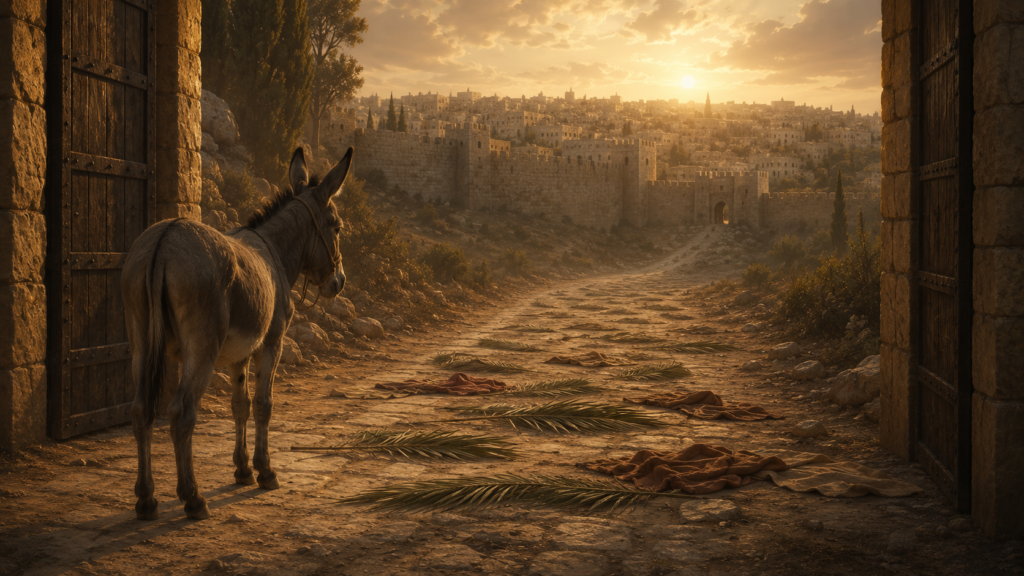
Matthew 21 is the chapter that turns the gospel’s narrative on its hinge. Jesus enters Jerusalem on a donkey, fulfilling Zechariah 9:9, with the crowds spreading branches and shouting Hosanna. He goes directly to the temple and overturns the tables of the money-changers. The next morning he curses a fruitless fig tree, and the same day he answers the religious establishment’s challenge to his authority with two pointed parables (the two sons and the wicked tenants). The chapter is dense with symbolic action: a king-who-rides-a-donkey, a temple-cleansing in the name of my house shall be called a house of prayer, a fig-tree-cursing that prefigures the temple’s coming end, and parables that name the religious establishment’s failure to receive the son the vineyard’s owner sent.
The chapter has three movements. The first (verses 1 to 11) is the triumphal entry: the donkey-and-colt sourcing, the spreading of cloaks and branches, the Hosanna shouts, the entry into a stirred-up Jerusalem. The second (verses 12 to 22) is the temple action and the fig tree: the overturning of the money-changers’ tables, the house of prayer citation, the children’s praise, the withered fig tree, and the faith-and-prayer teaching. The third (verses 23 to 46) is the temple-conflict: the chief priests’ question about authority, Jesus’s counter-question about John, and the parables of the two sons and the wicked tenants.
Beneath the chapter’s surface flow is the gospel’s most concentrated single staging of the kingdom’s arrival in the temple-city, and the religious establishment’s recognition that the kingdom has arrived as a threat to its current operations. The chapter is also the first explicit single staging of the gospel’s two-kingdoms contrast in its sharpest form: another procession is entering Jerusalem the same week, from the other side of town, with very different vocabulary.
A · Matthew 21:1–11 · The triumphal entry
¹ When they came near to Jerusalem, and came to Bethsphage, to the Mount of Olives, then Jesus sent two disciples, ² saying to them, “Go into the village that is opposite you, and immediately you will find a donkey tied, and a colt with her. Untie them and bring them to me. ³ If anyone says anything to you, you shall say, ‘The Lord needs them,’ and immediately he will send them.” ⁴ All this was done that it might be fulfilled which was spoken through the prophet, saying, ⁵ “Tell the daughter of Zion, behold, your King comes to you, humble, and riding on a donkey, on a colt, the foal of a donkey.” ⁶ The disciples went, and did just as Jesus commanded them, ⁷ and brought the donkey and the colt, and laid their clothes on them; and he sat on them. ⁸ A very great multitude spread their clothes on the road. Others cut branches from the trees, and spread them on the road. ⁹ The multitudes who went before him, and who followed kept shouting, “Hosanna to the son of David! Blessed is he who comes in the name of the Lord! Hosanna in the highest!” ¹⁰ When he had come into Jerusalem, all the city was stirred up, saying, “Who is this?” ¹¹ The multitudes said, “This is the prophet, Jesus, from Nazareth of Galilee.” (Matthew 21:1–11, World English Bible)
- When they came near to Jerusalem, and came to Bethsphage, to the Mount of Olives (verse 1). The Greek Bethphage, “house of unripe figs,” names a small village on the eastern slope of the Mount of Olives just outside Jerusalem. The Mount of Olives itself is theologically loaded: Zechariah 14:4 places the LORD’s eschatological standing-place there (on that day his feet shall stand on the Mount of Olives). The chapter is recording, with characteristic Hebrew Bible-geographic precision, that Jesus is approaching the city from the prophet-named direction.
- Go into the village that is opposite you, and immediately you will find a donkey tied, and a colt with her (verse 2). The Greek records a piece of pre-arranged logistics. Whether Jesus has prophetic foreknowledge of where the donkey is or has made prior arrangements with the village, the result is the same: the donkey-and-colt are exactly where the disciples are sent. The chapter is recording, with characteristic narrative restraint, the deliberate fulfillment-staging of what is about to happen.
- Tell the daughter of Zion, behold, your King comes to you, humble, and riding on a donkey, on a colt, the foal of a donkey (verse 5). The Greek cites Zechariah 9:9. The Zechariah passage explicitly contrasts this king’s mount with a war-horse: in the verses that follow (Zechariah 9:10), the LORD will cut off the chariot from Ephraim and the war horse from Jerusalem, and the king will speak peace to the nations. The chapter is recording, with characteristic Hebrew Bible-citation care, that Jesus is entering Jerusalem precisely as the Zechariah-king: the peace-bringing king who comes mounted on the animal of working-class transportation, not on the horse of military victory.
Influence callout: Marty Solomon and Brian Zahnd (the two processions of Holy Week)
Solomon’s reading (paired with Zahnd’s The Wood Between the Worlds development of the same theme) names this scene as one half of a deliberate two-procession contrast that historians have reconstructed in detail. According to first-century Roman practice, the Roman governor traveled from his coastal headquarters at Caesarea Maritima up to Jerusalem before each of the major Jewish festivals to maintain order during the high-tension pilgrimage weeks. Pontius Pilate would have ridden into Jerusalem the same week Jesus entered (almost certainly on the same day, and from the opposite side of the city). Pilate’s procession would have been every inch the Roman adventus: a war-horse, a polished armor-clad escort of legionaries, banners with the imperial eagle, the sound of marching boots and brass. The crowd along Pilate’s route would have been ordered to acclamation. Jesus’s procession is a deliberate parody-and-reversal: a borrowed donkey, a peasant disciple-band, cloaks and tree-branches spread on the road, the crowd’s Hosanna (Hebrew hoshia-na, “save us”) rising spontaneously rather than under official direction. Solomon and Zahnd both argue that the chapter is staging, in narrative form, the gospel’s thesis about the two kingdoms: there are two kings entering Jerusalem the same week, and the disciple-community is being asked to recognize which one is rightfully called king. The Zechariah-king on the donkey is not a softer version of the Roman king on the war-horse; he is a structurally different king, bringing a structurally different kingdom. The chapter is recording, in the staged contrast of the two processions, the gospel’s deepest single counter-imperial moment.
- A very great multitude spread their clothes on the road. Others cut branches from the trees, and spread them on the road (verse 8). The Greek records the spontaneous welcome. The branch-spreading echoes 2 Kings 9:13 (Jehu’s coronation, where the people took every man his garment and put it under him) and the Festival of Tabernacles’ palm-branches (Leviticus 23:40; though it is Passover, the palm-branch celebration has bled across festivals in popular practice by the first century, especially around themes of national deliverance). John 12:13 specifies the branches as palms; Matthew is more general. The chapter is recording, with characteristic narrative-cultural care, that the crowd is staging a coronation.
- Hosanna to the son of David! Blessed is he who comes in the name of the Lord! Hosanna in the highest! (verse 9). The Greek hosanna transliterates the Hebrew hoshia-na (Psalm 118:25, save us, we beseech you). The crowd is shouting Psalm 118 directly: the Hallel-psalm sung at every major Jewish festival. The chapter is recording, with characteristic narrative-liturgical precision, that the crowd is acclaiming Jesus in the language Israel had been singing for centuries. There is also a deeper resonance worth tracing. Palm branches and Psalm 118 acclamations were the crowd-imagery of the Maccabean-revolt celebrations of Hanukkah (1 Maccabees 13:51; 2 Maccabees 10:7), the festival commemorating Judas Maccabeus’s victory over the Greek occupiers and the rededication of the temple. By the first century, palm branches had become the popular symbol of revolutionary national independence, even minted onto coins of Jewish revolts. The crowd along the road is, in part, expecting another Maccabean-style military deliverance from another foreign occupier. The chapter is recording, with characteristic narrative honesty, the gap between the crowd’s expectation and the king’s actual mission. The same crowd that is shouting Hosanna this Sunday will, by Friday, be shouting crucify him. The expectations being projected onto Jesus this week are not the kingdom Jesus has actually been bringing.
- When he had come into Jerusalem, all the city was stirred up, saying, “Who is this?” (verse 10). The Greek eseisthe pasa he polis, “the whole city was shaken,” uses the same verb (seio) the gospel will use of the earthquake at the crucifixion (27:51, 54) and at the resurrection (28:2). The chapter is recording, with characteristic verbal-narrative care, that the city’s reaction is theological-seismic vocabulary. Something has just shaken Jerusalem, and the chapter is using the shake-vocabulary as a quiet pointer toward the larger seismic events that the rest of the gospel will record.
B · Matthew 21:12–22 · The temple cleansing and the fig tree
¹² Jesus entered into the temple of God, and drove out all of those who sold and bought in the temple, and overthrew the money changers’ tables and the seats of those who sold the doves. ¹³ He said to them, “It is written, ‘My house shall be called a house of prayer,’ but you have made it a den of robbers!” ¹⁴ The lame and the blind came to him in the temple, and he healed them. ¹⁵ But when the chief priests and scribes saw the wonderful things that he did, and the children who were crying in the temple and saying, “Hosanna to the son of David!” they were indignant, ¹⁶ and said to him, “Do you hear what these are saying?” Jesus said to them, “Yes. Did you never read, ‘Out of the mouth of babes and nursing babies you have perfected praise?’” ¹⁷ He left them, and went out of the city to Bethany, and lodged there. ¹⁸ Now in the morning, as he returned to the city, he was hungry. ¹⁹ Seeing a fig tree by the road, he came to it, and found nothing on it but leaves. He said to it, “Let there be no fruit from you forever!” Immediately the fig tree withered away. ²⁰ When the disciples saw it, they marveled, saying, “How did the fig tree immediately wither away?” ²¹ Jesus answered them, “Most certainly I tell you, if you have faith, and don’t doubt, you will not only do what was done to the fig tree, but even if you told this mountain, ‘Be taken up and cast into the sea,’ it would be done. ²² All things, whatever you ask in prayer, believing, you will receive.” (Matthew 21:12–22, World English Bible)
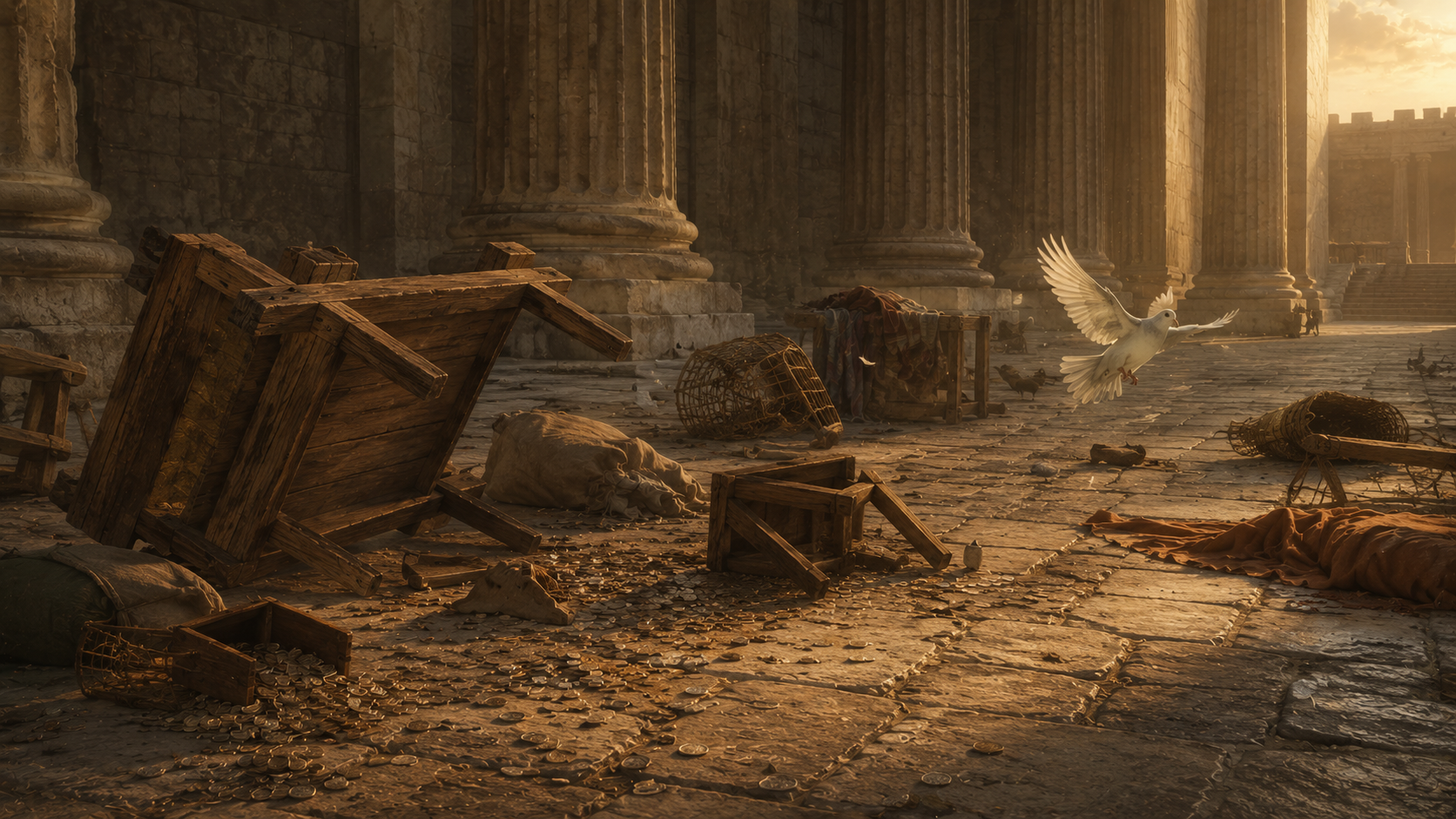
- Jesus entered into the temple of God, and drove out all of those who sold and bought in the temple, and overthrew the money changers’ tables and the seats of those who sold the doves (verse 12). The Greek records the chapter’s most physical action. The temple’s outer court (the Court of the Gentiles) had become a marketplace where pilgrims could exchange foreign currency for the temple shekel and purchase pre-approved sacrificial animals. The chapter is recording, with characteristic narrative-cultural specificity, that the practical infrastructure of festival-pilgrim worship had become a profit center under the priestly establishment’s control. The system was not, in itself, unbiblical (Pilgrims traveling long distances genuinely needed exchange and sacrifice services); the system’s exploitation of pilgrims was the issue.
- My house shall be called a house of prayer, but you have made it a den of robbers (verse 13). The Greek combines two prophetic citations: Isaiah 56:7 (my house shall be called a house of prayer for all peoples; note the for all peoples, the universal-Gentile inclusion that Isaiah explicitly attached) and Jeremiah 7:11 (has this house, which is called by my name, become a den of robbers in your eyes?, Jeremiah’s temple-sermon predicting Jerusalem’s destruction by Babylon). The chapter is recording, with characteristic Hebrew Bible-prophetic precision, that Jesus is doing prophetic-act-and-citation in the Jeremiah-style. The Court of the Gentiles, the one space in the temple where non-Israelites could come to pray, had been turned into a transaction-zone, effectively excluding from prayer the very people Isaiah’s prophecy had named. Den of robbers is also worth a slow read: the Hebrew underlying robbers is the term for brigands, the kind of armed bandits who used caves in the wilderness as bases. The chapter is naming the temple-system, in Jeremiah’s vocabulary, as a hideout for those who profit from religious power.
- The lame and the blind came to him in the temple, and he healed them (verse 14). The Greek records the chapter’s quietest single contrast. Where the chief priests and money-changers had been doing transactional commerce in the Court of the Gentiles, the messianic-king is doing healing in the same temple. 2 Samuel 5:8’s reference to David excluding the blind and the lame from the house is being deliberately reversed by the Son of David: the people the Davidic-tradition was thought to have excluded are the people the messianic-Davidic-king now welcomes. The chapter is recording, with characteristic narrative-Hebrew-Bible-reversal precision, the king’s quiet correction of the tradition’s exclusion-pattern.
- Out of the mouth of babes and nursing babies you have perfected praise (verse 16). The Greek cites Psalm 8:2. Psalm 8 is the Hebrew Bible’s praise-of-the-creator psalm, with the same image (from the mouths of children and infants you have ordained praise). The chapter is recording, with characteristic narrative-citation care, that the children’s Hosanna is, on Jesus’s reading, the Psalm 8 vocabulary working in real time. The chief priests are scandalized by the children; Jesus names the children as the prophesied praisers.
- Seeing a fig tree by the road, he came to it, and found nothing on it but leaves. He said to it, “Let there be no fruit from you forever!” (verse 19). The Greek records the chapter’s most enigmatic single action. The fig tree had leaves but no fruit, in a season (early spring, by Passover-week timing) when first-fruit figs (the paggim, the early figs that appear before the leaves are full) should have been present even if the main crop was still ripening. The tree is, in horticultural fact, presenting itself as fruit-bearing without actually bearing fruit. The chapter is recording, with characteristic narrative-symbolic care, what becomes obvious in light of the temple-action that has just preceded: the fig tree is a parabolic enactment of the temple’s condition. Israel’s covenant-pattern in the prophets repeatedly used the fig tree as a national symbol (Hosea 9:10; Joel 1:7; Micah 7:1; Jeremiah 8:13). A fruitless-fig-tree-with-leaves names the religious system that has the appearance of religious vitality without the actual fruit. The cursing is prophetic-symbolic action: the system that presents itself as fruitful and is not is, like the fig tree, withering.
- If you have faith, and don’t doubt, you will not only do what was done to the fig tree, but even if you told this mountain, “Be taken up and cast into the sea,” it would be done (verse 21). The Greek records the chapter’s faith-teaching. The reference to this mountain may have a specific local sense: Jesus and the disciples are walking near the Mount of Olives, in view of the temple mount. This mountain could be either (or both), and the temple-mount reading is theologically loaded in the immediate context, given what has just happened in the temple. The chapter is recording, with characteristic narrative-pedagogical care, that the disciples’ faith-life is going to be needed for what is coming. The temple-system the disciples have known their whole lives is going to come down (the chapter has already enacted its symbolic withering); the kingdom they are entering is one that will require faith-as-trust in the rabbi who has just performed both the temple-action and the fig-tree-symbol.
C · Matthew 21:23–46 · The question of authority and two parables
²³ When he had come into the temple, the chief priests and the elders of the people came to him as he was teaching, and said, “By what authority do you do these things? Who gave you this authority?” ²⁴ Jesus answered them, “I also will ask you one question, which if you tell me, I likewise will tell you by what authority I do these things. ²⁵ The baptism of John, where was it from? From heaven or from men?” They reasoned with themselves, saying, “If we say, ‘From heaven,’ he will ask us, ‘Why then did you not believe him?’ ²⁶ But if we say, ‘From men,’ we fear the multitude, for all hold John as a prophet.” ²⁷ They answered Jesus, and said, “We don’t know.” He also said to them, “Neither will I tell you by what authority I do these things. ²⁸ But what do you think? A man had two sons, and he came to the first, and said, ‘Son, go work today in my vineyard.’ ²⁹ He answered, ‘I will not,’ but afterward he changed his mind, and went. ³⁰ He came to the second, and said the same thing. He answered, ‘I’m going, sir,’ but he didn’t go. ³¹ Which of the two did the will of his father?” They said to him, “The first.” Jesus said to them, “Most certainly I tell you that the tax collectors and the prostitutes are entering into the Kingdom of God before you. ³² For John came to you in the way of righteousness, and you didn’t believe him, but the tax collectors and the prostitutes believed him. When you saw it, you didn’t even repent afterward, that you might believe him. ³³ “Hear another parable. There was a man who was a master of a household, who planted a vineyard, set a hedge about it, dug a wine press in it, built a tower, leased it out to farmers, and went into another country. ³⁴ When the season for the fruit drew near, he sent his servants to the farmers, to receive his fruit. ³⁵ The farmers took his servants, beat one, killed another, and stoned another. ³⁶ Again, he sent other servants more than the first; and they treated them the same way. ³⁷ But afterward he sent to them his son, saying, ‘They will respect my son.’ ³⁸ But the farmers, when they saw the son, said among themselves, ‘This is the heir. Come, let’s kill him, and seize his inheritance.’ ³⁹ So they took him, and threw him out of the vineyard, and killed him. ⁴⁰ When therefore the lord of the vineyard comes, what will he do to those farmers?” ⁴¹ They told him, “He will miserably destroy those miserable men, and will lease out the vineyard to other farmers, who will give him the fruit in its season.” ⁴² Jesus said to them, “Did you never read in the Scriptures, ‘The stone which the builders rejected, the same was made the head of the corner. This was from the Lord. It is marvelous in our eyes?’ ⁴³ “Therefore I tell you, the Kingdom of God will be taken away from you, and will be given to a nation producing its fruit. ⁴⁴ He who falls on this stone will be broken to pieces, but on whomever it will fall, it will scatter him as dust.” ⁴⁵ When the chief priests and the Pharisees heard his parables, they perceived that he spoke about them. ⁴⁶ When they sought to seize him, they feared the multitudes, because they considered him to be a prophet. (Matthew 21:23–46, World English Bible)
- By what authority do you do these things? Who gave you this authority? (verse 23). The Greek en poia exousia, “by what authority,” uses the same authority-vocabulary the gospel has been tracing since 7:29 (the crowd’s recognition of Jesus’s exousia at the close of the Sermon on the Mount). The chapter is recording, with characteristic narrative-theological care, that the chief priests are asking the chapter’s central question. Authority is the gospel’s running thread, and the religious establishment’s challenge is the question Matthew has been preparing the reader to ask.
- The baptism of John, where was it from? From heaven or from men? (verse 25). The Greek records Jesus’s counter-question, structurally a rabbinic kal va-chomer trap. If the chief priests acknowledge John’s authority as from heaven, they implicate themselves in their failure to repent at his preaching. If they deny John’s authority, they alienate the crowds who held John as a prophet. The chapter is recording, with characteristic rabbinic-debate precision, the establishment’s bind. They answer we don’t know: the answer of those whose position has become more important than the truth.
- The tax collectors and the prostitutes are entering into the Kingdom of God before you (verse 31). The Greek proagousin hymas, “they are going before you,” uses the precedence-vocabulary. The tax collectors and prostitutes are not on a different track than the chief priests; they are on the same track, just ahead. The chapter is recording, with characteristic narrative-theological care, that the chief priests are not excluded from the kingdom in principle; they are simply being passed by the very people they have been writing off. The first parable (the two sons) names the principle: the son who said no but went is doing the father’s will; the son who said yes but did not go is not. The chief priests are the latter; the tax collectors and prostitutes are the former.
- There was a man who was a master of a household, who planted a vineyard, set a hedge about it, dug a wine press in it, built a tower, leased it out to farmers (verse 33). The Greek echoes Isaiah 5:1-7, the Song of the Vineyard. Every element of Jesus’s opening (vineyard, hedge, wine press, tower) is taken directly from Isaiah’s parable, and Isaiah’s parable is itself an indictment of Israel: the vineyard of the LORD of hosts is the house of Israel. The chapter is recording, with characteristic Hebrew Bible-citation precision, that Jesus is reusing the chief priests’ own scriptural-tradition’s most pointed parable against them. They know exactly what story Jesus is telling.
Influence callout: N.T. Wright (the wicked tenants and the indictment of Israel’s leadership)
Wright’s reading of the wicked-tenants parable names it as the gospel’s most direct single application of Israel’s own prophetic tradition to the religious establishment. Isaiah 5’s vineyard-song was the original indictment: God planted Israel as his vineyard, and the vineyard produced wild grapes. Jesus’s parable extends Isaiah’s frame by naming what has happened to the prophets-as-servants God has sent: they have been beaten, killed, stoned (the historic record of Israel’s prophetic tradition is full of this; Jeremiah, Zechariah son of Jehoiada, the prophets killed by Manasseh). The parable’s most pointed move is the son-as-heir: the owner sends his son, the tenants kill him, and the inheritance is taken from them. Wright argues that Jesus is naming, in his own parable, the trajectory the religious establishment is currently on. The leadership has been killing the prophets for generations; they are about to kill the son. The kingdom-of-God will be taken away from them and given to a nation producing its fruit. Wright reads this as the gospel’s most direct prediction of the temple’s coming destruction (which would happen in 70 AD, at the hands of the Romans, in fulfillment of the parable’s miserably destroy those miserable men) and the simultaneous re-foundation of God’s people on a different basis (the nation producing its fruit, which will be the cross-and-resurrection-formed people of the gospel, not a different ethnic group). The chapter is recording, in one parable, the gospel’s clearest statement that the religious establishment of Jerusalem has run out of time.
- The stone which the builders rejected, the same was made the head of the corner (verse 42). The Greek cites Psalm 118:22-23, the same Hallel-psalm the crowd was shouting at the entry. The chapter is recording, with characteristic narrative-citation continuity, that Jesus is extending the Psalm-118 vocabulary the crowd was using. The stone the builders rejected is, in Psalm 118, a deliverance-image; Jesus is identifying himself as that stone. The chief priests are the builders who have rejected the stone, and the rejection is going to result in the stone’s eventual exaltation as the head of the corner (the foundational stone of the new structure).
- Therefore I tell you, the Kingdom of God will be taken away from you, and will be given to a nation producing its fruit (verse 43). The Greek ethnei poiounti tous karpous autes, “to a nation producing its fruits,” names the chapter’s most controversial single line. The nation here is not, on careful reading, an ethnic-replacement statement (replacement theology has often misread this verse to mean that the church replaces Israel). The ethnos is, on the chapter’s grammar, the fruit-producing nation: the kingdom-people who, in distinction from the religious establishment whose vineyard-tenancy has failed, will produce the kingdom’s fruit. The Jewish people (including all twelve apostles, all the early disciples, and Paul himself) are abundantly represented in this fruit-producing people. What the chapter is naming is the failure of the current religious-establishment leadership of the temple, not the failure of the Jewish people as such. The chapter is recording, with characteristic narrative-theological precision, the kingdom’s leadership-transfer.
- When the chief priests and the Pharisees heard his parables, they perceived that he spoke about them. When they sought to seize him, they feared the multitudes, because they considered him to be a prophet (verses 45 to 46). The Greek closes the chapter with the religious establishment’s accurate hearing of the parable. They got the message. They wanted to seize Jesus immediately; they did not, only because the crowds were on his side. The chapter is recording, with characteristic narrative honesty, the establishment’s calculation: they will need a different opportunity. The chapter ends with the trap being set for what the next four chapters will narrate.
Reflection prompts
- The chapter stages two processions entering Jerusalem the same week, from opposite sides of the city. Pilate’s procession is a Roman adventus with war-horse, armor, and imperial banners. Jesus’s procession is a borrowed donkey, peasant disciples, and the cloaks and branches of the people on the road. The chapter is recording the kingdom’s deepest single political-theological contrast. Where in your life are you currently being formed by the wrong procession’s pattern, and what would it mean to recognize which king you have been following?
- The fig tree had leaves but no fruit. The temple had transactions but not prayer. The religious establishment had positions but not faithfulness. Each one is the same diagnosis: the appearance of fruitfulness without the actual fruit. Where in your life is your own religious life currently leaved without being fruited, and what would it mean to take the chapter’s quiet alarm seriously: the leaves alone will not preserve the tree?
- The chief priests ask, by what authority do you do these things? Jesus refuses to answer because they are not actually asking; they are positioning. Where in your life are you currently asking questions about Jesus that are really positioning-moves rather than open inquiries, and what would it mean to ask the question the way the blind men of chapter 20 asked it: Lord, that our eyes may be opened?